
The best cottage cheese in 2026 is creamy, fresh and properly curdy, never watery or rubbery. A good tub tastes clean and milky, holds its curds without swimming in whey, and works just as well on toast as it does straight from the spoon. A bad tub, by contrast, tastes flat and chalky, sheds liquid the moment you open it, and puts people off a food that should be one of the easiest high-protein choices in the fridge.
Choosing the best cottage cheese is not about chasing the highest protein number on the label. It is about the balance between curd size, creaminess, salt and freshness, because a tub that is technically high in protein but dry and grainy will sit uneaten at the back of the fridge. This guide compares the strongest cottage cheese options of 2026 side by side, explains what actually matters when you are buying, and helps you pick a tub you will finish before its date runs out.
Key Takeaways
- Large curds feel creamier and more satisfying, while small curds blend better into cooking and smooth recipes.
- Full-fat cottage cheese usually tastes better and keeps you fuller, while low-fat versions win when every calorie counts.
- Check the liquid in the tub: a little whey is normal, but a tub swimming in it is usually past its best.
- Salt varies widely between brands, so taste before you add more, especially on savoury toast and salads.
- Buy the size you will finish in three to four days, because cottage cheese fades fast once it is opened.
Curds, Cream and Culture: What Sets Good Cottage Cheese Apart
Cottage cheese is made by curdling milk, draining the whey and adding cream, and every step shows in the finished tub. Good curds are tender and distinct, not hard little pellets and not a formless paste. The cream should coat the curds lightly, giving a rich mouthfeel without making the whole tub greasy. When you lift a spoonful, it should hold together for a moment and then fall apart softly, and the smell should be fresh and milky, with only the faintest tang.
The tang matters too. A gentle cultured note is a sign of a well-made cheese, but a sharp, sour edge usually means the tub is old or was stored badly. A good cottage cheese stays creamy after a few days in the fridge, while a poor one turns grainy and weeps liquid, so buy from a busy shop with fast turnover.

Fat content shapes the whole experience. Full-fat cottage cheese, usually around four percent fat, tastes rounder and more satisfying, and it holds up in hot dishes without turning watery. Low-fat versions, at one or two percent, are lighter and still high in protein, but they can taste thinner and drier, so they suit smoothies, bowls and recipes where other ingredients add richness. Non-fat cottage cheese is the leanest choice of all, yet it is also the hardest to make taste good, so it is best saved for cooking rather than eating plain.
How We Judged the Best Cottage Cheese of 2026
We judged every cottage cheese on curd texture, creaminess, flavour, salt balance, protein per serving and value, tasting each one plain, on toast and in a simple cooked dish. A tub had to taste good on its own to rank highly, and we checked how each one behaved after three days in the fridge. The picks below cover everyday eating, low-fat eating, cooking and budget buying.
The Best Cottage Cheese of 2026
Best Overall: Large-Curd Full-Fat Cottage Cheese
The best cottage cheese for most people in 2026 is a large-curd, full-fat tub from a dairy that cultures its milk properly and sells through quickly. The curds are generous and tender, the cream is silky rather than slick, and the flavour is clean and milky with a gentle tang. It works on toast with tomatoes and herbs, in a bowl with fruit and honey, and straight from the tub with a spoon when you need a quick protein-rich snack.
What lifts it above the rest is consistency: tub after tub tastes the same, the curds stay firm for three or four days after opening, and it never arrives swimming in whey. At around four to five dollars for a sixteen-ounce tub, it is the one we reach for most often.
Best Low-Fat: Two-Percent Small-Curd Cottage Cheese
The best low-fat cottage cheese is a two-percent, small-curd tub that stays creamy where most light versions turn dry. The smaller curds blend smoothly, the protein stays high at around fourteen grams per half cup, and the salt is restrained enough that it works in both sweet and savoury dishes. It is the tub to buy if you eat cottage cheese every day and want the protein without the full-fat calories.
It is less satisfying eaten entirely plain than the full-fat pick, so pair it with berries and honey, cucumber and black pepper, or wholemeal toast. Used that way, most tasters could not tell it from a richer tub.
Best Full-Fat: Rich Four-Percent Cottage Cheese
The richest cottage cheese in this guide is a four-percent tub with a thick, almost whipped cream and large, soft curds. It is the most indulgent option here, and it shows: the flavour is buttery and round, the texture is spoon-coating, and a small serving feels like a proper meal rather than a diet food. It is also the best choice for cooking, because it melts into hot pasta, eggs and baked dishes without splitting or watering them down.
The trade-off is calories, at roughly twice the fat of the two-percent pick, so it suits people who want satisfaction and staying power more than the leanest numbers. Buy the smaller tub if you live alone, because a little goes a long way.
Best for Cooking: Small-Curd Cottage Cheese for Blending
The best cottage cheese for cooking is a smooth, small-curd tub that blends into sauces, batters and fillings without leaving lumps. Blitzed for a few seconds, it turns into a creamy base for pasta sauce, a lighter filling for lasagne, or a protein-rich addition to pancake batter, and it holds up in the oven where cream cheese would turn heavy. It is also the easiest tub to hide in family cooking for anyone who claims not to like cottage cheese.
Taste it plain and you will find it milder than the best overall pick, and that is the point: in cooking, a neutral, smooth cheese is a strength. Keep one tub for cooking and one for eating.
Best Budget: Store-Brand Large-Curd Cottage Cheese
The best budget cottage cheese is a store-brand, large-curd tub that costs noticeably less than the big names while tasting surprisingly close to them. The curds are a little smaller and the cream a little thinner, but the flavour is clean, the protein is the same per serving, and it performs well on toast, in salads and in cooking. For everyday use, the gap between this tub and the premium picks is small, and the saving over a month of regular buying is real.
Check the date carefully with budget tubs, because a fresh budget tub beats a tired premium one every time.

Cottage Cheese, Cheddar and Cream Cheese: How They Differ
Cottage cheese is often shelved near cheddar and cream cheese, but it is a different food with a different job. Cheddar is a hard, aged cheese built for melting and sharp flavour, and our guide to the best cheddar of 2026 shows how widely melting and sharpness vary between blocks. Cream cheese is a soft, spreadable cheese made for bagels and baking, and our guide to the best cream cheese of 2026 covers which tubs spread smoothly without tearing the bread. Cottage cheese sits between them: fresh, spoonable, high in protein and low in fat, with a curdy texture neither of the others has.
That protein is the real reason cottage cheese has become a staple again. It is rich in casein, the slow-digesting milk protein, and our guide to the best casein protein of 2026 compares food sources with powders. A half cup gives roughly twelve to fourteen grams of protein for around a hundred calories in a low-fat tub, and keeps you full far longer than yoghurt with the same calories.
How to Buy, Store and Serve Cottage Cheese
Buy cottage cheese from the coldest part of the dairy aisle, check the date, and look for a tub that feels full and sealed, with no bulging lid. Once home, keep it at the back of the fridge, not in the door, where the temperature swings every time the door opens. Eat it within three to four days of opening, and stir it gently before serving if a little whey has gathered on top, rather than pouring the liquid away, since that whey carries flavour and nutrients.
Serve it simply: on toast with tomato and pepper, with cucumber and dill, or with peaches and honey. In cooking, stir it into scrambled eggs at the end, fold it into pasta sauce off the heat, or blend it into pancake batter. Avoid boiling it hard, because high heat makes the curds tough.
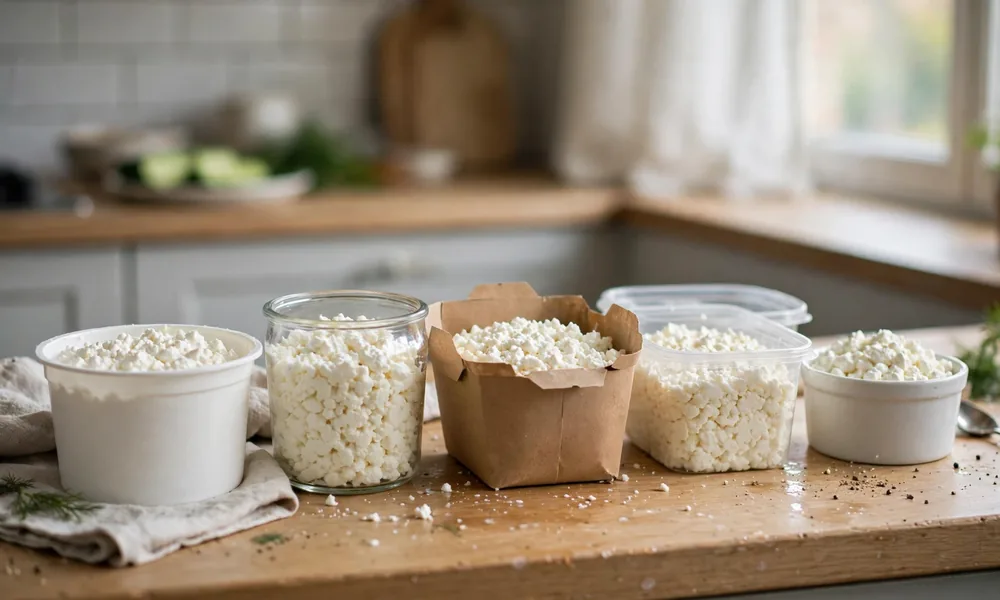
Cottage Cheese Compared
| Cottage Cheese | Best For | Fat | Protein per Half Cup | Why It Wins |
|---|---|---|---|---|
| Large-curd full-fat | Overall | 4% | 13 g | Creamiest, most consistent tub |
| Two-percent small-curd | Low-fat eating | 2% | 14 g | Light yet still creamy |
| Rich four-percent | Cooking and indulgence | 4% | 12 g | Buttery, melts beautifully |
| Small-curd for blending | Sauces and baking | 2% | 13 g | Smooth, neutral, versatile |
| Store-brand large-curd | Budget | 4% | 13 g | Close to premium for less |
Cottage Cheese Buying Checklist
- Choose large curds for eating plain and small curds for blending and cooking.
- Pick full-fat for flavour and fullness, low-fat when calories matter most.
- Check the date and buy from a shop with fast dairy turnover.
- Look for a tub that is not swimming in whey before you open it.
- Buy a size you will finish within three to four days of opening.
- Taste before adding salt, because brands vary widely in saltiness.
Frequently Asked Questions
Is cottage cheese healthy?
Yes, in most diets. It is high in protein, relatively low in calories, and a good source of calcium and B vitamins. The main watch-outs are salt, which varies by brand, and added sugar in flavoured tubs.
What is the difference between large-curd and small-curd cottage cheese?
Large-curd cottage cheese has bigger, more distinct curds and a creamier, more substantial bite, while small-curd cottage cheese is smoother and blends more easily. Large curd suits eating plain and on toast, small curd suits cooking, sauces and smoothies.
How long does cottage cheese last once opened?
Three to four days in the fridge is a safe guide, kept cold at the back of the fridge with the lid on. If it smells sharply sour, tastes bitter, or has mould, throw it away, even if the date has not passed.
Can you freeze cottage cheese?
You can, but the texture suffers: thawed cottage cheese turns grainy and watery. It is still usable in cooked dishes after freezing, but not pleasant eaten plain.
Is cottage cheese good for weight loss?
It can help, because it is high in protein and low in calories, which keeps you full for longer. Low-fat cottage cheese is the leanest option, but pair it with vegetables and whole grains rather than sugary toppings.
What can I use instead of cottage cheese in recipes?
Ricotta is the closest swap for baking and fillings, Greek yoghurt works in sauces and dips, and blended silken tofu suits dairy-free cooking. None matches cottage cheese exactly, so adjust seasoning.
The Bottom Line
The best cottage cheese in 2026 is the large-curd, full-fat tub that tastes fresh, creamy and clean, with the two-percent small-curd tub close behind for everyday low-fat eating. Buy fresh, buy the size you will finish in a few days, and serve it simply: on toast, in a bowl, or stirred into cooking at the last moment.


