Desk Shelves That Add Storage Without the Clutter in 2026
Desk shelves are the quiet fix for the most common home-office problem: a desk too small for everything it has to hold. A good desk shelf lifts books, chargers, notebooks and plants off the work surface and onto the wall, so the desk stays clear for actual work. A bad one does the opposite. It sags under a row of hardbacks, crowds the wall until the room feels smaller, or becomes a dusty ledge for things nobody uses. This guide explains how to choose desk shelves that genuinely add storage without adding clutter: the types worth buying, the sizes that fit real desks, the weight limits that matter, and the styling rules that keep a shelf looking deliberate rather than crowded.
Key Takeaways
- Measure first: a desk shelf should sit 45 to 60 centimetres above the desktop, and its width should match the desk or stop at least 10 centimetres short of each edge.
- Floating shelves look cleanest, but bracketed shelves hold far more weight; a shelf that holds books needs proper wall fixings, not adhesive strips.
- A shelf depth of 20 to 25 centimetres fits books and storage boxes without jutting into your line of sight.
- Keep a third of every shelf empty, or mix open display with closed boxes, so the wall reads as organised rather than crowded.
- The best desk shelf holds the things you reach for daily; anything untouched for a month belongs in a cupboard, not on display.
Why Most Desk Shelves End Up Looking Cluttered
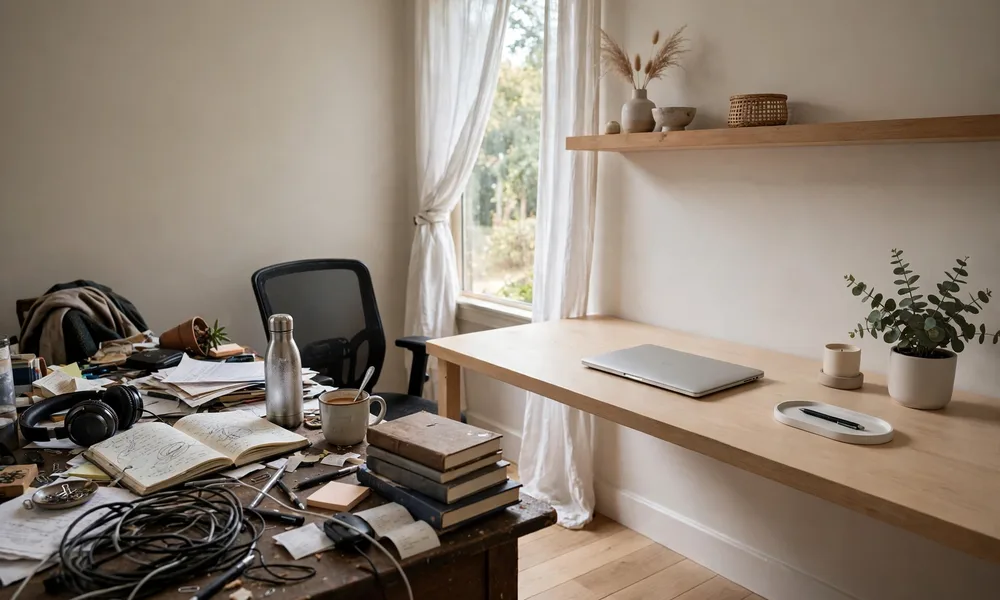
Walk into a home office that has gone wrong and the shelf is usually the first thing you notice: a long board crammed edge to edge with binders, cables draped over the front, a dying plant in the corner, and papers that migrated upward when the desk ran out of room.
The failure is rarely about the shelf itself. It is about three decisions made too quickly. The first is size: too deep and it pushes into the space above the keyboard; too shallow and it cannot hold a book upright. The second is load: shelves get filled with whatever is nearest, instead of the handful of items that deserve to live at arm’s reach. The third is height: a shelf mounted too low forces you to duck under it to see the monitor, and one mounted too high turns into a ledge you cannot reach without a chair.
The Main Types of Desk Shelves Compared
Desk shelves come in four broad types: floating, bracketed, hutch, and clamp-on. The right one depends less on taste than on what the wall is made of and what the shelf has to hold.
Floating shelves are the most popular style of 2026, and the most commonly misbought. They fail quietly: a floating shelf rated for 5 kilograms will sag or pull out of plasterboard under a row of hardbacks. They suit light loads, plants, and decorative boxes; anything heavier belongs on brackets.
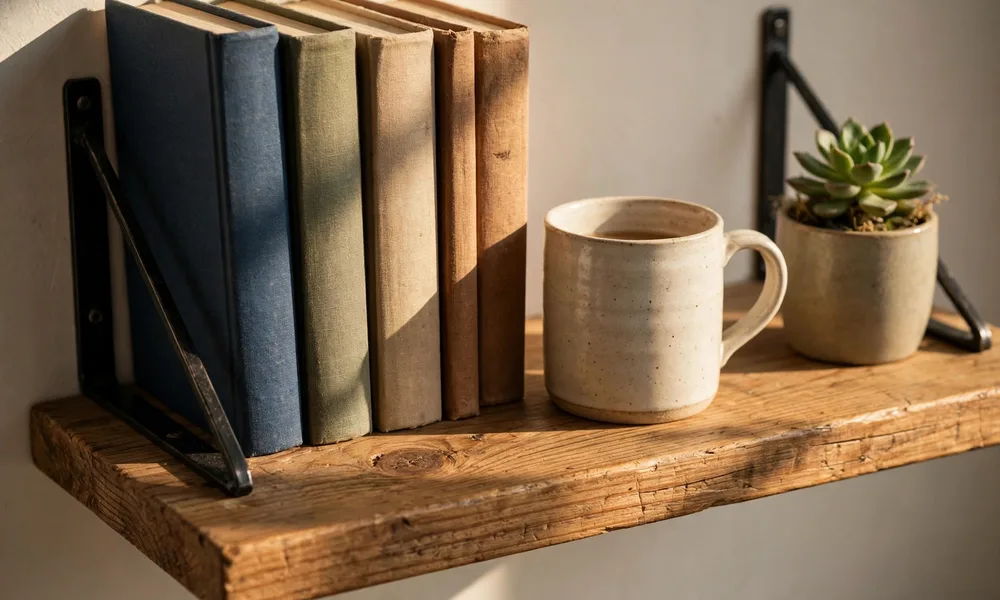
Bracketed shelves are the workhorses. A pair of steel brackets screwed into studs or solid masonry will hold 20 to 30 kilograms per shelf without complaint, enough for a full run of reference books. Slim black steel or brass brackets read as a design choice. On plasterboard with no studs in the right place, heavy-duty toggle fixings are the minimum.
Hutch shelves sit on the desk and need no wall at all. They suit renters and desks in the middle of a room. The trade-off is footprint: a hutch eats 20 to 25 centimetres of desk depth, so it only works on desks at least 70 centimetres deep. Clamp-on shelves grip the back edge of the desk like a monitor arm, hold 5 to 8 kilograms, and move with the desk, which makes them ideal for standing desks. They need a desk edge at least 2 centimetres thick and unobstructed underneath.
Comparison Table: Which Desk Shelf Suits Your Setup
| Type | Best for | Typical load | Wall damage | Price range |
|---|---|---|---|---|
| Floating shelf | Light display, plants, a few books | 5 to 10 kg | Hidden fixings, small holes | Low to medium |
| Bracketed shelf | Heavy books, full storage | 20 to 30 kg | Visible fixings, larger holes | Low to medium |
| Hutch shelf | Renters, desks away from walls | 10 to 15 kg | None | Medium to high |
| Clamp-on shelf | Standing desks, no-drill setups | 5 to 8 kg | None | Medium |
How to Measure for a Desk Shelf
Measuring takes ten minutes and prevents almost every desk shelf mistake. A shelf wider than the desk looks like a mistake, and one much narrower looks lost. The sweet spot is a shelf the same width as the desk, or up to 10 centimetres shorter on each side. The bottom of the lowest shelf should sit 45 to 60 centimetres above the desktop. If you work with a monitor on a stand, measure from the top of the monitor: the shelf should clear it by at least 10 centimetres. Our guide to the best desk lamps covers lamps that fit under a low shelf without glare.
Depth is the measurement most people skip. A shelf 20 to 25 centimetres deep holds a paperback, a storage box or a small plant comfortably. Deeper than 30 centimetres and it casts a shadow over the keyboard; shallower than 15 and books will not stand upright. Before drilling, find the studs. A stud finder takes a minute, and it is the difference between a shelf that holds 25 kilograms and one that pulls plasterboard out of the wall. Check that at least two fixings per shelf land in a stud or solid masonry.
What to Put on a Desk Shelf, and What to Leave Off
A desk shelf works when it holds the things you reach for between tasks: the notebook you write in, the reference book you open daily, the charger for the headphones, a small plant, and one or two storage boxes for the bits that would otherwise drift across the desk. Everything on the shelf should pass a simple test: have you used it in the last week, and would you miss it if it moved to a cupboard? If the answer to either is no, it does not belong on the shelf.
The most useful arrangement mixes three zones. The working zone, directly above the keyboard, holds daily tools at eye level. The storage zone, to one side, holds closed boxes for cables, spare stationery and paperwork, so the clutter is contained rather than displayed. The breathing zone, the remaining third of the shelf, stays empty or holds a single plant or framed photo. That empty space is what makes the shelf look organised instead of crowded.
Desk Shelves for Small Rooms and Small Desks
Small rooms are where desk shelves earn their keep, because the wall above a desk is often the only storage space a small room has. A single long shelf above the desk is better than two short ones, because one shelf reads as a line and two read as clutter. For corner desks, a single shelf on the longer wall is the simpler choice. Desks under windows have the same issue in reverse: a shelf above a desk under a window blocks the light, so a narrow shelf to one side of the window is better. A good laptop stand lifts the screen to eye level and frees the desk surface underneath.
Installing a Desk Shelf Without Regret
Installation is where most desk shelf projects go wrong, and it is the easiest part to get right. Use fixings that match the wall, not the ones that came in the box, which are often wrong for plasterboard or old brick. Mark the shelf position with painter’s tape and live with it for a day before drilling: moving tape is free, moving a drilled shelf leaves holes. Level the shelf itself, not the wall, because walls are rarely straight. Load the shelf slowly: put the lightest things on first, leave it a week, and check the fixings have not moved before adding books.

Desk Shelf Checklist: Before You Buy
- Measure the desk width, the wall height above it, and the monitor height, and write all three numbers down before shopping.
- Find the studs or check the wall type, and confirm that at least two fixings per shelf will land in solid material.
- Choose the shelf type for the load: floating for light display, bracketed for books, hutch or clamp-on if you cannot drill.
- Check the shelf depth: 20 to 25 centimetres for books and boxes, and never deeper than 30 centimetres above a working desk.
- Count what the shelf will hold, and buy boxes in one matching colour before the shelf goes up, not after it is full.
- Leave a third of the shelf empty on purpose, and set a monthly five-minute reset to return anything that has drifted there.
Styling a Desk Shelf So It Stays Tidy
Styling is the system that keeps a shelf tidy, and it takes about five minutes a month. The rule that does the most work is the simplest: one row of objects per shelf, not two. A second row behind the first hides things, collects dust, and makes the shelf look twice as full as it is. Group objects by height, tallest at the ends and shortest in the middle. Vary the materials: wood, ceramic, paper and one plant is a good mix. Books on a desk shelf should be the ones you are reading or referencing, not the ones you own. Keep the rest on a proper bookcase; our guide to bookshelves that make small rooms feel bigger covers the bigger storage job. Once a month, take everything off the shelf, wipe it down, and put back only what passes the weekly-use test.
Frequently Asked Questions
How high should a desk shelf be above the desk?
The bottom of the lowest shelf should sit 45 to 60 centimetres above the desktop, and at least 10 centimetres above the top of the monitor.
How much weight can a desk shelf hold?
It depends on the type and the fixings. A floating shelf typically holds 5 to 10 kilograms, a bracketed shelf fixed into studs or masonry holds 20 to 30 kilograms, and a clamp-on shelf holds 5 to 8 kilograms.
Can I put a desk shelf up in a rented home?
Yes, with the right type. A hutch shelf sits on the desk and needs no holes at all, and a clamp-on shelf grips the desk edge. Check the tenancy agreement first.
What depth of desk shelf is best?
A depth of 20 to 25 centimetres suits most desks. It fits paperbacks, storage boxes and small plants without jutting into your line of sight.
Are floating shelves or bracketed shelves better for books?
Bracketed shelves are better for books, because they hold far more weight and the fixings are visible, so a failure is obvious before it happens. Floating shelves suit light loads only.
How do I stop a desk shelf from looking cluttered?
Keep a third of every shelf empty, store paper and small clutter in matching closed boxes, and put back only the things you have used in the last week.
The Bottom Line
Desk shelves work when they are treated as part of the desk, not as extra storage bolted onto the wall. Measure the desk, fix the shelf into solid wall, and fill it with the few things you reach for every day. A shelf that holds a notebook, a reference book, a plant and a box of cables makes a desk feel bigger. One that holds everything you could not fit on the desk makes the room feel smaller. The difference is measurement, fixings, and the discipline to leave a third of the shelf empty.