
Best Workbenches 2026
A good workbench changes the way a workshop feels. It turns a pile of tools on the floor into a place where things actually get made, a flat, steady surface at the right height where a saw cut stays true and a glue-up stays square while it dries. Without one, every job starts with clearing the kitchen table and ends with apologising for the dents in it. With one, the work has a home.
But not every bench earns its floor space. Some wobble the moment you lean into a hand plane, some sag under a toolbox, and some are so shallow that a sheet of plywood has nowhere to rest. The best workbenches in 2026 are the ones that stay rock solid under real use, hold the tools you reach for most, and fit the space you actually have rather than the workshop you wish you had. We looked at benches for garages, spare rooms, and small flats, and the six below are the ones we would buy with our own money.
Key Takeaways
- Stability matters more than size: a bench that does not rock or rack is worth more than a bigger one that moves under load.
- A hardwood or thick butcher-block top resists dents and stays flat, while a thin chipboard top sags and swells with damp.
- Check the weight rating honestly: a bench rated for 500 kilograms sounds impressive, but only if the frame, not just the top, carries it.
- Storage you can reach while working beats deep drawers you have to walk around to open, so look for drawers and shelves at arm’s length.
- Measure twice before ordering: leave at least a metre of clear space on the working side, and check the bench fits through the door.
Best Workbenches 2026 at a Glance
| Best for | Top | Weight rating | Standout strength |
|---|---|---|---|
| Best overall | Hardwood butcher block | 600 kg | Rock solid, huge flat working area |
| Best for garages | Thick maple | 500 kg | Steel frame, drawers, and lower shelf |
| Best for woodworking | Hardwood with dog holes | 450 kg | Vice, dog holes, and a flat true top |
| Best heavy duty | Steel-topped | 1,000 kg | Built for engine parts and metalwork |
| Best budget | Laminated beech | 300 kg | Strong enough for most home jobs |
| Best for small spaces | Fold-down hardwood | 200 kg | Folds away, fits in a flat |
How We Picked the Best Workbenches
We judged every workbench on stability first, because a bench that moves is worse than no bench at all. We leaned on each one, pushed it sideways, and loaded it with toolboxes to see whether the frame racked or the legs flexed. Only benches that stayed planted passed to the next round, and several promising-looking models failed here because their cross-bracing was thin or their feet were uneven.
Next came the top itself. We checked it for flatness with a straight edge, knocked on it to judge its thickness, and looked at how it handled a dropped hammer and a spilled cup of water. A good top should take abuse without denting deeply or swelling, and it should be thick enough to hold a vice without flexing. We also looked at the working height, since a bench that is too low wrecks your back and one that is too high makes sawing awkward.

1. Best Overall Workbench
The best overall workbench is the one that does everything well without demanding a whole room to itself. It has a thick hardwood butcher-block top, wide enough for a full project but not so deep that you cannot reach the back edge, and a frame that stays square even when you lean into a cut. The top is the star: dense, flat, and forgiving, it takes clamps, holds a vice, and shrugs off the odd hammer blow. After months of use it gains character rather than damage, and a quick sanding restores it to near-new.
2. Best Workbench for Garages
A garage bench has to work harder than any other kind. It holds the tools, the parts, and the half-finished jobs, and it doubles as a parking spot for everything that has no other home. The best garage workbench answers that with a thick maple top on a steel frame, three drawers for the tools you reach for daily, and a lower shelf that swallows toolboxes whole. Nothing about it is delicate, and that is exactly the point.
3. Best Workbench for Woodworking
Woodworking asks more of a bench than almost any other hobby. You need a top that stays dead flat, a vice that grips without crushing, and dog holes that let you clamp a board anywhere along its length. The best woodworking workbench delivers all three: a hardwood top drilled with a row of dog holes, a front vice with smooth jaws, and a weight that keeps it planted when you drive a chisel or push a hand plane along a board.
The dog holes are the feature that changes everything. With a pair of bench dogs and a holdfast, you can clamp a board flat for planing, hold it upright for sawing, or pin it still while you chisel a joint, all without reaching for a separate clamp. The vice is equally well thought out, with wooden jaw liners that grip firmly without marking the work. It is not the cheapest bench here, but for anyone who works wood seriously, it pays for itself in straighter cuts and less frustration.

4. Best Heavy-Duty Workbench
Some jobs need a bench that treats a hundred kilograms as a light load. Engine parts, metal stock, and heavy machinery do not forgive a flimsy frame, so the best heavy-duty workbench is built like a piece of industrial equipment: a steel top over a welded frame, a weight rating of around a thousand kilograms, and feet that bolt to the floor if you want them to. It is overkill for hanging a picture, and exactly right for rebuilding a gearbox.
5. Best Budget Workbench
A budget workbench has to prove itself against a fair question: is it actually better than a sturdy table? The best budget option answers yes, because even at a modest price it offers a laminated beech top thick enough to stay flat, a steel frame with real cross-bracing, and a weight rating of around 300 kilograms. That is enough for most home jobs, from assembling flat-pack furniture to servicing a bicycle, and it costs far less than the premium benches above.
6. Best Workbench for Small Spaces
Not everyone has a garage. For a flat, a small shed, or a spare corner of a room, the best small-space workbench folds down when the job is done and still holds its own while you work. Its hardwood top is compact but honest, its folding legs lock firmly in place, and when folded it leans against a wall or slides behind a door. It is the bench for people who make things in the space they have, not the space they wish they had.
What to Look for When Buying a Workbench
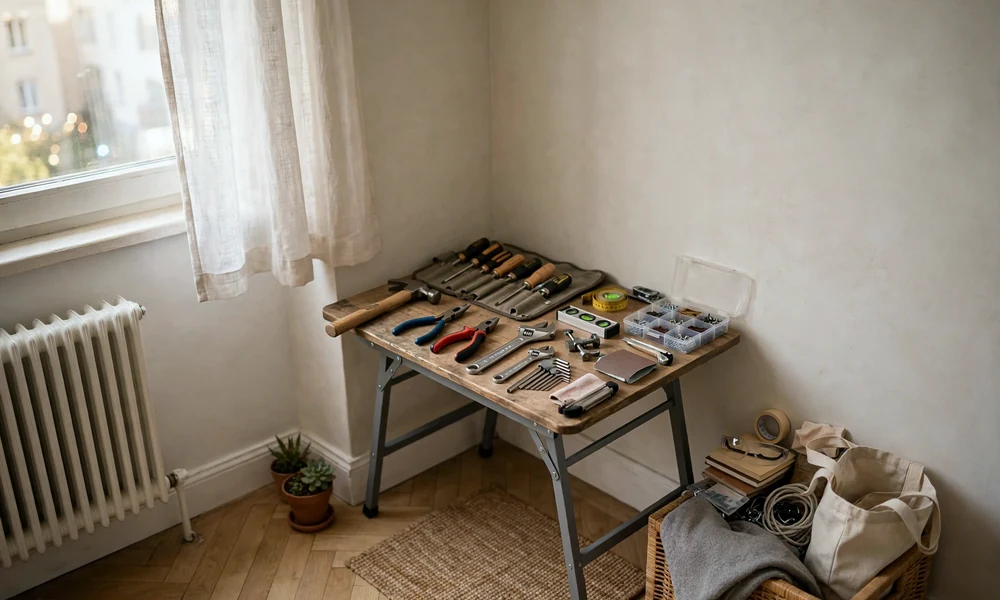
Start with the top, because it is the part you actually work on. Hardwood and butcher block are the best choices for general use: they stay flat, resist dents, and can be sanded back to new. Laminated beech is a good budget compromise, while a steel top suits metalwork and oily jobs. Avoid thin chipboard tops, which sag between supports and swell if they get wet, and check the top thickness with your own eyes rather than trusting a photograph.
Then check the frame and the height. A good frame has diagonal bracing or a solid lower shelf tying the legs together, because that is what stops the bench racking sideways. The working height should let you rest your palms flat on the top with your arms relaxed, usually around 90 centimetres for most adults, though taller people may want a bench a few centimetres higher. Adjustable feet are worth having, since few garage floors are truly level.
Storage and accessories come last, but they matter more than they seem. Drawers keep the tools you use constantly within reach, a lower shelf keeps the top clear, and a pegboard above the bench puts hand tools where you can see them. A vice is the single most useful accessory for woodworking, so if your bench does not include one, check that the top is thick enough to mount one later. And before you order, measure the door, the stairs, and the space around the bench, because a workbench that cannot get into the room is no use at all.
Common Workbench Mistakes to Avoid
The most common mistake is buying the biggest bench that fits, rather than the bench that fits how you work. A huge bench in a small garage leaves no room to walk around it, and you end up working from one side only, which defeats the purpose. Measure the space, leave a metre clear on the working side, and remember that you need room to carry long boards past the bench, not just to stand in front of it.
The second mistake is trusting the weight rating without looking at the frame. A bench can have a strong top on weak legs, and it will still fail when you load it unevenly. Push the bench sideways in the shop if you can, or read owner reviews that mention wobble, because a bench that racks under a sideways push will only get worse with age. Cheap plastic feet, thin brackets, and missing cross-braces are all warning signs.
The third mistake is skipping the vice and the clamping options. A bench without a way to hold work still is just a table, and you will spend half your time chasing boards across the top. Even a simple front vice or a set of bench dogs transforms what you can do. Finally, do not forget lighting: a bench tucked into a dark corner is a bench you will avoid, so put a lamp or a strip light above it before you blame the bench for your mistakes.
The Bottom Line
The best workbench is the one that matches your work, your space, and your budget, and then stays solid for years. For most people, that means a hardwood-topped bench on a braced steel frame, with enough storage to keep the top clear and a vice to hold the work still. Garage owners should look at the steel-frame models with drawers, woodworkers should prioritise dog holes and a flat top, and anyone short on space should choose a folding bench that actually locks solid.
Buy the bench once, set it up properly, and it will repay you every time you use it. A steady bench makes every cut straighter, every glue-up squarer, and every job more enjoyable, and that is worth far more than the price difference between a bench that wobbles and one that does not. Pick the one that fits your work, keep its top clear, and let it become the centre of your workshop.
For more workshop ideas, see our guide to the best garage storage systems, which shows how to organise the space around your bench, and our roundup of the best vs worst power tools to stock it with. If you cut a lot of timber, our guide to the best vs worst saws will help you choose the right blade for the job.


