
Why Desk Trays Beat a Messy Desk in 2026
A desk tray is the simplest fix for a desk that never stays tidy, and the best desk trays in 2026 prove it. Papers arrive all day: letters to open, bills to pay, forms to sign, notes to file. Without a tray, every sheet lands wherever there is space, and the desk slowly disappears under a drift of paper.
This guide is about desk trays themselves: the shallow open trays, stacking letter trays, and in-and-out sets that sort paper as it arrives. It is not about multi-compartment desk organisers, which hold pens, clips, and small supplies in upright caddies, and it is not about drawer organisers, which sort things hidden inside a drawer.
Key Takeaways
- A desk tray works because it gives incoming paper a fixed home, so paper stops spreading across the desk.
- Stacking letter trays suit paper-heavy desks; a single valet tray suits phones, keys, and glasses.
- Buy for the paper you actually handle: A4 trays fit standard letters, while legal trays suit longer sheets.
- Wood looks warm and lasts for years, metal mesh is light and airy, and bamboo is the best budget balance.
- Three trays are enough for most people: one for incoming, one for work in progress, and one for outgoing.
What a Desk Tray Actually Does
A desk tray catches paper at the point where it enters your life. The post arrives, a form comes home from school, a delivery note lands on the mat, and instead of joining a pile on the kitchen counter or the corner of the desk, it goes into the top tray.
The second job is visibility. Paper in a closed drawer is paper forgotten, which is how bills get paid late and forms miss their deadlines. Paper in an open tray stays in sight, and the height of the pile tells you at a glance how much is waiting.
The third job is boundaries. A tray has edges, and edges set a limit. When the tray is full, you cannot add more without dealing with what is already there, so the pile cannot grow without bound. A desk surface has no such limit, which is why a messy desk keeps getting messier. The tray turns an open-ended mess into a container with a capacity, and capacity forces decisions.

The Main Types of Desk Tray
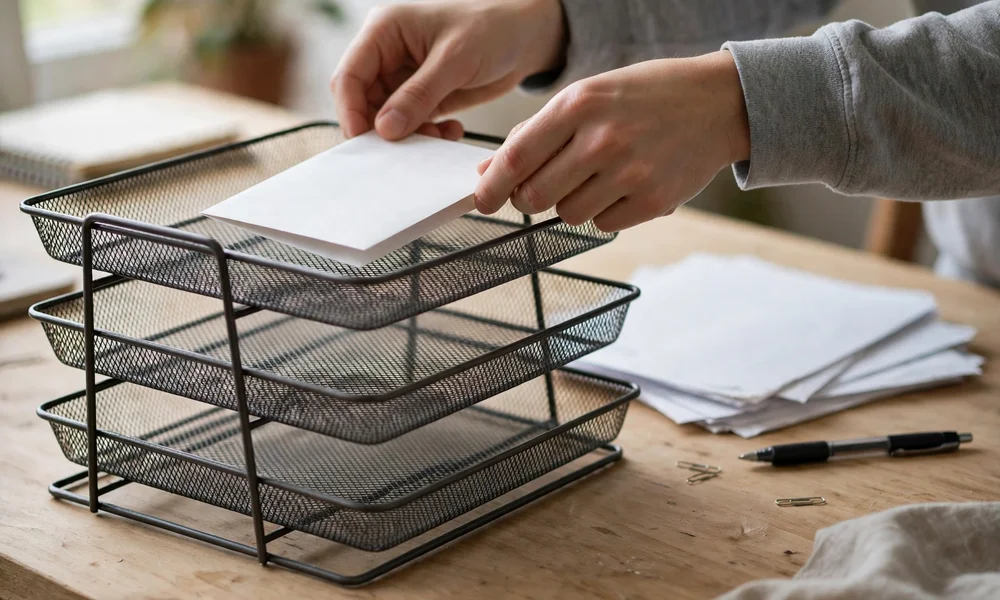
Stacking letter trays are the classic choice, and they are the best starting point for most desks. Two, three, or four shallow trays sit one above another on a small frame, each holding a stack of A4 or legal paper. The top tray is for incoming paper, the middle tray is for work in progress, and the bottom tray is for outgoing paper or filing.
Single trays and valet trays
A single tray is a shallow open box, usually about the size of a sheet of paper, that holds one stack or one set of small items. Valet trays are the smaller, squarer version, made for a phone, keys, glasses, and a wallet rather than for paper. They are the right choice if your desk problem is small items drifting across the surface rather than paper piling up.
Document trays and in-and-out sets
Document trays are deeper than letter trays and are built for thicker stacks: project folders, magazines, catalogues, and the kind of paperwork that arrives in bundles. In-and-out sets are the office version of the stacking tray, usually sold as a pair, with one tray labelled for incoming work and one for outgoing work.
How to Choose the Best Desk Tray
Start with the paper, not the tray. Measure the largest sheet you handle regularly, and buy a tray that fits it flat with a little room to spare. A4 paper is 210 by 297 millimetres, and most letter trays are sized for it, but legal paper is longer, and magazines and folders are wider.
Next, count the trays you need, and be honest about it. One tray is enough if you only need a landing spot for the day’s post. Two trays cover incoming and outgoing. Three trays cover incoming, in progress, and outgoing, which is the system most people settle on.
Then look at the material, because it decides how the tray feels and how long it lasts. Solid wood trays are heavy, stable, and handsome, and they age well, but they cost more and they are the heaviest option. Bamboo trays are lighter and cheaper, with a warm look that suits most desks, and they are the best value for most buyers.
Finally, check the practical details before you buy. The tray should sit flat without rocking, because a rocking tray spills paper. The sides should be high enough to hold a stack without it sliding out, but low enough at the front that you can pull a sheet out without lifting the whole stack.

Desk Trays Compared
| Type | Best for | Capacity | Price range |
|---|---|---|---|
| Stacking letter trays | Everyday paper sorting | 3 to 4 stacks of A4 | Low to mid |
| Single valet tray | Phone, keys, glasses | One small pile | Low to mid |
| Document tray | Thick folders and magazines | Deep single stack | Mid |
| In-and-out set | Shared desks and workflows | Two stacks | Low to mid |
| Tray with drawer | Paper plus small tools | One stack plus drawer | Mid to high |
Our Picks: The Best Desk Trays of 2026
The best desk tray for most people is a three-tier bamboo stacking set. It holds A4 paper flat, it is light enough to move when you clean the desk, and it looks at home in a living room as well as in an office.
Best for small desks
If your desk is small, buy a two-tier metal mesh set. Mesh trays are the slimmest option, and the see-through sides mean you can check what is in the bottom tray without lifting the top one. Two tiers are enough for incoming and outgoing, and the whole set takes up barely more space than a single sheet of paper.
Best for a smart home office
If the desk is in a room you care about, buy a solid wood document tray. A single deep wooden tray holds a thick stack of project folders without looking like office equipment, and the wood warms up a room in a way that metal and plastic never do.
Setting Up a Desk Tray System That Sticks
Put the tray where paper arrives, not where it looks tidy. If the post comes through the front door and lands on the hall table, the tray belongs near the door or on the desk closest to it. If you open letters at the kitchen table, the tray belongs there.
Label the trays, even if you live alone. A small label that says In, Doing, and Out turns three identical trays into a workflow, and it stops you from using the top tray as a general dumping ground. Use plain words rather than clever ones, because the system has to work when you are tired and in a hurry.
Empty the trays on a schedule, not when they overflow. Ten minutes at the end of the day is enough to clear the incoming tray: open the letters, pay what needs paying, file what needs filing, and throw away what needs throwing away.
Desk Trays vs Desk Organisers
A desk tray and a desk organiser solve different problems, and confusing them is the most common buying mistake. A tray holds paper flat in open stacks, so you can see it and reach it quickly. An organiser holds small items upright in compartments, so pens, clips, and cables each have a slot. If your desk is covered in paper, buy a tray. For small items, see the best desk organisers.
Drawer organisers solve a third problem, which is the inside of a drawer. They sort things you want out of sight, while a tray sorts things you want in sight. That distinction matters, because paper you need to act on should stay visible, while paper you have already dealt with should go into a drawer or a file. For finished work, see the best drawer organisers.
Other desk accessories play smaller roles in the same system. A desk calendar keeps dates visible in the same way a tray keeps paper visible, and the two work well together, because a deadline on the calendar tells you when the paper in the tray needs attention.
Keeping a tray clean takes almost no effort, and it makes a surprising difference. Wipe a wooden or bamboo tray with a dry cloth once a week, because dust settles in the corners and makes paper look grubby. Metal mesh trays can be shaken out over a bin, and plastic trays can be wiped with a damp cloth. Check the frame of a stacking set every month, because screws and clips loosen with use, and a wobbly stack is a stack that will spill. A tray that is clean and steady is a tray you will keep using.
Desk Tray Checklist
- Measure your largest paper and buy a tray that fits it flat.
- Choose two or three tiers: incoming, in progress, and outgoing.
- Pick a material that suits the room: wood, bamboo, metal mesh, or plastic.
- Check that the tray sits flat and does not rock or slide.
- Label each tray so everyone using the desk follows the same system.
- Empty the trays weekly so they stay a sorting tool, not a storage pile.
Frequently Asked Questions
How many desk trays do I need?
Most people need two or three. One tray holds incoming paper, a second holds work in progress, and a third holds outgoing paper or filing. Start with two if your desk is small, and add a third only if the two trays keep filling up.
What size desk tray should I buy?
Buy a tray that fits A4 paper flat, which is the standard size for letters and printed sheets. If you handle legal paper, folders, or magazines, buy the larger size that fits those, because paper that overhangs the tray will curl and tear.
Are wooden desk trays better than metal ones?
Wood looks better and lasts longer, but it costs more and is heavier. Metal mesh is lighter, cheaper, and lets you see through it, which helps you find a sheet quickly. Bamboo sits between the two, with the warmth of wood at a lower price.
Can a desk tray replace a filing cabinet?
No. A tray sorts paper that needs action soon, while a filing cabinet stores paper you need to keep. Use the tray for the present week and the cabinet for the long term, and move paper from the tray to the cabinet once it has been dealt with.
Where should I put a desk tray?
Put it where paper first arrives: near the door, on the desk you sit at, or on the table where you open the post. A tray in the wrong room will stay empty while paper piles up somewhere else.
How do I stop a desk tray filling up again?
Empty it on a schedule. Spend ten minutes at the end of the day clearing the incoming tray, and ten minutes a week clearing the rest. A tray that is emptied regularly stays useful; a tray that is never emptied becomes a pile with edges.
The Bottom Line
The best desk trays in 2026 are not the fanciest or the most expensive, they are the ones that fit your paper, sit flat on your desk, and get emptied every week. A three-tier bamboo stacking set will suit most people, a two-tier mesh set will suit a small desk, and a single wooden tray will suit a room where looks matter.


