An egg timer is a small thing with one job, and that is exactly why it is worth choosing well. A boiled egg goes from silky to chalky in about sixty seconds, and guessing the time from the clock on the wall is how breakfasts are ruined. The best egg timers of 2026 take that guesswork away: they count down clearly, they can be heard from the next room, and they are still working a year later when the novelty of a new kitchen gadget has worn off. The worst ones drift, go quiet, or die in a drawer full of dead batteries.
What Makes an Egg Timer Different
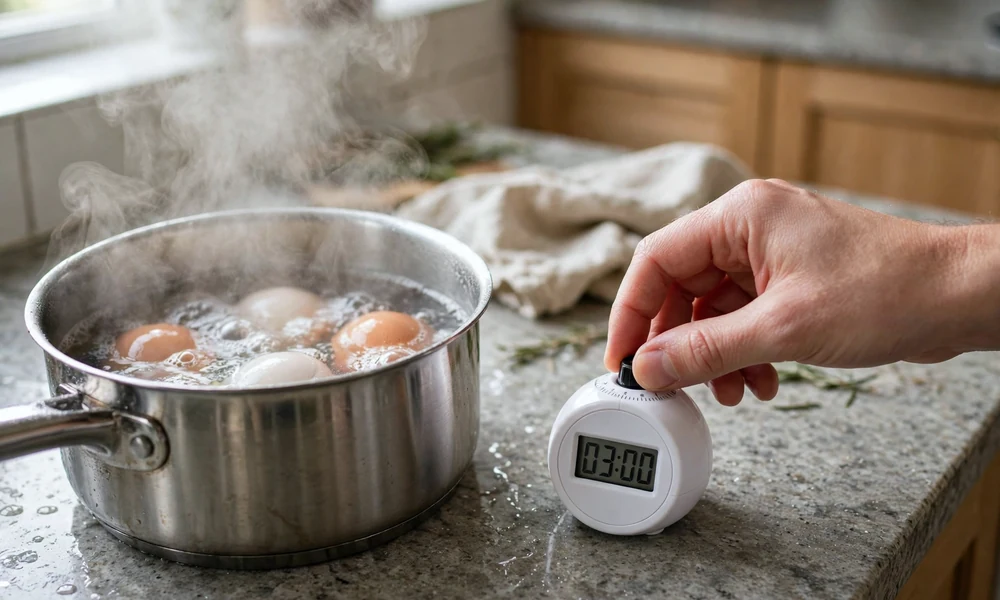
A general kitchen timer is built to time anything, from a roast to a loaf of bread, and it usually does that with a long countdown and a loud alarm. An egg timer is narrower and more demanding. It has to be accurate over three to twelve minutes, because that is the whole range of a boiled egg, and it has to be readable at a glance when your hands are wet and the water is already boiling. A timer that is accurate to the minute is not accurate enough here: thirty seconds is the difference between a runny yolk and a set one.
How to Choose: The Four Things That Matter Most
Start with accuracy. A digital timer that counts in seconds and is accurate to within a few seconds over ten minutes is the standard to expect. A sand timer should be checked against a clock the first time you use it: many are sold as three, five or six minutes and actually run ten or twenty seconds long or short, which is enough to matter. A wind-up timer should be tested the same way. If a timer cannot be trusted to within half a minute, it is decoration, not a tool.
Next, look at the alarm. The whole point of a timer is that you can walk away from the stove, so the alarm has to reach you. It should be loud enough to hear from another room, distinct enough that you do not confuse it with the washing machine, and long enough that you cannot miss it if you are out of the room for a moment. A single soft beep is not enough. A rising alarm or a repeated beep that continues for at least thirty seconds is far more useful, and if you often cook with the extractor fan running, loudness matters more than anything else.
Readability comes third. You should be able to read the time remaining from across the kitchen, without picking the timer up and without your glasses. A large, high-contrast display with clear digits beats a small, stylish one every time. On a digital timer, look for digits at least a centimetre tall and a display that is easy to read at an angle. On a sand timer, look for pale sand against a clear glass, so the level is obvious at a glance.
Finally, check the battery and the build. A digital timer should run for a year or more on a common battery, and the battery should be easy to replace without a special tool. A timer that needs a rare battery, or one that has to be prised open with a knife, will be thrown away when the battery dies. The body should feel solid rather than hollow, the buttons should still click after months of use, and the feet or magnet should hold it where you put it.
The Main Types of Egg Timer
Digital timers are the most accurate and the most flexible. They count down in seconds, let you set any time from one minute to well over an hour, and usually have a loud alarm. The best ones have a magnet on the back, a fold-out stand, and a large display. Their weakness is the battery, and the fact that a cheap one can feel flimsy. For everyday use, a good digital timer is the safest choice, and it is the type most cooks reach for first.
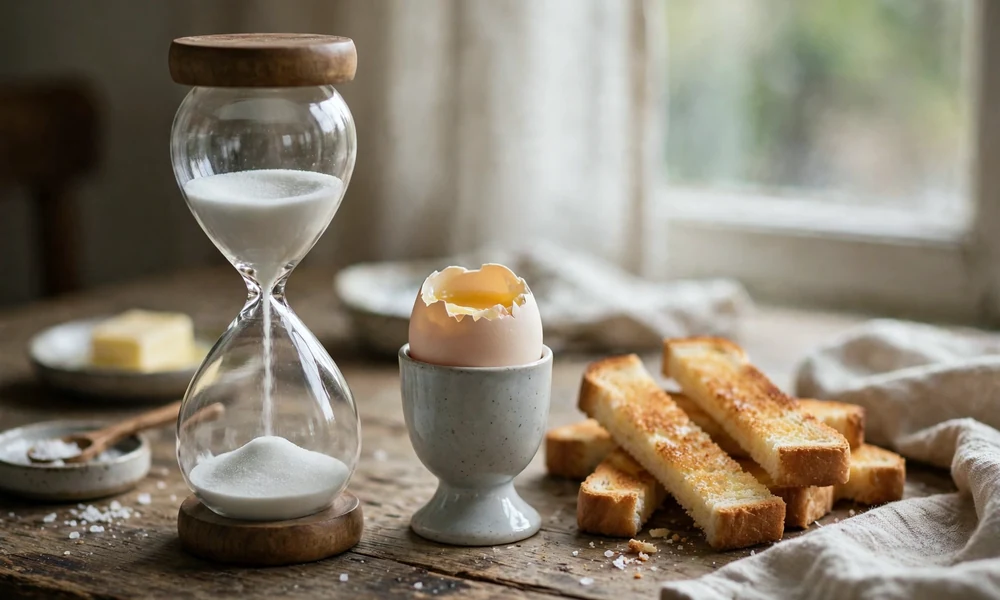
Sand timers are the simplest and the most reliable in one sense: they have no battery, nothing to set, and nothing to go wrong. You turn them over and the sand runs. Their weakness is that they only time one fixed period, usually three or five minutes, and their accuracy varies. A good sand timer, checked against a clock and kept upright, is a pleasure to use, and it suits a slow breakfast where the ritual matters as much as the result. A poor one is a guess with glass around it.
Wind-up timers are the classic kitchen dial: turn the knob, and a bell rings when the time is up. They need no battery, they are satisfying to use, and the bell is usually loud. Their weakness is accuracy at short times: a wind-up mechanism that is set for three minutes can be a minute out if the spring is wound unevenly. They suit cooks who like a mechanical feel and who check the first few timings against a clock. For a gift, a well-made wind-up timer in a solid metal case is hard to beat.
Colour-changing timers are a different idea altogether: a small disc that goes into the water with the eggs and changes colour as the egg cooks, showing soft, medium and hard stages. They work by reacting to the heat of the water, which means they track the egg rather than the clock, and they adjust automatically if the water is cooler than usual. They are less precise than a digital countdown, and they need cleaning after every use, but for a beginner they remove all the guesswork, and children love watching them change.
Getting the Timing Right
The times that matter most are the ones for a standard large egg, lowered into water that is already boiling. Six minutes gives a soft egg with a fully runny yolk and a just-set white. Eight minutes gives a medium egg with a jammy yolk that holds its shape. Ten minutes gives a firm egg with a fully set yolk, and twelve minutes gives a hard egg for salads and sandwiches. These times assume the egg started at room temperature; an egg straight from the fridge needs about a minute longer, and a smaller egg needs about a minute less.
The Best Egg Timers by Use
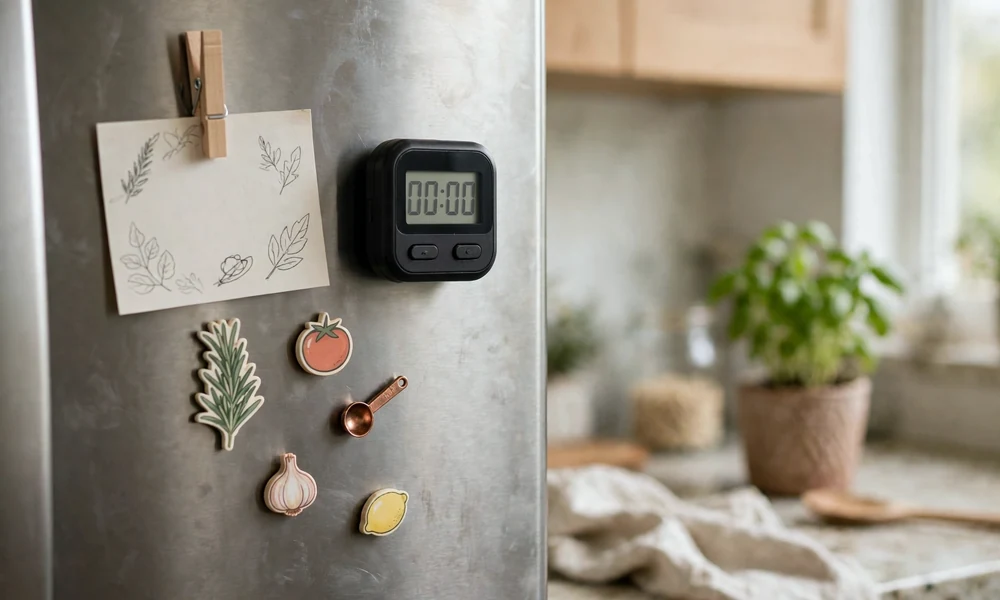
For the everyday breakfast table, a simple digital timer with a loud alarm and a big display is the best choice. It should take three seconds to set, be readable from the table, and be loud enough to hear from the bathroom. A magnet on the back is a bonus, because it lets the timer live on the fridge where everyone can find it. Avoid anything with a complicated menu: at seven in the morning, nobody wants to read a manual.
For the precise cook, accuracy is everything, and that means a digital timer with a seconds display and a repeat function. Some digital timers let you save a favourite time, so six minutes is one press away, and a few will run two countdowns at once, which is useful when the eggs and the asparagus are on different schedules. A timer that can count up as well as down is a bonus: if you miss the alarm, you can see exactly how far over time you went.
For a gift, looks matter as much as function. A glass sand timer with a wooden base, or a solid metal wind-up timer, looks good on a breakfast table and gets used because it is always in sight. Our guide to egg cookers worth the counter space covers the machines that do the cooking for you, but a beautiful timer is the smaller, cheaper gift that gets used every single morning.
Accuracy, Batteries and Care
Care is simple. Wipe a digital timer with a damp cloth, and never hold it under a running tap. Rinse a colour-changing timer after every use so it does not stain. Keep a sand timer upright and out of direct sunlight, which can fade the sand and weaken the seal. Change the battery in a digital timer as soon as the display starts to dim, rather than waiting for it to die mid-boil, and keep a spare battery in the same drawer as the timer.
What to Avoid When Buying an Egg Timer
Avoid timers that try to do too much. A timer with a clock, a stopwatch, a thermometer and a recipe database is a gadget, not an egg timer, and every extra feature is another menu to fight through before the eggs go in. The best egg timer does one thing, does it accurately, and rings loudly when it is done. Everything else is a reason to choose a different model, and the same is true of the machines around it: if you would rather have the cooking done for you, our guide to the best egg poachers of 2026 covers the tools that take over the whole job.
Frequently Asked Questions
Do I need a separate timer for soft and hard eggs? No, unless you use a sand timer, which only times one fixed period. A digital timer can be set to any time, so one timer covers soft, medium and hard eggs. If you love sand timers, keep two: a three-minute one for soft eggs and a six-minute one for a firmer result, and flip the second one when the first runs out.
Are colour-changing timers accurate? They are accurate enough for most people, because they measure the heat the egg has actually absorbed rather than the time on a clock. They are less precise than a digital timer, and they do not give you a number, so if you want the same result every single morning, a digital countdown is the better tool. If you want a simple visual guide and a timer that a child can use, they are hard to beat.
Can I use a phone instead of an egg timer? You can, and many people do, but a dedicated timer has two advantages: it is always in the kitchen, and it does not show you notifications while the eggs are boiling. A phone timer also goes silent if the phone is on silent, which is exactly when you will forget the eggs. A cheap kitchen timer that lives on the fridge is a better tool for the job, and it costs less than a takeaway coffee. If precision matters to you in the rest of the kitchen too, our guide to the best kitchen scales of 2026 covers the other measuring tool every good cook reaches for daily.
The best egg timer is the one you will actually use every morning: loud enough to hear, clear enough to read, and simple enough to set with wet hands. Choose a digital timer for accuracy, a sand timer for simplicity, or a wind-up timer for the pleasure of the bell, and the eggs will come out right far more often than they go wrong.