The best kitchen scales turn guesswork into consistency. A cup of flour can weigh anywhere from 120 to 160 grams depending on how you scoop it, and that 40-gram swing is the difference between a loaf that rises beautifully and one that comes out dense and dry. The best kitchen scales of 2026 fix that problem in seconds, giving you exact measurements for baking, coffee, portion control, and everyday cooking.
Modern scales have come a long way from the bulky dial models in our grandparents’ kitchens. Today’s best kitchen scales are slim, fast, and accurate to a single gram, with bright displays, tare functions, and platforms big enough for a mixing bowl. Many run for months on a single battery.
We compared the features that matter — accuracy, capacity, readability, build quality, and cleaning — and tested each style in a real kitchen. This guide explains what to look for and how to pick the right scale for the way you cook.
Key takeaways
- Weighing beats measuring by volume: a cup of flour can vary by 40 grams or more.
- Look for 1-gram increments, a capacity of at least 5 kilograms, and a tare function on any scale you buy.
- A large, flat platform and a display you can still read with a bowl on top matter more than fancy extras.
- Digital scales beat mechanical ones for precision, speed, and ease of use in almost every kitchen.
- Match the scale to your cooking: bakers need fine accuracy, coffee lovers need 0.1-gram precision, and busy families need high capacity.

Why Weighing Beats Measuring Every Time
Cups and spoons feel convenient, but they are surprisingly unreliable. Flour settles and compacts, brown sugar packs differently every time, and a cup of chopped vegetables depends entirely on how finely you chop. Weight has none of these problems: one hundred grams of flour is one hundred grams of flour, no matter who measures it.
The difference shows up most clearly in baking, where small errors change the outcome. Too much flour makes cakes heavy and bread tough, while too little leaves cookies spreading into thin crisps. Professional bakers weigh everything for exactly this reason, and most of their recipes list ingredients in grams first. Weighing is also faster: place a bowl on the scale, press tare, and add each ingredient in turn. Scaling a recipe becomes simple arithmetic, and portion control becomes honest.
What Makes the Best Kitchen Scales in 2026
The best kitchen scales share a short list of qualities: they weigh accurately, they are easy to read, they fit the bowls you actually use, and they survive daily life on a counter. Everything else — timers, apps, nutrition databases — is a bonus most cooks rarely use.
Accuracy and Increments
Most good kitchen scales measure in 1-gram increments, which is fine for everyday cooking and baking. If you make pour-over coffee or bake with small amounts of yeast and salt, look for a scale that reads to 0.1 grams, since a single gram of error matters at that scale. Avoid cheap scales that drift: one that reads differently each time you weigh the same object is worse than no scale at all. Test yours with an unopened 500-gram bag of sugar.
Capacity and Platform Size
A scale that tops out at 3 kilograms will struggle with a large bowl of bread dough, while 5 kilograms handles most kitchen tasks comfortably. Heavy-duty models reach 10 kilograms or more, which suits big families and batch cooking. The platform matters just as much: a generous flat platform holds mixing bowls, plates, and pots securely. Stainless steel and tempered glass platforms are the easiest to wipe clean after weighing sticky ingredients.
Display, Controls and Tare
A scale is only useful if you can read it while you cook. Look for a large, bright display with clear digits, ideally backlit so it stays readable in a dim kitchen. The display should sit where a bowl does not hide it; some of the best designs angle the display forward for exactly this reason. Physical buttons are easier to press with floury or wet hands than sleek touch controls. Tare should be instant, and a unit switch between grams, ounces, millilitres, and pounds helps with recipes written in different systems.
Build Quality, Materials and Cleaning
A kitchen scale faces spills, steam, and the occasional knock off the counter, so solid construction matters: a light, hollow-feeling scale is more likely to crack or lose calibration after a fall. Stainless steel platforms resist stains and odours, tempered glass wipes clean in seconds, and a sealed body keeps crumbs and liquid out of the electronics. Prefer scales that run on AAA batteries or recharge over USB rather than obscure coin cells.

Kitchen Scales for Baking: Precision Where It Counts
Bakers benefit from a kitchen scale more than any other cook. Bread, cakes, and pastries depend on ratios: the balance of flour, water, yeast, and salt decides whether a loaf rises, a cake stays moist, or a pastry turns flaky. Measured by weight, those ratios work the same way every time.
For baking, 1-gram increments and at least 5 kilograms of capacity is the sweet spot: enough for a full batch of bread dough, and precise enough for the small quantities of yeast, baking powder, and salt that make or break a bake. A tare function is essential, since baking means adding ingredient after ingredient to the same bowl. If you bake often, a scale pairs naturally with the best stand mixers for baking, since weighed ingredients and a powerful mixer together take the guesswork out of bread, cakes, and pastry.
Kitchen Scales for Coffee and Precision Work
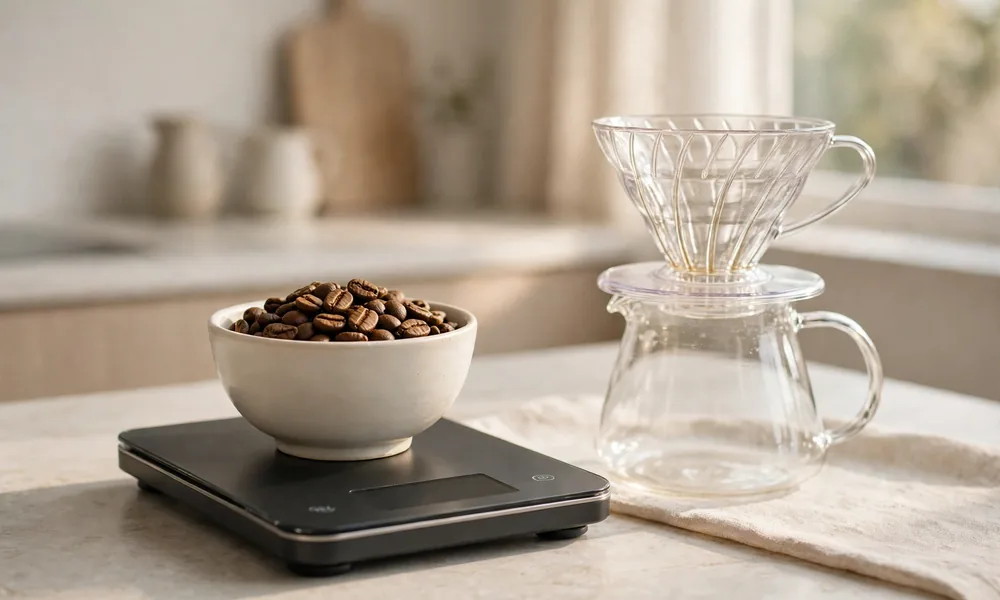
Coffee is where kitchen scales earn their keep in the smallest increments. A pour-over ratio of one part coffee to sixteen parts water means a single gram changes the strength of the cup, so serious coffee drinkers weigh both beans and water. That calls for a scale that reads to 0.1 grams, responds quickly as water is poured, and includes a timer.
A precise scale is the other half of great coffee, and it works hand in hand with the best coffee grinders for home to dial in your brew ratio. Grind size and dose work together: a finer grind extracts faster, a coarser grind slower, and the only way to adjust one without guessing the other is to weigh your dose every time. Precision scales suit spice blending too, where a gram of chilli changes a whole dish, and small-batch cooking, where halving a recipe leaves you measuring two grams of baking powder.
Digital vs Mechanical Kitchen Scales
Mechanical scales, with their dials and springs, never need batteries, and a well-made one can last for decades. But they lose on accuracy: most read in increments of 25 or 50 grams, their springs wear and drift, and reading a needle is far less precise than reading a digital number.
Digital scales win on precision, speed, and convenience: they read to a gram or better, tare instantly, and switch units at the touch of a button. Their only weakness is batteries, and even that is minor — a set of AAAs typically lasts a year or more. Unless you want a battery-free scale for a cabin or a vintage kitchen, digital is the right choice for almost everyone in 2026.
How to Choose the Right Kitchen Scale for Your Kitchen
Start with how you cook. A keen baker needs fine accuracy and a long auto-off time; a coffee lover needs 0.1-gram precision and a timer; a busy family needs high capacity and a big platform; a small kitchen needs a slim scale that slides into a drawer. There is no single best kitchen scale for everyone, only the best one for the way you cook.
Set a realistic budget first. Good digital scales start at a modest price, and the jump to a mid-range model buys real improvements in accuracy, display quality, and build. Beyond that, you pay for extras such as app connectivity and nutrition tracking, which rarely change how well you cook. Think of your scale as part of a small, well-chosen countertop kit alongside the best electric kettles and your other daily tools: reliable, easy to reach, and used every single day.
| Type | Best for | Accuracy | Capacity | Typical price |
|---|---|---|---|---|
| Compact digital | Everyday cooking | 1 gram | 5 kg | Budget friendly |
| High-capacity digital | Families and batch cooking | 1 gram | 10 kg or more | Mid range |
| Precision coffee scale | Coffee and spices | 0.1 grams | 1–2 kg | Mid to premium |
| Mechanical dial scale | Basic weighing, no batteries | 25–50 grams | 3–5 kg | Budget friendly |
Checklist: Before You Buy
- Accuracy of 1 gram or better, or 0.1 grams if you brew pour-over coffee or blend spices.
- Capacity of at least 5 kilograms, so a full mixing bowl of dough never tops the scale out.
- A tare function that zeroes instantly, plus a unit switch between grams, ounces, and millilitres.
- A large, bright display that stays readable with a bowl sitting on the platform.
- A flat platform big enough for your largest bowl, in stainless steel or tempered glass for easy cleaning.
- An auto-off time of at least two minutes, and batteries you can actually buy: AAA or USB charging.
Frequently Asked Questions
Do I really need a kitchen scale?
If you bake, brew coffee, or track portions, yes. A scale removes the biggest source of error in recipes — the difference between a loosely scooped cup and a packed one — and makes results repeatable. Weighing is also faster: ingredients go straight into one bowl instead of dirtying a set of measuring cups.
What accuracy should a good kitchen scale have?
For most cooking and baking, 1-gram increments are plenty. Coffee brewers and spice blenders should look for 0.1-gram precision. Whatever the claimed accuracy, test the scale with a known weight when it arrives and return it if the readings drift.
How much capacity do I need?
Five kilograms covers most home cooking, including a full bowl of bread dough. Large families and batch cooks should look for 10 kilograms. Precision coffee scales usually top out at 1 or 2 kilograms — fine for coffee, too small for general cooking.
Are expensive kitchen scales worth it?
Up to a point. A mid-range scale is usually more accurate, better built, and easier to read than a bargain model. Beyond that, you mostly pay for apps and nutrition databases that rarely improve your cooking. Spend enough for solid accuracy and build quality, then stop.
Can I weigh liquids on a kitchen scale?
Yes, and it is often more accurate than a measuring jug: one millilitre of water weighs one gram, so you can weigh water, milk, and stock directly. Many scales include a millilitre mode for other liquids.
How do I keep my kitchen scale accurate?
Store it flat in a dry place, away from heat and damp, and avoid dropping it. Wipe the platform after use, remove the batteries if you will not use it for months, and check it against a known weight now and then. If readings wander, replace the batteries first — low power is the most common cause of drift.
The Bottom Line
The best kitchen scales are the ones you reach for every day without thinking: accurate to a gram, big enough for your largest bowl, easy to read, and tough enough for life on the counter. Match the scale to how you cook — fine precision for coffee, high capacity for family meals, solid accuracy for baking — and it will quietly make everything you cook more consistent.