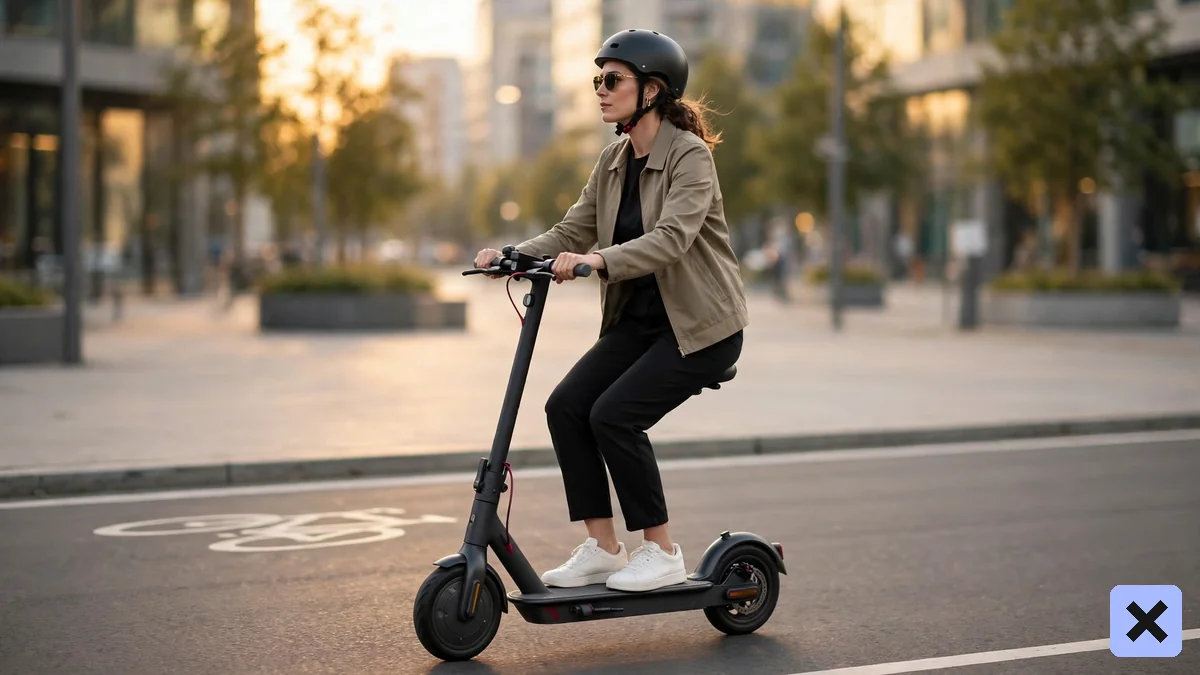
The best electric scooters for commuting in 2026 are faster, safer and longer-ranging than anything that came before them. A good commuter scooter now covers a 5 to 15 mile round trip on a single charge, folds in seconds for the train, and costs less per mile than almost any other way to work.
Choosing the wrong scooter is an expensive mistake. A model with too little range leaves you pushing it home, and one with solid tyres rattles your teeth on every pothole. The best electric scooters for commuting balance real-world range, ride comfort, braking and portability, at a price that pays for itself within months of ditching the bus or the car.
We judged the shortlist on what matters daily: honest range, hill climbing, braking in the wet, carrying it up stairs, and folding it at the station. Below are nine scooters that earned their place.
Key takeaways
- Match range to your round trip, then add 30 percent for cold weather and hills.
- Pneumatic tyres and suspension matter more than top speed on real city roads.
- Dual braking, bright lights and a loud bell are non-negotiable safety features.
- A scooter under 16 kg is genuinely portable; anything over 20 kg is a lift, not a carry.
- Check your local rules before you buy, because speed and power limits vary by city.
How We Chose the Best Electric Scooters for Commuting
Every scooter here was judged on usable range, ride quality, braking, build quality and value. Manufacturer range claims are usually measured at low speed on flat ground, so we treated them with scepticism: real commuting range is typically 60 to 70 percent of the claimed figure.
The 9 Best Electric Scooters for Commuting in 2026
1. Segway Ninebot Max G2 — Best Overall
The Ninebot Max G2 is the default answer for most commuters. Its 1000 W motor accelerates smoothly up to around 22 mph, and the 551 Wh battery claims up to 43 miles, or a realistic 25 to 30 miles at commuting speeds. Self-sealing tubeless tyres shrug off small punctures, the hydraulic and drum brakes stop confidently in the wet, and built-in turn signals are a safety upgrade most rivals still lack. At around 24 kg it is not light, but the ride is calm and planted.
2. Xiaomi Electric Scooter 4 Pro — Best Value Mid-Ranger
The Xiaomi Electric Scooter 4 Pro packs a 700 W motor and a 446 Wh battery into a clean design, with a claimed range of up to 34 miles and a top speed of around 22 mph. Real-world range lands closer to 20 miles, which covers the average commute twice over. The 10-inch pneumatic tyres and front suspension take the edge off rough roads, and the app offers ride stats and a lock function. At about 16.5 kg it folds quickly and undercuts most rivals on price.
3. NIU KQi3 Pro — Best for First-Time Riders
The NIU KQi3 Pro is the friendliest scooter on this list. Its 350 W motor tops out at around 20 mph, and the 365 Wh battery claims 31 miles, or roughly 18 to 20 miles in real use. The wide 9.5-inch deck feels stable, and the pneumatic tyres give a comfortable ride without suspension. Build quality stands out at this price: the frame feels solid, the folding latch is reassuring, and the app offers a useful lock. At about 18 kg it is manageable on stairs.
4. Apollo City 2024 — Best for Longer Commutes
For riders with a 10-mile-plus each-way trip, the Apollo City 2024 is built for the job. Dual 500 W motors reach around 32 mph, and the 752 Wh battery claims up to 40 miles, with a realistic 25 miles at speed. Self-healing tyres, triple-spring suspension and regen braking make long rides comfortable and controlled. It also has a bright display, turn signals, a loud horn and an IP66 water-resistance rating. At about 30 kg it is a ground-level parker, not a stair carrier.
5. TurboAnt X7 Pro — Best Budget Pick
The TurboAnt X7 Pro proves a good commuter scooter need not cost a fortune. Its 350 W motor reaches about 20 mph, and the removable 360 Wh battery claims 30 miles, or roughly 16 to 18 miles in real riding. The removable battery is the clever part: charge it at your desk while the scooter stays locked outside. It has 10-inch pneumatic tyres, a clear display and a simple, sturdy fold. At 15 kg it is light enough to carry onto a train.
6. Hiboy S2 Pro — Best for Rough Roads
If your route includes cracked asphalt, cobbles and speed bumps, the Hiboy S2 Pro is the pick. Its 500 W motor and 36 V battery claim 25 miles and a top speed of about 19 mph, while dual rear suspension and 10-inch pneumatic tyres soak up the worst a city can throw at it. It also comes with a useful rear seat option and a detachable bag. Braking is handled by a disc brake and regenerative braking, and it folds in one motion.
7. GoTrax GMAX Ultra — Best for Maximum Range
The GoTrax GMAX Ultra is the range champion of this list. Its 350 W motor and large 557 Wh battery claim up to 45 miles; even at a realistic 60 percent, that is 25 miles or more, enough for a serious two-way commute with no midday charging. Top speed is around 20 mph. Pneumatic tyres and dual rear suspension keep the ride smooth, and the wide deck suits larger riders. At 20 kg it is on the heavier side, but it delivers more miles per pound than anything else here.
8. Unagi Model One Voyager — Best Lightweight Premium
The Unagi Model One Voyager is the scooter for riders who carry their scooter as much as they ride it. At just 13.6 kg it is the lightest dual-motor scooter in its class, yet its two 250 W motors still reach around 20 mph and the 521 Wh battery claims up to 28 miles. The carbon-fibre handlebars and magnesium frame explain both the weight and the price. Solid rubber tyres mean no punctures ever, though the ride is firmer than pneumatic rivals. If you climb station stairs every day, those saved kilos matter most.
9. EMOVE Cruiser — Best for All-Weather Riding
The EMOVE Cruiser is a long-range workhorse built for riders who commute in all weathers. Its 1000 W motor reaches around 33 mph, and the huge 1560 Wh battery claims up to 62 miles, with a realistic 35 to 40 miles even in cold weather. Pneumatic tyres, full suspension and IPX6 water resistance make it a genuine four-season scooter, and the wide deck and bright headlight suit dark winter mornings. At 27 kg it is heavy, but for maximum range and weatherproofing it is the toughest commuter here.

Best Electric Scooters for Commuting Compared
| Scooter | Top Speed | Claimed Range | Weight | Best For |
|---|---|---|---|---|
| Segway Ninebot Max G2 | 22 mph | 43 miles | 24 kg | Overall commuting |
| Xiaomi Electric Scooter 4 Pro | 22 mph | 34 miles | 16.5 kg | Value |
| NIU KQi3 Pro | 20 mph | 31 miles | 18 kg | First-time riders |
| Apollo City 2024 | 32 mph | 40 miles | 30 kg | Longer commutes |
| TurboAnt X7 Pro | 20 mph | 30 miles | 15 kg | Budget |
| Hiboy S2 Pro | 19 mph | 25 miles | 16 kg | Rough roads |
| GoTrax GMAX Ultra | 20 mph | 45 miles | 20 kg | Maximum range |
| Unagi Model One Voyager | 20 mph | 28 miles | 13.6 kg | Lightweight premium |
| EMOVE Cruiser | 33 mph | 62 miles | 27 kg | All-weather riding |
Ranges above are manufacturer claims; in real commuting, expect roughly 60 to 70 percent of the claimed figure, less again in cold weather or on hills. For the wider market, our roundup of the best electric scooters of 2026 covers more models across every price bracket.
What to Look for in a Commuting Scooter
Real Range, Not Claimed Range
Work out your round trip, add a third for safety, and buy a scooter whose realistic range clears that number. A 10-mile round trip needs at least 15 miles of real range, usually a claimed range of 25 miles or more. Battery capacity in watt-hours is a better guide than the marketing number: 350 Wh is the minimum, and 500 Wh or more is comfortable.
Tyres and Suspension
Pneumatic tyres transform a commute: they absorb the bumps solid tyres transmit to your feet and knees, and they grip better in the wet. Suspension helps too, but good tyres matter more than basic suspension. If you ride on smooth tarmac only, solid tyres are acceptable; anywhere else, choose air-filled.
Weight and Folding
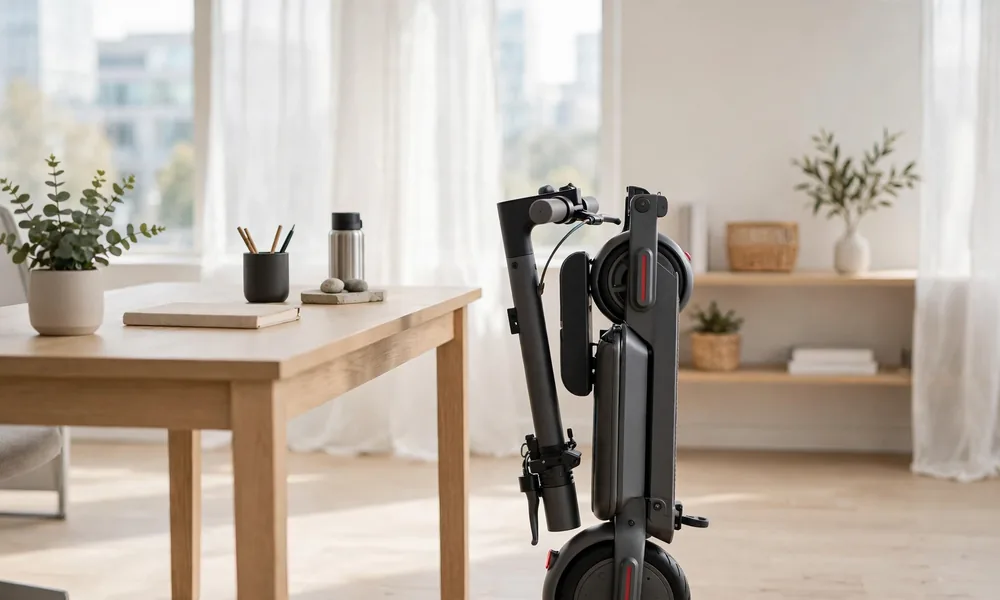
Under 16 kg is genuinely portable, 16 to 20 kg is manageable for short carries, and anything over 20 kg is a scooter you roll rather than lift. A one-handed fold and a latch that locks the stem to the deck make train and office life far easier. If your commute mixes a scooter with a train or bus, weight should be your first filter.
Brakes, Lights and Water Resistance
Dual braking, a disc or drum brake plus regenerative braking, stops you shorter and gives you a backup if one system fails. Bright lights and a bell or horn are essential for dark mornings, and an IPX5 rating or better matters if you ride in rain. If you are torn between two wheels and four, our guide to the e-bike vs scooter for city commuting breaks down which one suits which route.
Commuting Checklist: Before You Ride
- Charge to 100 percent the night before and check the battery in the morning.
- Check tyre pressure weekly; soft tyres cut range and make punctures more likely.
- Test both brakes before every ride, especially after rain.
- Wear a helmet and a hi-vis layer on dark or busy roads.
- Plan your route on bike lanes and quiet streets, not main roads.
- Carry a lock, and know where you will park at both ends of the trip.
Frequently Asked Questions
How much range do I need for commuting?
Measure your round trip and add 30 percent. A 10-mile round trip calls for at least 15 miles of realistic range, usually a manufacturer claim of 25 miles or more.
Are electric scooters legal to ride?
Rules vary by city and country: some allow private scooters on roads and bike lanes, others restrict them to private land, and speed and power limits differ widely. Check your local rules before you buy.
How long does an electric scooter battery last?
A good lithium battery lasts 500 to 1,000 full charge cycles, roughly three to five years of daily commuting. Avoid storing the scooter fully charged or fully flat for weeks.
Can I take an electric scooter on a train?
Most folded scooters are allowed on trains and buses, though rules vary by operator and time of day. Lighter models under 16 kg are the easiest to carry and stow.
What should I wear when commuting on a scooter?
A helmet is the single most important item. Add gloves in cold weather, a hi-vis layer for dark mornings, and shoes with good grip for the deck. A backpack beats a shoulder bag, because it keeps your weight centred.
Is an electric scooter cheaper than a car for commuting?
Yes, by a wide margin. Charging costs pennies per ride, there is no fuel, insurance or parking to pay, and maintenance is mostly tyres and brake pads. Most riders recover the cost of a mid-range scooter within a few months of not driving. For a broader look, see our breakdown of electric vs petrol motorcycles.

The Bottom Line
The best electric scooter for commuting is the one that matches your route, not the one with the biggest numbers on the box. For most riders, the Segway Ninebot Max G2 is the safest all-round choice, with the Xiaomi Electric Scooter 4 Pro as the value pick and the Unagi Model One Voyager for anyone who carries their scooter up stairs every day. Pick your range with headroom, prioritise pneumatic tyres and dual brakes, and buy the scooter that fits your real commute.