
Which Entryway Bench Is Worth the Hallway Space in 2026?
An entryway bench earns its hallway space only if you actually sit on it. The best entryway benches in 2026 do three jobs at once: they give you somewhere to sit while you put on shoes, they hide the shoes, bags and clutter that collect by the front door, and they make the first thing you see when you come home feel calm rather than chaotic.
Most people buy an entryway bench the wrong way round. They fall for a style, bring it home, and only then discover it is too wide for the hallway, too low to stand up from comfortably, or too shallow to hold a pair of boots. A bench is furniture you use twice a day, every day, so measure first, think about what goes under and around it, and only then worry about how it looks.
Key takeaways
- An entryway bench should leave at least 90 centimetres of clear walkway in front of it.
- A seat height of 45 to 48 centimetres suits most adults; lower benches are hard to stand up from.
- Open cubbies hold shoes you grab daily; closed drawers or baskets hide the pairs you wear once a week.
- A bench without hooks above it only does half the job — coats and bags need somewhere to go.
- Hard-wearing materials matter more than looks: entryways take mud, wet coats, keys and school bags every day.

What an entryway bench is really for
An entryway bench is a seat with storage, placed where you come in and out of the house. Its main job is simple: somewhere to sit while you put on or take off shoes. That sounds trivial until you try doing it standing up with a bag on your shoulder and a child asking for help. A bench turns a daily fumble into a thirty-second routine.
Its second job is corralling the clutter: shoes, bags, hats, dog leads and post all land by the front door, and without a system they spread across the floor within days. A bench with storage underneath gives all of it a home. The third job is visual: the entryway is the first room you see when you come home, and a bench anchors it the way a console anchors a living room wall. Without one, the hallway becomes a corridor with a pile of shoes in it.
Getting the size right
Size is where most entryway bench purchases go wrong. Hallways are rarely generous, and a bench a few centimetres too wide can turn a comfortable entrance into a daily squeeze. Measure the wall, measure the walkway, and check the door swing before you order anything.
Length: fit the wall, not the room
Most entryway benches are 90 to 150 centimetres long. A bench for one person needs about 60 centimetres of seat; a bench for a family needs 120 centimetres or more so two people can sit at once. Measure the wall, then subtract space for anything else that lives there: a door that swings open, a radiator, or a console table. Leave at least 5 centimetres of breathing room at each end so the bench does not look wedged in.
Height: 45 to 48 centimetres is the sweet spot
Seat height matters more than most people expect. A bench 45 to 48 centimetres high suits most adults: low enough to sit on comfortably, high enough to stand up from without effort. Benches below 40 centimetres look elegant in photographs but feel like sitting on the floor, especially for older knees. Benches above 50 centimetres start to feel like a bar stool. If the bench will be used by children, 40 to 45 centimetres is more practical. Test the height in the shop if you can: sit, put on an imaginary shoe, and stand up again.
Depth: enough for boots, not so much it blocks the hall
Most entryway benches are 35 to 45 centimetres deep: enough to sit on comfortably and to store shoes underneath. Anything shallower than 35 centimetres feels like a ledge, and boots will stick out of the cubbies below. Anything deeper than 45 centimetres eats into the walkway. The golden rule: after the bench is in place, you should still have at least 90 centimetres of clear floor in front of it. In a narrow hallway, a slim bench of 30 to 35 centimetres with open shoe shelves underneath beats a deep bench that forces everyone to sidestep.
The main types of entryway bench
Entryway benches fall into a handful of types. The right choice depends on how many people use the door, how much you need to store, and whether the bench stands alone or forms part of a bigger unit.
| Type | Best for | Storage | Watch out for |
|---|---|---|---|
| Open cubby bench | Families with daily shoes | Good — shoes visible and grabbable | Looks messy if cubbies overflow |
| Drawer bench | Tidy halls, occasional shoes | Very good — clutter hidden | Drawers need clearance to open |
| Storage bench with lift-up seat | Seasonal items, small halls | Excellent — deep hidden space | Heavy lid; items pile up inside |
| Bench with hooks above | Coats, bags and hats | Good — vertical storage | Needs a solid wall for fixing |
| Built-in mudroom unit | Large families, new builds | Excellent — the most storage | Expensive and permanent |
| Simple backless bench | Wide halls, minimalists | Poor — no storage at all | Clutter ends up on the floor |
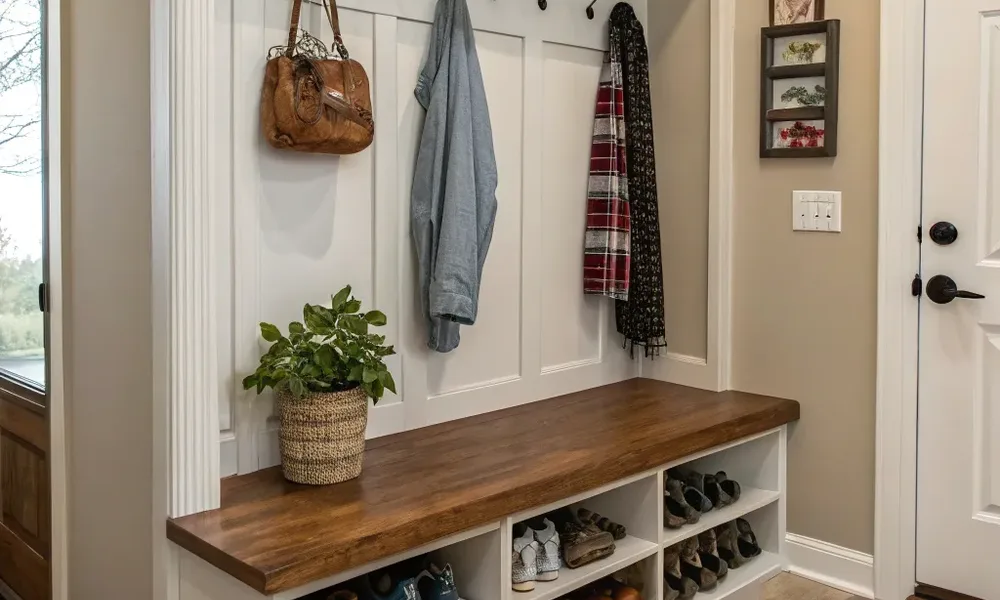
The open cubby bench is the most popular choice for families: each person gets a cubby or two, shoes go in and out without opening anything, and you can see at a glance what is missing. The trade-off is visual — cubbies only look tidy if they are not overstuffed — so a basket inside each cubby hides the mess while keeping the grab-and-go convenience.
A bench with hooks above it does double duty: coats, bags and hats hang at eye level, shoes sit below, and the whole routine happens in one spot. Check the wall first, because hooks loaded with winter coats need solid fixings. A separate shoe rack can take the overflow if the household owns more pairs than the bench can hold.
Storage that earns its space
A bench without storage is just a seat, and a hallway seat without storage quickly becomes a dumping ground. The benches that earn their space give every item by the door a proper home, so the floor stays clear even on the busiest mornings.
Cubbies, drawers or baskets
Open cubbies are the fastest option: shoes go straight in and out, with no doors to open. They suit the pairs you wear every day. Drawers are better for the pairs you wear once a week, plus gloves, hats and dog leads, because they hide everything behind a clean front. Baskets sit in the middle: they hide the mess, pull out like drawers, and let shoes breathe, which matters for damp footwear. Many of the best benches mix all three — cubbies for daily shoes, a drawer for small items, and a basket or two for the overflow.
Hooks, shelves and the wall above
The wall above the bench is free storage, and wasting it is the most common entryway mistake. A row of hooks at 150 to 170 centimetres takes coats, bags and hats; a shelf above the hooks takes baskets for gloves, scarves and sunscreen. A mirror above the bench is the finishing touch: it bounces light into what is often the darkest part of the house, and it gives you a last check before you leave. Our guide to the best mirrors for small rooms and dark hallways covers sizes that work above a bench without overwhelming it.
What belongs under the bench
The space under the bench is prime real estate. Shoes are the obvious answer, but think about the rest of the daily load: a tray for wet boots, a basket for the dog lead, a small box for keys and post. A boot tray is worth its weight in winter: it catches mud and meltwater and slides out for emptying. Our guide to door mats worth buying for muddy boots and wet paws covers what to put in front of the bench as well as under it. Whatever you store underneath, leave the front of the bench clear: if you have to move a pile to reach a pair of shoes, the system has already failed.
Materials and finishes that survive the hallway
Entryways take more abuse than any other room in the house. Mud, wet coats, keys, school bags and sports kit all pass through, and the bench is in the middle of it. Solid wood is the most forgiving choice: oak, ash and walnut stand up to scuffs, and a scratched wooden bench can be sanded and re-oiled. Painted MDF looks crisp on day one but chips at the corners and swells if wet boots sit against it. A cushion makes the bench far more inviting — and far more used — but it needs a removable, washable cover, because hallway cushions collect dirt faster than any other cushion in the house.

Before you buy checklist
- Measure the wall and subtract door swings and radiators: that is your maximum bench length.
- Check the walkway: at least 90 centimetres of clear floor must remain in front of the bench.
- Sit on it at 45 to 48 centimetres high and stand up again: it should feel easy, not like a squat.
- Count the shoes: each person needs at least one cubby or basket.
- Check the wall above: solid fixings for hooks and a shelf.
- Look at the floor: a boot tray underneath and a good mat in front will save the flooring.
Frequently asked questions
How wide should an entryway bench be?
Most entryway benches are 90 to 150 centimetres long. Allow about 60 centimetres of seat per person, and leave at least 5 centimetres at each end. A bench for a family of four should be at least 120 centimetres long.
What is the best height for an entryway bench?
About 45 to 48 centimetres suits most adults: low enough to sit on comfortably, high enough to stand up from without effort. Below 40 centimetres feels like sitting on the floor; above 50 feels like a bar stool.
Should an entryway bench have storage?
Yes, unless the hallway already has a cupboard or a shoe rack nearby. A bench without storage is just a seat, and the shoes and bags will end up on the floor anyway. Cubbies suit daily shoes, drawers hide the rest.
Do I need hooks above the bench?
Not always, but they make the bench far more useful: coats, bags and hats need somewhere to go, and the wall above the bench is otherwise wasted space. If the hallway has a coat cupboard nearby, you can skip the hooks and hang a mirror instead.
What material is best for an entryway bench?
Solid wood is the most durable and the easiest to repair: oak, ash and walnut all stand up to scuffs. Painted MDF looks smart but chips at the corners. For the seat, a cushion with a removable, washable cover beats bare wood for comfort, especially in winter.
Can an entryway bench work in a narrow hallway?
Yes, if you keep it slim. Choose a bench 30 to 35 centimetres deep with open shoe shelves underneath, and keep at least 90 centimetres of walkway in front of it. A floating bench fixed to the wall makes a narrow hallway feel wider.
Bottom line
The entryway bench worth the hallway space in 2026 is the one you actually sit on: 45 to 48 centimetres high, long enough for the household, slim enough to leave 90 centimetres of walkway, with storage for the shoes and hooks for the coats. Measure the wall and the walkway before you shop, choose a material that survives mud and wet boots, and give every item by the door a home.


