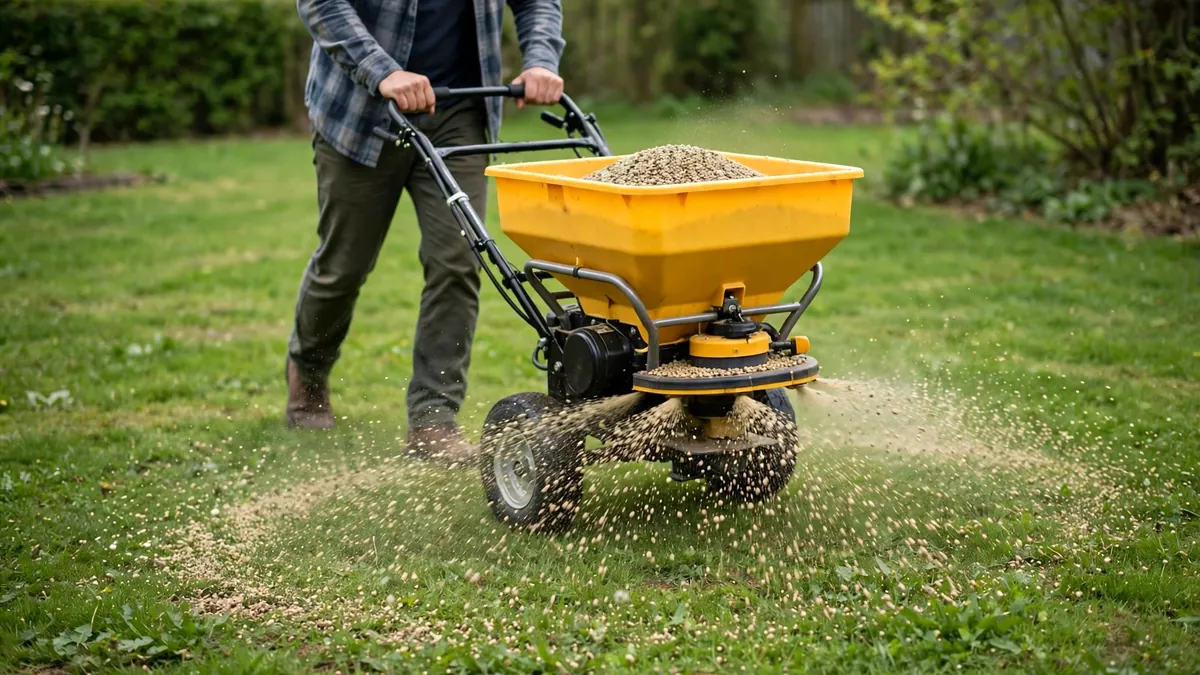
The best fertilizer spreaders of 2026 turn a patchy, hungry lawn into even, healthy growth without scattering granules by hand. A good spreader puts the same amount of feed on every square metre, so the lawn greens up evenly instead of in striped bands of dark and pale grass. The difference between a good spreader and a bad one shows up within weeks: even coverage, no burnt patches, and no fertilizer wasted where the wheels never reached.
Choosing well matters because fertilizer is not forgiving. Too much in one spot scorches the grass, too little leaves it thin, and an uneven spread makes both problems appear in the same lawn. This guide compares the main types, explains how to set the rate correctly, and shows how to use one so the lawn gets exactly what it needs.
Key Takeaways
- Broadcast spreaders suit most lawns: they cover ground quickly and spread granules in a wide, even fan.
- Drop spreaders are the precise choice for small lawns, edges and beds, where accuracy matters more than speed.
- Match the hopper to your lawn: a 20-litre hopper covers roughly 500 square metres per fill.
- Always calibrate first: a short test strip on a driveway shows the real spread rate.
- Clean the spreader after every use: fertilizer residue corrodes metal parts and jams the mechanism.
How We Judged Fertilizer Spreaders in 2026
We judged every fertilizer spreader on five things that decide whether it earns its place in the shed. Evenness of spread came first, because a spreader that throws more to one side than the other is worse than no spreader at all. Next came build quality: a solid frame, wheels that turn freely when loaded, and a hopper that does not flex or crack. Ease of use mattered too, including a rate lever you can reach while walking and a handle at a comfortable height.
Capacity was weighed against the lawns most people actually own. A hopper that is too small means constant refilling, while one that is too big becomes heavy and hard to push when full. Finally we looked at cleaning and storage: parts that rinse clean and a mechanism that does not seize after a winter in the shed.
Fertilizer Spreader Types Compared
There are four main types of fertilizer spreader, and the right one depends on the size of your lawn and how precise you need to be. Broadcast spreaders fling granules out in a wide arc from a spinning plate. Drop spreaders let granules fall straight down, giving a narrow, exact band. Handheld spreaders are small crank or battery units for tiny lawns, while tow-behind spreaders attach to a ride-on mower for very large plots.
| Spreader Type | Best For | Typical Coverage | Accuracy | Watch Out For |
|---|---|---|---|---|
| Broadcast (rotary) | Medium and large lawns | Up to 5 metres per pass | Good, with overlap | Granules on paths and beds |
| Drop | Small, neat lawns and edges | About 60 centimetres per pass | Excellent | Slow on big lawns; stripes if misaligned |
| Handheld | Tiny lawns and spot feeding | Up to 2 metres per pass | Fair | Tiring on anything bigger than a patch |
| Tow-behind | Very large lawns and fields | Up to 4 metres per pass | Good | Needs a ride-on mower to tow it |
Broadcast Spreaders: The Best Choice for Most Lawns
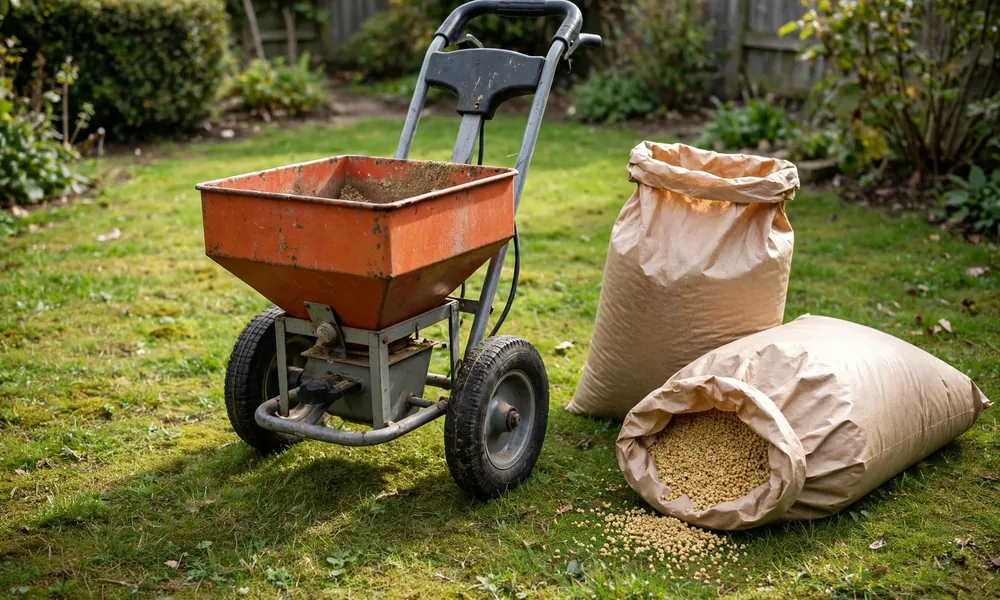
The broadcast spreader is the best fertilizer spreader for most gardens in 2026, because it does the most work with the least effort. Granules drop from the hopper onto a spinning disc, which throws them out in a wide fan, usually two to five metres across. Walk at a steady pace and a lawn of several hundred square metres is fed in fifteen minutes.
The trick with a broadcast spreader is overlap. Each pass should overlap the last by about a third, so the lighter edges of the fan meet and the coverage evens out. Walk in straight, parallel lines, and use the wheel tracks or a garden hose laid on the lawn as a guide. Start the spreader moving before you open the hopper, and close the hopper before you stop or turn, or you will leave a dark pile of granules exactly where the wheels paused.
What to Look For in a Broadcast Spreader
Look for a hopper of at least 15 litres, which covers a typical suburban lawn without a refill, and a rate lever that clicks firmly into place rather than sliding loosely. Pneumatic tyres are worth having: they roll over uneven ground without bouncing the spreader, and bouncing is what throws granules in clumps.
Drop Spreaders: Precision for Small and Neat Lawns
Drop spreaders are the precise tool in the range. Granules fall straight down through a row of holes in the base, so the strip you feed is exactly the width of the spreader, usually around 45 to 60 centimetres. There is no fan and no scatter onto the path. For a small, formal lawn, for feeding along the edge of a bed, or for applying a weed-and-feed product that must not touch the flowers, a drop spreader is hard to beat.
The price of that precision is speed. A drop spreader covers a narrow band with each pass, so a large lawn takes far longer than it would with a broadcast model, and the passes must line up exactly. Overlap by even a few centimetres and that strip gets a double dose, which shows up as a dark green stripe a fortnight later. Mark your lines with a piece of string or a garden hose to avoid both.
Handheld Spreaders: Small Lawns and Quick Jobs
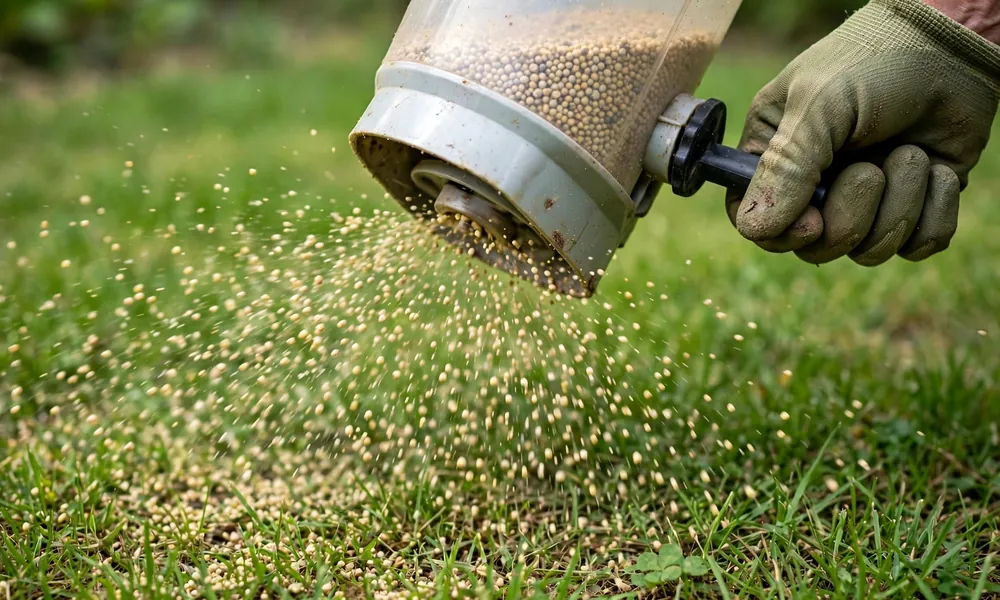
Handheld spreaders suit a very specific job: a tiny lawn, a patch that needs feeding, or a balcony garden where a wheeled spreader would be absurd. Most are crank-operated, with a small hopper you hold in one hand while the other turns a handle that spins a small disc. The honest limit is capacity: a hopper that holds a litre or two needs refilling every few minutes, so for anything bigger than a patch, a wheeled spreader does it better.
Setting the Rate: The Step Most People Skip
The rate setting is the number on the lever, and it is the step most people skip. Every bag of fertilizer lists a spreader setting for its product, but those numbers are only a starting point, because different spreaders flow differently and granule size varies from brand to brand. The only way to know your spreader is putting down the right amount is to calibrate it, and calibration takes ten minutes.
Weigh out the amount of fertilizer the bag says should cover 10 square metres, load it into the hopper, and spread it over a measured 10-square-metre strip on a driveway or a path. Then weigh what is left. If the hopper is empty exactly at the end of the strip, the setting is right. If granules remain, the rate is too low; if you run out early, it is too high.
Walking speed matters as much as the setting. A spreader calibrated at a normal walking pace will over-apply if you stroll and under-apply if you hurry. Pick a steady pace and keep it for the whole lawn, and do not stop mid-pass with the hopper open. Close the lever before you turn, line up the next pass, and only then open it again.
When and How to Feed Your Lawn
Timing is half the job. Feed when the grass is actively growing and the soil is moist, which in most gardens means spring and early autumn. A spring feed wakes the lawn up after winter, while an autumn feed strengthens the roots before the cold arrives. Avoid feeding in the heat of midsummer, when stressed grass is easily scorched, and feed on a calm, dry day when rain is expected within a day or two.
Water matters too. If no rain comes within a couple of days of feeding, water the lawn yourself, lightly and evenly. Granules left sitting on dry blades can burn the tips, and the fertilizer does no good at all until it reaches the soil. Mow first, then feed: a freshly mown lawn lets the granules fall through to the soil instead of catching on long blades.
Common Fertilizer Spreader Mistakes
The most common mistake is filling the hopper on the lawn. A spilled pile of granules where you filled up will scorch a brown patch that takes weeks to recover, so always fill on the driveway or a path and sweep up any spill before you start. The second mistake is spreading on a windy day: a broadcast spreader in a breeze throws granules sideways, and the lawn ends up fed on one side and starved on the other.
The third mistake is never cleaning the spreader. Fertilizer is corrosive, and residue left in the hopper and around the mechanism draws damp, rusts metal parts and seizes the moving bits. After every use, empty the hopper completely, brush out the dust, and rinse the spreader with a hose, then leave it to dry in the sun before putting it away.
Buying Checklist
- Measure your lawn first, then buy a hopper that covers it with at most one refill.
- Choose broadcast for speed on medium and large lawns, and drop for precision on small ones.
- Check the rate lever clicks firmly and is easy to reach while you walk.
- Look for pneumatic tyres and a solid frame that does not flex when the hopper is full.
- Make sure spare parts such as wheels and levers are available for the model you buy.
- Calibrate on a measured strip before the first real pass, and re-check when you change product.

Frequently Asked Questions
What size fertilizer spreader do I need?
For a lawn up to about 200 square metres, a 10 to 15 litre hopper is plenty. Lawns of 500 square metres suit a 20 to 25 litre hopper, while anything larger is easier with a broadcast spreader of 25 litres or more.
Are broadcast spreaders better than drop spreaders?
Broadcast spreaders are better for speed and for medium to large lawns, while drop spreaders are better for accuracy on small lawns and along edges. Most gardens are best served by a broadcast spreader.
How do I stop my spreader leaving stripes?
Overlap each pass by about a third with a broadcast spreader, and line up drop spreader passes exactly with no gap and no overlap. Keep a steady walking pace and close the hopper before turning.
Can I use a fertilizer spreader for grass seed?
Yes, most spreaders handle grass seed, lawn sand and even salt for icy paths, as long as the material flows freely. Clean the spreader between materials, and re-check the rate, because seed is lighter than fertilizer.
How do I clean a fertilizer spreader?
Empty the hopper completely, brush out all dust and residue, then rinse with a hose and leave it to dry fully before storing. A light spray of oil on metal moving parts before winter storage stops them seizing.
When is the best time to fertilize a lawn?
Spring and early autumn are the best times, when the grass is growing and the soil is moist. Feed on a calm, dry day, water the granules in if no rain is expected within a day or two, and avoid feeding in hot sun.
The Bottom Line
The best fertilizer spreaders of 2026 are the ones that match your lawn: a broadcast spreader for speed on a medium or large lawn, a drop spreader for precision on a small one, and a handheld model only for the tiniest jobs. Calibrate the rate, walk steadily, overlap your passes, and clean the spreader after every use. Do those four things and the spreader will do the rest. For the rest of the toolkit, our guides to the best garden tools and the best lawn mowers cover the tools that work alongside it, and our guide to the best garden hoses covers watering the feed in afterwards.