
A food dehydrator is the quietest appliance in the kitchen, and one of the most rewarding. It sits on the counter for hours, moving warm air over thin slices of apple, trays of garden herbs, or strips of seasoned beef, and what comes out keeps for months, tastes more of itself, and costs a fraction of the dried fruit and jerky sold in packets. The best food dehydrators of 2026 turn a glut of orchard apples into chewy rings, a summer herb harvest into jars that smell of July in January, and a cheap cut of beef into jerky that bends without snapping. A poor one dries the top tray while the bottom stays damp.
Buying well matters more here than with most kitchen machines, because a dehydrator is a slow machine. This guide picks the best food dehydrators of 2026 by the food you will dry most often. If you want the other side of the story, our comparison of the best and worst dehydrators of 2026 shows what goes wrong with the machines to avoid, and why even airflow matters more than any extra feature.
Key Takeaways
- Even airflow matters more than anything else: the best food dehydrators dry every tray at the same speed.
- A wide, accurate temperature range is essential, because herbs need gentle heat near 35 degrees while jerky needs steady heat near 70 degrees.
- Boxy dehydrators with a fan at the back dry far more evenly than cheap stackable round ones, though the round ones still suit occasional fruit drying.
- Buy for the food you will dry most often, and check the tray space first: a machine that is too small will put you off using it altogether.
- Sturdy trays and a thermostat that holds steady for ten hours matter more than timers and presets.
How We Judged the Food Dehydrators
We judged every food dehydrator on five things that matter in a real kitchen rather than on the box. First, evenness: whether the top tray dries at the same speed as the bottom tray, so you do not have to swap them around while the machine is running. Second, temperature control: whether the heat you set is the heat you actually get, and whether it holds steady for ten hours without drifting. Third, capacity: how much fruit, herbs, or jerky you can load at once. Fourth, noise and smell. Fifth, cleaning. Price mattered only after those five.
Best Overall Food Dehydrator 2026
The best overall food dehydrator of 2026 is a boxy machine with a rear fan, a digital thermostat, and sturdy mesh trays that slide in and out like oven shelves. The rear fan is the whole secret: instead of blowing hot air up from the base, where the bottom tray overheats and the top tray stays damp, it pushes air horizontally across every tray at once, so apple rings on the top shelf finish at the same time as the ones on the bottom. The thermostat runs from about 35 to 75 degrees and holds steady across a long run. Ten square trays hold a full load, and they are dishwasher safe. It does every job well, and it is the one most households should buy first.
Best Food Dehydrator for Jerky 2026
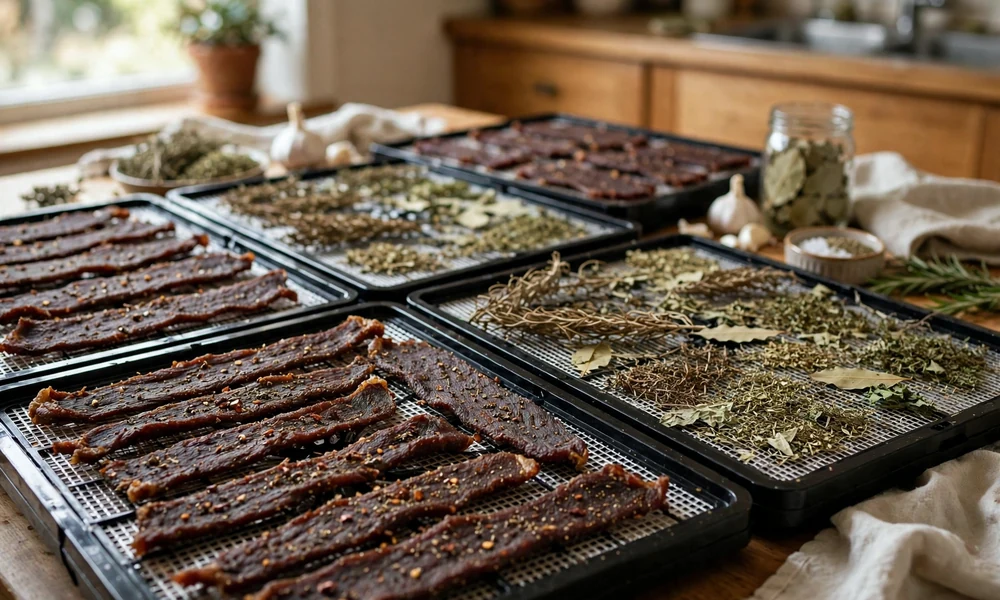
Jerky is the hardest test of a food dehydrator, because meat must dry evenly and reach a safe temperature all the way through, with no room for a damp centre. The best food dehydrator for jerky in 2026 is a large boxy machine with a powerful rear fan, a thermostat that reaches 75 degrees, and deep trays that take long strips without folding them. Set it to 70 degrees and it stays at 70 degrees, so the meat dries steadily instead of cooking outside while the inside stays soft. The trays are stainless mesh rather than plastic, so they do not warp under a long hot run and they wash clean of marinade. It costs more than the budget picks, but jerky is the one job where a weak machine is genuinely unsafe.
Best Food Dehydrator for Fruit 2026
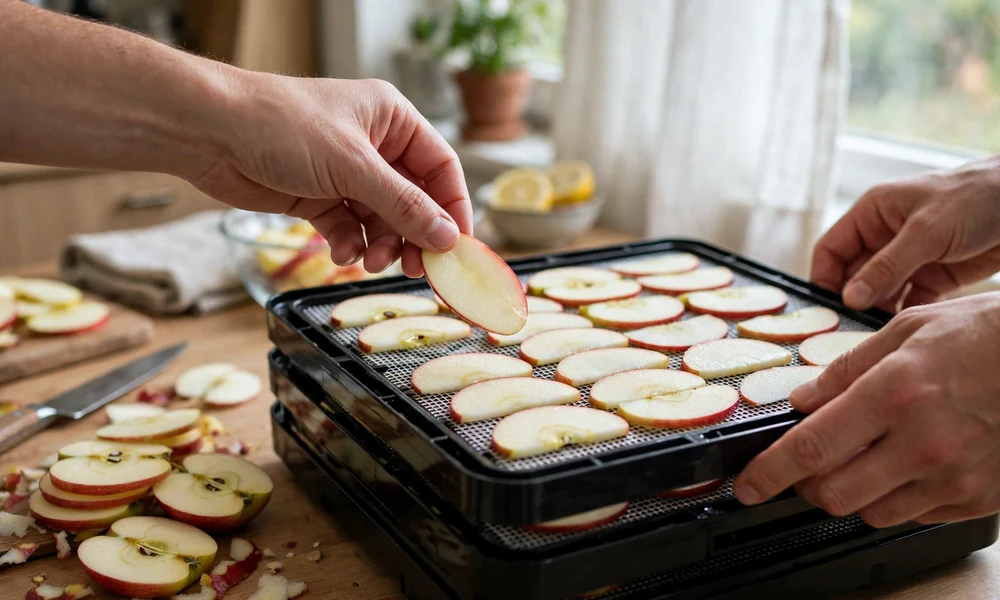
Fruit is where most people start with a food dehydrator, and the best machine for it in 2026 is one that dries gently and evenly, so apple rings come out chewy and sweet rather than brittle and brown. The pick here is a mid-sized boxy dehydrator with a rear fan and a temperature range that starts low, around 40 degrees, because fruit dried too hot loses its flavour and turns leathery. Square trays with a fine mesh stop small pieces falling through and use every centimetre. Fruit leather sheets are worth buying as an extra.
Best Food Dehydrator for Herbs 2026
Herbs need the gentlest drying of all. Too much heat and the fragrant oils that make basil smell of basil simply vanish, leaving green dust that tastes of nothing. The best food dehydrator for herbs in 2026 is a machine that can hold a low, steady temperature near 35 degrees, with fine mesh trays that keep small leaves from falling through and a fan gentle enough not to blow them into a corner. Fine mesh sheets are worth buying, and small batches dry better than crammed trays, because air needs room to carry moisture away. Once the leaves crumble between your fingers, store them whole in a dark jar and crush them only when you cook. A good grinder matters just as much as the dryer, and our guide to the best spice grinders of 2026 covers the mills that turn dried herbs into even, fragrant powder without heating them.
Best Budget Food Dehydrator 2026
The best budget food dehydrator of 2026 is a stackable round machine with a fan in the base, five trays, and a simple dial thermostat. It is not as even as the boxy machines, and nobody should pretend otherwise: the bottom tray dries faster than the top, and you will need to rotate the trays once or twice during a long batch. But for the price, it does the core job well, and for a household that dries fruit a few times a year rather than every week, it is a sensible way in. Slice evenly, and swap the top and bottom trays halfway through to even the batch out. For fruit and the occasional batch of herbs, though, this is the best cheap food dehydrator of 2026.
Best Large-Capacity Food Dehydrator 2026
For a family with an orchard, an allotment, or a freezer full of game, a small dehydrator is a false economy: you will run it three times to do what a big one does once. The best large-capacity food dehydrator of 2026 is a wide boxy machine with twelve or more trays, a strong rear fan, and a thermostat that holds steady across a long, full load. This one moves enough air to dry a full load evenly, and the trays slide out individually. Big machines take up real counter space, so measure before you buy: the best place is a utility room or a garage shelf with a power socket. If you preserve a serious harvest every year, this is the machine that pays for itself in a single season.
Best Compact Food Dehydrator 2026
Not every kitchen has room for a boxy machine, and the best compact food dehydrator of 2026 is a small square unit with four trays, a rear fan, and a footprint not much bigger than a toaster oven. Compact machines have one built-in weakness: small trays mean small batches, and a small batch of jerky is hardly worth the marinade. But for one or two people drying fruit and herbs, it is the right size. If counter space is your main limit, this is the dehydrator to buy, and it pairs well with other compact countertop machines: our guide to the best air fryer toaster ovens of 2026 covers the other appliance that earns its place on a crowded worktop.
What to Look For in a Food Dehydrator
Airflow comes first. A rear fan that blows air across every tray dries evenly; a base fan that blows air up through a stack dries the bottom tray first and the top tray last. Temperature range comes second: look for a machine that goes down to 35 degrees for herbs and up to 70 or 75 degrees for jerky, with a thermostat you can set in small steps. Capacity comes third. Count the tray area, not the number of trays: square trays hold more than round ones. Tray material comes fourth: stainless mesh lasts longer and washes cleaner than plastic, though plastic is lighter and cheaper. Noise and cleaning come last.
How to Get the Best From Your Food Dehydrator
Preparation matters more than the machine. Slice evenly, because a thick slice next to a thin one will never finish at the same time, and a mandoline is the cheapest upgrade you can make to your drying. Leave space between pieces so the air can move, and do not overlap slices: overlapping pieces trap moisture and dry into a single leathery sheet. Time is a guide, not a rule: the only reliable test is to touch the food. Fruit should be leathery and bend without snapping, herbs should crumble, and jerky should bend and crack but not break.
Storing What You Dry
Dried food keeps for months, but only if it is stored properly. Let everything cool completely before you pack it away, because warm food sealed in a jar will sweat, and moisture is the enemy of everything you have just done. Glass jars with tight lids are the best storage. Check the jars after a few days, and if you see any moisture inside, the food was not dry enough and needs another spell in the dehydrator. Fruit keeps for six months or more, herbs for a year if they are kept whole, and jerky for a month or two in a jar, longer in the fridge.

Mistakes to Avoid With a Food Dehydrator
The commonest mistake is slicing unevenly, and it ruins more batches than any machine fault. Thick and thin slices in the same load will never finish together, and the thin ones will be brittle before the thick ones are dry. The second mistake is overloading the trays: a crowded tray blocks the airflow, and blocked airflow means damp food. Leave gaps, and dry in two batches if you must. The third mistake is trusting the dial instead of the food: thermostats drift, kitchens vary, and the only test that matters is how the food feels when you take it out. The fifth is storing food before it is fully dry.
The Verdict
The best food dehydrators of 2026 are the ones you can set running and forget: a boxy machine with a rear fan, an honest thermostat, and sturdy trays that dry every level at the same speed. Buy the best overall machine if you want one dehydrator that does everything well, the jerky pick if meat is your main reason for owning one, and the budget round machine if you mostly dry fruit and want to start cheap. A good food dehydrator only needs steady heat, moving air, and trays you can trust.


