Why the Best Fridge Organizers Save Food, Space and Money in 2026
The best fridge organizers pay for themselves in food that no longer gets forgotten at the back of a shelf. A fridge organizer is a bin, turntable or drawer insert made for cold storage: it gives every item a fixed place inside the fridge, so you can see what you have and use food before it goes off. A good set ends the weekly clear-out of wilted vegetables.
Fridge organizers are easy to confuse with their dry-storage cousins. Pantry organizers work in dry cupboards, and our guide to pantry organizers that end the clutter covers turntables, risers and can racks for shelves at room temperature. Drawer organizers split a drawer into compartments, as our guide to drawer organizers that end the junk drawer explains. A fridge organizer is different: it must survive constant cold, condensation and daily washing, stay food-safe, and never block airflow. Fridge liners, covered in our guide to fridge liners that keep shelves clean, are thin mats that protect a shelf; an organizer is the bin, turntable or caddy that holds the food itself.
Key Takeaways
- Zone first, buy second: group food by how you cook, then give each zone one bin.
- Measure every shelf first: a bin one centimetre too tall or too deep is one you will never use.
- Choose BPA-free, food-safe plastic, glass or silicone: fridge organizers touch food directly and live in constant cold.
- Leave a gap at the back of each shelf for cold air.
- Clear bins beat solid ones: you can see what is inside, so food gets used before it goes off.
What a Fridge Organizer Actually Is
A fridge organizer is any container or insert designed to hold food inside a refrigerator. The common types are clear bins that corral jars and packets, turntables that spin the back row forward, stackable lidded containers for leftovers, egg holders, bottle holders, and drawer inserts for crispers. What unites them is the job: they turn a flat shelf, where things slide, pile and vanish, into zones where everything is visible.
The fridge is harder to organize than a pantry. It is cold, damp and opened dozens of times a day, and food inside it goes off if forgotten. A pantry organizer only has to hold dry goods still. A fridge organizer has to survive temperatures near freezing, resist condensation and smells, wash clean after a spill, and let cold air flow around the food. That is why a cheap dry-storage box, however pretty, is the wrong tool inside a fridge.
How We Chose the Best Fridge Organizers
We judged every fridge organizer on what decides whether it gets used or abandoned. First, food safety: BPA-free, food-grade materials that do not absorb smells or stain. Second, fit: honest dimensions, handles that work with wet hands, and lids that seal without trapping moisture. Third, visibility: clear walls so you can see what is inside at a glance. Then we weighed durability in constant cold, ease of washing, and value.
The 7 Best Fridge Organizers in 2026 at a Glance
| Best for | Organizer type | Best zone | Standout strength |
|---|---|---|---|
| Best overall | Clear stackable bins | Main shelves | See everything, stack safely |
| Best for deep shelves | Turntable | Deep shelves | Spins the back row forward |
| Best for leftovers | Lidded containers | Any shelf | Airtight, stackable, washable |
| Best for produce | Vented produce bins | Crisper drawers | Airflow keeps veg crisp |
| Best for eggs | Egg holder | Middle shelf | Stops eggs rolling and cracking |
| Best for bottles | Bottle holder | Door shelves | Stops bottles toppling |
| Best on a budget | Open-top bins | Main shelves | Cheapest way to zone a fridge |
Best Overall: Clear Stackable Bins
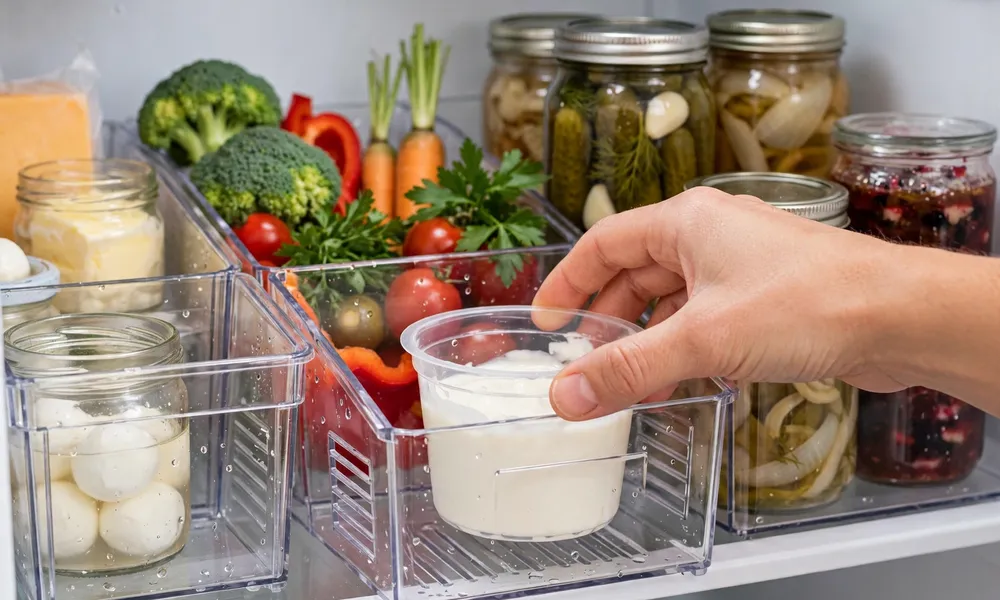
Clear stackable bins remain the best all-round fridge organizer for most homes. Look for BPA-free plastic bins about 25 to 30 centimetres long, with built-in handles and a rim that lets a second bin stack on top. The clear walls are the point: you can see what is inside without pulling the bin out. One bin per category stops the mixed pile that turns into a junk shelf.
Best for Deep Shelves: Turntable
A deep fridge shelf hides food, and a turntable is the fix. A spinning disc about 25 to 38 centimetres across brings the back row to the front, so small jars and sauces stop vanishing behind the milk. Look for a raised rim so jars do not slide off mid-spin, a non-slip base, and a low profile that fits under the shelf above.
Best for Leftovers: Lidded Containers
Leftovers need a lid, and a good lidded container keeps them fresh for days instead of hours. Look for airtight, leak-proof lids, BPA-free plastic or glass, and a footprint that stacks neatly. Glass suits reheating and does not stain or hold smells, while plastic is lighter and safer on a high shelf.
Best for Produce: Vented Produce Bins
Vegetables stay crisp when air moves around them, and a vented produce bin is built for exactly that. Look for bins with adjustable vents and a raised base that lifts produce above condensation.
Best for Eggs: Egg Holder
Eggs roll, crack and vanish into corners, and a dedicated egg holder ends all three problems. Look for a holder that fits a dozen eggs in individual cups, with a lid that lets you stack on top. Keep eggs on a middle shelf, not in the door, where the temperature swings every time the door opens.
Best for Bottles: Bottle Holder
Bottles topple every time the door swings, and a bottle holder keeps them upright and quiet. Look for a holder sized to your bottles, with dividers that stop them knocking together and a base that grips the shelf. Measure the door shelf depth first, because a holder that overhangs the edge will jam the door.
Best on a Budget: Open-Top Bins
Open-top bins are the cheapest way to zone a fridge, and for a small household they are often enough. A set of three or four plain BPA-free bins, one per shelf zone, costs less than a single turntable. Open bins do not stack safely when full, so they suit one layer per shelf. Choose bins with handles, because a bin without a handle is a bin you will not pull out.
The Main Types of Fridge Organizer, Compared
The right choice depends on what disappears in your fridge. Clear bins suit general zoning, turntables suit deep shelves and small jars, lidded containers suit leftovers, vented bins suit produce, egg holders suit eggs, bottle holders suit the door, and open-top bins suit a tight budget. What they share is the cold: every one of them must survive near-freezing temperatures, condensation and daily washing. Buy organizers made for the cold, not ones that merely look the part.
Getting the Size Right
Size is where most fridge organizer purchases go wrong. Fridge shelves are almost never identical: the top shelf is often narrower than the middle one, and the shelf above the crisper is usually a different depth. Measure every shelf separately, inside width, depth and height to the shelf above, and measure twice. A bin one centimetre too tall will not fit, and a bin one centimetre too deep will stop the door closing. Leave a gap at the back of each shelf for cold air.
Depth matters more than width: most fridge shelves are 40 to 50 centimetres deep, so a 30-centimetre bin is the safe default. Height matters most of all: a tall bottle or a stacked pair of bins needs the full clearance to the shelf above. Count the categories before you count the bins.
Materials: What Survives the Cold
The material decides whether a fridge organizer lasts three months or three years. BPA-free PET and polypropylene are the standard: clear, light, food-safe and tough in the cold, and dishwasher-safe. Glass is the premium choice: it does not stain or hold smells and reheats safely, but it is heavy and breaks if dropped. Silicone suits lids and flexible inserts, but it is too soft for a load-bearing bin. Bamboo and wood belong nowhere near a fridge: they swell, stain and grow mould in constant condensation. Whatever the material, check it is labelled food-safe and BPA-free.

Food Safety and Airflow
A fridge organizer must never make food less safe. The golden rule is airflow: cold air has to circulate to keep food below 5 degrees. A fridge packed solid runs warmer in the middle, and food there goes off faster. Leave gaps between bins and keep the vents at the back clear. The second rule is temperature zones: raw meat belongs on the bottom shelf in a lidded container, dairy and eggs on a middle shelf, not the door. The third rule is washing: rinse bins weekly with hot soapy water and dry them first.
Mistakes to Avoid
The most common mistake is buying a matching set before zoning the fridge: ten identical bins solve nothing if your fridge needs four bins, a turntable and an egg holder. Zone first, buy second. The second mistake is blocking airflow: bins pushed against the back wall cover the vents and warm the whole fridge. The third is choosing solid, opaque bins, which hide food just as well as an open shelf does. The fourth is putting eggs and dairy in the door, the warmest part of the fridge. The fifth is never washing the bins. And the sixth is overfilling: a bin stuffed to the brim is a bin you cannot see into.
Fridge Organizer Buying Checklist
- Zone the fridge first, then buy one bin per zone.
- Measure every shelf separately, inside width, depth and height to the shelf above.
- Choose BPA-free, food-safe plastic, glass or silicone, and avoid bamboo, wood and thin brittle plastic.
- Pick clear bins so you can see what is inside without pulling everything out.
- Leave a gap at the back of each shelf so cold air can circulate and the vents stay clear.
- Wash bins weekly and dry them before they go back in.
Frequently Asked Questions
What is the difference between a fridge organizer and a pantry organizer?
A pantry organizer works in dry cupboards at room temperature. A fridge organizer must survive constant cold, condensation and daily washing, stay food-safe next to unpackaged produce, and never block airflow.
Do fridge organizers block cold air?
They can, if you pack the fridge solid. Leave a gap at the back of each shelf, keep the vents clear, and leave space between bins so cold air can circulate.
Are plastic fridge bins safe for food?
Yes, if they are labelled BPA-free and food-safe. PET and polypropylene are the standard materials, and they are dishwasher-safe. Avoid thin, brittle plastic, bamboo and wood.
Should eggs go in a fridge organizer in the door?
No. Eggs belong on a middle shelf in a dedicated holder, where the temperature is stable. The door is the warmest part of the fridge, and its temperature swings every time the door opens.
How do I stop my fridge smelling?
Zone it, so nothing gets forgotten at the back, and wash the bins weekly with hot soapy water. An open box of bicarbonate of soda absorbs smells. Throw out anything past its date every week.
Can I use pantry bins in the fridge?
Only if they are BPA-free, food-safe and rated for cold use. Most pantry bins are not: they crack in the cold and hold smells. Buy organizers made for the fridge.
The Bottom Line
A fridge organizer earns its shelf space by making food visible, reachable and used before it goes off. Zone the fridge first, measure every shelf, and choose clear, BPA-free bins and containers made for the cold. Leave gaps for airflow, keep eggs and dairy off the door shelves, and wash the bins weekly. The best fridge organizer still holds every jar, leftover and vegetable where you can see it, every day, without blocking the cold air.