
A Guide to Futons That Actually Sleep Well in 2026
A futon that actually sleeps well is not the thin, sagging mattress of student flats. The best futons of 2026 pair a proper folding frame with a mattress thick enough for a full night of sleep, and fold back into a decent sofa. Get it right and one piece of furniture does two jobs well; get it wrong and you end up with an uncomfortable sofa and a sore back.
The word itself causes much of the confusion. In Japan, a futon is a flat mattress laid on tatami and rolled away each morning. In the West, a futon is a sofa bed: a folding frame with a mattress that bends at the hinge, upright by day and flat by night. This guide explains how to judge the frame, mattress and mechanism.
Key Takeaways
- Mattress thickness decides sleep quality: at least 15 centimetres, 20 for nightly use.
- The frame matters as much as the mattress: closely spaced solid wood slats support it far better than wide gaps.
- Bi-folds sleep best; tri-folds and click-clacks are cheaper but usually sleep firmer.
- Test the fold in the shop: a good mechanism moves smoothly with one hand and locks firmly in both positions.
- A futon is not a sleeper sofa: it folds its own mattress down; a sleeper sofa hides a separate mattress inside.
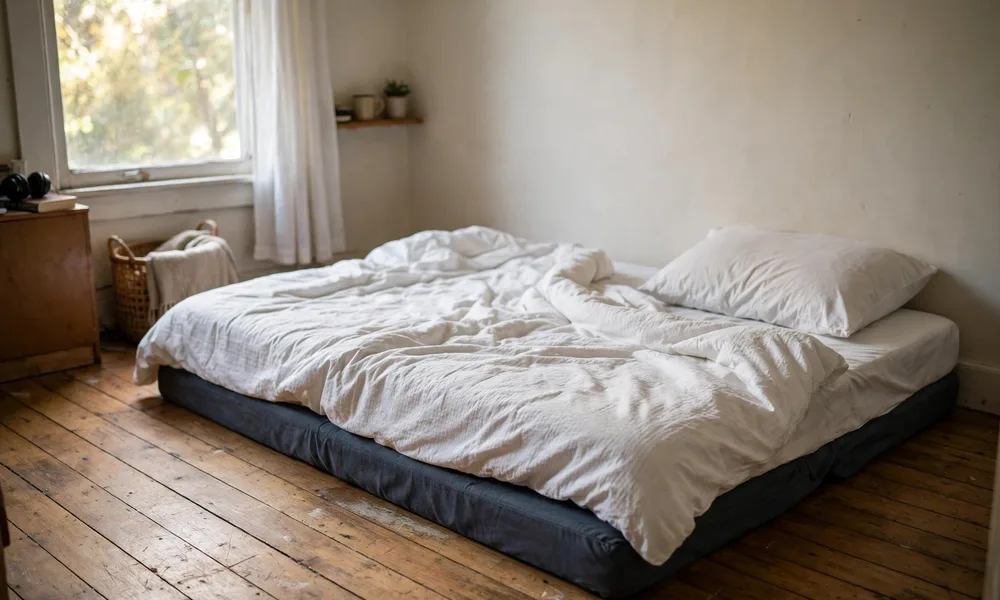
What a Futon Actually Is
A Western futon is a frame and a mattress that work as one piece. The frame, usually wood or metal, is hinged in the middle so the backrest drops down until it lies level with the seat. The mattress is a single thick tufted pad that bends over the hinge. Upright, you sit on the front half; flat, the whole mattress lies level.
That simplicity is the futon’s greatest strength and its greatest weakness. With no hidden mattress to pull out, a futon is light, cheap and quick to convert. But the same mattress serves as seat and bed, so it takes twice the wear. The difference between a good futon and a bad one is almost always the mattress, so that is where your money should go.
The Main Types of Futon
Bi-Fold Futons
The bi-fold is the classic futon and still the best all-rounder. Its frame folds in two: the seat and the backrest. In sofa position the backrest stands upright; to make the bed you lift the seat slightly and lower the back until it lies flat. Because the mattress only bends once, it stays thick and even, and bi-folds usually sleep best. They are also the heaviest and need the most floor space: a queen needs roughly 200 centimetres of length when flat.
Tri-Fold Futons
A tri-fold frame bends in three sections, so the mattress folds into a compact block. In sofa position it looks like a small loveseat; opened out, it becomes a twin or full bed. Tri-folds are lighter and cheaper than bi-folds and fit into tighter corners, which makes them popular in studios and dorm rooms. The trade-off is comfort: a mattress that bends twice is usually thinner, and the fold lines can be felt through the bedding. Tri-folds suit occasional guests and naps far better than nightly sleeping.
Click-Clack Futons
Click-clack futons convert by lowering the backrest in steps until it lies flat, clicking into place at each angle. They are the quickest to convert and often the cheapest, and the adjustable backrest also works as a half-reclined lounger. The sleeping surface is the seat cushions rather than a single mattress, so click-clacks sleep firmer and less evenly than bi-folds. Check each position clicks firmly.
Japanese Shikibuton
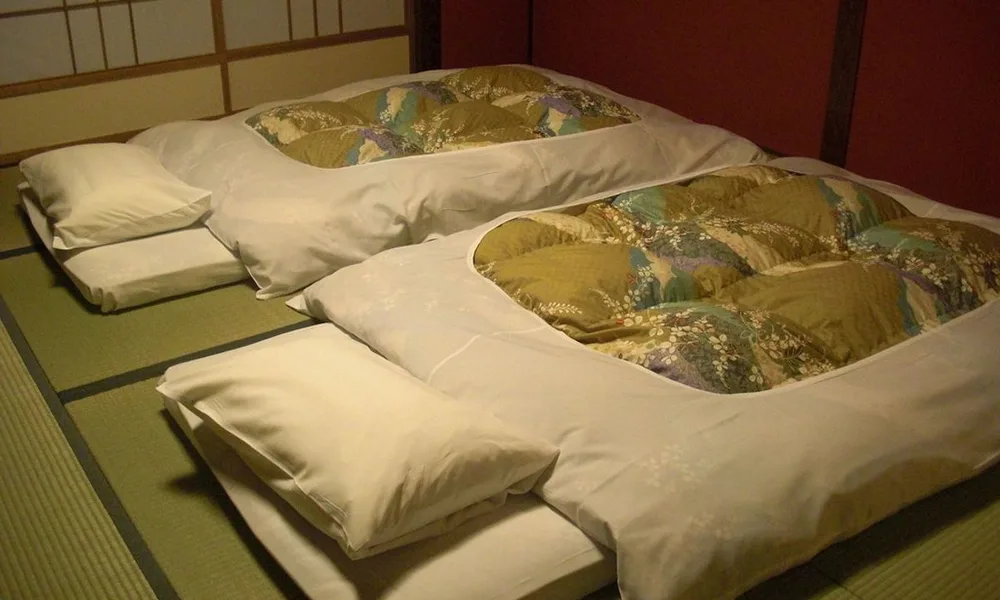
The shikibuton is the frameless original: a thin mattress, usually cotton or wool, laid on the floor or on tatami. There is no frame and nothing to break, and it rolls up each morning. It is the firmest sleep in this guide and the cheapest. The catch is daily effort: it needs airing to stay fresh, and it offers no seating at all.

Futon Mattresses Compared
| Mattress type | Feel | Thickness | Best for | Price in 2026 |
|---|---|---|---|---|
| Cotton | Firm, traditional | 10–15 cm | Back sleepers | Low |
| Innerspring | Bouncy, supportive | 15–20 cm | Everyday sleeping | Mid |
| Memory foam | Soft, moulding | 15–20 cm | Side sleepers | Mid to high |
| Hybrid foam and spring | Balanced, supportive | 20–25 cm | Nightly use, couples | High |
| Wool | Firm, breathable | 10–15 cm | Hot sleepers | Mid to high |
Cotton is the traditional filling and still the cheapest, but it compresses over time and needs regular turning. Innerspring mattresses feel closest to a normal bed, though they are heavier and fold less neatly. Memory foam moulds to the body and suits side sleepers, but it sleeps warm. Hybrids combine a spring core with foam layers and are the most comfortable option for nightly use. Wool breathes well and resists damp, but it is firm and expensive.
Whatever the filling, thickness is the number to watch. A mattress under 12 centimetres will let you feel the slats within weeks. Fifteen centimetres is the minimum for guests; nightly sleepers should aim for twenty or more. Check also that it is tufted through its full thickness, so the filling cannot shift to the edges and turn it lumpy.
What Makes a Futon Sleep Well
Slat Spacing and Support
The frame underneath decides whether a thick mattress can do its job. Slats spaced more than eight centimetres apart let the mattress sag between them. Closely spaced slats, or slats with a thin layer of plywood or fabric over them, spread the weight evenly. Solid wood frames with slats every five to seven centimetres are the standard to look for. Test the frame by pressing down hard in the middle of the seat and at the hinge: it should feel solid, with no give and no creak.
The Fold Line
Every folding futon has a weak point where the mattress bends, and it is the first place to wear out. On a bi-fold, the fold runs across the middle of the bed, right where a sleeper’s hips rest. A good mattress has extra padding at the fold, and some designs offset it so it falls under the knees. When you test a futon, lie across the fold line and roll onto your side: if you can feel a dip or a ridge, you will feel it every night. Flip the mattress end to end every month.
Bedding and the Sleep Setup
Futons sleep better with the right bedding. A fitted futon sheet, or a standard sheet tucked firmly under the mattress, stops bedding bunching at the fold. A thin topper, two to five centimetres of foam or wool, can transform a firm futon into a comfortable bed, and it costs far less than replacing the mattress. Keep a spare set of bedding with the futon so guests are not hunting for sheets at midnight. Futons sit low, so a rug under the frame helps in a cold room.
How to Choose the Right Size
Futon sizes follow the same names as beds, but the measurements are not always identical, so check the actual dimensions. A twin is roughly 100 centimetres wide and suits one sleeper. A full is about 140 centimetres and sleeps two people who do not mind being close. A queen is around 150 to 160 centimetres and is the most comfortable for two, but needs two metres of length when open. Measure as a sofa and as a bed. As a sofa, leave at least 75 centimetres of walking space in front of it; as a bed, check it does not block a door or the route to the bathroom. Also measure the delivery route: a queen frame may not turn a tight stairwell.
Where a Futon Works Best
A futon earns its place in rooms that must do two jobs. In a studio flat it is the sofa by day and the bed by night, without a second piece of furniture. In a home office it turns a workroom into a guest room in seconds. In a teenager’s bedroom it gives friends somewhere to sit and sleep. It is less suited as the only bed for two nightly sleepers, because even the best futon needs more care than a normal bed.
Compared with its closest relatives, the futon’s advantage is simplicity. Our guide to the best sleeper sofas covers the heavier alternative: a sofa that hides a separate mattress and pulls out into a bed. Sleepers generally sleep better, because the mattress is a real bed mattress, but they cost more, weigh more and need far more floor space. A futon is lighter, cheaper and quicker, and for many small homes that is the deciding factor. If it will be your main seat as well as your bed, read our guide to choosing a sofa that survives real life first. If it is going in a bedroom, the frame advice in our best bed frames guide applies too.
Futons Compared
| Type | Sleep comfort | Seat comfort | Space needed | Price |
|---|---|---|---|---|
| Bi-fold | Excellent | Good | Large when open | Mid to high |
| Tri-fold | Fair | Good | Compact | Low to mid |
| Click-clack | Fair to good | Good | Compact | Low to mid |
| Japanese shikibuton | Good, very firm | None | Rolls away | Low |
| Metal frame futon | Good | Fair | Moderate | Low |
Before You Buy: The Checklist
- Lie on it flat for five minutes, on your back and side, and check you cannot feel the slats or fold line.
- Measure the room in both positions, sofa and bed, and check the delivery route for a long flat frame.
- Choose a mattress at least 15 centimetres thick, 20 for nightly use, tufted through.
- Fold and unfold the mechanism yourself: it should move smoothly with one hand and lock firmly in both positions.
- Check the slats are solid wood, spaced no more than eight centimetres apart, and that the joints bolt together.
- Budget for a mattress protector and a thin topper, and a spare set of bedding kept with the futon.
Frequently Asked Questions
Can you sleep on a futon every night?
Yes, if it is a good one. A bi-fold with a mattress at least 20 centimetres thick, preferably a hybrid of springs and foam, sleeps well every night, especially with a thin topper. Thin tri-folds and click-clacks are better for guests.
Are futons bad for your back?
Not if the futon is firm and well supported. Many back sleepers prefer a firm futon, because it keeps the spine level. Problems come from thin mattresses or a sagging frame.
What is the difference between a futon and a sofa bed?
A futon folds its own mattress down to form the bed, while a sofa bed hides a separate mattress inside its frame and pulls it out. Futons are lighter, cheaper and quicker; sofa beds usually sleep better, because the hidden mattress is thicker.
How thick should a futon mattress be?
For occasional guests, 15 centimetres is enough. For regular use, aim for 18 to 20 centimetres, and for nightly sleeping, 20 to 25 centimetres, ideally a hybrid mattress. Below 12 centimetres you will feel the frame.
How do you keep a futon fresh?
Air it regularly, turn it end to end every month, and use a washable mattress protector. A futon folded daily should be opened and aired weekly.
Do futons work in small rooms?
Yes, and that is their best use. A twin or full futon turns a studio or a home office into a bedroom without a second piece of furniture, and a tri-fold fits where a bi-fold will not.
The Bottom Line
The futon that sleeps well in 2026 is a bi-fold frame with closely spaced wooden slats and a mattress at least 20 centimetres thick, tested by lying on it flat. Spend on the mattress, check the fold line with your own back, and keep a topper and spare bedding with it. Do that, and one piece of furniture gives you a proper sofa by day and a proper bed by night.


