Glue guns that flow smooth without dripping in 2026 turn a fiddly craft job into a calm, clean one. The best lay down a thin, even bead exactly where you point them, then stop the moment you release the trigger: no stringing, no puddle on the workbench, no burnt fingertip. A bad one does the opposite, dripping constantly and leaving sticky threads across everything you own.
Choosing the best glue gun is about matching the gun to the work: fixing a chair leg, making a wreath and building a model all need different amounts of glue at different speeds. This guide explains how glue guns work and helps you pick one that flows smooth and stays clean.
Key Takeaways
- A glue gun melts solid glue sticks and pushes the melted glue out through a nozzle, so smooth flow depends on the heater, the feed and the stick.
- Low-temperature guns suit paper, fabric and foam; high-temperature guns suit wood, metal and ceramics.
- Anti-drip nozzles and a good trigger matter most, because a gun that keeps oozing wastes glue.
- Full-size guns hold more glue and suit bigger jobs, while mini guns are lighter and better for delicate work.
- Let the gun heat fully before you start, and never pull a half-melted stick out, because it jams the feed.
How a Glue Gun Actually Works
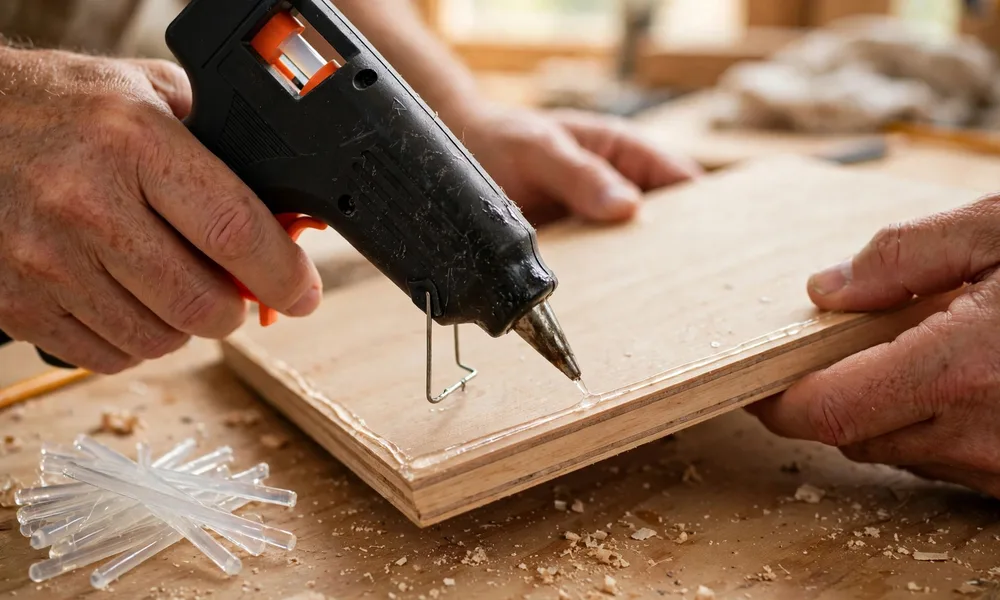
A glue gun melts a solid stick of hot-melt adhesive and pushes it out in a controlled stream. A heating element warms a chamber around the stick until its end turns liquid, and squeezing the trigger feeds the stick forward so melted glue flows out of the nozzle. Release the trigger, and the flow should stop too.
That last part is where cheap guns fail. In a good gun, the nozzle holds the melted glue back once the pressure drops, and the heater keeps the temperature steady so the glue is neither too runny nor too thick. In a poor gun, the glue stays hot and thin and keeps oozing long after you have stopped squeezing. Glue that is too hot runs like water and strings everywhere, while glue that is too cool comes out in lumps and sets before it can grip.
Hot-melt glue sets in under a minute as it cools, so you can hold two pieces together for thirty seconds and move on. It bonds well to wood, paper and fabric, but weaker to smooth, oily or flexible surfaces, where it can peel away. For those jobs a different adhesive is better, and our guide to wood glue for joints that hold explains what to use when a joint has to last for years.
The Main Types of Glue Gun
Mini Glue Guns
Mini guns take slim seven-millimetre sticks and weigh almost nothing, which makes them right for paper crafts, card making and ribbon work. They heat up in two or three minutes and are easy to hold for a long session. Their weakness is capacity: the small sticks run out fast, and the low power struggles on wood or anything needing a lot of glue at once.
Full-Size Glue Guns
Full-size guns take eleven-millimetre sticks and deliver far more glue per squeeze, which makes them right for woodwork, repairs and bigger projects. They hold heat better, so the flow stays steady through a long bead, but they are heavier and can feel clumsy on tiny work.
Low-Temperature Guns
Low-temperature guns melt glue at around 120 degrees, cool enough for foam, ribbon and lace that would scorch at full heat. They are also safer for children. The bond is gentler, so they are not right for wood or metal, but for delicate materials they are the only safe option.
High-Temperature Guns
High-temperature guns run at around 190 to 200 degrees and make the strongest hot-melt bonds, which is why they suit wood, ceramics, glass and metal. The glue flows thinner and grips harder as it cools, but the nozzle can burn skin in a second, and delicate materials can scorch.
Cordless Glue Guns
Cordless guns run on a rechargeable battery and free you from the cable, which matters when you are gluing a wreath on a door or repairing something away from a socket. The best heat in under a minute and hold temperature for twenty to thirty minutes, but a flat battery mid-job means waiting for a recharge.
The Best Glue Guns of 2026
We judged every glue gun on flow control, dripping, heat-up time, comfort and value, testing each one on wood, paper, fabric and card.
Best Overall: Bosch PKP 18 E
The Bosch PKP 18 E is the best glue gun for most people in 2026. Its 200-watt heater reaches working temperature in about four minutes, and the flow is the smoothest we tested: a steady bead with no surging, and a nozzle that stops cleanly when the trigger is released. The wide stand keeps it upright and safe between squeezes.
Best Budget: Stanley GR25
The Stanley GR25 proves a cheap glue gun can still flow well. Its 25-watt heater is slow, taking five or six minutes to warm up, but once hot the bead is even and the dripping is minimal for the price. It struggles on thick wood, where the low power cannot keep up with a long bead, but for paper, card and light repairs it is genuinely good value.
Best Mini: Dremel 930
The Dremel 930 is the best mini glue gun we have tested. It takes seven-millimetre sticks, heats in about three minutes, and weighs so little you can hold it for an hour without noticing. The nozzle is fine and precise, which suits card making and model work. It is not a repair tool, but for delicate craft it is the most pleasant gun to use.
Best Cordless: Ryobi R18GLU-0
The Ryobi R18GLU-0 is the best cordless glue gun for anyone who already owns Ryobi batteries. It heats in under a minute, the flow is smooth, and the battery lasts for a solid half-hour of steady work. The catch is the battery: it is sold separately, so the real cost is higher if you do not already own one.
Best for Woodwork: Steinel Gluematic 3002
The Steinel Gluematic 3002 is the best glue gun for woodwork and repairs. Its 200-watt heater keeps the glue at a steady high temperature, so long beads on timber stay fluid until the joint is closed, and the interchangeable nozzles let you switch from a fine line to a wide bead.
Best Low-Temperature: Surebonder Cool Shot
The Surebonder Cool Shot is the best low-temperature gun for foam, ribbon and fabric. It melts glue at a gentle temperature that will not scorch delicate materials, and the bond is strong enough for crafts. The gun is light and the trigger is easy.

Glue Guns Compared
| Glue gun | Size | Temperature | Heat-up time | Best for |
|---|---|---|---|---|
| Bosch PKP 18 E | Full-size | High | 4 minutes | Most jobs |
| Stanley GR25 | Full-size | High | 6 minutes | Budget crafting |
| Dremel 930 | Mini | High | 3 minutes | Delicate crafts |
| Ryobi R18GLU-0 | Full-size | High | 1 minute | Cordless repairs |
| Steinel Gluematic 3002 | Full-size | High | 4 minutes | Woodwork |
| Surebonder Cool Shot | Mini | Low | 3 minutes | Foam and fabric |
What to Avoid
The worst glue guns share the same faults. The first is a nozzle that drips constantly: if reviews mention puddles on the bench, walk away, because no technique fixes a nozzle that cannot hold glue back. The second is a trigger with no feel, either stiff and jerky or so loose that the stick feeds in bursts. The third is a gun with no stand, or a stand so narrow the gun tips over.
Cheap unbranded guns are the worst offenders. They often heat unevenly, so the glue is too hot at the nozzle and too cool at the feed, which means lumps, strings and a bond that fails within days. If a repair needs a bond hot-melt glue cannot give, a fast-setting adhesive is the better tool, and our guide to super glue that bonds in seconds covers the small repairs where speed matters most.
How to Get a Smooth, Drip-Free Bead
Technique matters as much as the gun. Always let the gun heat fully before the first squeeze: a gun still warming up pushes out half-melted glue that strings and lumps. Hold the nozzle about five millimetres from the surface and move at a steady speed. Release the trigger a moment before the end of the bead, so the last of the glue flows out cleanly instead of pooling.
Keep the nozzle clean: a crust of old glue around the tip drags the fresh bead into strings, so wipe it on a scrap of card while it is hot. Store the gun upright on its stand, never on its side, because a gun on its side leaks melted glue. And never pull a stick out of a hot gun: push it through with a fresh stick, because a pulled stick leaves a gap the next stick cannot fill, and the feed jams.
Buying Checklist
- Match the temperature to your materials: low for foam and fabric, high for wood and metal.
- Check the nozzle: look for an anti-drip design and a tip size that suits your work.
- Pick the right size: mini for delicate crafts, full-size for repairs and woodwork.
- Test the trigger: it should feed smoothly, not in jerks.
- Make sure it has a wide, stable stand.
- Buy good sticks: cheap sticks bubble, spit and make weak bonds.
Frequently Asked Questions
Why does my glue gun keep dripping?
A glue gun drips because melted glue stays liquid in the nozzle after you release the trigger. A good anti-drip nozzle holds it back, but a gun that runs too hot keeps the glue thin and runny. If the dripping never stops, the nozzle design is the problem, not your technique.
Can a glue gun hold wood together?
Yes, for light-duty joints, but hot-melt glue is not as strong as wood glue. It is good for tacking pieces in place while another glue cures and for joints that carry little weight. For a chair leg or a load-bearing joint, use a proper wood adhesive and clamps.
What is the difference between low and high temperature glue guns?
Low-temperature guns melt glue at around 120 degrees and suit foam, ribbon and lace that would scorch at full heat. High-temperature guns run at around 190 degrees and make stronger bonds on wood, ceramics, glass and metal. Some guns switch between the two.
Are glue sticks all the same?
No. Sticks come in different diameters, usually seven or eleven millimetres, and different formulas, including standard, low-temperature, coloured and heavy-duty versions. Always match the diameter to your gun: a standard stick works for most crafts, while a heavy-duty stick grips better on wood.
Is hot-melt glue waterproof?
Not really. Hot-melt glue resists a splash, but it softens in heat and weakens when it stays wet, so it is not right for outdoor work. For a repair that has to survive water and weather, a two-part adhesive is stronger, and our guide to epoxy that holds where glue fails explains when to reach for it.
How do I unclog a glue gun?
Let the gun heat fully, then push a fresh stick in behind the stuck one to force it through. Never poke the nozzle with a pin while the gun is hot, and never pull a half-melted stick out. If the feed is truly jammed, let the gun cool completely and clean the chamber with a wooden skewer.
The Bottom Line
The best glue gun flows when you squeeze and stops when you do not. For most people, that is the Bosch PKP 18 E: smooth, steady and clean on almost any job. Crafters should add a mini gun like the Dremel 930, and anyone working with foam or fabric needs a low-temperature gun. Buy the right temperature, buy good sticks, and let the gun heat fully.