A golf bag is the one piece of kit that goes with you on every single hole, and it is the one most golfers think about least. Clubs get the research, the fittings and the arguments, while the bag is often whatever came free with a set or whatever was cheapest on the shelf. That is a mistake. A good bag keeps your clubs protected and easy to reach, carries everything you need without digging, and stays comfortable on your shoulder or steady on your trolley for four hours. A bad bag does the opposite: clubs rattle and clash, zips stick, pockets are either too small or in the wrong place, and the strap digs in by the ninth hole. The best golf bags of 2026 are not the most expensive ones, and they are not the flashiest. They are the bags that carry well, organise well, and keep working season after season without fuss.

What Makes a Golf Bag Good
The first thing to judge is how it carries. If you walk the course, the bag lives on your shoulder, so weight matters more than anything else. A good stand bag weighs around two kilograms empty and balances so it does not pull to one side. The strap should be wide, padded and easy to adjust, and a double strap that spreads the load across both shoulders is worth having if you walk eighteen holes regularly. If you ride in a cart or push a trolley, weight matters less, but the base matters more: it should sit flat and stable, and the strap pass-through should hold the bag firmly without covering the pockets you need during the round.
The second thing to judge is the top. The divider system decides whether your clubs slide in and out cleanly or snag every time you reach for one. A full-length divider for every club is the gold standard: each club has its own slot from top to bottom, so shafts never tangle and grips never catch. Cheaper bags use partial dividers, where clubs share a channel for part of the way down, and those are fine if you carry a small set, but they tangle more with a full fourteen clubs. The top cuff should be padded and wide enough for oversized grips, and it should not flex so much that the whole bag twists when you lift it by the handle.
The third thing is storage, and this is where bags differ most. Count the pockets and think about what actually goes in them. You need a waterproof valuables pocket for a phone and wallet, an insulated pocket for a drinks bottle, a large apparel pocket for a waterproof jacket, and a ball pocket that holds a sleeve or two without a fight. Pockets should open easily with one hand and stay shut when the bag is jostled. A bag with ten pockets sounds generous, but if half of them are too small for anything useful, they are just weight and zips. The best bags give you fewer, better pockets in the right places.
The Main Types of Golf Bag
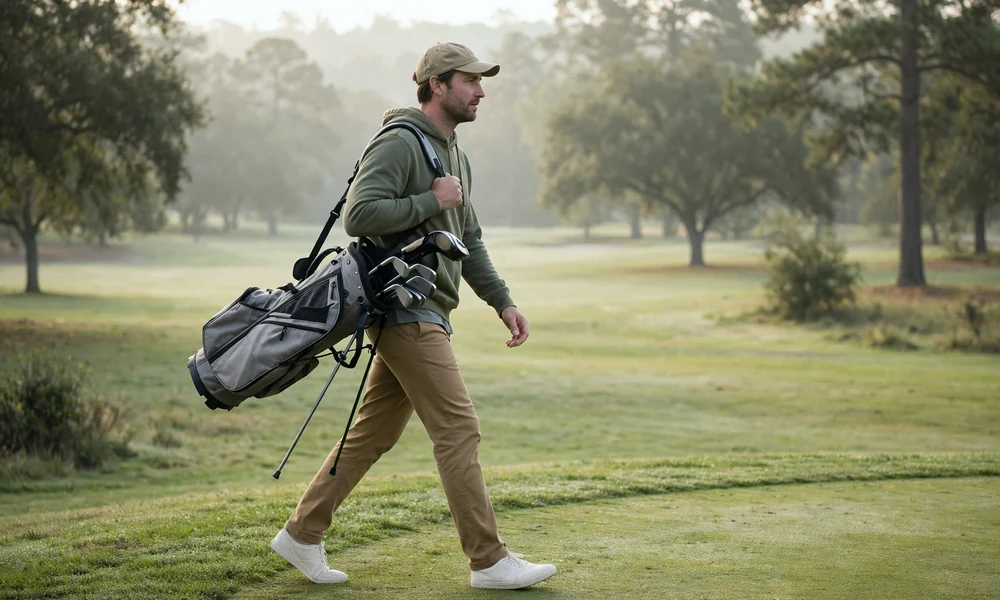
Stand bags are the most popular choice, and for good reason. They have pop-out legs that hold the bag upright on the fairway, a padded carry strap, and enough pockets for a full round, all while staying light. They work on a trolley too, though the legs can get in the way on some cart straps. If you walk most of your golf and ride sometimes, a stand bag is the safest single choice, and it is the type most golfers should start with.
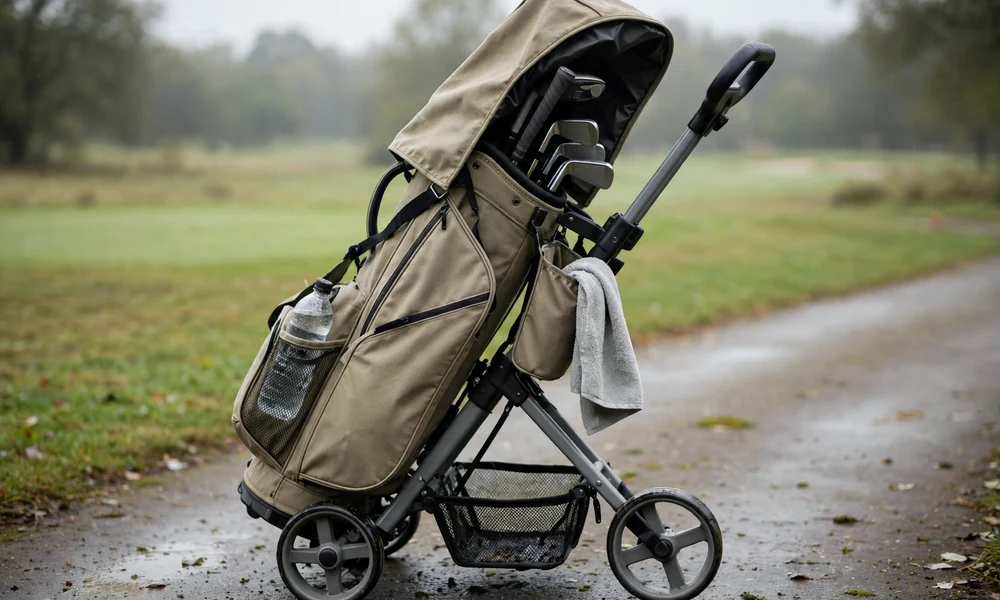
Cart bags are built for riders. They are heavier and roomier, with a flat base that locks onto a cart, a top that faces forward so every pocket is reachable from behind the cart, and often a cooler pocket and an umbrella sleeve. They are a poor choice for carrying, because the weight and the shape are wrong for a shoulder strap, but if you almost always ride, they are more comfortable to use than a stand bag and they hold more kit.
Sunday bags, sometimes called pencil bags, are the lightweights. They hold six or seven clubs, a handful of balls and a bottle of water, and they weigh next to nothing. They are perfect for a quick evening round, a par-three course, or a practice session at the range when you do not want to lug the full set. They are not a main bag, but as a second bag they are hard to beat, and many golfers who own one wonder how they managed without it.
How to Choose the Right Bag for You
Start with how you actually play, not how you wish you played. If you walk nine or eighteen holes most weeks, buy a stand bag and spend the money on a good strap and a light frame. If you ride in a cart almost every round, buy a cart bag and enjoy the extra pockets. If you do a bit of both, a stand bag with a cart-friendly base is the best compromise, and most modern stand bags are designed exactly that way. Be honest about your habits: a bag bought for a fantasy version of your golf will annoy you every round.
Next, match the bag to your clubs. The number of clubs you carry and the size of your grips decide how many dividers you need and how wide the top must be. A full set of fourteen clubs with midsize or oversized grips needs a fourteen-way top with full-length dividers, or you will fight the bag on every hole. A smaller set can live happily in a six-way top. This is also the moment to think about the clubs themselves, because a bag that suits a beginner set may not suit the set you buy next year. Reading a guide to the best golf clubs of 2026 before you choose helps you see which club types you are likely to carry, and a bag with room to grow is a better buy than one that is already full.
Then check the details that only show up on the course. Open and close every pocket with one hand. Lift the bag by the handle and see if it twists. Put it on your shoulder and walk around the shop with it. Check that the rain hood fits over the clubs easily and that it is actually in the bag, not an accessory you have to buy separately. Look at the base: a bag that rocks or tips on a flat floor will tip on a slope too. These small checks take five minutes and save years of irritation.
Waterproofing deserves its own thought. A waterproof bag costs more, but if you play through winter or in a wet climate, it is worth every penny. A water-resistant bag keeps out a light shower but soaks through in steady rain, and wet grips, wet gloves and a wet towel ruin a round. Even if you do not buy a fully waterproof bag, make sure the valuables pocket is waterproof, because a soaked phone is an expensive lesson. A rain hood helps, but it is no substitute for waterproof fabric and sealed seams.
Finally, think about your shoes and the rest of your kit as one system. A bag is only part of what you carry, and a comfortable pair of golf shoes changes how much walking you enjoy, which in turn decides whether a light stand bag is worth the money. A guide to the best golf shoes of 2026 is a useful companion read, because the golfers who walk the most are the ones who benefit most from both good shoes and a light bag. Together, the right shoes and the right bag turn a long round from a slog into a pleasure.
What to Avoid
The most common mistake is buying on looks alone. A bag that photographs beautifully can still have a strap that slips, zips that catch, and a top that tangles your clubs. Colour and style matter, because you will look at the bag every week, but they should be the last thing you decide, not the first. Try the bag before you buy it if you possibly can, and if you are buying online, read reviews that talk about carrying comfort and divider quality rather than reviews that only praise the colour.
The second mistake is buying too big. A huge bag with room for everything sounds practical, but every extra pocket and every extra centimetre adds weight, and weight is what you feel on the sixteenth hole. Most golfers carry far less than they think they need: a dozen balls at most, a glove or two, a waterproof, a towel, some tees and a bottle. A mid-size bag holds all of that comfortably. If you need more space than that, you are probably carrying things you never use.
The third mistake is ignoring the legs. On a stand bag, the leg mechanism is the part most likely to fail, and it is the hardest to repair. Legs should deploy smoothly with a light push and retract fully when you lift the bag. If they stick, wobble or deploy halfway, walk away. A bag with broken legs is a bag you have to lean against something for the rest of its life, and that gets old very quickly. It is worth paying a little more for a bag from a maker with a good record on leg mechanisms, and a comparison of the best versus worst golf clubs of 2026 shows the same principle at work with clubs: the difference between the best and the worst is usually build quality and attention to detail, not the headline features.
Looking After Your Golf Bag
A good bag lasts for years if you look after it, and the care is simple. Empty it after every round, because old balls, wet gloves and forgotten food do it no good. Brush off mud from the base and the legs, and let it dry fully before you store it, ideally standing upright in a dry place rather than flat in a damp garage. Wipe the zips clean now and then, because grit in a zip is what makes it stick and eventually fail. Check the strap stitching once a season, and replace a fraying strap before it breaks on the course. A bag that is cleaned and dried after use will outlast a neglected one by years.
The Bottom Line
The best golf bag of 2026 is the one that fits how you actually play. Walkers need a light stand bag with a great strap and full-length dividers. Riders need a roomy cart bag with a stable base and pockets that face the right way. Occasional players need something simple and light that does not cost the earth. Whatever you choose, judge it by carry comfort, divider quality and pocket sense, not by the badge or the colour. Get those three things right and the bag will disappear into the background of your golf, which is exactly what a good bag should do. Spend your attention on the game, not on fighting your kit, and the right bag will quietly make every round a little better.