
The best griddles in 2026 turn an ordinary kitchen into a short-order diner. A griddle is a flat, wide cooking surface that lets you cook a whole breakfast at once. It is just as useful for smashed burgers, grilled sandwiches, and stir-fry.
The best griddles share a few qualities: a surface that heats evenly from edge to edge, enough space to cook for a family without crowding, a non-stick or well-seasoned coating that releases food and cleans up easily, and temperature controls that hold steady instead of swinging hot and cold. Get those right and a griddle becomes the most-used piece of equipment in your kitchen.
This guide compares the best griddles of 2026 by type, size, and use, explains how to choose the right one, and covers the seasoning, cooking, and cleaning habits that keep a griddle working well for years.
Key Takeaways
- Choose the griddle type for where you cook: electric for the kitchen counter, stovetop for the hob, and gas flat-top for outdoor cooking.
- Even heating matters more than maximum temperature: look for thick plates and independent heat zones.
- Size for your household: a family of four needs at least 20 inches of cooking width, while couples can manage with a compact model.
- Cast iron needs seasoning and hand washing, while non-stick trades some searing power for easy cleaning.
- Preheat for a full five minutes, oil lightly, and never crowd the surface, because crowded food steams instead of searing.
Why a Griddle Earns Its Place in the Kitchen
A griddle does something no frying pan can do: it gives you a large, flat, evenly heated surface where every item cooks at the same temperature. That matters most at breakfast, when timing is everything: pancakes, bacon, eggs, and hash browns all finish at the same moment instead of in a staggered queue.
The flat surface is also ideal for foods that fall apart in a pan. Smashed burgers get a better crust because the meat makes full contact with the hot metal, and grilled cheese, quesadillas, and French toast all cook more evenly.
The Main Types of Griddles
Griddles fall into four main types, and the right one depends on where you cook, how much space you have, and how much maintenance you will do.

Electric Griddles
Electric griddles are the most popular choice for indoor kitchens. They sit on the counter, plug into a socket, and have a built-in thermostat that holds a steady temperature. Most offer a removable non-stick plate, a drip tray for grease, and a surface between 20 and 24 inches wide. Their main weakness is top-end heat: most peak around 220 to 240 degrees Celsius, fine for pancakes and eggs but less ideal for a hard sear.
Stovetop Griddles
Stovetop griddles are flat plates that sit across one or two burners on your hob. Cast iron versions hold heat superbly and last for decades, while aluminium ones are lighter and heat up faster. The trade-off is uneven heating: areas over the burners run hotter than the gaps, so learn your hob’s hot spots, and measure your hob before you buy.
Cast Iron Griddle Pans
A cast iron griddle pan is a single-burner flat pan with a handle. It is the cheapest way into griddle cooking, and it is brilliant for grilled sandwiches, searing steaks, and cooking for one or two people. Cast iron needs seasoning, a thin coat of oil baked onto the surface, and it must be dried immediately after washing to stop it rusting. Treated well, it improves with age.
Outdoor Gas Flat-Top Griddles
Outdoor gas griddles are large, freestanding units with two to four burners under a thick steel or cast iron plate, usually 28 to 36 inches wide. They reach over 300 degrees Celsius, and independent burners give you separate hot and warm zones. They need outdoor space, a gas supply, and regular seasoning, but for serious outdoor cooks they are the most capable griddles you can buy.
How to Choose the Best Griddle for You
Choosing a griddle comes down to five questions: where you will use it, how many people you cook for, what surface you want, how much heat you need, and how much cleaning you will tolerate.
Size It to Your Household
Griddle size is measured by cooking width. A couple can manage with 16 to 18 inches, a family of four needs 20 to 24 inches, and regular hosts should look at 28 inches or more. If you are building out a kitchen, our guide to the best cookware sets for beginners 2026 covers the pans and pots that pair well with a griddle.
Surface Material: Non-Stick vs Cast Iron vs Steel
Surface material decides how food cooks and how much care the griddle needs. Non-stick coatings are the easiest to use and clean, ideal for eggs, pancakes, and fish, but they scratch easily and cannot take very high heat or metal utensils. Cast iron gives the best sear and lasts forever, but needs seasoning and hand washing.
Cleaning and Maintenance
Be honest about how much cleaning you will do. A non-stick electric plate with a removable, dishwasher-safe surface takes two minutes to clean. A cast iron plate needs scraping, a light oiling, and careful drying every single time, and an outdoor steel flat-top needs scraping while hot, a wipe-down, and a thin coat of oil after every cook.
Best Griddles by Use Case
There is no single best griddle for everyone. The right pick depends on your kitchen, your household, and what you cook most often.
Best for Family Breakfasts
For family breakfasts, a large electric griddle of 20 to 24 inches is hard to beat. It cooks a full round of pancakes, bacon, and eggs at once, holds a steady temperature, and cleans up in minutes.
Best for Searing and Burgers
If burgers, steaks, and searing are your priority, you need heat, and that means cast iron or an outdoor gas flat-top. A cast iron stovetop griddle on a gas hob reaches searing temperatures and gives burgers a proper diner crust, and outdoor gas models go further, with multiple zones and room for a dozen burgers at once. Our roundup of the best stand mixers of 2026 covers the other heavy-duty kit serious home cooks reach for.
How to Cook on a Griddle: The Basics
Griddle cooking is simple, but a few habits make the difference between good food and great food. Preheat properly, oil lightly, and give food space.
Preheat and Test the Temperature
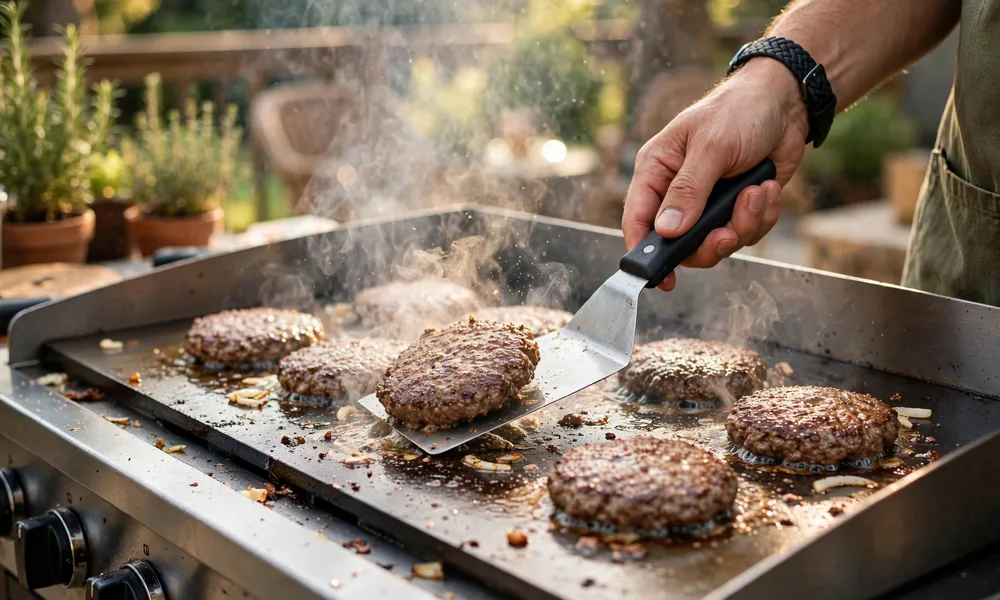
Always preheat for at least five minutes: a griddle that is not fully hot will stick and steam food instead of searing it. Test by flicking a few drops of water onto the surface: they should sizzle and dance. For pancakes, aim for around 180 degrees Celsius; for burgers and steaks, 220 or higher.
Oil Lightly, Not Heavily
A thin film of oil is all you need on a well-seasoned or non-stick surface. Pour a teaspoon of high-smoke-point oil, such as vegetable or avocado oil, onto the surface and spread it with a paper towel held in tongs. Too much oil pools and fries food unevenly; too little and eggs stick.
Do Not Crowd the Surface
Crowding is the most common griddle mistake. Food releases moisture as it cooks, and if pieces are packed together that moisture has nowhere to go, so everything steams instead of browning. Leave at least an inch between items and cook in batches if you have to.
Seasoning, Cleaning, and Care
A griddle that is looked after lasts for decades. One that is neglected will rust, stick, and end up in the bin within a year.
Seasoning Cast Iron and Steel
Seasoning is a thin layer of oil polymerised onto the metal, and it is what makes cast iron and steel non-stick. To season a new griddle, wash it, dry it completely, rub a very thin coat of high-smoke-point oil over the whole surface, and heat it until the oil smokes lightly and bonds. Repeat two or three times, and always finish by wiping a thin coat of oil on the clean, dry surface.
Cleaning After Every Cook
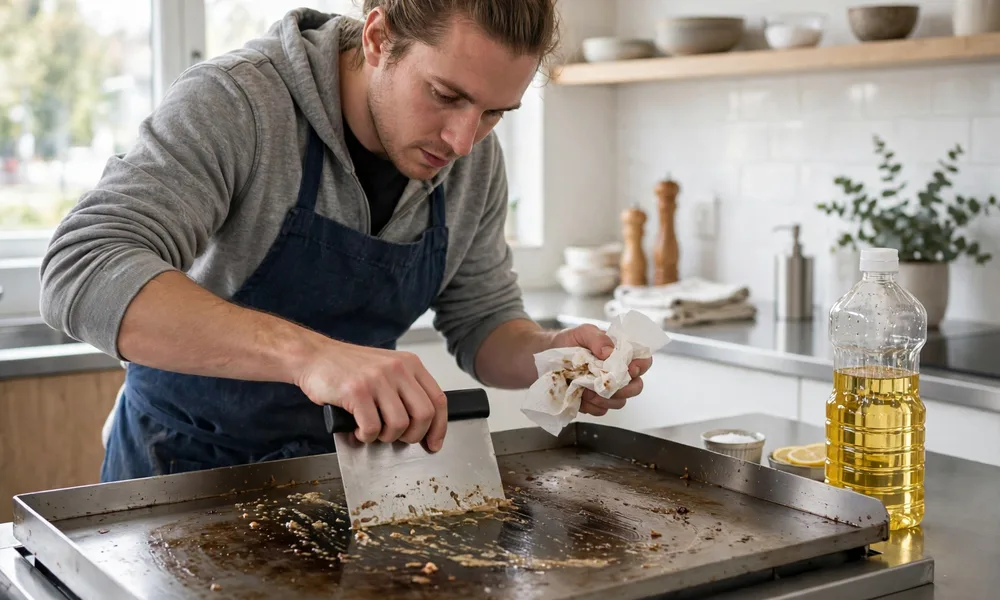
Clean while the griddle is still warm. Scrape food residue into the grease trap, wipe the surface with a paper towel, and for stubborn spots, pour a little water on the hot surface and scrape again as it steams. For non-stick plates, let the plate cool, then wash with warm soapy water and a soft sponge. Never put a hot cast iron griddle under cold water, and never use a dishwasher on cast iron or steel.
Best Griddles 2026 Compared
| Griddle Type | Best For | Typical Price | Cooking Size | Care Level |
|---|---|---|---|---|
| Electric griddle | Family breakfasts, easy cleanup | $40–$120 | 20–24 in | Low |
| Stovetop griddle plate | Gas hob owners, searing | $30–$90 | 18–20 in | Medium |
| Cast iron griddle pan | Small kitchens, sandwiches, steaks | $25–$60 | 10–12 in | High |
| Outdoor gas flat-top | Garden cooking, large groups | $250–$600 | 28–36 in | High |
Common Griddle Mistakes to Avoid
Most griddle problems come from a few avoidable habits. Skipping the preheat is the biggest: food sticks to a cold surface and never browns properly. Too much oil pools and makes food greasy, and crowding the surface turns searing into steaming. Scraping a non-stick surface with metal utensils destroys the coating, so use wood, silicone, or plastic on non-stick and save metal for steel and cast iron. Finally, never leave a cast iron or steel griddle wet: dry it immediately after cleaning and wipe on a thin coat of oil, or rust will appear within days. If you cook a lot of pizza too, our guide to the best pizza stones for home ovens 2026 is a useful companion read.
Griddle Buying Checklist
- Decide the type: electric for indoors, stovetop for the hob, gas flat-top for outdoors.
- Measure your counter, hob, or garden space before choosing a size.
- Check the actual cooking area, not just the overall dimensions.
- Look for even heating: thick plates, good thermostats, and independent zones.
- Choose the surface for your cleaning tolerance: non-stick for easy care, cast iron or steel for searing.
- Confirm spare parts, a drip tray, and a cover are available.
Frequently Asked Questions
What is the best griddle for pancakes?
A large electric griddle is the best choice for pancakes, because it holds a steady, even temperature across the whole surface and has room for a full batch at once.
Are electric griddles better than stovetop griddles?
Neither is universally better. Electric griddles are easier to use, hold temperature better, and clean up faster, which suits most families. Stovetop griddles reach higher temperatures and sear better, which suits keen cooks with a good hob.
How do I stop food sticking to my griddle?
Preheat fully, oil lightly, and do not move food until it releases naturally. On cast iron and steel, build up a good seasoning layer over the first few cooks with fatty foods. On non-stick, avoid metal utensils and high heat, both of which damage the coating.
Can I use a griddle on an induction hob?
Only if it is induction-compatible, which means it has a magnetic base. Most cast iron griddles work on induction, but many aluminium and stainless steel plates do not. Test with a magnet: if it sticks firmly to the base, it should work.
How do I clean a flat-top outdoor griddle?
Clean while it is still hot. Scrape food and grease into the trap, pour a little water on the surface and scrape again as it steams, then wipe dry and apply a thin coat of oil. Do this after every cook.
What size griddle do I need for a family of four?
At least 20 inches wide is the minimum for a family of four, and 24 inches is more comfortable, giving you room for pancakes, bacon, and eggs at the same time without crowding.
The Bottom Line
The best griddles of 2026 are the ones that match your kitchen and your cooking. A large electric griddle is the easiest win for family breakfasts, a cast iron plate is the best value for serious searing, and an outdoor gas flat-top is the most capable option for garden cooking at scale. Preheat properly, oil lightly, give food space, and clean and oil the surface after every cook.


