A hamster may be small, but its dinner matters more than its size suggests. A good bowl of food is the centre of a hamster’s day: it is sniffed, sorted, carried away in cheek pouches, hidden in a corner of the bedding and nibbled through the evening. The best hamster food of 2026 makes that routine easy, with a mix a hamster will actually eat, pieces that are the right size for small paws and mouths, and a recipe that stays fresh in the bag. The poorest food, by contrast, sits untouched, gets picked through for one or two favourite bits, and ends up swept away half-eaten.

What Good Hamster Food Looks Like
Start with variety. A hamster in the wild eats a wide range of seeds, grains and plant matter, and a good shop-bought food reflects that. Look for a mix with several different seeds and grains you can see and name: sunflower seeds, pumpkin seeds, oats, wheat, barley and millet, with a few dried peas or lentils for variety. The pieces should look clean and whole, not crushed, and the bag should smell fresh and nutty when you open it, not musty or stale. If the mix is mostly one ingredient, with everything else in tiny amounts, it is not really a mix at all.
Seed Mixes, Pellets and Blocks: Which Format Wins
Most hamster food comes in one of three formats, and each has a clear strength. A loose seed mix is the most natural to eat and the most fun for a hamster, because it can sort, choose and pouch different pieces. It also shows you exactly what your hamster likes and what it leaves, which is useful information. Its weakness is selective eating: a fussy hamster will eat the sunflower seeds and leave the rest, so the bowl can look empty while the less-loved pieces pile up.
How to Choose: The Five Things That Matter Most
First, check the ingredients list, and read it the way you would read one for your own food. The first few ingredients should be recognisable seeds and grains, not vague fillers. A long list of colourings, flavourings and sweeteners is a warning sign, and a list that hides behind words like cereal by-products tells you very little. Short, plain ingredient lists are usually the better buy, and they are easier to compare between bags.
Second, think about piece size. Syrian hamsters are larger and can handle bigger seeds and pieces, while dwarf hamsters need smaller pieces they can pick up and pouch comfortably. A mix made for a large hamster can be frustrating for a dwarf, and a mix made for a dwarf can be picked through too quickly by a Syrian. If the bag says which type of hamster it suits, trust that, and if it does not, look at the pieces yourself before you buy.
Third, look at the balance of the mix. Sunflower seeds are a favourite, but a mix that is mostly sunflower seeds is too rich to be the whole diet, in the same way that a human diet of only one food would be. A good mix keeps sunflower seeds as one part of a wider range, with plenty of smaller seeds, grains and pulses alongside them. You should be able to see that balance in a handful, without needing to read a chart.
Fourth, consider how the food is packed. A resealable bag keeps the mix fresh far longer than a bag that has to be folded over and clipped, and a smaller bag is often better value than a large one if the food would go stale before it is finished. Clear packaging, or a bag with a window, lets you check the mix before you buy, which is a small advantage that is worth having.
Fifth, watch your own hamster. The best guide to a food is not the bag but the bowl the next morning. A food that is eaten steadily, with little left behind, is a good fit. A food that is mostly left, or picked through for one ingredient, is telling you something, even if the bag looked perfect on the shelf. Change foods slowly, mixing a little of the new food into the old for a few days, so the change is gradual rather than sudden.
Syrian Hamsters and Dwarf Hamsters Eat Differently
Syrian hamsters and dwarf hamsters may look similar on a shelf, but their feeding needs are not identical. Syrian hamsters are larger, eat a little more, and handle bigger pieces with ease. They are also more likely to be kept alone, so their food is entirely their own, and a bowl that suits one Syrian will usually suit another of the same size. A generous handful of a varied mix, with pellets for balance, is a good starting point, adjusted by watching how much is eaten and how much is stored.
Dwarf hamsters are smaller, quicker and often kept in pairs or small groups, which changes the feeding picture. Pieces need to be smaller, the bowl needs to be easy for a small hamster to reach, and food scattered in more than one place helps every hamster in the cage get a share. Dwarf hamsters also tend to pouch food eagerly, so a mix with small, pouch-friendly pieces suits them better than one full of large seeds they struggle to carry. If you keep dwarfs, choose a mix that says so on the bag, and check the piece size with your own eyes.
Fresh Foods and Treats Worth Adding
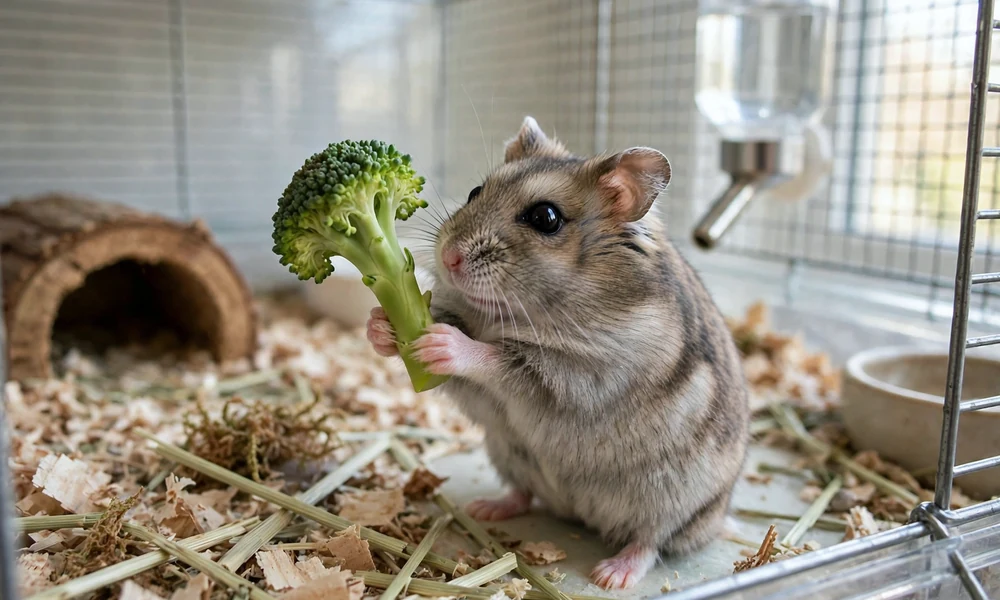
A good dry food is the base of the diet, but a little fresh food adds variety and moisture. Small pieces of vegetables such as broccoli, carrot, cucumber and courgette are popular, and a tiny piece of apple or pear makes a welcome change. Keep portions small, about the size of a fingernail, and remove anything uneaten after a few hours so it does not spoil in the bedding. Fresh food is a supplement, not a replacement for the dry mix, and a hamster that fills up on treats will leave its main food untouched.
Treats deserve the same restraint. A sunflower seed, a small piece of plain nut or a dried mealworm is a fine occasional treat, and it is also a useful way to tame a shy hamster, offered from the hand so the hamster learns that hands bring good things. What matters is frequency: a treat every day is no longer a treat, and a hamster that expects sweet or fatty extras will start to ignore its ordinary food. Keep treats to a few times a week, and keep them small.
The Daily Routine That Keeps Feeding Simple
Feed at the same time each day, ideally in the evening when hamsters wake and become active. A small, measured portion is better than a bowl that is always heaped, because it lets you see what is being eaten and what is being stored. A tablespoon of mix a day is a useful starting measure for a Syrian hamster, with a little less for a dwarf, adjusted up or down by what you find in the bowl each morning. If the bowl is empty and the bedding is full of stored food, the portion is already generous enough.
Our guide to the best hamster cages of 2026 covers the home the food goes into, and the cage matters for feeding as well as for sleeping. A cage with a flat, stable place for the bowl, room to scatter food for foraging, and a water bottle that stays in place makes the daily routine far easier than a cage where the bowl tips and the bottle drips.
What to Leave Out of the Bowl
Some foods are best left out of a hamster’s bowl altogether, and it is easier to remember a short list than a long one. Chocolate, sweets, crisps, biscuits and anything salted or sugared have no place in the cage, and neither do citrus fruits, onion, garlic or raw beans. Sticky foods such as peanut butter can be hard for a small hamster to manage, and anything with a strong flavour or a lot of fat is better avoided. When in doubt, leave it out: a hamster that misses a new food loses nothing, while a hamster that eats the wrong food may be uncomfortable for a day.
Our guide to best versus worst pet food in 2026 looks at the wider pet food shelf, and the same lesson runs through it: the best food for any animal is the one made for that animal, with plain ingredients and no sugary extras, while the worst is the one that relies on colour, sweetness and a bright bag to sell itself.
Storage, Freshness and Getting Value for Money

The bowl matters here too. A heavy ceramic bowl that cannot be tipped is worth more than a light plastic one that slides across the cage and spills the food into the bedding. A bowl that is easy to lift out, wash and refill will be cleaned more often, and a clean bowl keeps fresh food fresh. Our guide to the best pet food bowls of 2026 covers bowls in detail, and a good hamster bowl is the same idea in miniature: heavy, stable, easy to clean and the right size for the animal eating from it.
Frequently Asked Questions
How much hamster food should I give each day? A tablespoon of mix a day is a good starting point for a Syrian hamster, with a little less for a dwarf, plus a small piece of fresh food a few times a week. Watch the bowl each morning: if it is empty and the hamster is active and bright, the portion is about right, and if food is always left, offer a little less.
Can I feed my hamster only pellets? You can, and many owners do, because pellets give an even diet with no picking and choosing. Most hamsters enjoy a little seed mix as well, though, for variety and foraging, so a pellet base with a small scatter of seed mix is a popular middle ground that gives the best of both formats.
Why does my hamster only eat the sunflower seeds? Sunflower seeds are the tastiest part of most mixes, so a hamster will pick them first, just as a child picks the sweetest part of a meal first. If the rest of the mix is left every day, try a mix with fewer sunflower seeds, or a pellet-based food, so the hamster cannot pick out only one ingredient.
Should I change my hamster’s food if it seems bored? A hamster that eats steadily does not need a change, but a little variety in treats and fresh food is enough to keep feeding interesting. If you do change the main food, mix the new food into the old for a few days, increasing the new food gradually, so the change is gentle rather than sudden.
The best hamster food is the one your hamster finishes, day after day, from a clean bowl in a comfortable cage. Choose a varied mix with plain ingredients, keep the portions measured and the bag fresh, add a little fresh food and a few treats, and let your hamster forage for part of its meal. The bowl will tell you the rest, one empty morning at a time.