Why a Sharp Hand Plane Still Beats a Power Sander in 2026
A sharp hand plane leaves wood smoother than sandpaper ever will. That sounds backwards in a workshop full of power tools, but it is the oldest truth in woodworking: a plane cuts the wood fibre cleanly, while sandpaper tears it. A planed board feels like glass under the hand, takes a finish evenly, and shows the grain instead of hiding it under scratches. A sanded board feels smooth until the light hits it, and then the scratches show.
This guide covers the hand planes worth buying in 2026: the types that flatten, smooth and trim, how to set one up so it cuts instead of chattering, and how to keep its edge sharp. A plane is only as good as its blade. The work starts on a flat workbench, the shavings are judged against what sandpaper leaves behind, and the lines it follows are marked with marking gauges.
Key Takeaways
- A hand plane cuts wood fibre cleanly; sandpaper tears it. A sharp plane leaves a surface that needs no sanding at all.
- Buy a smoothing plane first if you finish boards, a jack plane first if you flatten rough timber, and a block plane first if you trim edges.
- The sole must be flat, the blade must be sharp, and the mouth must be tight: those three things decide whether a plane works or chatters.
- Cast iron bodies are the safe buy; wooden planes are lighter and cheaper but need more care to stay flat.
- Sharpening is part of owning a plane, not an extra: budget for a stone and learn the angle before you buy the tool.
Why a Hand Plane Beats Sandpaper for Fine Finishing
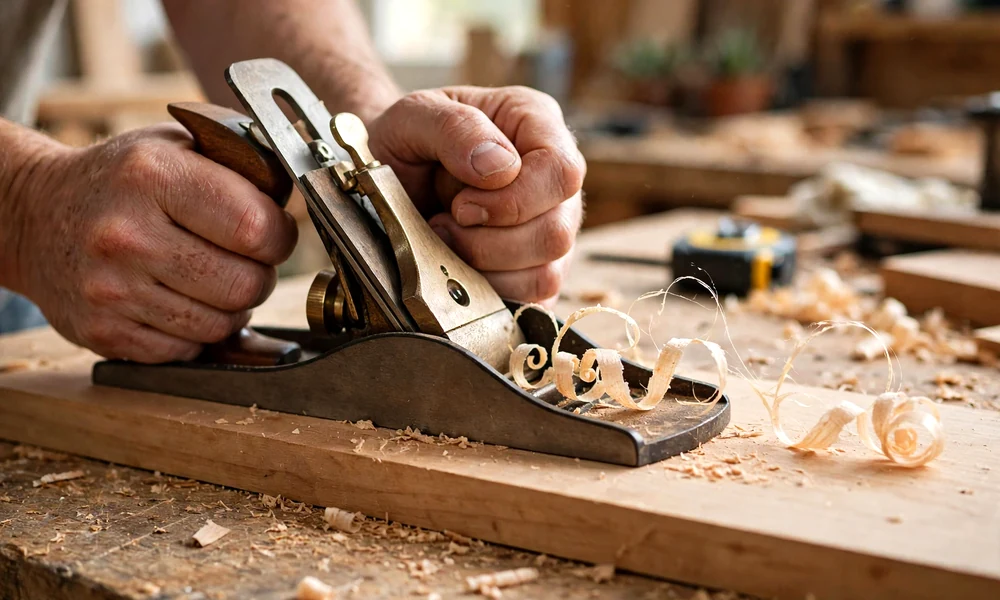
Sandpaper works by scratching. Every grit leaves its own pattern of scratches, and each finer grit only makes smaller scratches. The surface looks smooth, but the scratches are still there, filled with dust, and the first coat of finish reveals them. A hand plane works by cutting. A sharp blade slices the fibre in one clean pass, leaving a surface with no scratches to hide and nothing for the finish to catch on. Run your hand along a planed board and then along a sanded one, and the difference is obvious: the planed board is slick, almost polished, while the sanded board has a faint drag to it.
There is a second difference, and it matters more. Sanding creates dust, and fine dust gets everywhere: in the grain, in the air, in the finish. Planing creates shavings, which fall to the bench and sweep up in seconds. It is slower, but for the last few passes on a board that matters, slow is the point.
The Main Types of Hand Plane
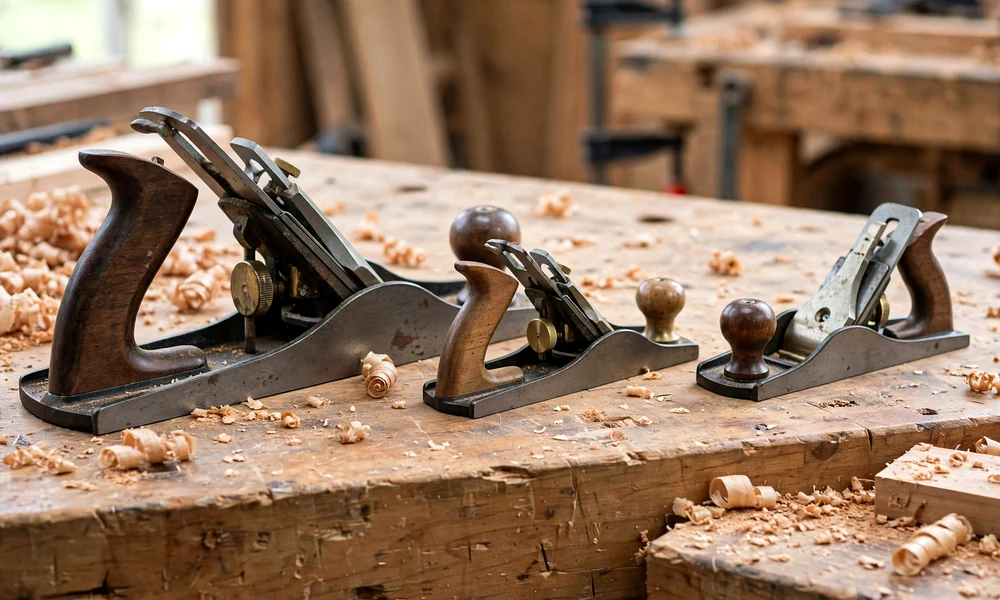
Hand planes come in a handful of sizes, and the size decides the job. The bigger the number, the longer the body, and the longer the body, the flatter the surface it leaves.
Smoothing Planes
The smoothing plane is the finisher, and the best hand plane for most homes in 2026. At around twenty-five centimetres long, it is short enough to follow a board and long enough to bridge small dips, and it takes whisper-thin shavings that leave a surface ready for finish. It is the plane to buy if you only buy one. Look for a flat sole, a blade that adjusts easily, and a mouth that closes tight. The classic size is the No. 4.
Jack Planes
The jack plane is the workhorse, built for flattening rough timber. At around thirty-five centimetres long, it bridges the dips and humps of a rough-sawn board and takes a heavier shaving than a smoothing plane, removing material fast. It is the plane that turns a twisted board into a flat one, and the first plane to reach for when a board arrives rough from the timber yard. The classic size is the No. 5, and it leaves a surface a smoothing plane finishes afterwards.
Jointer Planes
The jointer plane is the long one, fifty-five centimetres or more, and it exists for one job: making long edges dead straight. Its length bridges every dip along a board, so only the high spots are cut, and the edge it leaves is straight enough to glue without a gap. It is the plane for tabletops, for jointing boards edge to edge, and for any glue-up that must not show a seam. It is heavy, but nothing else straightens a long edge as truly.
Block Planes
The block plane is the small one, held in one hand, and it is the plane for trimming. It cleans up end grain, chamfers an edge, trims a sticking door and takes the sharp corner off a board. Its blade sits at a low angle, which is what lets it cut end grain cleanly where a bench plane would tear it. Every workshop needs one, and it is the cheapest useful plane to buy. Keep it on the bench: it is the plane you reach for ten times a day.
Shoulder Planes
The shoulder plane is the specialist, built for fine fitting. Its blade runs the full width of the body, right to the edges, so it can trim the shoulder of a tenon or the side of a rebate square and clean. It is the plane for joinery, for fitting drawers and for any cut that must be square to a corner. Beginners rarely need one, but when a tenon will not fit, it is the only tool that fixes it properly.
Hand Planes Compared
| Type | Best For | Length | Shaving |
|---|---|---|---|
| Smoothing plane | Final finish | ~25 cm | Whisper-thin |
| Jack plane | Flattening rough boards | ~35 cm | Heavy |
| Jointer plane | Straight long edges | ~55 cm | Medium |
| Block plane | Trimming and end grain | ~15 cm | Fine |
| Shoulder plane | Tenons and rebates | ~20 cm | Fine |
If you finish boards, start with a smoothing plane. If you flatten rough timber, start with a jack plane.
How to Choose the Right Hand Plane
Start with the sole. Lay a straightedge along it and hold it up to the light: any gap means the sole is not flat, and a plane with a hollow sole will never cut evenly. Cheap planes often are not flat, and flattening a sole is an afternoon of work on sandpaper stuck to glass. Check the mouth too, the slot the blade pokes through. A tight mouth supports the fibre and stops tear-out; a wide mouth lets the wood lift and split ahead of the blade.
Then check the adjusters. A good plane lets you set the blade depth with a small wheel and move it sideways with a lever, and both should move smoothly with no slop. The blade itself should be thick, at least three millimetres, because a thin blade chatters under load and a thick one stays still. Hold the plane before you buy it, and push it along a board in the shop.
Cast iron bodies are the safe buy: heavy, stable and flat for decades. Wooden planes are lighter, cheaper and quieter, and a wooden sole glides more easily, but wood moves with humidity and needs flattening more often. Vintage planes are a good buy if the sole is flat and the parts are complete, and a poor buy if anything is missing, because a missing frog or adjuster can cost more than the plane.
Sharpening: The Skill That Makes the Tool
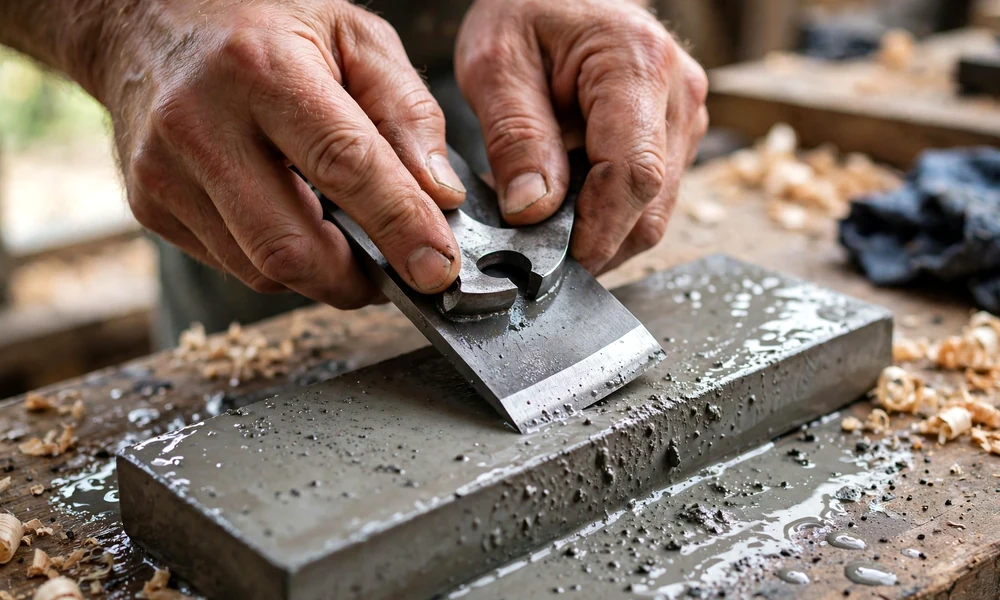
A hand plane is only as good as its edge, and the edge dulls with use. Sharpening is not a chore to avoid; it is the skill that makes the tool work. The blade needs a flat back and a bevel ground to about twenty-five degrees, then honed to thirty. The test is simple: a sharp blade takes a full-width shaving you can read through, while a dull one takes dust and skips.
Sharpen little and often, not rarely and for hours. A few strokes on a fine stone every half hour of work keeps the edge keen, while waiting until the plane stops cutting means grinding back a rounded, blunt edge. Keep the stone flat, keep the angle steady with a guide until your hands learn it, and wipe the blade with an oily rag before putting the plane away. A plane stored blade-down on a bench will blunt its edge on the first knock, so store it on its side or on a strip of wood.
Mistakes That Waste Money
The most common mistake is buying a cheap plane and expecting it to work out of the box. Cheap planes arrive with soles that are not flat, blades that are soft, and adjusters that slip, and fixing all three costs more than buying a good plane in the first place. The second mistake is buying a full set of five planes before learning to use one. A smoothing plane and a block plane cover most home woodworking.
Another mistake is planing against the grain. Wood has a direction, and a plane pushed against it tears the fibre instead of cutting it, leaving a rough, torn surface. Read the grain, plane with it, and skew the plane slightly when the grain changes direction. Clamp the board, hold it in a vice, or wedge it against a bench stop, and keep both hands on the plane.
Checklist: Buying a Hand Plane
- Check the sole is flat with a straightedge before you pay anything.
- Choose the size for the job: smoothing for finishing, jack for flattening, block for trimming.
- Check the mouth closes tight and the blade adjusts smoothly, with no slop in the wheel or lever.
- Buy a thick blade, at least three millimetres, and a stone to keep it sharp.
- Hold the plane first: the tote and knob should fit your hand without cramping.
- Store it on its side or on a strip of wood, never blade-down on the bench.
Frequently Asked Questions
What is the best hand plane for a beginner?
A No. 4 smoothing plane. It is the most useful size, it finishes boards ready for oil or varnish, and it teaches you everything about setting up a plane.
Can a hand plane replace a power planer?
For finishing and fitting, yes. For thicknessing rough timber in volume, no: a power planer removes material far faster. Most home woodworkers use both, the power planer for the heavy work and the hand plane for the final passes.
How do I stop a hand plane from tearing the grain?
Plane with the grain, keep the blade sharp, close the mouth tight, and take a thin shaving. If the grain changes direction mid-board, skew the plane slightly across the cut or plane from the other end.
How often should I sharpen a hand plane blade?
Sharpen little and often: a few strokes on a fine stone every half hour of work keeps the edge keen. If the plane starts taking dust instead of shavings, the edge is already too dull.
Are wooden hand planes any good?
Yes, and they glide beautifully, but wood moves with humidity and needs flattening more often than cast iron. A wooden plane suits a dry workshop and a patient owner; cast iron suits everyone else.
What is the difference between a smoothing plane and a jack plane?
A smoothing plane is short and takes whisper-thin shavings for a final finish. A jack plane is longer and heavier, built to flatten rough boards fast. The jack does the hard work; the smoothing plane does the finishing.
The Bottom Line
A sharp hand plane leaves wood smoother than sandpaper ever will, and it does it quietly, cleanly and cheaply. Buy a No. 4 smoothing plane with a flat sole and a thick blade, learn to sharpen it, and add a block plane for trimming. Keep the blade keen and plane with the grain, and the surface will need no sanding at all.