
The best handheld consoles in 2026 are no longer a compromise for players who cannot sit in front of a television. They run full, modern games, they last long enough for a real journey, and they are comfortable enough to hold for an evening. The trick is choosing the right one, because a handheld that suits a commuter can frustrate a home player, and a powerful machine can disappoint someone who mainly wants simple, family-friendly games. This guide explains how to choose the best handheld consoles of 2026 for the way you actually play, weighing screens, battery life, game libraries, comfort, and value side by side.
A handheld earns its place by fitting into the gaps in your day: a train ride, a lunch break, or a quiet hour in bed. That only works if the machine is charged, comfortable, and loaded with games you want. Before comparing models, be honest about where you will play most and how much weight you will happily carry. A device that lives in a coat pocket gets used far more than one that needs its own bag.
Key Takeaways
- Match the handheld to where you play most: commuting, sofa, bed, or travel all point to different machines.
- Screen quality and battery life matter more day to day than raw processing power.
- Check that the games you actually want are available before you buy any handheld.
- Comfort beats a spec sheet: weight, grip, and button layout decide whether you keep playing.
- A handheld with expandable storage and a strong library will still feel like good value years from now.
Best Handheld Consoles 2026 at a Glance
Before the detail, here is the short version. Each type below earns its place for a different kind of player, and the right pick depends on your games, your journeys, and your budget.
| Handheld type | Best for | Standout strength | Watch out for |
|---|---|---|---|
| Family handheld | Families and casual players | Exclusive games, easy sharing | Less power for demanding games |
| PC handheld | Players with a PC library | Huge game catalogue | Heavier, shorter battery life |
| Premium handheld | Serious portable players | Best screen and controls | Highest price |
| Budget handheld | First-time buyers | Lowest price, simple to use | Smaller screen, modest storage |
| Retro handheld | Classic game fans | Pocket size, long battery | Cannot run modern games |
How to Judge a Handheld Console
The screen comes first
You stare at the screen for every minute of play, so it deserves the first look. A bright, sharp display makes every game look better, and it matters most outdoors, where a dim screen washes out. Size is a trade-off: a larger screen is easier on the eyes, but it makes the machine heavier and harder to carry. A screen of around seven inches is the sweet spot for most players, big enough to read small text and small enough to hold comfortably.
Battery life decides how you use it
Advertised battery life is measured on gentle games at low brightness, so treat the headline number with care: demanding games can cut it in half. Look for at least four hours of real play in the games you like, and six or more if you travel often. A machine that dies halfway through a journey is one you stop trusting. Fast charging matters too, and a power bank should be a backup, not a requirement for a normal day out.
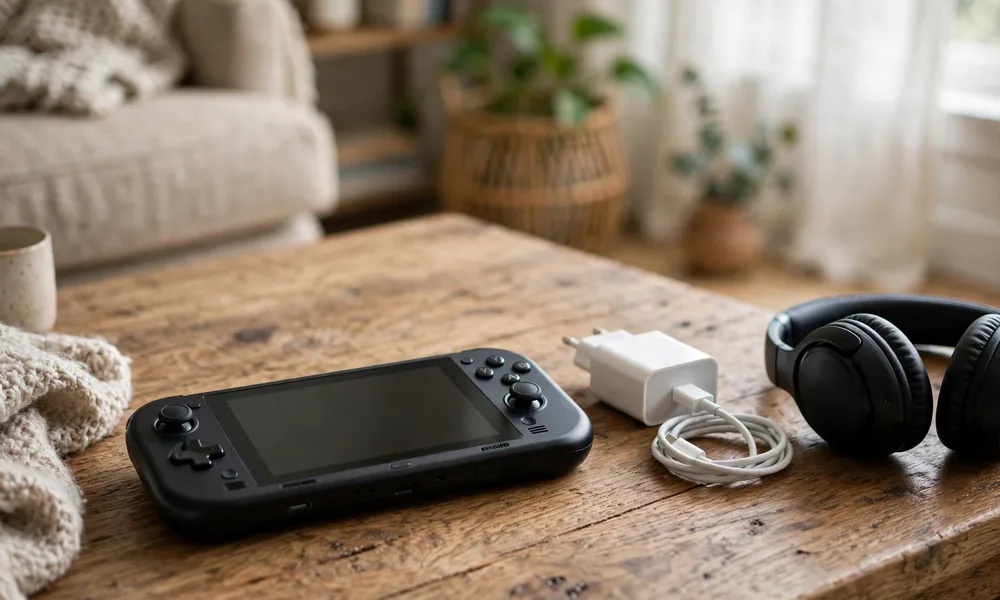
Comfort over long sessions
Weight and grip decide whether a handheld stays fun after an hour. A machine over 600 grams starts to feel heavy, especially for younger players or anyone playing in bed. Rounded grips and well-placed sticks matter more than they sound, so hold the machine before you buy it if you can. A handheld that cramps your hands will sit on a shelf, however good its games are.
The library is the real decision
Hardware is only as good as the games it runs. Before you buy, list the five games you most want to play and check each one against the machine. A handheld with a smaller library of games you love beats a faster machine with nothing you want. Family players should look for local multiplayer and games for all ages, and PC players for a handheld that plays the library they already own.
The Handheld Types That Stand Out in 2026
The strongest handhelds of 2026 are not all trying to do the same job: each type below suits a different player.
The best family handheld
For families, the winning handheld is the one everyone can pick up. Its games are bright, inventive, and built for playing together, and its parental controls are clear enough to set up in minutes. Docked to the television, it doubles as a home console, so one purchase covers the living room and the car alike. The trade-off is power: demanding games may arrive late or not at all, but for most families that hardly matters.
The best PC handheld
A PC handheld suits players who already own a large library of computer games, running the same storefronts with cloud saves that carry progress to a desktop. The catalogue is enormous and sales make it cheap to build. The cost is weight, heat, and battery life: these machines are heavier, demanding games drain them fast, and they need more setup than a simpler console. For a flexible player who enjoys tinkering, that is a fair trade; for someone who wants to press a button and play, it is not.
The best premium handheld
The premium handheld is for players who want the finest portable experience and will pay for it: a bright screen, the most comfortable controls in the class, and enough power to run modern games smoothly. Build quality is a step above, with solid materials and quiet cooling. The price is the drawback, and the library may be narrower than a PC handheld, so check your games first.

The best budget handheld
A budget handheld is the smartest first step for a new player or a younger gamer. It costs far less than the flagships yet plays a strong library, and its simplicity is a feature: no settings to fiddle with. The screen is smaller and storage is modest, so expect to add a memory card. It also suits a second household machine or a travel companion, though demanding games may run at lower settings or not at all.
The best retro handheld
Retro handhelds serve a different joy: classic games in a pocket-sized machine with battery life measured in days. They are light, cheap, and charming, and they suit short sessions on the move. They cannot run modern games, and that is the point: buy one as a companion to a main handheld, not a replacement.
Handheld vs Home Console: Which Fits Your Life?
The honest question is not which machine is better, but which one fits your life. A home console wins on the big screen: sharper graphics, bigger sound, and a controller that never runs out of charge. It suits players who play in one place, on a good television, often with others in the room. Our guide to the best gaming consoles of 2026 compares the whole field if you are still deciding.
A handheld wins everywhere else: on the train, in bed, on holiday, or while someone else uses the television. It also wins for short bursts, waking instantly and pausing without fuss. Many players end up with both. If you can only buy one, choose the place you play most: the machine that is with you gets played, and the one waiting for a free television does not.
Storage, Accessories, and the True Cost
The price on the box is rarely the final price. Storage fills fast: modern games regularly exceed 50GB, and a small internal drive holds only a handful of major titles. Budget for a memory card at the start, because deleting games to make room gets old quickly. A screen protector is cheap insurance, a case protects the sticks in a bag, and a second charger saves more arguments than it costs.
Sound matters more than most buyers expect: a decent headset reveals footsteps, direction, and detail that small speakers flatten. Our roundup of the best gaming headsets of 2026 covers the options worth your money, from budget wired pairs to premium wireless sets. If you also play on a computer, our comparison of the best gaming laptops of 2026 is a useful check before you commit to one portable platform over another.
Online services add a monthly cost that adds up over a handheld’s life. Each platform charges for online multiplayer and bundles a catalogue of games. Before buying, add up the subscription cost over three years: a cheap handheld with an expensive subscription can cost more than a premium one.
What to Avoid When Buying a Handheld
The worst handhelds share the same flaws. The first is a tiny library dressed up with a big launch: a machine that arrives with fanfare and then goes quiet for months. The second is a battery that cannot survive a normal journey, turning every trip into a hunt for a socket. The third is a screen that is dim or hard to read in daylight, which ruins the whole point of playing anywhere.
Be wary of handhelds that sell features rather than fundamentals: extra buttons and flashing lights are fine extras, but none matters if the machine is uncomfortable, short on battery, or starved of games. Also check repairs, since sticks drift and batteries age, and do not buy a handheld for one game alone.
Buyer Checklist
- List the five games you most want to play and confirm each one runs on the handheld.
- Check real battery life in demanding games, not just the advertised headline number.
- Hold the machine if you can, or check its weight against a device you already carry.
- Budget for a memory card, a case, and a screen protector from the start.
- Confirm the screen is bright enough to read outdoors and in sunlight.
- Add up three years of subscription costs before comparing prices.
Frequently Asked Questions
Is a handheld console worth it in 2026?
Yes, if you play away from the television. Modern handhelds run full games well, and playing anywhere is hard to give up once you have it. If you only play on the sofa, a home console is the better spend.
How much storage do I need on a handheld console?
At least 512GB, built in or added with a memory card. Large games regularly exceed 50GB, and a smaller drive holds only a handful before you are deleting games to make room.
Which handheld console has the best battery life?
Simpler handhelds last longest, often six hours or more, while powerful PC handhelds may manage only two to three hours in demanding games. Check real-world tests for your games.
Can a handheld console replace a home console?
For many players, yes. Most handhelds can dock to a television, and for casual and family play the difference is small. Players who want the sharpest graphics in demanding games will still prefer a home console.
Are handheld consoles good for children?
Yes, with the right choice. Family handhelds have the clearest parental controls, sturdy designs, and games made for younger players. Set time limits and spending controls first, and choose games rated for their age.
When is the best time to buy a handheld console?
Major sales events and the holiday season bring the best bundles, often pairing a handheld with a game, a case, or a memory card. Prices rarely drop far outside those windows, so buying during a sale is the smartest move.
The Bottom Line
How to choose the best handheld consoles of 2026 comes down to your own play: commuters should buy for battery life, families for games and controls, and PC players for the library they already own. Check your five must-play games before you pay, and budget for storage and a case.


