Top Hawthorne Strainers for a Clean, Ice-Free Pour in 2026
The top Hawthorne strainers decide whether a stirred or shaken drink arrives clean, cold and clear, or cloudy with ice chips and fruit pulp. A Hawthorne strainer is a flat metal disc with a coiled spring around its edge and two or four small prongs, and it sits on top of a shaker tin or mixing glass: the spring holds back the ice while the drink pours through in a smooth stream. A bad one leaks ice, wobbles on the tin, or pours so slowly that the drink warms in your hand. A good one seats firmly with one press of a finger, pours quickly, and catches everything you do not want in the glass. This guide compares the Hawthorne strainers worth buying in 2026.
Key Takeaways
- A Hawthorne strainer holds back ice with a coiled spring while the drink pours through, and the spring is the part that matters most.
- Fit comes first: a strainer that does not seat firmly on your shaker tin will leak ice no matter how good its spring is.
- Four-prong strainers grip the tin more securely than two-prong ones, especially on wide or heavy tins.
- A tight, even spring catches small ice chips, while a loose or gappy spring lets them straight through.
- Pair a Hawthorne strainer with a fine mesh strainer for double straining, and citrus drinks will come out silky rather than pulpy.
What a Hawthorne Strainer Actually Is
The Hawthorne strainer is named after the Hawthorne Cafe in Boston, where it was first used in the late nineteenth century, and its design has barely changed since. A flat steel disc covers the mouth of the tin, a coiled spring presses against the inside wall, and small prongs hook over the rim. When you tip the tin, liquid flows through the gaps between the spring coils while the spring blocks the ice. Most strainers fit the standard Boston shaker tin, about nine centimetres across, and the spring flexes to fit tins a little wider or narrower. That flexibility is the design’s strength, and its weakness too: a spring that has stretched with age no longer presses firmly enough to hold back small chips.
How We Judged the Hawthorne Strainers
We judged every Hawthorne strainer on six things: fit on a standard Boston tin and a mixing glass; the spring, tight and even with no gaps wide enough for ice chips; the pour, quick and even rather than dribbling; grip, with prongs holding the disc steady on a full tin; build, resisting bending, rust and dishwasher damage; and cleaning, with pulp rinsing out of the spring easily.
The Main Types of Hawthorne Strainer
Two-Prong Hawthorne Strainers
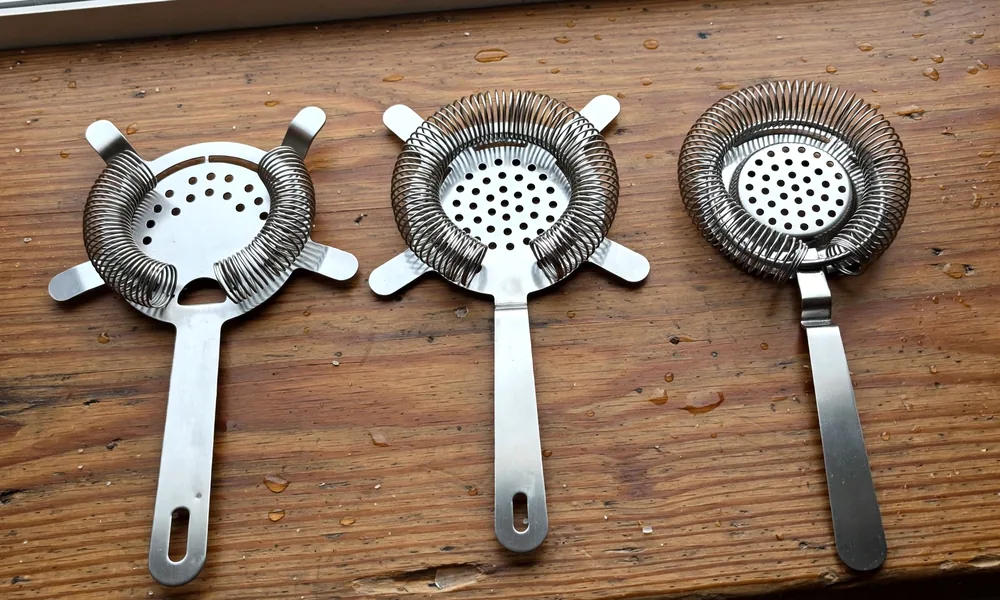
The two-prong Hawthorne strainer is the classic design, with a prong on each side of the disc that hooks over the rim. It is light, simple and cheap, and it fits almost any standard tin. Two prongs are enough for most home bars, because the spring does most of the holding. The weakness shows up with a full, heavy tin: two prongs can flex, and the disc can tilt if you press unevenly, opening a gap that lets ice slip through. It is the best first strainer to buy, and the cheapest way to learn the pouring technique.

Four-Prong Hawthorne Strainers
Four-prong strainers hold the disc at four points around the rim instead of two, so the strainer is noticeably steadier on a full tin, and far harder to tilt by pressing unevenly, the most common cause of ice leaking into the glass. They are the standard in professional bars for that reason: four prongs let you forget about the strainer. They cost only a little more than two-prong models and fit the same tins. Their only drawback is that the extra prongs can catch on a narrow mixing glass, so check the fit first. For most home bars, a four-prong strainer is the best all-round buy.
Long-Handle Hawthorne Strainers
Long-handle strainers extend the disc into a handle of fifteen to twenty centimetres, which keeps your hand further from the cold tin and gives you more leverage. The long handle also makes the strainer easier to lift off without touching the wet disc. These models suit larger hands and anyone who finds the short tab of a standard strainer fiddly. The trade-off is storage: a long handle does not fit in a small bar caddy and can snag in a drawer. Buy one if comfort matters more than compact storage.
Hawthorne Strainers With a Built-In Fine Mesh
A few Hawthorne strainers add a fine mesh screen across the disc, which catches the smallest ice shards and pulp that slip past the spring, combining a Hawthorne and a fine mesh strainer in one tool. They suit citrus and muddled drinks, where pulp is the problem. Their weakness is the pour: the mesh slows the flow, and it needs brushing after every use, because pulp dries into it quickly. They are a useful second strainer rather than a first one.
Hawthorne Strainers Compared
| Type | Best For | Grip | Pour Speed | Care Level |
|---|---|---|---|---|
| Two-prong | First strainers, light use | Good | Fast | Low |
| Four-prong | Everyday home bars | Excellent | Fast | Low |
| Long-handle | Comfort and leverage | Excellent | Medium | Low |
| Built-in fine mesh | Citrus and muddled drinks | Good | Slow | High |
The four-prong strainer wins on grip and value, the two-prong strainer wins on price and simplicity, and the mesh model wins on clarity for pulpy drinks. A long-handle strainer is the right buy when comfort matters most.
How to Choose the Best Hawthorne Strainer for You
Check the Fit Against Your Tin First
Fit is the first thing to check, because a strainer that does not seat firmly will leak ice whatever else it does well. Press it onto your shaker tin with one finger and tip the tin over a sink: the disc should stay put and no water should escape around the edge. Repeat the test with your mixing glass, because a strainer that fits one may wobble on the other. A strainer that fits your tin is worth more than one with a fancier spring that does not.
Inspect the Spring Before Anything Else
The spring is the working part, so inspect it closely. The coils should be tight and evenly spaced, with no gaps wide enough to pass a small ice chip. A loose spring is the most common fault in cheap strainers, and the first thing to wear out: after a year of use, a poor spring stretches and the strainer starts leaking chips. You cannot fix a stretched spring. Stainless steel springs last longer than plated ones, which can rust at the joins.
Prongs, Handles and Weight
Four prongs beat two for grip, most obviously on a full tin. The handle, usually a small tab on the disc, should be large enough to press with one finger without slipping. The best strainers sit in the middle on weight: heavy enough to feel solid, light enough to use all evening. A bar spoon works alongside the strainer most often, because stirred drinks are strained far more than shaken ones, and our guide to the best bar spoons explains how length and a twisted shaft change a stirred drink. Measuring is the other half of the job, and our guide to the best jiggers covers the accurate, easy-to-read measures worth buying.
When to Double Strain
Double straining means pouring through a Hawthorne strainer and then through a fine mesh strainer held over the glass, and it is worth doing whenever the drink contains anything smaller than an ice cube: citrus pulp, muddled herbs or fine ice shards. The Hawthorne catches the large ice, the mesh catches the rest, and the drink arrives silky and clear. It is not needed for stirred spirit-only drinks. Our guide to the best bar tools sets out the small set of tools that covers almost every drink, including when a second strainer earns its place.
How to Pour With a Hawthorne Strainer
Hold the tin in one hand and press the strainer down with the index finger of the same hand, keeping the disc flat against the rim. Tip the tin smoothly in one movement, and pour in a steady stream rather than a dribble, because a slow pour lets the drink warm and the ice melt into it. Keep the glass close to the tin, and stop before the last drops, which carry the smallest chips. If ice leaks through, check whether the spring presses evenly and whether you are pressing the disc flat: a tilted disc is the most common cause of a leak, fixed by pressing in the centre rather than on the edge.
Common Hawthorne Strainer Mistakes to Avoid
Pressing the disc on its edge instead of its centre tilts it and opens a gap, so press in the middle. Pouring too slowly lets the drink warm and the ice melt, so pour in one smooth stream. Using a strainer with a stretched spring is the third mistake: replace it, because a loose spring cannot be tightened. Shaking with the strainer on the tin is the fourth, because it is not a lid and will fly off. Finally, rinse the strainer under hot water as soon as you have poured, before pulp sets between the coils.
Cleaning and Storing Your Hawthorne Strainer
Rinse promptly: hold the strainer under hot running water and run a finger around the spring to shift pulp, then leave it to dry spring-down so water drains out. Most steel strainers are dishwasher safe, but hand washing is kinder to the spring and takes only seconds. If pulp has dried, soak in warm soapy water for ten minutes and use a small brush, never a metal scourer. Store it flat, and do not stack heavy tools on top, because a bent disc will never seat properly again.

Hawthorne Strainer Buying Checklist
- Test the fit on your own shaker tin and mixing glass before you buy.
- Inspect the spring: tight, even coils with no wide gaps.
- Choose four prongs for the steadiest grip on a full tin.
- Check the handle is large enough to press with one finger.
- Prefer stainless steel springs, welded to the disc, over plated ones.
- Add a fine mesh strainer if you make citrus or muddled drinks often.
Frequently Asked Questions
What is a Hawthorne strainer used for?
It holds back ice when you pour a shaken or stirred cocktail from a shaker tin or mixing glass. The coiled spring blocks the ice while the drink pours through.
What is the difference between a Hawthorne and a julep strainer?
A Hawthorne strainer uses a coiled spring and prongs to grip a shaker tin. A julep strainer is a perforated bowl-shaped disc with a handle, made to sit inside a mixing glass, and it strains more slowly.
Do I need a Hawthorne strainer if I have a Cobbler shaker?
No. A Cobbler shaker has a built-in strainer in its cap. A Hawthorne strainer is for Boston shakers and mixing glasses, which have none.
Why does my Hawthorne strainer let ice chips through?
Usually the spring has stretched, or the disc is tilted because you are pressing on its edge. Press in the centre, and replace the strainer if the spring no longer presses firmly.
Should I double strain every cocktail?
No. Double strain only drinks with pulp, muddled herbs or fine ice shards, such as citrus and muddled drinks. Stirred spirit-only drinks rarely need it, and double straining slows the pour.
Are Hawthorne strainers dishwasher safe?
Most stainless steel ones are, but hand washing is kinder to the spring and takes only a few seconds. Rinse promptly so pulp does not dry between the coils.
Bottom Line
The top Hawthorne strainers are the ones you forget about while you pour: a tight, even spring, a disc that seats firmly on your tin, and four prongs for grip. For most home bars that means a four-prong stainless steel strainer, paired with a fine mesh strainer for citrus and muddled drinks. Buy the one that fits your tin, press it flat in the centre, and pour in one smooth stream.