Choosing the best hybrid cars for families in 2026 is no longer a compromise between saving fuel and fitting everyone in. The newest family hybrids seat five to eight people and still return fuel economy that would have seemed impossible for a three-row SUV a decade ago, cutting fuel bills roughly in half while doing the job of a big family car.
What makes 2026 a particularly good year to buy is how complete the hybrid family range has become. Toyota, Honda, Kia, and Hyundai all offer hybrid versions of their most popular family SUVs and minivans, and the hybrid is now often the default choice rather than a niche option, with the same space and safety equipment.
This guide compares the strongest family hybrids on sale in 2026, from compact SUVs that are easy to park to three-row haulers and the one minivan that still rules the school run, judging real-world fuel economy, seating, cargo space, safety, and running costs.
Key Takeaways
- The best hybrid cars for families in 2026 combine 35 to 40 mpg with room for five to eight people, making them the lowest-cost way to run a large family car.
- Three-row hybrid SUVs such as the Toyota Highlander Hybrid and Kia Sorento Hybrid are the sweet spot for most families.
- The Toyota Sienna Hybrid remains the most practical family vehicle of all, with sliding doors and up to eight seats.
- Hybrid family cars need no charging and no change to how you drive, which makes them far easier to live with than a pure electric car for many households.
- Buy on space and safety first, then fuel economy: a hybrid that cannot fit your car seats will frustrate you no matter how little fuel it uses.
Why Hybrids Make Sense for Families
Family driving is mostly short trips, stop-start traffic, and school queues, which is exactly where hybrid systems shine. The electric motor handles low-speed crawling and pulling away from junctions, while the petrol engine takes over at cruising speed, so the savings show up every week rather than only on long motorway runs.
Fuel Savings That Add Up
A typical family SUV returning 25 mpg costs roughly twice as much in fuel as a hybrid returning 40 mpg over the same miles. For a family covering 12,000 miles a year, that difference can easily reach 800 to 1,000 dollars a year. Hybrids also hold their value well, and the premium over the petrol-only model is usually recovered within two to three years of normal family driving.
No Charging Anxiety
Unlike a plug-in hybrid or a pure electric car, a conventional hybrid never needs to be plugged in. It charges its own small battery through regenerative braking and the engine, so you drive it exactly like a normal car. That matters for families who park on the street or live in flats, and you get the fuel saving without changing a single habit.
The Best Hybrid Cars for Families in 2026
We judged each car on seating, cargo space, real-world fuel economy, safety equipment, and value for money. All six picks are on sale in 2026 as hybrids, without sacrificing the space or equipment that makes the petrol version a good family car.
Toyota RAV4 Hybrid: The All-Rounder
The RAV4 Hybrid is the default answer for a reason. It seats five comfortably, returns around 40 mpg combined, and has a roomy boot that swallows a pushchair, a weekly shop, and school bags without a struggle. Toyota Safety Sense comes as standard, with automatic emergency braking, lane keeping, and adaptive cruise control, and rear legroom is generous enough for tall teenagers. Starting at around 32,000 dollars, it is one of the most affordable ways into a proper family hybrid.
Honda CR-V Hybrid: The Comfortable Choice
The CR-V Hybrid trades a little of the RAV4’s rugged character for a quieter, more refined cabin that long-distance families will appreciate. It also returns around 40 mpg combined, and its sliding, reclining rear seats make fitting child seats and tall passengers far easier. The boot is one of the largest in its class, and the low loading lip helps when you are lifting a heavy pushchair in the rain. Prices start at around 35,000 dollars.
Toyota Highlander Hybrid: The Three-Row Workhorse
If you need seven or eight seats, the Highlander Hybrid is the strongest three-row option. It returns around 36 mpg combined, which is remarkable for a car of this size, and the third row is genuinely usable for children and shorter adults. With the third row folded, cargo space is enormous, the cabin is quiet and well built, and Toyota’s standard safety suite is comprehensive. Prices start at around 41,000 dollars.
Kia Sorento Hybrid: The Value Pick
The Kia Sorento Hybrid offers three rows, around 37 mpg combined, and a long warranty at a price that undercuts most rivals. It seats six or seven depending on specification, and the sliding middle row gives third-row passengers a fair amount of legroom. The cabin is smart and well equipped, with a large touchscreen and plenty of USB ports for charging tablets. Prices start at around 38,000 dollars.
Hyundai Santa Fe Hybrid: The Stylish Family Hauler
The Santa Fe Hybrid is the most distinctive-looking family hybrid on sale, with a boxy shape that maximises interior space. It seats up to seven, returns around 36 mpg combined, and has one of the most flexible cabins in its class, with seats that fold flat to create a van-like load area. The rear doors open wide for easy child-seat access, and its standard equipment list is generous. Prices start at around 37,000 dollars.
Toyota Sienna Hybrid: The Minivan King
For sheer family practicality, nothing beats the Sienna. It seats up to eight, has sliding rear doors that make loading children in tight parking spaces painless, and returns around 36 mpg combined despite its size. The flat floor and walk-through cabin let parents reach the back rows without climbing over seats, and the boot swallows luggage for a family holiday with room to spare. Prices start at around 39,000 dollars.
How the Top Family Hybrids Compare
Fuel economy figures are combined estimates, and prices are approximate starting figures for 2026 models.
| Model | Seats | Combined MPG | Cargo Space | Starting Price |
|---|---|---|---|---|
| Toyota RAV4 Hybrid | 5 | 40 mpg | 37.6 cu ft | Around $32,000 |
| Honda CR-V Hybrid | 5 | 40 mpg | 39.3 cu ft | Around $35,000 |
| Toyota Highlander Hybrid | 7–8 | 36 mpg | 16.0 cu ft | Around $41,000 |
| Kia Sorento Hybrid | 6–7 | 37 mpg | 12.6 cu ft | Around $38,000 |
| Hyundai Santa Fe Hybrid | 6–7 | 36 mpg | 14.6 cu ft | Around $37,000 |
| Toyota Sienna Hybrid | 7–8 | 36 mpg | 33.5 cu ft | Around $39,000 |
First, the five-seat models return the best fuel economy, but the three-row cars are not far behind, which makes the extra seats a cheap upgrade in fuel terms. Second, cargo space behind the third row is small in every three-row SUV, so if you regularly carry seven people and their luggage, the Sienna’s far larger boot is worth serious consideration.
What to Look For in a Family Hybrid
The best hybrid on paper is not always the best hybrid for your family. Before you buy, think about how many car seats you need, how far you drive, and how much luggage you carry on a typical weekend. A short test drive with the whole family and the pushchair in the boot tells you more than any brochure.
Space and Seating
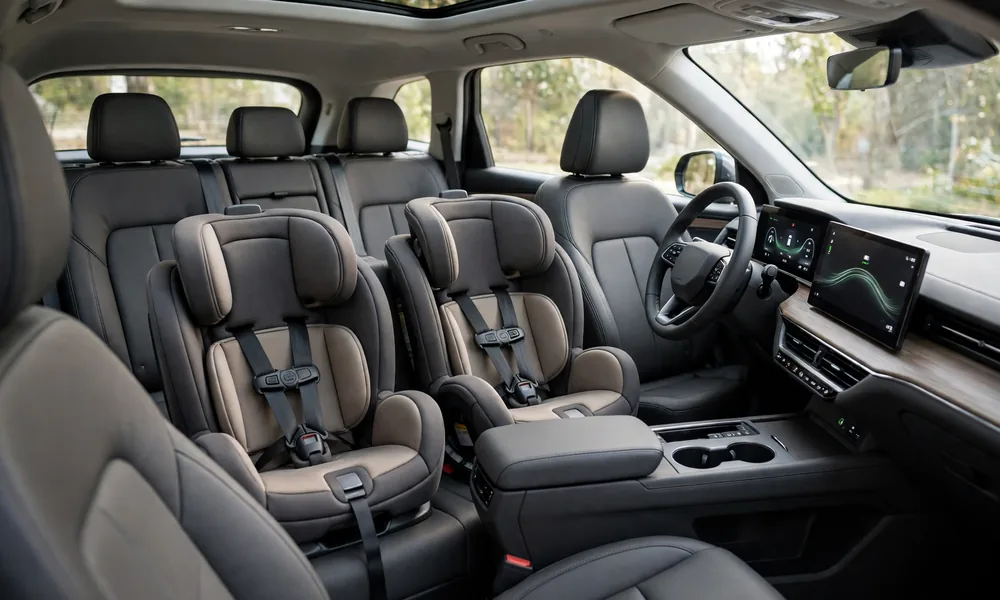
Check that your car seats fit without forcing the front seats forward, and that adults can still sit comfortably beside them. Three-row SUVs are ideal when the third row is only used occasionally, but if you carry six or seven people every day, a minivan is far easier to live with. If you are torn between body styles, our guide to the SUV vs minivan for family travel breaks down the practical trade-offs in detail.
Safety Features
Every car in this guide comes with automatic emergency braking, blind-spot monitoring, and rear cross-traffic alert, but check the exact specification of the trim you are buying. Look for a 360-degree camera if you park in tight spaces, and rear occupant alert if you have small children. A larger, heavier car is not automatically safer: modern driver assistance systems prevent more accidents than extra bulk ever will.
Running Costs
Fuel is only part of the cost of running a family car. Check insurance quotes before you buy, because larger hybrids can cost more to insure, and look at servicing costs and tyre prices. Hybrid batteries are covered by long warranties, typically eight to ten years, and replacement is rare within a normal ownership period. If you tow a trailer or caravan, read our comparison of hybrid vs diesel cars for towing before deciding which powertrain suits your holidays.

Hybrid vs Electric for Family Duty
Electric cars are cheaper to run per mile, but they ask more of a family: home charging, longer stops on road trips, and higher purchase prices. A hybrid asks for nothing new. You fill it in five minutes at any petrol station and drive on, which is a genuine advantage on a 400-mile holiday drive with tired children in the back. For households with one car, or without a driveway charger, a hybrid is the lower-stress choice in 2026. Our detailed look at hybrid vs electric cars for range explains where each technology wins and where it loses.

Family Hybrid Buying Checklist
- Fit all your car seats at the dealer and check that front passengers still have enough legroom.
- Test the boot with your pushchair, weekly shop, and luggage, not just with an empty floor.
- Check the third row in person: sit in it yourself before assuming children will be comfortable there.
- Compare real-world fuel economy from owner reports, not just the official combined figure.
- Get insurance quotes for your top two choices before you sign anything.
- Confirm the hybrid battery warranty length and what it covers, and check servicing costs for the hybrid system.
Frequently Asked Questions
Are hybrid cars good for families?
Yes. Modern family hybrids offer the same space and safety as their petrol equivalents, with far better fuel economy and no need to plug in. Most family driving is short, stop-start journeys, which is where hybrids save the most fuel.
How long do hybrid batteries last?
Hybrid batteries are designed to last the life of the car and are typically covered by an eight to ten year warranty. In practice, most last well beyond 150,000 miles, and replacement is uncommon.
Do hybrid cars cost more to service?
Servicing costs are similar to petrol cars, and in some cases lower, because the brakes last longer thanks to regenerative braking. The hybrid system itself rarely needs attention outside of scheduled servicing.
Can a hybrid car tow a trailer or caravan?
Yes, many family hybrids can tow between 1,500 and 3,500 pounds depending on the model, which covers small trailers and lighter caravans. Always check the exact towing capacity of the model and trim you are buying.
Is a hybrid or a plug-in hybrid better for families?
A conventional hybrid is simpler: no charging, no planning, and a lower purchase price. A plug-in hybrid suits families who can charge at home and mostly drive short distances. If you cannot charge at home, the conventional hybrid is the better choice.
Which hybrid SUV has the most space for families?
Among SUVs, the Toyota Highlander Hybrid and Hyundai Santa Fe Hybrid offer the most usable three-row space, but the Toyota Sienna Hybrid minivan beats every SUV for outright practicality, with up to eight seats and sliding doors.
The Bottom Line
For most families in 2026, the Toyota RAV4 Hybrid is the best all-round choice, the Honda CR-V Hybrid is the most comfortable, and the Toyota Highlander Hybrid is the best three-row option. If you need maximum space and the easiest daily life with small children, the Toyota Sienna Hybrid is still the most practical family vehicle you can buy.