
A kids camera is a real camera made for small hands, short attention spans and the occasional drop onto the pavement. It takes proper photographs, it survives being knocked about, and it is simple enough for a child to use without a grown-up explaining menus. A bad kids camera is fiddly, fragile or so slow that the moment is gone before the picture is taken, while a good one is tough, quick and fun enough that a child reaches for it again the next day. The best kids cameras of 2026 turn taking photographs into a game a child wants to keep playing.

What Makes a Kids Camera Good
The first thing to judge is toughness. A kids camera will be dropped, bumped and left in the sand, so one that cracks after a single fall wastes money. The best kids cameras have a thick rubbery body, a protected lens and a chunky grip that small hands can hold. A camera that survives the first month is a camera a child can trust, and a camera a child can trust is one they will actually use.
The second thing is simplicity. A child does not want menus and settings, and a camera with too many buttons will sit in a drawer while the child goes back to asking for a phone. The best kids cameras have one big shutter button, a simple way to look back at photographs, and a screen that is bright in daylight. A child should be able to switch it on, take a photograph and see it straight away, with no help at all.
The third thing is picture quality that is good enough to be proud of. A kids camera does not need to match a grown-up camera, but photographs should be sharp, bright and full of colour, so a child can print them and pin them on a wall. The best kids cameras take clear photographs in daylight and keep colours looking natural. A child who likes their photographs will take more of them, and that is how a child learns to look at the world.
The Main Types of Kids Camera
Simple point-and-shoot kids cameras are the classic choice. They have a sturdy body, a fixed lens, a big screen on the back and very few buttons, and they are the best choice for most children, because they do the hard work and let the child concentrate on what to photograph. They suit children from about four years old, they are the easiest to learn, and they are usually the cheapest option. The trade-off is control: a child cannot zoom far or change much, but for a first camera that is a strength rather than a weakness.
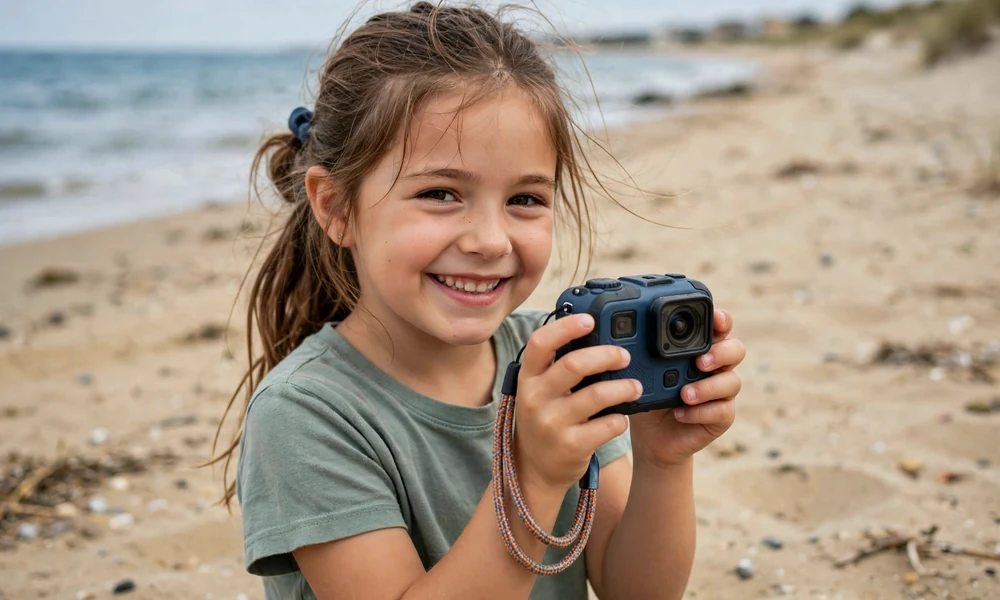
Waterproof kids cameras are the adventurous option. They can be taken to the beach, the pool and out in the rain, they survive splashes and sand, and they are the best choice for a child who spends a lot of time outdoors. They suit holidays and summer days, and they open up a whole new set of photographs, from rock pools to paddling pools. The downside is the size: a waterproof camera is often a little bigger and heavier, and the waterproof cover can make the buttons slightly harder to press. For a child who loves water, a waterproof camera is the one that works.
Instant-print kids cameras are the sociable option. They print a small photograph straight out of the camera, giving a child something to hold, share and stick in a scrapbook. They suit birthdays and family days out, and they are the most rewarding option, because the photograph appears within moments. The downside is the cost of the paper, which adds up, and the photographs are small. If you like photographs you can hold, our guide to the best instant cameras covers the wider range, including models that suit older children and grown-ups.
The Best Kids Cameras of 2026
The best overall kids camera is the tough, simple point-and-shoot that does everything well. It has a chunky rubbery body that survives drops, a bright screen, a big shutter button and photographs that are sharp and colourful in daylight. It suits children from about five years old, it is light enough to carry all day, and it needs no help from a grown-up once it is switched on. It is the camera to buy when you want one camera that works for birthdays, holidays and everyday adventures, and it is the one most children will still be using a year later.
The best kids camera for younger children is the smallest, lightest model with the fewest buttons. It has a soft grip that fits a four-year-old’s hands, a single shutter button that is easy to find, and a screen that shows each photograph straight away. It suits a first camera, it is cheap enough that a drop does not matter much, and it is simple enough that a young child can use it without asking for help. It is the camera to buy when the child is just starting out and the most important thing is that taking photographs feels easy and fun.
The best waterproof kids camera is the one that is genuinely tough in and near water. It survives being dunked, splashed and dropped on wet sand, it has a strap that keeps it safe around a child’s wrist, and it takes clear photographs in bright sunlight. It suits beach holidays, pool days and rainy walks, and it is the camera to buy when water is part of the fun rather than something to avoid. Check the waterproof rating before you buy, and rinse the camera in clean water after a day at the beach.
The best instant-print kids camera is the one that prints quickly and keeps the paper affordable. It prints a small photograph within moments, the paper is easy to load, and the photographs are bright enough to stick on a wall or give to a grandparent. It suits children who love making and sharing, and it is the camera to buy when the photograph itself is the reward. Keep spare paper at home, because a child who loves printing will use it up faster than you expect.
The best kids camera for video is the one with a simple video button and fun effects that do not get in the way. It records clear short clips, it has a few silly frames and filters that children love, and it is easy to play clips back on the screen. It suits children who like telling stories and making little films. For the grown-up side of the family, our guide to the best cameras covers the full range, from simple models to cameras that suit serious photography.
Choosing by Age
For children aged three to five, the best camera is the simplest one you can find. It should be small, light, very tough and have almost no buttons, because a young child will judge a camera by whether they can use it on their own. A wrist strap stops it hitting the floor, and a bright colour helps a child find it in a toy box. At this age, the fun of taking photographs matters more than picture quality.
For children aged six to eight, the best camera is one with a little more to explore. A child of this age can handle a zoom, a few fun effects and a simple way to delete photographs they do not like. A slightly better lens rewards them with sharper pictures, and short video keeps them interested for longer. This is the age when a child starts to have opinions about their photographs, so a camera that lets them choose is the right step up.
For children aged nine and older, the best camera is one that starts to feel like a real camera. An older child can handle more buttons, a better zoom and a camera that works well indoors as well as outdoors, and they may be ready for photographs good enough to print large. A serious young photographer may be ready to share a grown-up camera, while a child who still wants fun effects will be happier with a playful model. A tablet can be a useful companion for looking at photographs, and our guide to the best kids tablets covers the models that suit the same age group.
What to Check Before You Buy
Check the battery first, because a kids camera that needs charging every hour is a camera that will be left at home. The best kids cameras last a whole day of normal use, charge with a simple cable, and tell a child clearly when the battery is running low. A camera that uses ordinary batteries can be handy on holiday, but a rechargeable camera is cheaper to run at home. Whichever you choose, charge the camera the night before a day out, and keep a spare cable in the bag.
Check the memory next, because a child who takes a hundred photographs a day will fill a small card very quickly. The best kids cameras take a standard memory card, and a larger card costs very little and saves a lot of frustration. Teach a child to look through their photographs at the end of the day, keep the ones they love and delete the ones they do not, because choosing is part of learning photography. A camera with a full card is a camera that cannot take the next photograph, and the next photograph is often the best one.

Looking After a Kids Camera
A kids camera does not need much care, but a little care goes a long way. Wipe the lens with a soft cloth when it gets smudged, because a dirty lens makes every photograph look cloudy, and keep the camera in a small bag when it is not being used. Teach a child to use the strap every time, because most drops happen when a camera is carried in a hand rather than worn.
Questions Parents Ask
What age should a child get their first camera? Most children are ready at about four years old, when they can hold a camera steady, press a button on purpose and understand that the camera needs to be looked after. A younger child will enjoy a toy camera, but a real camera is better saved until they can use it without breaking it in a day. The right age depends on the child, and a careful three-year-old may be readier than a boisterous five-year-old.
Is a kids camera better than a phone? For a young child, a kids camera is better, because it is tougher, simpler and made for taking photographs, while a phone is fragile, expensive and full of distractions. A camera lets a child concentrate on looking at the world, while a phone invites them to play games and watch videos. An older child may be ready for a phone, but a camera is still the better way to learn photography.
Our Verdict
The best kids cameras of 2026 are tough, simple and fun, and the right one is the one that fits the child who will use it. For most families, a sturdy point-and-shoot is the best place to start, with a waterproof model for beach holidays and an instant-print model for children who love sharing. Choose by age, check the battery and the memory, and let the child hold the camera before you buy.


