Knife Sharpeners That Bring a Dull Edge Back in 2026
A dull knife is the most dangerous tool in the kitchen. It does not cut, it skids, and the extra force it demands sends a blade sideways across a knuckle. A good knife sharpener fixes that in minutes. The choice comes down to three families: whetstones, which give the sharpest edge and demand the most skill; pull-through sharpeners, which give a good edge with almost no learning; and electric sharpeners, which give a consistent edge at the push of a button.
Every kitchen knife goes dull, however much it cost. Steel is soft enough to cut food and hard enough to hold an edge, so the edge folds and chips a little with every use. A £200 chef’s knife and a £20 supermarket knife both need sharpening; the expensive one simply holds its edge longer. Sharpening is not a mystery: remove a small amount of metal at a consistent angle until the edge is straight again, then refine it until it is smooth. The sharpener you choose decides how much of that process you do by hand.
Key Takeaways
- Whetstones produce the sharpest, longest-lasting edge, but they need practice and about ten minutes per knife.
- Pull-through sharpeners are the best choice for most home cooks: they hold the angle for you and restore a working edge in under a minute.
- Electric sharpeners are the fastest option for a full knife block, but they remove more metal, so they shorten a knife’s life if used weekly.
- Most Western kitchen knives sharpen at 20 degrees per side; Japanese knives sharpen at 15 degrees, and a sharpener that forces the wrong angle will blunt the edge.
- A honing rod does not sharpen a knife, it straightens a folded edge: maintenance between sharpenings, not a replacement for them.
What Sharpening Actually Does
A knife edge is a thin wedge of steel that folds to one side, chips, and rounds off at the tip with use. Sharpening grinds that wedge back to a clean V, removing a little metal. Honing, what a steel rod does, pushes the folded edge back upright without removing metal. Honing keeps a good edge working for weeks; sharpening rebuilds one that has gone past honing. A knife that skids across a tomato skin instead of biting into it needs sharpening.
The number that controls the result is the angle. Hold a knife at 15 degrees and you get a fine, keen edge that slices beautifully and needs care. Hold it at 20 degrees and you get a tougher edge that survives bones and hard squash. Most European knives are ground at 20 degrees per side, most Japanese knives at 15 degrees, and a fixed-angle sharpener does the hardest part of the job for you. The second number is the grit: coarse grits around 200 to 400 repair chips, medium grits around 1000 reshape the edge, and fine grits around 3000 to 6000 polish it smooth.
The Three Families, Compared
| Type | Edge quality | Speed per knife | Skill needed | Metal removed | Best for |
|---|---|---|---|---|---|
| Whetstone | Excellent | 8–12 minutes | High | Very little | Good knives |
| Pull-through | Good | Under 1 minute | None | Moderate | Home kitchens |
| Electric | Good, consistent | 1–2 minutes | None | Most | Full knife blocks |
| Honing rod | Maintenance only | 30 seconds | Low | None | Between sharpenings |
Whetstones: the Sharpest Edge, the Steepest Learning Curve
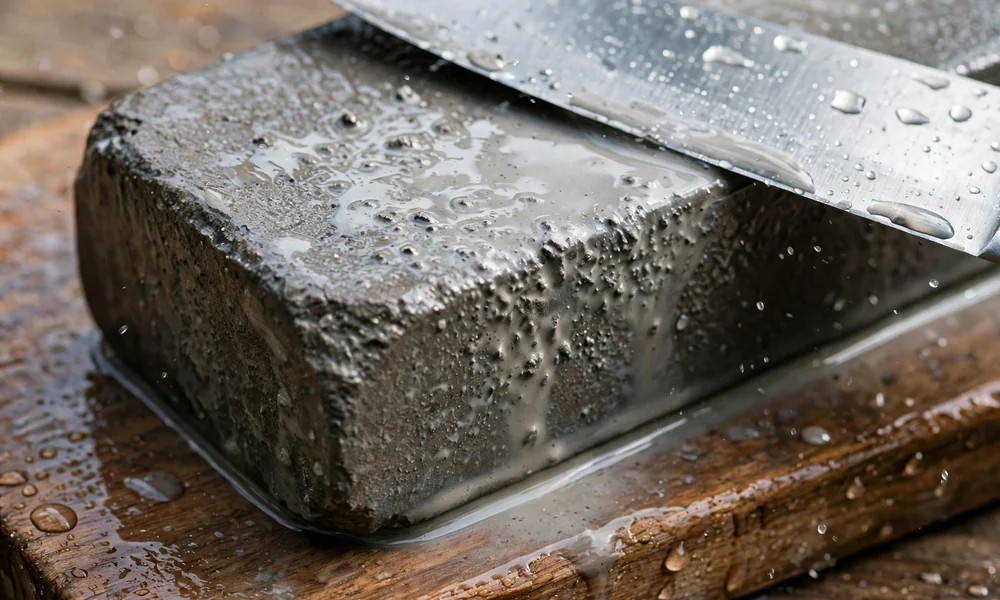
A whetstone is a block of abrasive, soaked in water and used by drawing the blade across it at a steady angle. A combination 1000/6000 stone covers most home sharpening: coarse rebuilds the edge, fine polishes it. The result is the sharpest edge any home method produces. The cost is skill: holding a steady 15 or 20 degree angle for a hundred strokes takes practice. An angle guide, a small clip that holds the blade at a fixed angle, removes most of the difficulty and is worth buying with the first stone. For a cook who owns good knives and enjoys the process, nothing comes close.
Pull-Through Sharpeners: the Best Choice for Most Kitchens
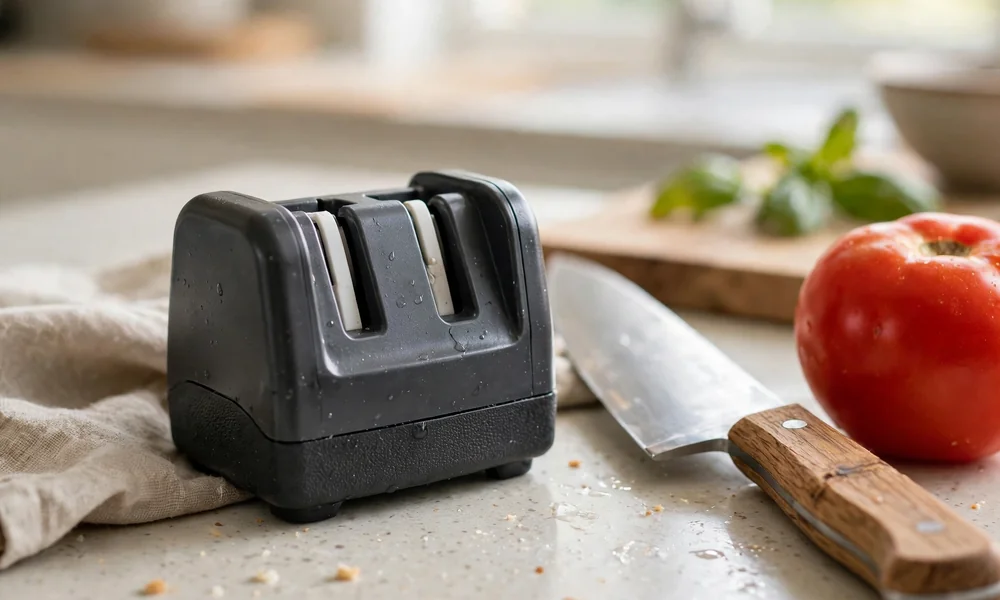
A pull-through sharpener is a small block with two or three slots lined with ceramic or carbide at a fixed angle. Draw the knife through the coarse slot a few times, then the fine slot. The whole job takes under a minute, the angle is held for you, and there is nothing to soak or plug in. The edge is not as fine as a whetstone edge, and carbide slots remove more metal than a stone, so a knife sharpened this way weekly will wear faster than one sharpened on a stone twice a year. For a normal home kitchen, that trade is worth it: a working edge in a minute beats a perfect edge that never happens because the stone sits in a drawer. Choose ceramic finishing slots rather than carbide alone, because ceramic removes less metal and leaves a smoother edge.
Electric Sharpeners: Fast, Consistent, and Hungry for Steel
An electric sharpener spins abrasive wheels at a fixed angle and pulls the blade through in stages. It is the fastest way to sharpen a whole knife block, gives the same result every time, and needs no skill. The trade-off is metal removal: the wheels are aggressive, and a knife run through one every month will lose years of its life. Use it two or three times a year and it is harmless. Electric sharpeners also struggle with very long blades, serrated knives and single-bevel Japanese knives. They suit a household with a full set of mid-priced knives and no interest in learning to use a stone.
Honing Rods: Maintenance, Not Sharpening
A honing rod, the long steel stick in most knife blocks, does not remove metal and does not create a new edge. It pushes a folded edge back upright, restoring cutting performance for a few weeks. Use it every few cooking sessions, with light strokes at the same angle as the knife’s edge, and the time between real sharpenings doubles. A ceramic rod removes a tiny amount of metal and sits halfway between honing and sharpening. Neither replaces a sharpener: if the knife will not cut a tomato after honing, it needs sharpening.
Angles and Grits: the Two Numbers That Matter
Most Western knives are ground at 20 degrees per side; most Japanese knives at 15 degrees per side. Sharpening a Japanese knife at 20 degrees will not damage it, but it will replace the fine edge with a blunter one. A Western knife at 15 degrees gets a keener edge that chips more easily on hard food. Match the sharpener to the knives: a fixed 20 degree angle suits Western knives, a 15 degree model suits Japanese knives, and an adjustable model suits a mixed drawer. Whetstones let you choose any angle, which is their great advantage.
Grit works the same way. A 1000 grit stone is a medium abrasive that reshapes an edge. A 3000 to 6000 grit finish polishes it smooth, and the difference shows in a tomato: a 1000 grit edge cuts it, a 6000 grit edge glides through it. A chipped edge needs a coarse 200 to 400 grit first; no fine stone can fix it on its own. For a first purchase, a combination 1000/6000 stone or a two-stage pull-through covers everything a home cook needs. The numbers reduce to one rule: coarse to repair, medium to sharpen, fine to finish.
Which Sharpener Fits Which Knife?
The sharpener has to fit the knives it will meet. A chef’s knife, a santoku and a paring knife all sharpen on any of the three families. Serrated knives cannot go through a pull-through or electric sharpener, because the slots flatten the teeth; they need a narrow ceramic rod or a professional service. Single-bevel Japanese knives need a whetstone, because a fixed-angle sharpener will grind the flat side and ruin the geometry. If the drawer holds a bread knife and a Japanese knife alongside the chef’s knife, the whetstone is the only single tool that covers all three.
The sharpener is one part of a working kitchen. Our comparison of the best and worst knives of 2026 covers which blades are worth sharpening, because no sharpener can save a knife made from steel that will not hold an edge. A sharp knife beside dull cast iron is still a compromise: our guide to the best cast iron skillets covers the other workhorse that rewards a little care. And the cookware around the knives matters too: our guide to the best cookware sets of 2026 covers pots and pans that last as long as a well-kept knife.
Before You Buy: the Knife Sharpener Checklist
- Match the angle to your knives: 20 degrees per side for Western knives, 15 degrees for Japanese knives, adjustable for a mixed drawer.
- Check that the sharpener handles the knives you own, including serrated blades.
- Buy a combination of grits: coarse to repair, medium to sharpen, fine to finish.
- Choose ceramic finishing over carbide alone, because it removes less metal and leaves a smoother edge.
- Budget for a honing rod as well as a sharpener, because honing doubles the time an edge lasts.
- Test the result with the tomato or paper test; if the knife still fails, the edge needs more work, not a different sharpener.

Frequently Asked Questions
How often should I sharpen my kitchen knives?
A chef’s knife used most days should be sharpened two to four times a year and honed every few sessions. A knife used once a week needs sharpening once or twice a year. Sharpening more often than needed removes metal for no benefit.
Can a pull-through sharpener ruin a good knife?
It will not ruin it, but it will wear it faster than a whetstone, because carbide slots remove more metal. On a mid-priced knife that is a fair trade for the convenience. On a £200 Japanese knife, the metal loss and the fixed angle make a whetstone the better choice.
What is the difference between honing and sharpening?
Honing pushes a folded edge back upright without removing metal, and it restores a knife that is slightly dull. Sharpening grinds a new edge by removing a small amount of metal. A honing rod is maintenance; a sharpener is repair.
Can I sharpen serrated knives at home?
Yes, with a narrow ceramic rod worked through each serration one at a time, matching the angle of the bevel. It is slow work, about ten minutes for a bread knife. Pull-through and electric sharpeners will flatten the teeth and should never be used on serrated blades.
Do I need to soak a whetstone before use?
Most water stones need soaking for about ten minutes until the bubbles stop. Some stones are splash-and-go and only need a sprinkle of water. A stone used dry clogs quickly, cuts slowly, and can glaze over, so water is not optional.
What angle should I sharpen a chef’s knife at?
Twenty degrees per side for a Western chef’s knife, fifteen for a Japanese chef’s knife. To find twenty degrees, hold the blade at forty-five degrees to the stone, then halve the gap, then halve it again. An angle guide clip does the same job exactly and costs very little. Consistency matters more than the exact number.
The Bottom Line
A sharp knife is safer, faster and more enjoyable than a dull one, and the sharpener that gets used is the right one. For most home cooks, a good pull-through sharpener with ceramic finishing slots is the honest answer: under a minute, no skill, a working edge every time. For a cook who owns good knives and enjoys the craft, a 1000/6000 whetstone with an angle guide gives the finest edge a home kitchen can produce. For a full knife block and no patience at all, an electric sharpener used a few times a year does the job. Buy the one that matches your knives and your habits, hone between sharpenings, and test the edge on a tomato.