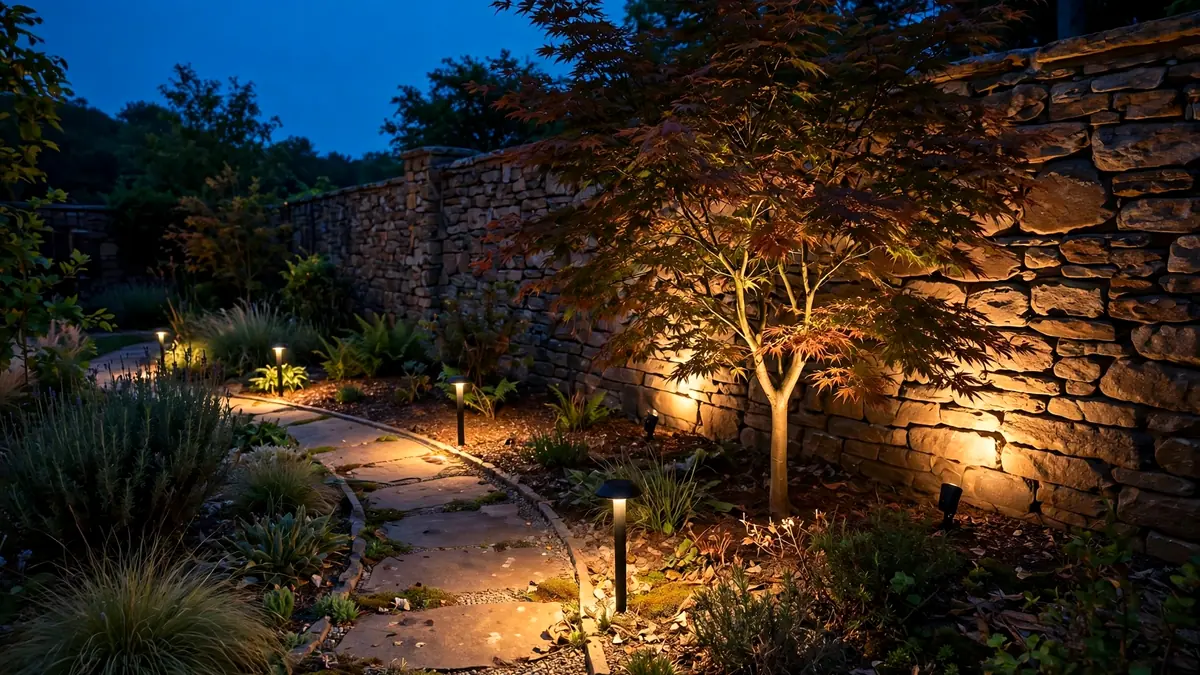
Top Landscape Lights for Gardens That Glow After Dark in 2026
The top landscape lights in 2026 do something no porch light or patio string can do: they turn the garden into the evening’s scenery. A tree lit from below, a wall washed with warm light, a path picked out in soft pools: these are design decisions, not just fittings. Landscape lighting is the discipline of lighting the garden as a place, layer by layer, so that after dark it still reads as a garden rather than a black hole with a bright door in it.
That discipline is different from general outdoor lighting, and different from solar garden lights. The best outdoor lights for porches, paths and patios in 2026 works zone by zone, porch then path then patio, and it is the right guide for the house itself. Landscape lighting starts where that guide stops: the beds, trees, walls and lawn, lit as a composition. It is mostly a wired, low-voltage system.

Key Takeaways
- Landscape lighting is a design system: plan the layers first, then buy fixtures to match.
- Low-voltage wired systems beat solar for landscape work: steady brightness, no fading by ten o’clock.
- Beam spread decides the effect: narrow beams pick out a tree or statue, wide beams wash a wall or hedge.
- A transformer with headroom and cable run with voltage drop in mind keeps far fixtures as bright as near ones.
- Light one or two features well and leave dark areas: a garden lit everywhere looks flat.
What Landscape Lighting Actually Is
Landscape lighting is the practice of lighting the planted and built parts of a garden as a designed scene. It borrows techniques from theatre and architecture: uplighting to make a tree read against the night sky, washing to give a wall an even glow, and moonlighting, where a fixture high in a tree throws soft light down through the branches.
That is a different job from lighting the house: a porch light welcomes visitors, a patio light lets people eat outside, a landscape light shows the garden. It is also a different job from solar lighting. Why solar lights are the easiest way to light your garden in 2026 covers the stake-and-panel lights that need no wiring, and they are excellent for marking a path. But solar lights are dim and fade as the battery drains. A landscape scheme needs fixtures bright at midnight as well as at dusk, and only a wired system reliably delivers that.
The system has four parts: a transformer that steps mains voltage down to 12 volts, a cable run buried under the soil or mulch, the fixtures, and the LED lamps inside them. Everything is designed together: transformer wattage, cable gauge, fixtures per run and distance to the farthest fixture all affect how bright the last light in the line is.
The Main Fixture Families
Each fixture family has one job it does better than the others. A good scheme uses three or four families together.
Path Lights
Path lights are low bollards or mushroom-capped stakes, usually 30 to 60 cm tall, that throw a pool of light down onto the walking surface. Their job is guidance, not brightness: a good path light shows the edge of the path and the next step without glare. Space them two to three metres apart, staggered from side to side.
Well Lights
Well lights sit flush with the ground, buried in a bed or a lawn, and throw their beam straight up. They are the uplighting fixture: put one at the base of a tree or a sculpture and it picks the feature out of the dark. Because they sit in the soil they need a sealed, waterproof housing, and a clear line up through the branches.
Spot Lights
Spot lights are small, adjustable fixtures on a stake or a short mount, and the most versatile family. Aim one up into a tree canopy, across a wall, or down from a high branch. Their beam is narrow, usually 15 to 40 degrees, so they pick out one feature at a time. Buy spots with an adjustable head and a movable spike: the right aim is found by standing back at night, not by guessing in daylight.
Wash Lights
Wash lights throw a wide, even beam, usually 60 degrees or more, across a flat surface: a wall, a fence, a hedge. Their job is to give the garden a background glow for the spots’ narrow beams to stand against. A washed wall behind a silhouetted tree is one of the oldest landscape tricks there is. Wash lights sit further back than spots, and they need to be level: a tilted wash light leaves a bright stripe at one end and darkness at the other.
Bollard Lights
Bollards are taller than path lights, usually 60 to 90 cm, and they mark boundaries and structure: the edge of a lawn, the corners of a terrace. They throw light in all directions at a low level, defining space rather than lighting a surface. Use them sparingly: three or four at the corners of a lawn give the garden its shape after dark.
Beam Spread and Angles
Beam spread decides what a fixture actually does. A narrow beam of 12 to 25 degrees throws a tight cone a long way, suiting a tall tree, a flagpole, a statue. A medium beam of 25 to 40 degrees suits a small tree, a shrub or a water feature at close range. A wide beam of 60 degrees or more is for washing walls and hedges, where even coverage matters more than distance.
Angle matters as much as spread. Uplighting, with the fixture at the base of the feature and the beam aimed up, makes a tree look taller and more dramatic. Downlighting, or moonlighting, puts the fixture high in a tree and aims the beam down through branches, throwing soft, moving shadows on the ground; it is the most natural-looking effect in the garden, because it mimics the moon. Grazing puts a fixture close to a textured surface, a stone wall or a tree trunk, with the beam running almost parallel to it, so every bump and groove throws a shadow.
Colour temperature ties the scheme together. Warm white, 2700K to 3000K, suits almost every garden: wood looks warm, leaves look green, stone looks soft. Cool white makes the same garden look like a car park. Buy every fixture in the same warm white.

Low-Voltage Systems: Transformers, Cable and Voltage Drop
A low-voltage landscape system runs at 12 volts, which is why it is safe to bury and install without an electrician in most places. The transformer is the heart of it: it plugs into a mains socket and steps the voltage down. Size it with headroom: add up the wattage of every fixture, then buy a transformer rated at least 20 percent higher. A transformer at its limit hums, runs hot and shortens lamp life; one with headroom runs cool and quiet for years.
Voltage drop is the problem that catches beginners: a 12-volt cable loses voltage along its length, so a fixture 30 metres from the transformer can be noticeably dimmer than one 3 metres away. The fix is thicker cable and smarter layout: use 12-gauge cable for long runs, keep the transformer central, and split the fixtures across two or three runs instead of daisy-chaining everything onto one long line. A hub layout, where each run goes out from a central junction near the transformer, evens the brightness out.
Connections are where systems fail. Every joint should be a proper waterproof connector, filled with silicone grease, and buried under mulch. The cheap twist connectors supplied with some kits corrode within a season and the fixture goes dark. Cable should be buried 10 to 15 cm deep, or run through conduit where a spade or a mower might reach it. Mark the route with a photo on your phone when you bury it.
Landscape Lights at a Glance
| Fixture | Best For | Beam | Power | Strength |
|---|---|---|---|---|
| Path Light | Walkways | Downward | 3–5 W | Soft pools |
| Well Light | Trees | Upward | 5–7 W | Flush with soil |
| Spot Light | Features | 15–40 degrees | 4–8 W | Adjustable aim |
| Wash Light | Walls | 60 degrees plus | 7–12 W | Even background glow |
| Bollard Light | Lawn edges | All-round | 4–6 W | Defines shape |
Layering a Garden in Light
A good landscape scheme has three layers, and the order matters. The first layer is the path and the steps: the practical light that lets people move safely. The second layer is the features: one or two trees, a wall, a water feature, lit with spots and well lights. The third layer is the background: a washed hedge or fence that gives the garden depth.
Start with one feature, not five. Pick the best tree or the most interesting wall and light it properly. Most gardens need only two or three lit features to feel complete, and lighting everything flattens the scene: with no dark areas left, there is no depth. Leave the far corners dark on purpose. Darkness is part of the design.
Work outward from the house. Light the beds nearest the windows first, then move toward the back of the garden. And keep the deck and terrace in the plan: the best deck lights in 2026 covers the step and rail lights that belong to the deck itself, while the landscape fixtures pick up where the deck ends and the garden begins.

Landscape Lighting Checklist
- Walk the garden at dusk and pick one or two features to light first.
- Choose a 12-volt system with a transformer rated 20 percent above total wattage.
- Match beam spread to the job: narrow beams for trees and statues, wide beams for walls and hedges.
- Keep every fixture the same warm white, 2700K to 3000K.
- Split long cable runs and use thicker cable, so the farthest fixture is as bright as the nearest.
- Aim and adjust at night, and leave dark areas on purpose for depth.
Frequently Asked Questions
Are landscape lights the same as outdoor lights?
No. Outdoor lights cover the house: porch, patio, steps and security. Landscape lights cover the garden itself, lit as a designed scene. A garden can have both, and they work best when the landscape fixtures pick up where the house lighting stops.
Do I need a transformer for landscape lights?
Yes, for a wired low-voltage system. The transformer steps mains voltage down to 12 volts, which is safe to bury and handle. Solar lights have no transformer, but they are dimmer and fade through the night.
How far apart should path lights go?
Two to three metres apart, staggered so the pools of light overlap gently. Closer wastes money and creates bright spots; further apart leaves dark gaps. Walk the path at night and move any light that glares into your eyes.
What is voltage drop, and why does it matter?
Voltage drop is the loss of voltage along a cable run, and it makes the farthest fixtures dimmer than the nearest ones. It matters because a scheme needs even brightness. Use thicker cable, keep runs short, split fixtures across several runs, and put the transformer near the middle of the garden.
Can I install landscape lighting myself?
Yes, for a 12-volt system: the low voltage is safe to bury and connect without an electrician in most places. The mains socket should already exist or be fitted by an electrician.
How do I keep landscape lights looking good in winter?
Choose fixtures rated at least IP65 for anything sitting in soil or fully exposed to rain, and clear leaves off well-light lenses. Check the waterproof connectors once a year, and trim back growth that has swallowed a fixture.
Bottom Line
Start with one tree and one wall, a wired 12-volt system, and warm white fixtures matched by beam spread to the job. Layer path, feature and background light, leave the dark areas dark, and the garden holds its shape after dark.