
How to Pick Laundry Detergent Pods That Actually Clean in 2026
Laundry detergent pods promise the simplest wash of all: one pod, no measuring, no spills. Yet anyone who has found a half-dissolved pod stuck to a shirt, or whites that still smell of sweat, knows the promise does not always hold. The difference between pods that clean and pods that disappoint is rarely the brand on the tub. It is the formula inside the pod, the water it dissolves in, and whether the fixed dose matches the load.
A pod is a pre-measured dose of concentrated detergent sealed in a water-soluble film. When it works, the film dissolves early, the detergent spreads evenly, and the load comes out clean. When it does not, the film survives a cold or short wash, or a single pod is too little for a full, dirty load. This guide explains how to pick pods that clean properly in 2026.
Key Takeaways
- Put the pod in the drum first, before the clothes, so water reaches it straight away and it dissolves fully.
- One pod suits a normal 7-kilogram load; a full or heavily soiled load needs two.
- Cold-water pods matter: ordinary pods can leave film behind in a 20-degree wash, while cold-water formulas dissolve properly.
- Look for enzymes on the ingredient list: they break down sweat, food and body oils at low temperatures.
- Store pods in a sealed tub, high up and out of reach of children.

What Makes a Pod Clean Well or Badly
The first thing to check is the formula. A good pod contains surfactants, which lift dirt and grease off fibres, and enzymes, which break down sweat, food, grass and body oils. Enzymes are why a good pod cleans well in a cold wash, because they work at low temperatures. A pod with no enzymes listed is unlikely to clean heavily soiled clothes well. Fragrance is not cleaning power: a strongly scented pod can smell clean while leaving dirt behind, and scent often irritates sensitive skin.
The second thing is the film. It needs enough water, time and warmth to dissolve. In a cold, short or heavily packed wash, it may only partly dissolve, leaving a sticky patch on clothes. Pods labelled for cold water dissolve at 20 degrees, and they are the right choice for households that wash mostly cold. Whatever the pod, never put it in the drawer: it belongs in the drum, at the back, before the clothes go in.
The third thing is the dose. A pod is a fixed dose, and that is both its appeal and its weakness. For a normal load, one pod is right. For a small load, one pod is more detergent than you need, which wastes money and leaves residue. For a full 8- or 9-kilogram load, or muddy sports kit, one pod is too little. You cannot use half a pod, so the honest test is whether your usual load matches a single pod.
The Main Pod Types Compared
1. Single-Chamber Pods
Single-chamber pods hold one liquid detergent in a single pouch, and they are the simplest and cheapest pods to buy. They clean everyday loads well and dissolve reliably in a normal 30- or 40-degree wash. Their weakness is that one formula has to do everything, so they are weaker on stains and whites than multi-chamber pods.
2. Three-in-One Pods
Three-in-one pods hold detergent, stain remover and a softener or scent booster in separate chambers. They are the best pods for a household that wants one product to do the whole job, and they clean noticeably better on stained and smelly loads. Their weakness is cost, and the softener can leave a coating on towels that makes them less absorbent.
3. Cold-Water Pods
Cold-water pods are made to dissolve and clean at 20 degrees, and they are the best choice for households that wash mostly cold. Their film dissolves faster in cool water, and their enzymes work at low temperatures, so they avoid the half-dissolved film ordinary pods leave behind in a cold wash. They cost more, and are unnecessary if you wash mostly at 40 degrees or above.
4. Sensitive-Skin Pods
Sensitive-skin pods are fragrance-free and dye-free, with a shorter ingredient list and no optical brighteners. They are the best pods where someone gets itchy after wearing freshly washed clothes, because fragrance is the most common irritant in laundry detergent. Their weakness is the fixed dose: for a small load, one pod is more product than sensitive skin needs. For gentle washing, our guide to the best laundry detergents for sensitive skin in 2026 covers the labels that matter.
5. Scented and Colour-Care Pods
Scented pods add a lasting fragrance, and colour-care pods add ingredients meant to keep darks from fading. They suit bedding and towels, where a pleasant scent lasts. Their weakness is that fragrance can irritate skin and mask poor cleaning, and the best protection for dark clothes is still a cold wash, turned inside out.

Laundry Detergent Pods Compared
| Pod type | Best for | Watch out for | Cost per wash |
|---|---|---|---|
| Single-chamber | Everyday loads, tight budgets | Weaker on stains and whites | Low |
| Three-in-one | Stained, smelly loads | Softener coats towels; highest cost | High |
| Cold-water | Washing at 20 degrees | Unnecessary above 40 degrees | Mid to high |
| Sensitive-skin | Fragrance-free, gentle washing | Fixed dose too much for small loads | Mid |
| Scented, colour-care | Bedding, towels, fresh smell | Fragrance can irritate skin | Mid |
How to Use Pods So They Actually Clean
Technique matters as much as the pod. Always put the pod in the drum first, at the back, before the clothes, so water reaches it the moment the cycle starts. Never put a pod in the detergent drawer, and never place it on top of the clothes, where it can stick to one item. Do not overload the machine: a drum packed tight leaves no room for water to circulate. Leave a hand’s width of space at the top.
Match the cycle to the load. A quick 15-minute wash is fine for lightly soiled clothes, but too short for a pod to dissolve fully and for enzymes to work on stains, so use a standard cycle for anything dirty. Cold washes need cold-water pods; with standard pods, wash at 30 degrees or above. For stains, treat them first: a dab of stain remover beats any pod. Our guide to top stain removers for everyday laundry in 2026 covers the products that earn their place beside the pods.
Pods vs Liquid vs Powder
Every format cleans, but they behave differently. Liquid is the most flexible: it dissolves fully and lets you measure an exact dose, so it wins for small loads and sensitive skin. Powder is the cheapest per wash and excellent on whites and muddy clothes, but it needs warm water to dissolve fully. Pods are the most convenient, but the most expensive per wash and the least flexible, because the dose is fixed. Sheets are the newest option, but weak on heavy stains.
The honest choice depends on your laundry. If your loads are mostly the same size and you hate measuring, pods are a good fit. If your loads vary, liquid saves money and avoids overdosing. If you wash hot and have hard water, powder is the best value. Many households use two formats: pods for the regular wash, and liquid or powder for loads that do not fit a single pod.
Cost, Storage and Safety
Pods cost more per wash than liquid or powder, because you pay for the pre-measured dose and the soluble film. The gap narrows if you were overdosing liquid before, but widens if you use two pods for full loads. Buy the largest tub you will use within a few months, because the price per pod falls sharply with pack size, and check the cost per wash rather than the price of the tub.
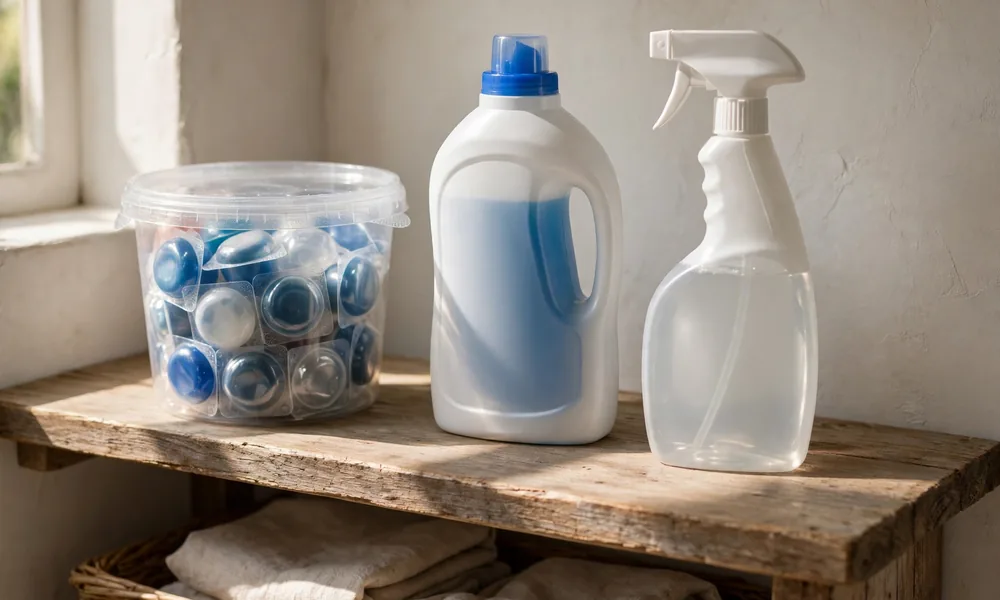
Storage and safety deserve the same attention as cleaning. Keep pods in their original tub, sealed, in a dry place, and handle them with dry hands, because damp makes the film sticky and pods clump together. Keep the tub high up and out of reach of children: pods look like sweets and are harmful if bitten or swallowed. If a child swallows one, seek medical advice straight away. A pod that has gone sticky should be thrown away, because it will not dissolve properly.
Buying Checklist: Six Checks Before You Pay
- Check the ingredient list for enzymes, and choose cold-water pods if you wash mostly at 20 degrees.
- Match the pod to your usual load: one pod should suit a normal 7-kilogram load, not a small one.
- Pick fragrance-free pods if anyone in the house has sensitive skin, and skip scented pods for baby clothes.
- Work out the cost per wash, not the price of the tub, and compare it with the liquid you used before.
- Check the tub seals properly and keep it out of reach of children.
- Buy a small pack first, and test it for two weeks before committing to a large tub.
Frequently Asked Questions
Why did my pod not dissolve?
A pod usually fails to dissolve because the wash was too cold, too short, or the drum was too full for water to reach it. Use cold-water pods for cold washes, a standard cycle for dirty loads, and put the pod in the drum first, before the clothes, with a hand’s width of space at the top.
Can I use two pods for a large load?
Yes. One pod suits a normal 7-kilogram load, and a full 8- or 9-kilogram load, or a heavily soiled one, needs two. Put both pods in the drum first, and do not use two pods for a normal load, because the extra detergent leaves residue and wastes money.
Are pods safe for all washing machines?
Pods are safe for front-loaders and top-loaders, including high-efficiency machines, provided the pod goes in the drum and the load is not overloaded. Check your machine’s manual if you use a very short cycle, because some quick washes are too brief for a pod to dissolve fully.
Do pods work in cold water?
Standard pods can struggle in a 20-degree wash, leaving film on clothes. Cold-water pods are made for it, with a film and enzymes that work at low temperatures. If you only have standard pods, wash at 30 degrees or above for a reliable result.
Are pods better than liquid detergent?
Pods are better for convenience and for stopping overdosing, because the dose is fixed. Liquid is better for flexibility, small loads and sensitive skin, because you can measure an exact dose. Neither cleans better in principle; the best choice is the one that matches your usual loads.
How should I store detergent pods?
Keep pods in their original tub, sealed, in a dry place, and handle them with dry hands. Store the tub high up and out of reach of children, because pods look like sweets and are harmful if bitten. Throw away any pod that has gone sticky or clumped together.
The Bottom Line
The best laundry detergent pods in 2026 are the ones whose formula matches your wash: cold-water pods for cold washes, fragrance-free pods for sensitive skin, and three-in-one pods for stained loads, used one per normal load, in the drum first. Pick the pod for your usual load, not the brightest tub, and treat stains first, because no pod can rescue a wash that is too cold, too short, or too full. For the soft finish, our guide to dryer sheets that leave laundry soft without the residue in 2026 covers the next step.


