Why LED Strips Are the Easiest Room Upgrade in 2026
LED strips are the quickest way to change how a room feels without buying new furniture or repainting a wall. A single flexible strip, stuck behind a television or under a kitchen cabinet, can turn a flat, plain room into one that glows warmly in the evening and looks finished during the day. The best LED strips in 2026 are bright, easy to control from a phone, simple to cut to size, and cheap enough to transform a whole room for less than a single lamp.
The appeal is not just the colour. A strip behind a screen softens the contrast between a bright television and a dark wall, which is easier on the eyes during a film. A warm white strip under a kitchen cabinet lights the worktop where you chop and read recipes, without a shadow from your own body. This guide explains how to choose LED strips that stick properly, glow evenly, and last.
Key takeaways
- Buy a cuttable adhesive strip with a proper power supply, not a bare reel with a weak adapter.
- Measure the run first and add ten percent, because a strip that is too short cannot be stretched.
- Check the LED density: 60 LEDs per metre is the minimum for an even glow.
- Choose app control with a remote as backup, and check it works with the voice assistant you already own.
- Warm white between 2700K and 3000K suits living rooms and bedrooms; save rainbow colours for parties.
What an LED strip actually is
An LED strip is a long, thin, flexible circuit board with dozens or hundreds of small LEDs mounted along it, backed with adhesive tape so it sticks to a flat surface. Most strips run on low-voltage power, usually 12V or 24V, from a plug-in adapter, and the better ones can be cut to length at marked points and joined again with small connectors.
That makes LED strips very different from the decorative lights they are confused with. Fairy lights are individual bulbs spaced along a wire, made for draping loosely around a headboard or a shelf for a scattered, cosy glow, and our guide to the best fairy lights covers that softer, decorative job in full. String lights are heavier festoon-style bulbs on a thick cable, built to survive a garden or balcony all year, which is why our guide to how to pick string lights that last all year spends so much time on weatherproofing. An LED strip is neither: a continuous line of light that sits flat against a surface, hides out of sight, and washes a wall or worktop with an even glow. Smart bulbs are different again, because they screw into an existing socket and light a room from one point, while a strip spreads light along a whole edge; our guide to the best smart bulbs is the right read if you want to change the bulbs you already own.
The types of LED strip
Most strips sold today fall into four types, and the right one depends on where it will live.
RGB strips
RGB strips mix red, green, and blue LEDs to make millions of colours from one strip, controlled by a remote or an app. They are the classic choice behind a television or a gaming desk. Their weakness is white light: the white they make by mixing colours often looks slightly pink or blue, so they are a poor choice for a kitchen worktop.
RGBIC strips
RGBIC strips add a control chip to each section, so different parts can show different colours at the same time, creating the rainbow wave effects you see in gaming rooms. They cost more than plain RGB strips, and most people settle on one steady colour once the novelty fades, so only pay the premium if you genuinely enjoy the effects.
White-only strips
White-only strips produce a single warm or cool white and nothing else. They are the best choice for task lighting: under kitchen cabinets, inside wardrobes, or behind a bathroom mirror. Because every LED is a dedicated white diode, the light is cleaner and colours look truer than the mixed white from an RGB strip.
Outdoor strips
Outdoor strips come sealed in a silicone sleeve with a weatherproof rating, usually IP65 or better, and are made for patios, decking edges, and garden steps. An indoor strip used outside will fail at the first heavy rain.
| Type | Best for | White light | Price |
|---|---|---|---|
| RGB | TV glow, gaming desks | Fair, slightly tinted | Budget |
| RGBIC | Rainbow effects, parties | Fair, slightly tinted | Mid-range |
| White-only | Kitchens, wardrobes, worktops | Excellent, true colour | Budget |
| Outdoor | Patios, decking, steps | Good | Mid-range |

Where LED strips work best
Behind a television is the classic spot. A strip stuck to the back of the screen throws a soft halo onto the wall, reducing the harsh contrast between the bright screen and the dark room, an effect called bias lighting that makes long films easier on the eyes. Buy one a little shorter than the perimeter, so the glow stays even at the corners.
Under kitchen cabinets is the most useful spot in the house. A warm white strip mounted towards the front edge lights the whole worktop without a shadow, which makes chopping and cleaning far easier than a single ceiling light does. Fit it in an aluminium channel with a diffuser if you can: it hides the LEDs, spreads the light evenly, and stops the strip peeling off in a warm kitchen.
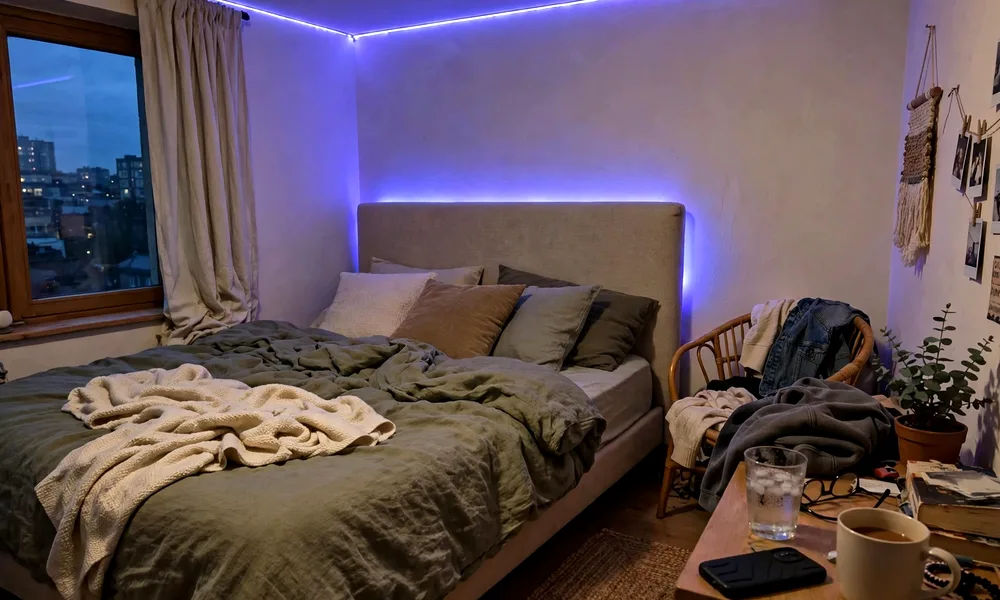
Bedrooms suit a strip along the ceiling edge or behind the headboard, run dim in a warm colour. At ten or twenty percent brightness it gives enough light to move around at night without waking anyone, and feels far calmer than a bedside lamp. A strip behind a desk shelf works the same way: a line of light where you need it, with the source out of sight.
Brightness, colour, and control
Brightness is measured in lumens per metre. For a gentle glow behind a television, around 300 to 500 lumens per metre is plenty. For a kitchen worktop, aim for 700 or more. A strip too dim for a kitchen will be left switched off, and one too bright for a bedroom will be turned down so far the colour washes out.
LED density decides whether the glow looks smooth or spotty. A strip with 30 LEDs per metre shows obvious bright dots when close to a wall. At 60 per metre the dots mostly disappear, and at 120 the light is a smooth, unbroken line. Density matters most when the strip is close to the surface, so pay for the denser strip in a bedroom or kitchen, and save money behind a television.
Colour temperature matters more than most people expect. Warm white between 2700K and 3000K suits living rooms and bedrooms, because it feels like lamplight. Neutral white around 4000K suits a kitchen or a desk, where you want to see clearly. Cool white above 5000K looks stark in a home and is best left to garages. Adjustable white as well as colour gives the best of both, but costs more.
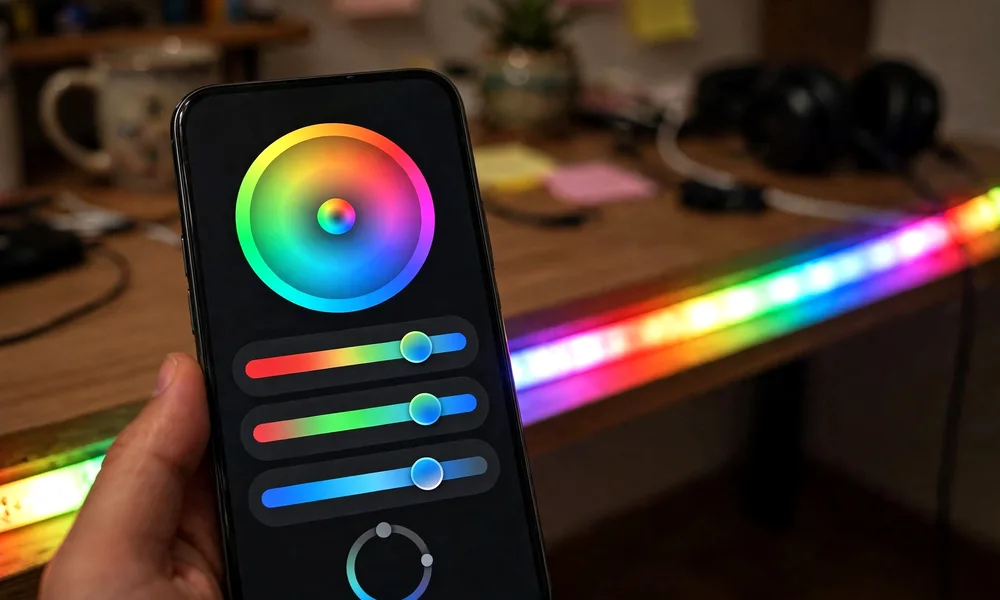
Control is where cheap strips disappoint. A basic remote works, but you will lose it, and the infrared signal needs line of sight to the controller. App control over Wi-Fi or Bluetooth is far better: dim the strip from the sofa, set a timer so it switches off after you fall asleep, and save a favourite colour. Check the app works with the voice assistant you already own before you buy.
Measuring, cutting, and sticking
Measure the run before you order anything, following the exact path the strip will take, including the drops around corners and the gap for the power lead. Add ten percent, because a strip too short cannot be stretched, while one too long can be cut down at the marked points. Those points are usually every five or ten centimetres, marked with a scissors symbol, and cutting anywhere else will kill the section beyond the cut.
Sticking is where most strips fail, and the fault is almost always the surface, not the tape. Clean it with a dry cloth, then wipe it with a little rubbing alcohol and let it dry completely. Dust, grease, and kitchen steam all weaken the adhesive, and a strip stuck to a dusty shelf will peel off within weeks. Press it firmly along its whole length. In a warm kitchen or above a radiator, add a few small mounting clips as insurance, because heat softens adhesive over time.
For corners, do not fold the strip sharply, because a hard fold can crack the circuit board and kill the LEDs beyond it. Use a short connector cable around a corner, or leave a small loop of slack, so the strip turns gently. If it must cross a gap, run it inside a channel so it has support all the way across.
Power and safety
Every strip needs a power supply matched to its length and wattage, and this is the part most people get wrong. Multiply the watts per metre printed on the reel by the length you are fitting, then buy a supply rated at least twenty percent higher than that total. A supply that is too small will run hot, dim the far end of the strip, and fail early. A five-metre strip at 10 watts per metre needs a 60-watt supply.
Voltage drop is the reason the far end of a long strip looks dimmer and redder than the end near the power supply. Keep single runs under five metres, and for longer runs feed power from both ends or split the strip into two shorter runs from the same supply. LED strips run on low voltage and stay cool, but the power supply plugs into the mains, so keep it somewhere dry and ventilated, and never run a strip under a rug or through a door that closes on it.
Checklist: choosing LED strips
- Measure the run along its exact path and add ten percent before ordering.
- Choose 60 LEDs per metre or more for a smooth glow with no bright dots.
- Pick warm white for bedrooms and living rooms, and bright white for kitchen worktops.
- Check the power supply is rated at least twenty percent above the strip’s total wattage.
- Clean the surface with rubbing alcohol and let it dry before sticking the strip down.
- Test the strip, the app, and the timer before you hide the cables and fix everything in place.
Frequently asked questions
Can you cut LED strips to size?
Yes, at the marked cut points every five or ten centimetres. Cut only on the marked line.
Do LED strips use much electricity?
No. A typical five-metre strip uses about 50 watts at full brightness.
Why is one end of my strip dimmer than the other?
That is voltage drop along a long run. Keep runs under five metres, or feed power from both ends, and the brightness will stay even.
Will LED strips damage paint when removed?
They can pull off weak paint. Warm the strip with a hairdryer on low and peel it slowly, and most paint will survive.
Can LED strips go in a bathroom?
Only strips with a waterproof rating, usually IP65 or better. A standard indoor strip will fail quickly in steam and splashes.
Do LED strips work without Wi-Fi?
Yes. Most strips work from a remote or a Bluetooth app.
The bottom line
The best LED strips in 2026 are the ones you barely notice once fitted: a warm white strip under the kitchen cabinets, a soft glow behind the television, a calm line along the bedroom ceiling. Measure first, buy a strip dense enough to glow evenly, match the power supply, and stick it to a clean surface. Do that, and one strip will quietly make a whole room feel finished.