Why Linen Cabinets Earn Their Place in Every Tidy Bathroom in 2026
The tidy bathroom is rarely the one with the most storage; it is the one where the storage fits what a household actually owns. Linen cabinets earn their place because they hold the bulky things that defeat every other bathroom store: folded towels, spare sheets, pillowcases and the bedding that never fits in a drawer. A good linen cabinet keeps a week’s worth of towels dry, aired and within reach. This guide explains which types suit which bathroom, and how to choose one that stays tidy. If your bathroom’s small items are the problem instead, our guide to medicine cabinets covers the mirrored cabinet above the sink; a linen cabinet is the bigger, taller store for everything else.
Key Takeaways
- A linen cabinet is tall, narrow storage for towels and bedding, not a mirrored cabinet for toiletries: the two solve different problems.
- Measure your tallest folded stack first, because a cabinet with shelves too close together wastes half its height.
- Freestanding cabinets suit renters and solid walls, while wall-hung cabinets suit small bathrooms that need the floor clear.
- Ventilation matters more than looks: towels stored in a sealed, steamy cabinet smell musty within days.
- Give every person or every use its own shelf, or the cabinet quietly becomes a shared pile again.
What a Linen Cabinet Actually Is
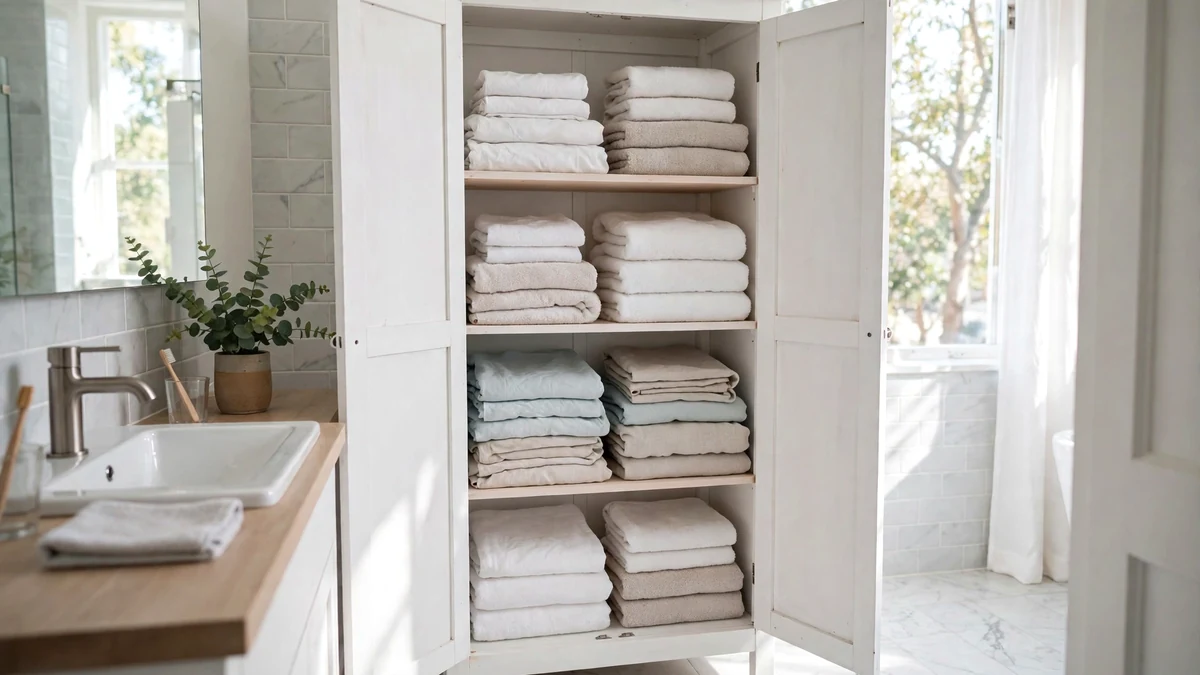
A linen cabinet is a tall, narrow cabinet built to store household linen: bath towels, hand towels, face cloths, bed sheets, pillowcases and duvet covers. The classic shape is a freestanding tower, roughly 30 to 45 centimetres wide and 150 to 180 centimetres tall, with four or five shelves behind one or two doors. Some are wall-hung boxes above a toilet or beside a mirror; some are built into a hallway or landing; a few are open towers with no doors at all. What unites them is the job: they store soft, bulky, folded things that need air and easy reach, not small bottles that need a mirror.
The distinction from the medicine cabinet matters, because the two are often confused in shops. A medicine cabinet is a shallow mirrored box above the sink, 12 to 15 centimetres deep, made for toothbrushes, creams and first-aid supplies. A linen cabinet is far deeper and taller, made for folded fabric, and it usually stands on the floor or hangs on a wall away from the sink.
The Main Types of Linen Cabinet
| Type | Best for | Storage | Watch out for |
|---|---|---|---|
| Freestanding tower | Most bathrooms | Excellent | Needs floor space and a level floor |
| Wall-hung cabinet | Small bathrooms | Good | Needs solid fixing into studs or masonry |
| Over-toilet cabinet | Wasted space above the toilet | Modest | Shallow shelves; mind the cistern lid |
| Open tower | Spare rooms and airing | Good | Everything on show; dust settles fast |
| Built-in cupboard | Hallways and landings | Excellent | Costs more; needs a suitable alcove |
The freestanding tower is the default choice, and for most homes it is the right one. It needs no fixing, it moves when you move, and it holds a full household’s towels on four or five shelves. The wall-hung cabinet is the small-bathroom answer: it lifts storage off the floor, which makes a tight room feel larger and keeps the floor clear for cleaning. The over-toilet cabinet uses space that is otherwise wasted, but its shelves are shallow and it sits above a cistern lid that must lift. Open towers air towels beautifully yet collect dust and damp. Built-in cupboards are the best storage when the house has an alcove to spare, but they are a joinery job, not a purchase.
Before You Buy: Measure the Linen, Not the Room
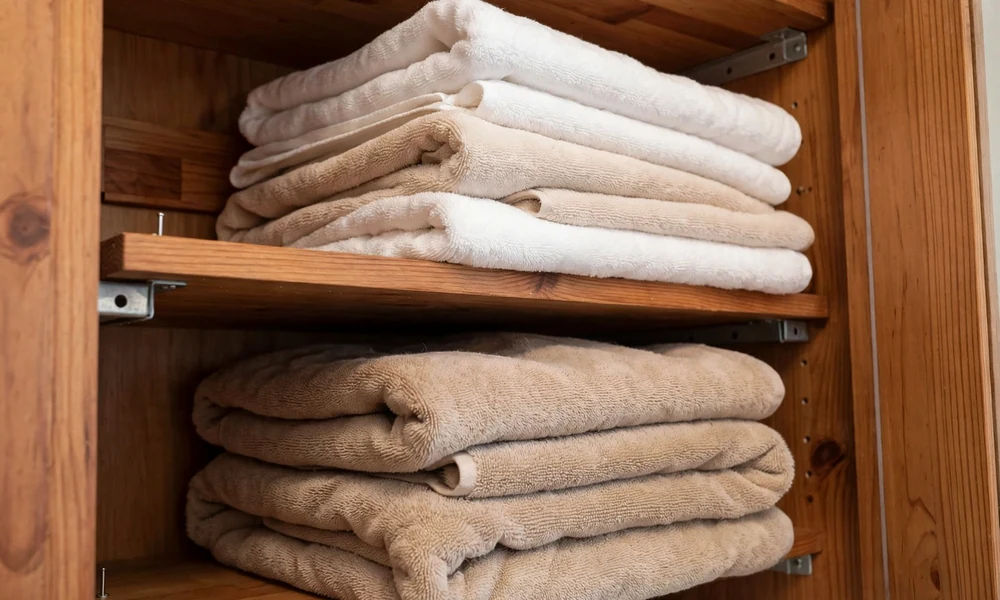
Most people measure the space where the cabinet will stand and forget to measure what will go inside it. Start with the linen itself. Fold your largest bath towel the way you actually fold it, measure the stack of four, and note its height. Do the same for a folded double sheet and a folded duvet cover. A cabinet with shelves 30 centimetres apart will hold three folded towels per shelf comfortably; shelves 20 centimetres apart will hold two, and the cabinet will feel cramped from the first week. Adjustable shelves are worth paying for, because a household’s linen changes with the seasons.
Then measure the room honestly. A tower 40 centimetres wide needs 45 centimetres of clear wall once the door swing is counted, and a door that opens onto a bath or a toilet is a daily annoyance. Check the floor is level where a freestanding cabinet will stand, because a tall narrow cabinet on a sloping floor leans, and a leaning cabinet’s doors swing open on their own. Finally, count the household: two people need two towel shelves, and a family of four needs four, or one shelf each plus one for bedding.
Materials That Survive a Steamy Room
A bathroom is the hardest room in the house for wooden furniture, and the material decides whether a linen cabinet lasts a decade or swells and sticks within a year. Solid wood and good plywood handle steam best, because they move a little with humidity and recover. Painted MDF is cheaper and looks crisp when new, but its edges swell if water gets in, and a swollen edge is the beginning of a door that will not close. Bamboo and sealed rattan suit the look of a bathroom and resist damp well, though they need their sealant refreshed every year or two. Metal cabinets never swell, but cheap steel rusts at the joints where the coating is thin.
Whatever the material, look at the back. A cabinet with a solid back panel keeps steam out and towels dry; a cabinet with an open or hardboard back lets damp air in from the wall behind it. Soft-close hinges are worth the small premium, because a slamming door shakes the shelves and topples the stacks. Check the feet too: short legs or a plinth keep it clear of mopping water, while a cabinet flat on the floor rots from the bottom up.
Ventilation: The Detail That Decides Whether Towels Smell Fresh
The difference between a linen cabinet that works and one that does not is usually air. Towels go into a cabinet slightly damp more often than anyone admits, and bedding stored in a sealed box in a steamy room grows musty within days. The best linen cabinets are not airtight. They have a small gap at the back of each shelf, a vent in the top or bottom, or doors that do not seal perfectly, and that small movement of air keeps the contents fresh. Louvred doors are the classic answer: they look traditional, they let air through, and they hide the contents at the same time.
The habits matter as much as the cabinet. Never put a wet towel straight into a closed cabinet; hang it to dry first, even for an hour. Leave a finger’s width of space between stacks so air can move around them. Air the cabinet itself by opening the doors for an hour once a week.
Where a Linen Cabinet Belongs
The bathroom is the obvious home for a linen cabinet, but it is not always the best one. A cabinet in the bathroom keeps towels where they are used, yet it also puts the linen in the dampest room in the house. A cabinet on the landing or in a hallway cupboard keeps the same linen drier and often holds more of it, at the cost of a short walk with an armful of towels. Many households split the difference: a small bathroom cabinet for this week’s towels, and a larger landing store for spares and bedding.

Placement inside the bathroom has its own rules. Keep the cabinet away from the shower’s direct spray and away from the wall behind the bath, where steam condenses first. A spot beside the door, or on the wall opposite the bath, stays drier than a spot next to the shower. In a hallway, pick the alcove or stretch of wall that nothing else uses, make sure the doors open clear of the traffic, and keep the bedding shelves high and the daily towels low. Bathroom shelves suit the small things that live out in the open, but folded linen belongs behind a door, where dust and steam cannot reach it.
Organising the Inside So It Stays Tidy
A linen cabinet only stays tidy if the inside has a system, and the simplest system is one shelf per job. Give each person their own shelf for towels, give the bedding its own shelf, and give the spares and the guest towels the top shelf. Roll hand towels instead of folding them: rolled towels take less space, they do not topple, and you can see at a glance how many are left. Fold sheets in sets, with the pillowcases tucked inside the folded sheet, so grabbing a set for one bed is a single movement. Keep a small basket on one shelf for the odds and ends: flannels, washcloths, the spare shower curtain.
The most useful habit is the monthly five-minute reset. Take everything out, wipe the shelves, refold anything that has slumped, and move the least-used items to the top. Five minutes a month is what separates a cabinet that looks like the photograph from one that looks like a laundry basket with doors. It also tells you when to stop buying towels: when every shelf is full, the household owns too much linen, not too little storage.
Linen Cabinet Checklist
- Measure your tallest folded stack and choose shelf spacing that fits it, not the other way round.
- Pick adjustable shelves, because winter towels and summer sheets need different heights.
- Check the doors open clear of the bath, the toilet and the traffic, with the cabinet in place.
- Choose a solid back panel and short legs or a plinth, so steam and mopping water stay out.
- Make sure air can move: louvred doors, a vent, or simply shelves that are never packed tight.
- Give every person and every use its own shelf, and reset the whole cabinet once a month.
Frequently Asked Questions
Is a linen cabinet the same as a bathroom cabinet?
Not quite. A bathroom cabinet usually means the shallow mirrored cabinet above the sink for toiletries and medicines. A linen cabinet is a taller, deeper store for towels and bedding.
How wide should a linen cabinet be?
Most towers are 30 to 45 centimetres wide, which fits a folded bath towel with room to spare.
Can a linen cabinet go in a hallway instead of a bathroom?
Yes, and it often keeps the linen drier there.
Do linen cabinets need ventilation?
Yes. Towels stored in a sealed, steamy cabinet smell musty within days. Louvred doors, a small vent, or simply not packing the shelves tight keeps the air moving.
What is the best material for a linen cabinet?
Solid wood or good plywood lasts longest in steam, painted MDF is cheaper but swells at the edges if water gets in, and bamboo suits the look if its sealant is refreshed yearly.
How do I stop a tall linen cabinet from toppling?
Fix it to the wall with the anti-tip strap in the box, especially in a house with children.
The Bottom Line
A linen cabinet earns its place by holding the bulky, everyday things that no other bathroom store can: towels, sheets and spare bedding, dry, aired and within reach. Measure the linen before the room, choose adjustable shelves and a solid back, leave room for air, and give every shelf a job. Do that, and the cabinet will quietly keep the bathroom tidy for years. For the towels in daily use, a towel rack beside the bath or shower is the perfect partner: the rack dries today’s towel, and the cabinet stores the rest.