Why Filing Cabinets Still Beat a Drawer Full of Loose Paper in 2026
Filing cabinets still beat a drawer full of loose paper, and it is not close. The best filing cabinets in 2026 keep tax returns, contracts, medical records and warranties sorted, labelled and findable in seconds, behind a lock, in furniture built to last decades. A drawer full of loose paper hides what you need, creases what you keep, and turns every search into a hunt. A filing cabinet ends that: every document has a folder, every folder has a place.
Paper has not gone away. Homes still receive tax letters, insurance documents, school records and warranties, and small businesses still keep invoices and contracts on paper. The trick is to buy for the paper you actually keep. Count your folders, measure the space, and choose a cabinet whose drawers glide, whose lock works, and whose folders hang properly.
Key Takeaways
- Count your folders first: a cabinet that is too small fills up in a year, and an overstuffed drawer jams.
- Vertical cabinets suit narrow spaces; lateral cabinets suit wide rooms and hold more per drawer.
- Full-extension ball-bearing slides matter most: they let you reach the folder at the very back.
- A lock is worth having on any cabinet holding tax, medical or financial papers.
- Label every folder the day it goes in: an unlabelled folder is just a drawer full of loose paper with extra steps.
What a Filing Cabinet Actually Is
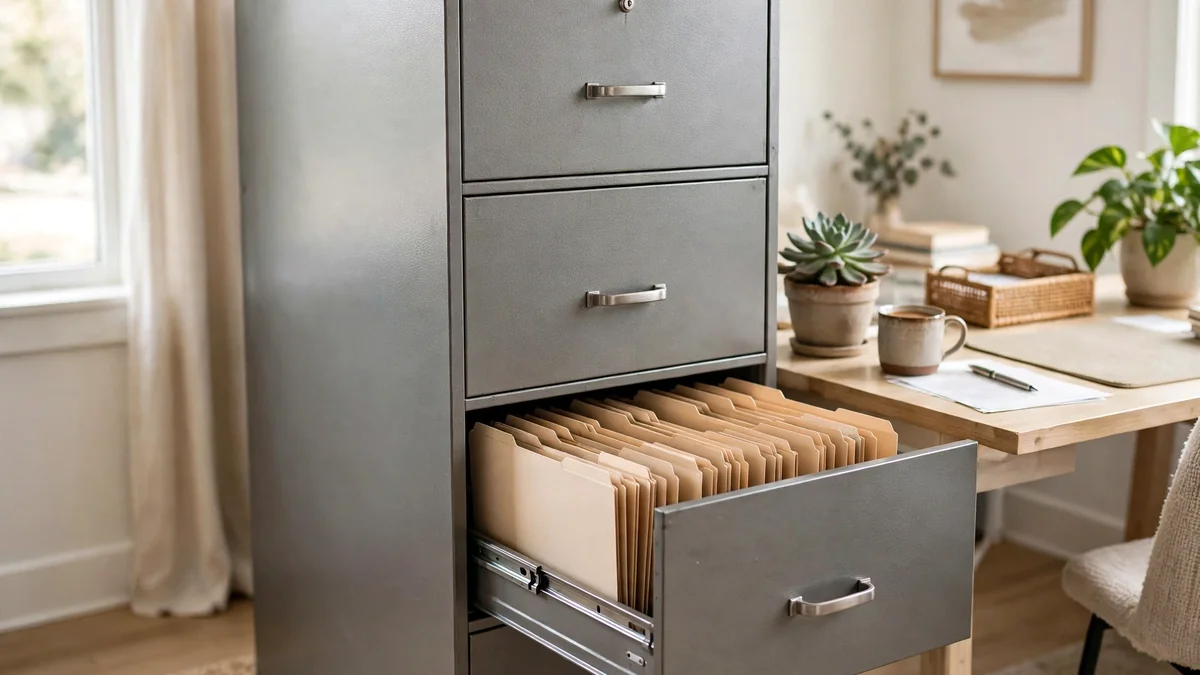
A filing cabinet is a floor-standing cabinet with deep drawers fitted with rails, from which folders hang in a row. Pull the drawer open and the folders stand upright, labelled along the top edge, so you can flip through them and lift out exactly the one you need. That is what separates it from every other kind of office storage. A desk organizer holds the small things you reach for every day, and our guide to desk organizers covers pen caddies, trays and drawer units that sit on the desk; a filing cabinet holds the archive underneath it, the papers you need a few times a year but must find in a minute.
A desk drawer holds a few folders flat in a pile, which creases them and hides the one at the bottom. A storage box holds papers in a stack, which means emptying the box to find anything. A filing cabinet is the only common piece of furniture that keeps papers upright, separated and labelled. The rails matter: standard hanging folders fit A4 and foolscap sizes, and a cabinet that takes both is worth more than one that takes only one, because paper comes in both.

The Main Types of Filing Cabinet, Compared
Most filing cabinets fall into four families, and the right one depends on how much paper you keep and how much floor space you have. Vertical filing cabinets are the classic: tall and narrow, usually 130 to 135 centimetres high and 40 to 45 wide, with three or four deep drawers. Each drawer holds folders front to back, so you pull the drawer and look down the row. They suit narrow spaces beside a desk, and a four-drawer vertical cabinet takes roughly 100 to 120 hanging folders. Their weakness is the top drawer, which is high enough that shorter people must stretch to see into it.
Lateral filing cabinets are wide and low, usually 70 to 75 centimetres high and 75 to 90 wide, with two or three wide drawers. Each drawer holds folders side by side, and the top doubles as a printer stand or an extra work surface. They suit wide rooms and shared offices, and they hold more per drawer than a vertical cabinet. Their weakness is the footprint: they need a wide stretch of wall, and a full lateral drawer is heavy, so the slides and frame must be strong.
Mobile pedestal cabinets are the small ones: a three-drawer unit on castors that slides under a desk, usually 60 centimetres high. They suit a single desk in a small room, holding the folders you use every week within arm’s reach, while the archive lives elsewhere. Their weakness is capacity: three shallow drawers hold perhaps 30 folders. Fireproof and security cabinets are the specialist choice: heavier, with insulated walls and a proper lock, built to protect papers from fire, water and theft. They suit anyone keeping irreplaceable documents at home: deeds, wills, passports, certificates. They cost far more and weigh far more too, so check the floor before you buy one.
| Type | Best for | Typical size | Watch out for |
|---|---|---|---|
| Vertical | Narrow spaces, large archives | 130–135 cm high, 40–45 cm wide | Top drawer is high to reach |
| Lateral | Wide rooms, shared offices | 70–75 cm high, 75–90 cm wide | Wide footprint; heavy full drawers |
| Mobile pedestal | Under a desk, weekly folders | 60 cm high, on castors | Small capacity, about 30 folders |
| Fireproof / security | Irreplaceable documents | Varies, much heavier | Costs far more; check the floor |
Getting the Size Right
Size is the decision most people get wrong, and it is the hardest to fix afterwards. Start by counting your folders, not by guessing. Pull every folder you own into one pile and count them, then add a third for growth, because a cabinet that is full on the day it arrives is one you will replace within a year. A drawer packed tight jams, and folders that cannot slide cannot be flipped through.
Then measure the space. A vertical cabinet needs about 45 centimetres of width and 65 of depth, plus a metre of clear floor in front so the drawer opens fully. A lateral cabinet needs 90 centimetres of width and the same clear floor in front. Check the ceiling too: a tall vertical cabinet under a low shelf makes the top drawer hard to use. And check the paper size: A4 folders need a drawer interior of at least 30 centimetres front to back, while foolscap needs 35, so measure the drawer, not the outside of the cabinet.
Locks, Slides and Build Quality
The lock is the feature most buyers ignore and most owners later wish they had. A filing cabinet holding tax returns, medical records, contracts or anything with a signature on it should lock, with a key you can copy. A central lock that secures every drawer with one turn is the standard on good cabinets; a lock that secures only the top drawer leaves the rest open. Keep a spare key safe, and write down the lock number, because replacing a lost key without it means drilling the lock out.
The drawer slides decide how the cabinet feels every day. Full-extension ball-bearing slides let the drawer come all the way out, so you can reach the folder at the very back. Cheaper roller slides stop three-quarters of the way out, which hides the back third of the drawer. Open and close every drawer before you buy: it should glide smoothly when full, without sticking or tipping. An anti-tilt mechanism, which stops a second drawer opening while one is already open, matters on a tall cabinet, because two full drawers open at once can tip the whole piece forward.
Build quality is mostly steel or wood. Steel cabinets are the workhorses: powder-coated, dent-resistant, and built to take the weight of a hundred folders without sagging. They suit offices and garages, and they cost less than wood. Wooden cabinets, usually oak, walnut or veneer over a stable core, suit living rooms and home offices, where the cabinet is on show. They cost more and hold less per drawer, because the wood is thicker than steel. Whichever you choose, check that the drawer bases are solid rather than thin hardboard, because a sagging base is the first thing to fail on a cheap cabinet.


Setting Up a System You Will Keep Using
A filing cabinet without a system is just a tidier drawer, so set the system up on the day the cabinet arrives. Sort papers into broad groups first: tax, home, medical, money, school, work, and vehicles is a good starting set for most households. Give each group a drawer or a section of a drawer, and give each folder a single clear label: “Tax 2025”, not “Misc”, and “Car insurance”, not “Important”. A label maker earns its keep here, and our guide to label makers explains how to print labels that stay readable for years; handwritten labels fade and smudge, and a folder you cannot read is one you will not open.
Keep the active folders at the front of each drawer and the archive at the back. Purge once a year: shred what is out of date, move last year’s tax folder to the back, and make room for the new one. A cabinet purged yearly never jams and never runs out of room, while one never purged fills up and stops being used. If the cabinet still overflows, the answer is usually a second cabinet rather than a bigger one, because two cabinets in different rooms beat one enormous cabinet nobody wants to walk to.
Desktop file trays have their place too: the in-tray catches today’s post, and our guide to file organizers covers the trays and sorters that turn paper chaos into a filing system. The rule is simple: paper lands in the tray, gets dealt with within a week, then goes into a labelled folder in the cabinet or into the shredder. Paper that sits in the tray for a month becomes a pile, and a pile becomes a drawer full of loose paper again.
Checklist: Before You Buy a Filing Cabinet
- Count your folders and add a third for growth before choosing a size.
- Measure the space, leaving a metre of clear floor in front for the drawers.
- Check the drawer interior fits A4 and foolscap hanging folders.
- Insist on full-extension ball-bearing slides and an anti-tilt mechanism.
- Choose a central lock that secures every drawer with one key.
- Plan the labels before the cabinet arrives: one clear label per folder.
Frequently Asked Questions
How many folders does a four-drawer filing cabinet hold?
Roughly 100 to 120 hanging folders, depending on how thick the papers inside them are. Count your folders first and add a third for growth, because a drawer packed tight jams.
Vertical or lateral: which is better?
Vertical cabinets suit narrow spaces beside a desk and hold a large archive in a small footprint. Lateral cabinets suit wide rooms, hold more per drawer, and give you a work surface on top. Choose by the wall space you have.
Do I need a lock on a filing cabinet?
Yes, if it holds tax, medical, financial or legal papers. A central lock securing every drawer with one key is the standard. Keep a spare key safe and note the lock number.
What is the difference between A4 and foolscap folders?
A4 folders are 297 millimetres tall; foolscap folders are slightly larger and longer. A cabinet that takes both is worth more than one that takes only one. Measure the drawer interior, not the outside of the cabinet.
Can a filing cabinet go in a living room?
Yes, if you choose wood rather than steel. A wooden lateral cabinet looks like ordinary furniture and doubles as a side table or printer stand. A steel vertical cabinet belongs in an office, not beside the sofa.
How often should I purge a filing cabinet?
Once a year. Shred what is out of date, move last year’s folders to the back, and make room for the new ones. A cabinet purged yearly never jams.
The Bottom Line
The best filing cabinet fits the paper you actually keep, fits the space you have, and opens smoothly every time you pull a drawer. Count your folders first, choose full-extension slides and a proper lock, and label every folder the day it goes in. Do that, and the cabinet becomes the one place in the house where any document can be found in under a minute.