Top File Organizers That Turn Paper Chaos Into a Filing System in 2026
The best file organizers do a job no pile, tray or drawer can do: they give every piece of paper a labelled category and a way back out again. Tax returns go in one tab, medical letters in another, school forms in a third. When you need one of them six months later, you open the right tab instead of digging through a stack. Here are the types, the trade-offs and the picks worth buying in 2026.
Key Takeaways
- A file organizer files by category; a tray only holds paper until you deal with it.
- Accordion files suit a whole household’s paperwork in one place.
- Hanging folders suit papers you pull out and put back often.
- Label every tab before you file a single sheet.
- Start with five or six categories, not twenty.
What a File Organizer Actually Does
A file organizer turns a pile of paper into decisions you have already made. That is what separates a file organizer from the other things on a desk. Desk trays are for paper in transit: the letters that arrived today and the forms that need doing this week. A file organizer is for paper that has been dealt with and must be kept, such as policy documents, receipts and certificates. The two work together, with the tray feeding the files, but they are not interchangeable.
A labelled folder system also shows you the categories at a glance, and the thickness of each folder tells you how much is in it. Paper in a file organizer also travels as a unit, so the whole tax folder can go to an appointment. A pen caddy is not one, however many compartments it has, and neither is a drawer insert. Drawer organizers sort small things inside a drawer, a different job from sorting named folders of paper. A file organizer always works with folders, tabs and labels. If it cannot hold a labelled folder, it is something else.
The Main Types of File Organizers
Every file organizer is a variation on a few basic ideas. The right one depends on how much paper you keep, how often you need it, and where it will live.
Accordion Expanding Files
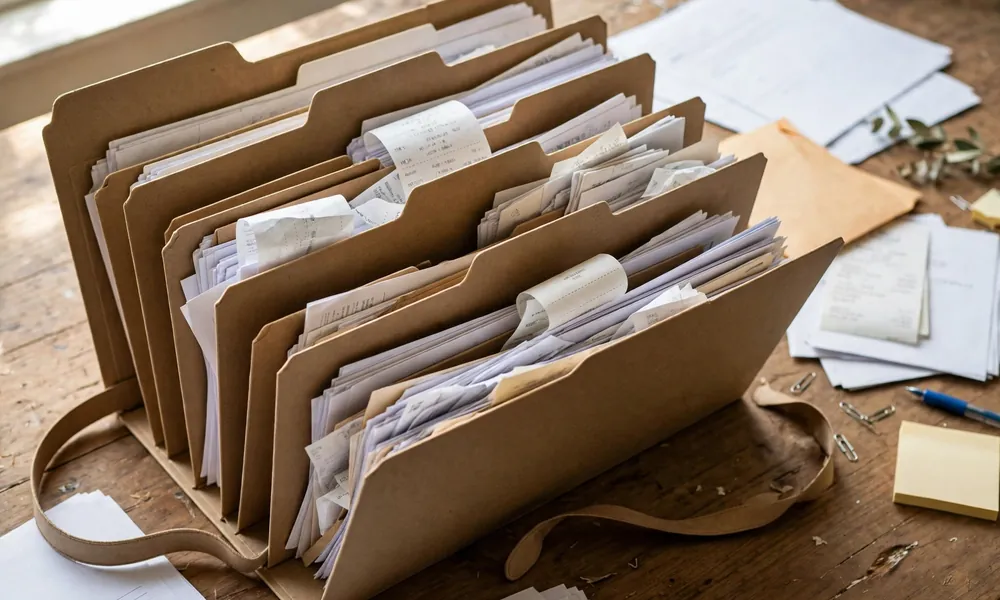
The accordion file is the classic household file organizer: one expanding case, divided into pockets by gusseted dividers, each with its own tab and label. The pockets expand only as far as they are filled, and the case closes with a flap or elastic band, so a household’s paperwork can live on one shelf. Their weakness is overfilling: a pocket stuffed past its gusset will not close, and papers at the back of a fat pocket are hard to reach. They suit a household that files in batches, once a week or once a month.
Hanging File Folders and File Boxes
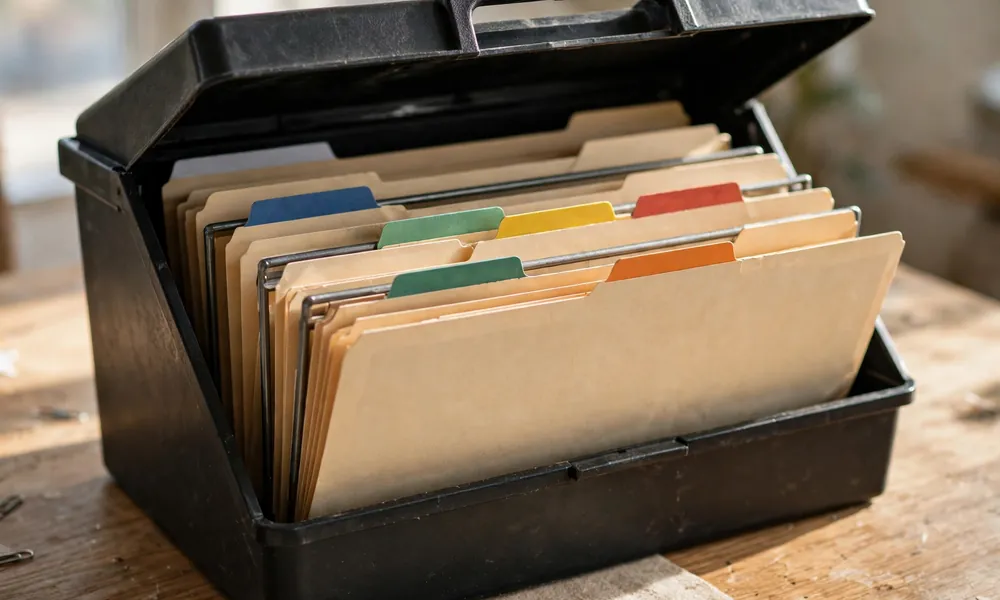
Hanging folders are the office standard for a reason. Each folder hangs from a pair of rails, so it stays upright and open at the top, and it can be pulled out and dropped back in without disturbing its neighbours. A file box is a portable frame that holds those rails, with a lid and a handle, so the system can move from a desk to a cupboard to a car. Hanging systems suit people who file little and often and pull folders out regularly. Their weakness is size: a file box holds fewer papers than an accordion file of the same footprint.
Vertical File Sorters
A vertical file sorter stands folders upright in narrow slots on the desk, so the papers you are working with this week are in sight and in reach. It is the closest a file organizer comes to a tray, and it is the right choice for active files: the project you are working on, the bills due this month, the forms waiting for a signature. Its weakness is capacity. It holds a handful of folders, not a household’s archive, Use it for the current week’s papers, and move finished papers into the accordion file or file box behind it.
Portable File Cases
A portable file case is a file box with a proper handle, a latch and a reinforced shell, built to be carried. It suits anyone who takes paperwork out of the house: to an accountant, a solicitor, a hospital appointment or a new home. The case should be rigid enough to protect papers from rain and knocks, and the handle should be comfortable when the case is full. Its weakness is the same as any portable system: it holds less than a static one, and it is easy to leave papers in it after the trip. Empty it when you get home.
Binder and Tab Systems
Binders with tabbed dividers suit papers that must stay in a fixed order: a course, a medical history, a house purchase, a long project. Each section has its own tab, the papers inside are punched and filed in sequence, and nothing can slip out of order. They suit a small number of important files rather than everyday paperwork. For most households, one or two binders for the truly important records, alongside an accordion file for the rest, is the right balance.

File Organizers Compared
| Type | Best for | Capacity | Price | Watch out for |
|---|---|---|---|---|
| Accordion file | Household paperwork in one place | 12 to 24 pockets | Low to mid | Overfilled pockets will not close |
| Hanging folders and file box | Papers filed often | 10 to 20 folders | Low to mid | Needs rails and a box |
| Vertical file sorter | Active files for this week | 5 to 8 folders | Low | Small capacity |
| Portable file case | Paperwork taken to appointments | 10 to 15 folders | Mid | Heavy when full |
| Binder and tab system | Records kept in order | One file per binder | Low to mid | Every sheet must be punched |
How to Choose the Best File Organizer
Start with the categories, not the container. Sort the paper you already have into groups on a table. Most households end up with five or six: household bills, tax and money, medical, car and home, school or work, and personal records. If you have more than eight groups, combine some, because a system with too many tabs is one nobody uses. The categories decide the size. Five groups fit in a small accordion file, while eight groups with thick folders need a hanging-file box.
Next, check the paper size. A4 is the standard sheet in most homes, at 210 by 297 millimetres, and most file organizers are sized for it. Legal paper is longer and will stick out of an A4 folder, and certificates need a wider pocket. Measure the largest sheet you keep regularly and buy folders that fit it flat with a little room to spare. Then look at the labels, because labels are the filing system. Tabs should be large enough to read at a glance, and labels should be easy to rewrite when a category changes.
Our Picks: The Top File Organizers of 2026
The best file organizer for most households is a 13-pocket accordion file in tough polypropylene, with wide tabs and a closing flap. It holds the standard set of household categories in one case, it survives being pulled off a shelf every week, and it costs little enough that replacing it every few years is no hardship. It is the right starting point if you are building a filing system from scratch, and the one most people should buy first.
Best for papers you use every week is a hanging-folder file box with a lid. The folders stay upright and in order, so pulling out the tax folder takes seconds, and the lid keeps dust off when the box is shut. Best for a small desk is a vertical file sorter in wood or metal mesh, with five or six slots. It holds the week’s active folders upright and in sight, and it takes up barely more space than a single folder lying flat. Best for taking paperwork out is a rigid portable file case with a hanging-folder frame inside. It protects the papers and carries comfortably even when full. Desk organizers still have their place for the small tools of desk work, but for the papers themselves, a folder system is what keeps them findable.
Setting Up a Filing System That Sticks
Set the system up in one sitting, because a half-built filing system is worse than none. It gives the impression of order while the papers still live in piles. Start by emptying every drawer, shelf and bag where paper has collected, and sort it all on a table into your categories. Throw away what is finished with: old leaflets, expired offers, duplicates and papers kept out of habit rather than need.
Then label every tab, put one category in each folder, and file the papers. Keep the system where you use it, and keep a simple routine. New paper goes in the tray or the sorter when it arrives, and once a week it moves into its folder. The weekly move takes five minutes if the folders are labelled, and it is the habit that keeps the system alive. Review the folders twice a year, and throw away what has expired. A filing system that is never thinned out becomes an archive of everything, which is the same as an archive of nothing.
Checklist: Before You Buy a File Organizer
- Sort your paper into categories first, and count them before choosing a size.
- Measure your largest sheet and buy folders that fit it flat.
- Check that tabs are wide enough to read and labels are easy to rewrite.
- Decide where the organizer will live, and buy a type that suits that spot.
- Buy spare folders, tabs and labels with the organizer, not later.
- Plan a weekly five-minute filing routine, or the system will stall within a month.
Frequently Asked Questions
What is the difference between a file organizer and a desk tray?
A file organizer files papers by labelled category for keeping, while a desk tray holds papers still in progress. The tray is for today and this week; the file organizer is for the months and years after that.
How many categories should a household filing system have?
Five or six is right for most households. Fewer than four means folders get mixed, and more than eight means tabs get ignored. Start with household bills, tax and money, medical, car and home, and personal records.
Are accordion files or hanging folders better?
Accordion files are better for keeping a household’s paperwork in one portable case. Hanging folders are better when you pull folders out and put them back often.
What size file organizer do I need?
Buy for the largest sheet you keep regularly. A4 folders suit most homes, but legal paper and certificates need larger pockets. Measure the sheet, not the folder’s label, and leave room so papers slide in without bending.
How do I stop a filing system from becoming a junk drawer?
Label every tab before you file anything, file each paper in its own category, and thin the folders out twice a year. The system fails when unlabelled pockets fill with whatever is nearest,
Should I keep paper files at all, or scan everything?
Scan what you can, but keep the originals of anything legal, medical or financial that may be asked for in paper form.
Bottom Line
The top file organizers of 2026 are the ones that make filing so easy you actually do it: an accordion file for the household archive, a hanging-folder box for the papers you use every week, a vertical sorter for the active files, and a portable case for the papers that leave the house. With that routine, any paper you need will be in the folder you expect, in the time it takes to open it.