The Fridge Thermometers That Keep Your Food Safe in 2026
A fridge thermometer is the small device that answers the one question your fridge never will: is the food inside actually cold enough? It is a dial or digital thermometer that lives inside the fridge and reads the air temperature around your food all day. The best fridge thermometers of 2026 tell you at a glance whether the fridge is holding 4 degrees Celsius or below, warn you when it is not, and keep working for years on a single battery or no battery at all. A fridge without one is a fridge you trust blindly.
Key Takeaways
- A fridge must hold 4 degrees Celsius or below, and a freezer minus 18 or below: only a fridge thermometer tells you for sure.
- Digital thermometers are the easiest to read at a glance, while dial thermometers need no battery and last for years.
- Put the thermometer on the middle shelf, away from the cooling vent and the door, where it reads the air your food actually sits in.
- A min-max memory or an alarm is worth having: it shows the warmest the fridge got while you were out.
- Check the reading against ice water once a year: a thermometer that reads two degrees high is worse than no thermometer at all.
Why a Fridge Thermometer Matters
Most fridges have a dial numbered one to five, and that dial is not a thermometer. It is a power setting, and the same setting gives a different temperature in summer than in winter, in a full fridge than in an empty one, and with a tired door seal than a new one. The number on the dial tells you nothing about the temperature of the milk. Only a thermometer inside the fridge does that. Bacteria grow fastest between 4 and 60 degrees, so every degree above 4 shortens the safe life of the food inside, and you cannot feel a two-degree difference by opening the door.
The other reason is the failures you never notice. A door left ajar overnight, a power cut while you are out, a cooling vent blocked by a tall carton: each one warms the fridge for hours, and the food looks exactly the same when you open the door in the morning. A fridge thermometer with a min-max memory shows the warmest temperature the fridge reached, so you can decide whether the food is still safe instead of guessing. An alarm thermometer beeps while the problem is still fixable. Either way, the thermometer turns a silent failure into information you can act on.
A fridge thermometer is also a different tool from the thermometers that measure food itself. A meat thermometer probes a roast to check it is cooked through, and an oven thermometer checks the air inside a hot oven. Neither one can live in a fridge and watch it all day. The fridge thermometer simply sits on a shelf and tells the truth about the cold.
Fridge Thermometers Compared
| Thermometer type | Best for | Watch out for | Price in 2026 |
|---|---|---|---|
| Digital, hanging or standing | Everyday fridges, easy reading | Battery changes; fogged displays | Low |
| Dial, analogue | No-battery reliability, second fridges | Harder to read precisely; slower to react | Low |
| Digital with min-max memory | Power cuts, doors left ajar | Needs a reset after each check | Low to mid |
| Wireless with alarm | Garage fridges, busy households | Signal drop through thick walls | Mid |
| Dual fridge-freezer | Fridge-freezers, chest freezers | One sensor rarely suits both zones | Mid |
Best Overall: The Digital Fridge Thermometer
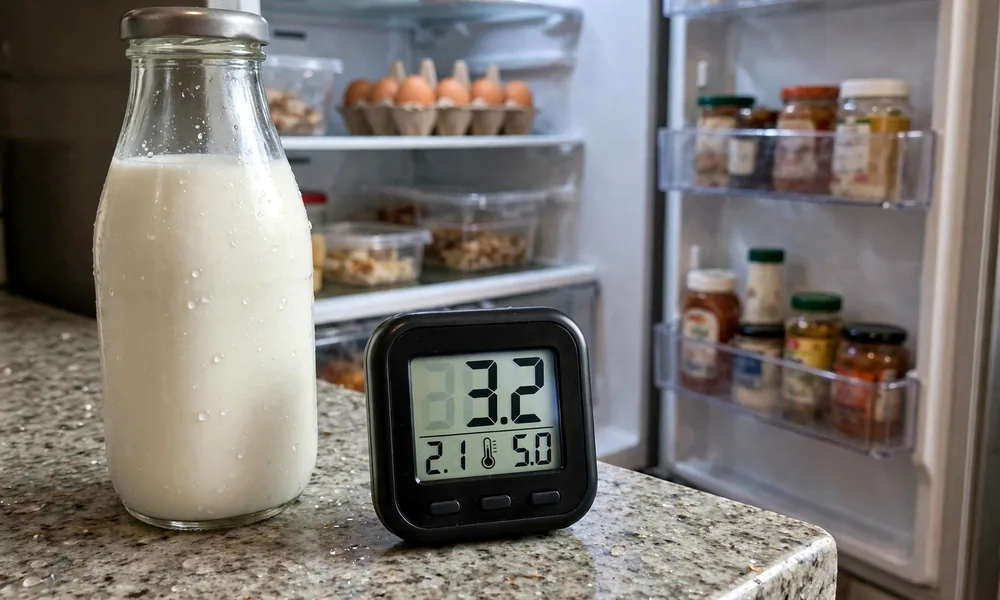
The best overall fridge thermometer for most homes in 2026 is a small digital unit, about the size of a matchbox, with a clear display, a hook, and a stand. It wins because it does the ordinary job brilliantly: it shows the temperature in large digits you can read through the fridge door in a second, it reacts to a change within minutes, and it costs little enough that every fridge in the house can have one. Hang it from the middle shelf and check it whenever you open the fridge. A reading of 3 or 4 degrees means the food is safe; 6 or above means the dial needs turning up or the door seal needs checking.
One small battery lasts a year or more, the display is readable in the dim light of a fridge, and the unit is small enough to sit anywhere without blocking food. Look for a display with digits at least a centimetre high, because a display you have to squint at is a display you will stop checking. Look for a hook as well as a stand: a hanging thermometer stays put when you pull food out, while one that only stands gets knocked over. And check the temperature range before you buy: a good fridge thermometer reads from minus 20 to plus 30 degrees, which covers both the fridge and the freezer if you ever move it.
Best for Reliability: The Dial Fridge Thermometer
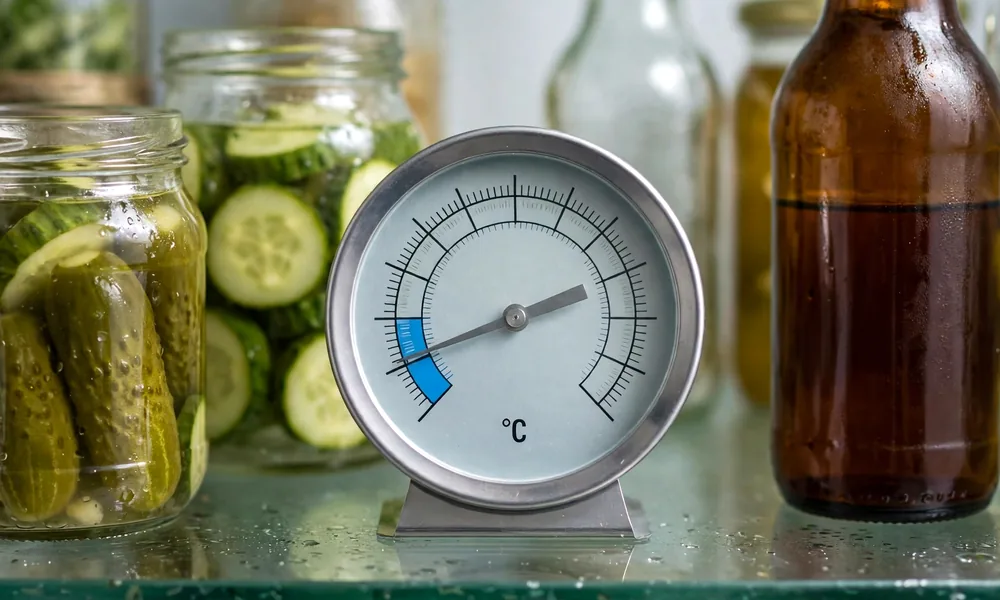
When the thermometer must work with no battery and no fuss, the dial thermometer is the honest choice. A round analogue dial with a needle, a coloured safe zone, and a hook or a stand, it needs nothing but a shelf to sit on and a glance to read. It is slower to react than a digital unit, and harder to read to the exact degree, but it never runs out of battery, never fogs its display, and lasts for years. It suits a second fridge in the garage or a fridge at a holiday home.
The coloured safe zone is the dial thermometer’s best feature: a green band marks 0 to 4 degrees, so needle in the green means the food is safe and needle above it means something is wrong. Check the needle whenever you open the fridge, and test accuracy once a year in a glass of ice water, where it should read 0 degrees. If it reads 2 degrees high there, it reads 2 degrees high in the fridge too.
Best for Peace of Mind: The Min-Max and Alarm Thermometer
A thermometer that only shows the temperature right now tells you half the story. A thermometer with a min-max memory tells you the rest: the warmest and coldest the fridge reached since you last reset it. That matters after a power cut or a door left ajar. If the maximum reads 8 degrees, the food warmed through while you were out. Reset the memory after every check, or the numbers stop meaning anything.

An alarm thermometer beeps when the temperature rises above a limit you set, usually 5 or 6 degrees. It is worth having in a garage fridge you open rarely, or in a household where children leave the door open. Wireless models add a display you keep in the kitchen, so you can see the temperature without opening the door. The trade-off is the signal: a wireless sensor can struggle through thick walls, so check the range and keep the display within a few metres of the fridge.
Where to Put a Fridge Thermometer
Placement decides whether the reading means anything. Put the thermometer on the middle shelf, towards the front, where it reads the air your food actually sits in. Do not put it against the back wall or beside the cooling vent, where the cold air blows straight onto it and the reading comes out two degrees colder than the food. Do not put it in the door, where the temperature swings every time it opens, and do not bury it behind a tall carton, where it reads the air in a pocket.
The same rules apply in a freezer, with one extra check: the thermometer must read minus 18 degrees or below, because one that stops at zero is useless there. A dual thermometer with two sensors suits a fridge-freezer, while a separate thermometer in each zone suits a chest freezer or a side-by-side. A room thermometer is a different tool again: it measures the air in a bedroom or living room, where the range is 10 to 30 degrees, not the cold inside a fridge. Do not swap the two, because a room thermometer cannot read 4 degrees accurately and a fridge thermometer is wasted on a wall.
How to Check and Calibrate a Fridge Thermometer
Check the reading every time you open the fridge, and check the thermometer itself once a year. The ice-water test is the simplest calibration there is: fill a glass with crushed ice, add just enough cold water to fill the gaps, stir, and stand the thermometer in it for five minutes. It should read 0 degrees. If it reads 1 or 2 degrees high, allow for the error; if the error is more than 2 degrees, replace it. A thermometer that reads two degrees high is worse than none, because it says the food is safe when it is not.
Between checks, keep the thermometer clean and dry, and replace the battery in a digital unit once a year even if the display still looks bright, because a weak battery reads low before it dies. Replace the thermometer when the display fades, the needle sticks, or readings turn inconsistent. A new one costs less than the food a faulty one lets you throw away.
Fridge Thermometer Checklist
- Choose digital for easy reading, dial for no-battery reliability, or wireless with an alarm for a garage fridge.
- Put it on the middle shelf, away from the vent and the door.
- Check the range reads from minus 20 to plus 30 degrees, so it works in a freezer too.
- Use the min-max memory after power cuts and doors left ajar, and reset it after every check.
- Test it in ice water once a year: it should read 0 degrees, and an error over 2 degrees means replace it.
- Replace the battery yearly and the thermometer itself when the display fades or the needle sticks.
Frequently Asked Questions
What temperature should a fridge be?
A fridge should hold 4 degrees Celsius or below, and a freezer minus 18 or below. A fridge thermometer is the only way to know for sure, because the numbered dial is a power setting, not a temperature.
Where is the best place to put a fridge thermometer?
On the middle shelf, towards the front, away from the cooling vent and the door. That is where it reads the air your food actually sits in.
Are digital or dial fridge thermometers better?
Digital thermometers are easier to read and react faster. Dial thermometers need no battery and last for years, and their coloured safe zone lets you check at a glance. Choose the one you will actually look at.
Can a fridge thermometer go in the freezer?
Yes, if it is rated to read minus 18 degrees or below. Check the range before you buy: a thermometer that stops at zero is useless in a freezer. A dual fridge-freezer model with two sensors suits a fridge-freezer best.
How do I know if my fridge thermometer is accurate?
Stand it in a glass of crushed ice and cold water for five minutes: it should read 0 degrees. If it reads 1 or 2 degrees high, allow for the error; more than 2 degrees, replace it.
What should I do if the fridge thermometer reads too warm?
Turn the fridge dial up one step, check the door seal for gaps, move tall cartons away from the cooling vent, and check again after four hours. If it still reads above 4 degrees, the fridge may need a service.
The Bottom Line
The best fridge thermometer of 2026 is the one you will actually look at: digital for a clear reading, dial for no-battery reliability, or wireless with an alarm for a fridge you open rarely. Put it on the middle shelf, check it every time you open the door, and test it in ice water once a year.