
Microfiber mops lift dirt, grease and pet hair instead of pushing them around in dirty water, but not every mop sold as microfiber behaves like one. Some have fibres so thin and flat they skate over grime, and some shed after three washes. This guide explains how to choose microfiber mops that actually clean, from the fibres themselves to the weave, the weight and the shape that suits your floors.
- Look for split microfiber, not just the word microfiber: split fibres trap dirt and grease, while smooth unsplit fibres only push dirty water around.
- Choose 300 to 400 GSM for everyday mopping, 400 GSM and above for pet homes and greasy kitchens, and a flat weave near 200 GSM for glass and mirrors.
- Match the weave to the job: loop pile for general cleaning, chenille or string for pet hair and rough tiles, flat weave for streak-free glass.
- Buy at least two spare pads on day one, because a dirty pad spreads dirt from one room to the next.
- Wash pads at 40 degrees without fabric softener, which coats the fibres and stops them picking up dirt.
What Makes a Mop Microfiber
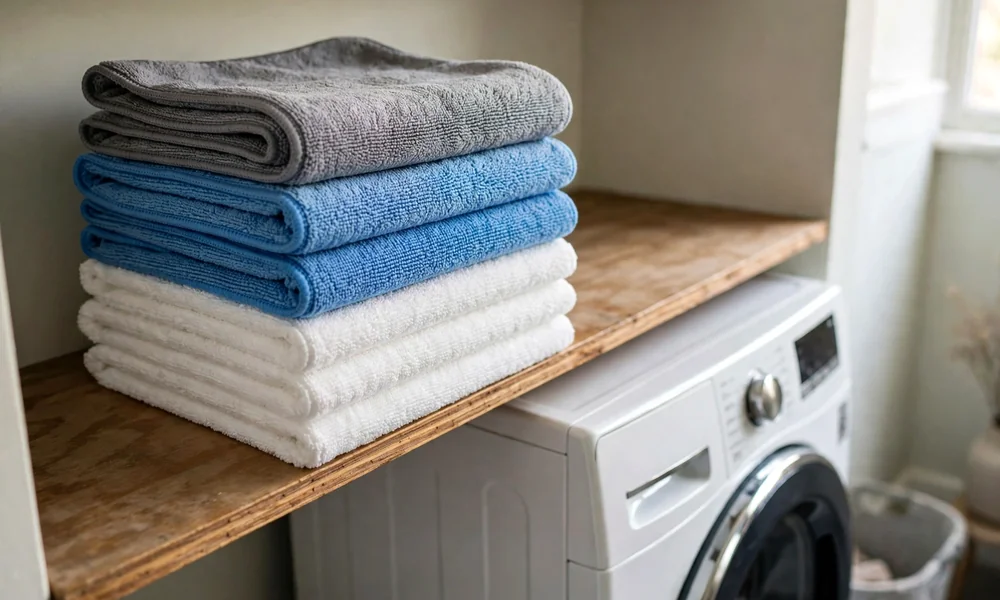
Microfiber is a yarn made from polyester and polyamide, split into fibres so fine that a single strand is thinner than a human hair. The split is the whole point: each fibre forks into tiny edges that scrape and trap dust, grease and dried spills, and the gaps between the fibres hold water and dirt until you rinse them out. A cloth made from unsplit fibres looks the same on the shelf but behaves like an ordinary rag.
You can feel the difference before you buy. A good microfiber pad feels thick and slightly grippy, and it clings a little to your dry hand. A poor one feels smooth, silky and thin, and slides across your palm without catching. Press it with your thumb: it should spring back, not stay dented. Check the label too. A pad that states its blend, usually around 80 percent polyester and 20 percent polyamide, and its weight in GSM, is made by a manufacturer that expects you to check.
The other thing to check is how the pad attaches. The best pads clip, slide or press onto the head firmly and come off easily for the washing machine. A pad that slips halfway across the room, or one that needs a fight to remove, will be the reason the mop ends up unused in the cupboard. Our guide to the best replacement mop heads that fit and last explains the fixings in detail.
GSM: The Number That Tells You How Thick the Pad Is
GSM means grams per square metre, and it is the simplest way to compare microfiber pads without touching them. A higher GSM means a denser, thicker, more absorbent pad. A lower GSM means a thinner, lighter pad that dries faster but holds less dirt. Neither is better in every case: the right weight depends on the floor and the job.
GSM bands and what they suit
Under 200 GSM, a pad is thin and light, good for dusting and for glass, where a thick pile would leave lint and streaks. Between 300 and 400 GSM sits the everyday sweet spot: thick enough to trap dirt and hold water, light enough to rinse and wring easily. At 400 GSM and above, pads turn plush and thirsty, which suits pet homes and greasy kitchens. Above 500 GSM, pads stay soggy, take ages to dry, and cost more than they are worth.
Do not pay extra for a GSM number you cannot use. For most homes, two 350 GSM pads beat one 500 GSM pad, because the second pad is always clean while the first is in the wash.
The Four Weaves, and Which Job Each One Does
Weave is the pattern the fibres are knitted into, and it changes what the mop is good at more than the handle ever will. The four weaves below cover almost every microfiber mop on sale.
| Weave | Best for | Typical GSM | Watch out for |
|---|---|---|---|
| Loop pile | Everyday mopping, tiles and wood | 300 to 400 | Thin loops go flat after a few washes |
| Chenille and string | Pet hair, rough tiles, heavy dirt | 350 to 450 | Holds more water, needs thorough wringing |
| Flat weave | Glass, mirrors, polished stone | Around 200 | Poor on greasy or gritty floors |
| Waffle weave | Drying floors, spill pickup | 350 to 450 | Grid traps grit that can scratch |
Loop pile is the all-rounder: short loops of fibre that trap dust and grease on smooth floors without leaving lint. Chenille and string heads have long, finger-like strands that reach into grout lines and rough tiles and pick up pet hair that a flat pad would push into a corner. Flat weave has almost no pile, which is exactly why it suits glass, and waffle weave has a raised grid that soaks up water fast, making it the best drying pad in the house, though the grid can trap grit, so rinse it well before it touches a polished floor.

The Four Microfiber Mop Shapes
The same microfiber can sit on four very different mops, and the shape decides how you wring it, how much floor you cover, and where you store it.
Flat-pad microfiber mops
A flat mop has a rectangular head, usually 30 to 45 centimetres wide, with a washable microfiber pad that clips or slides on. The whole pad stays in contact with the floor, which is why flat mops suit mixed hard floors, sealed wood and small homes best. They are light, they store upright behind a door, and the pad comes off for the washing machine. Our guide to how to choose the best flat mops for hard floors covers the wringing systems in detail.
Spin microfiber mops
A spin mop pairs a round microfiber head with a bucket that spins the head dry. Centrifugal force throws the water out of the fibres, leaving the head damp rather than wet, which is why spin mops win on large tiled floors: the floor dries in minutes with fewer streaks. A thick plush head traps pet hair far better than a thin one. Our guide to the top spin mops that leave floors streak-free explains the pump and pedal wringers.
String and chenille microfiber mops
String mops are the old-fashioned bundle of strands, now often made from microfiber chenille instead of cotton. They hold more water than any other mop, which makes them the best choice for rough floors and heavy spills. The downside is control: a string head is hard to wring evenly, so it leaves more water behind on smooth floors.
Spray microfiber mops
A spray mop is a flat mop with a refillable tank built into the handle and a trigger that mists the floor just ahead of the pad. The pad underneath is a washable microfiber cloth. Spray mops suit flats, busy kitchens and laminate that must stay nearly dry, though the small tank means they are for quick cleans rather than whole-house mopping.
How to Choose by Floor
Start with your floors, not with the mop. Sealed wood and laminate want the least water of any floor, so choose a flat or spray microfiber mop with a fine, dense pad and a wringer that leaves it barely damp.
Large tiled floors are the opposite problem: you need coverage and a wringer that gets the head properly dry, so a spin microfiber mop earns its keep there. Small flats and bathrooms suit a compact flat mop with a 30-centimetre head, which fits between the toilet and the bath and stores in a cupboard.
Pet homes need pile. A loop-pile pad will push pet hair into corners, while a chenille head traps it in the strands and releases it in the wash. Buy three or four pads, not two, because a pet home dirties a pad in one room, and a dirty pad spreads hair and grease instead of lifting them.
Washing and Care: Where Most Microfiber Mops Die
A microfiber pad can survive dozens of washes, but only if you wash it properly. Fabric softener is the main killer: it coats the split fibres with a waxy layer and stops them trapping dirt, so a softened pad behaves like an ordinary rag. Skip the softener every time, wash at 40 degrees, and avoid bleach, which breaks the fibres down. Wash pads with other microfiber, not with towels, because lint from cotton towels clings to the fibres and dulls them.
Dry pads in the air, not in a hot tumble dryer, which can melt the fine fibre tips and fuse them smooth. A pad that has gone flat, smooth or smelly after washing is finished: the fibres have lost their split edges and will not trap dirt again. Keep a spare pad in the cupboard so a replacement is never an excuse to mop with a dirty one.
Rinse the pad during mopping, too. A microfiber pad can only hold so much grime before it starts giving it back, and after a few passes across a grubby kitchen floor the pad is full of grease and dust. Rinse it in clean water, wring it until it feels damp rather than wet, and change the water when it turns grey.

Checklist: Before You Buy a Microfiber Mop
- Feel the pad: thick, grippy and springy, not thin, silky and flat.
- Check the label for a stated blend and a GSM weight in the 300 to 400 range for everyday use.
- Match the weave to your floors: loop pile for general cleaning, chenille for pets and rough tiles, flat weave for glass.
- Confirm spare pads are sold separately and fit the head without a fight.
- Test the wringer: the pad should come out damp, not dripping, with one wring.
- Measure your storage: the mop should stand upright or fit in the cupboard you actually have.
Frequently Asked Questions
Are microfiber mops better than cotton mops?
For smooth hard floors, yes. Split microfiber fibres trap dust and grease that cotton strands push around, and microfiber pads survive far more washes without shedding. Cotton still has a place on very rough floors and for heavy spills.
What GSM microfiber mop pad should I buy?
Choose 300 to 400 GSM for everyday mopping. Go to 400 GSM and above for pet homes and greasy kitchens, and down to around 200 GSM in a flat weave for glass and mirrors, where a thick pile would leave lint.
Can I wash microfiber mop pads in the washing machine?
Yes, at 40 degrees without fabric softener or bleach. Wash them with other microfiber rather than cotton towels, and air-dry them instead of using a hot tumble dryer, which can fuse the fine fibre tips smooth.
Why does my microfiber mop leave streaks?
Usually the pad is too wet, too dirty, or coated in softener. Wring it until it feels damp rather than wet, rinse it often, and change grey water. A pad that stays flat and smooth after washing has lost its fibres and needs replacing.
How many microfiber mop pads do I need?
At least three: one on the mop, one clean in the cupboard, and one in the wash. Pet homes and large tiled floors need four, because a pad dirties in a single room.
Do microfiber mops work on wood floors?
Yes, if the pad is barely damp. Use a flat or spray microfiber mop with a fine dense pad on sealed wood and laminate, and never use a soaking head on unsealed wood, where water seeps into the grain and seams.
Bottom Line
Choose a microfiber mop by its fibres first: split microfiber, 300 to 400 GSM, in the weave your floors need, with spare pads you can actually buy. Get the pad right, wash it without softener, and replace it when it goes flat, and a microfiber mop will clean better and last longer than any cotton mop at the same price.


