
Best Milk Pitchers for Silky Microfoam and Latte Art in 2026
The best milk pitchers of 2026 turn steamed milk into silky microfoam and pour it in a thin, controlled stream, so a home latte looks like it came from a café. A good pitcher is a simple steel jug with a pouring spout, and it decides whether your latte art is a rosetta or a blob.
A milk pitcher is not a milk frother. A frother is the machine that makes the foam, while the pitcher is the jug you steam milk in and pour it from. Our guide to the best milk frothers of 2026 covers the machines; this guide is about the jug itself.
Key Takeaways
- Size matters most: 12oz suits one drink, 20oz suits two drinks, and filling either past two-thirds ruins the foam.
- The spout decides your latte art: narrow pours thin lines for rosettas, wide pours fast and thick for cappuccinos.
- Stainless steel is the only material worth buying: it holds heat evenly and survives the dishwasher.
- Buy for the drink you make most often: a pitcher that holds twice your drink wastes milk.
- Clean the pitcher the moment you finish pouring: dried milk welds itself to steel.
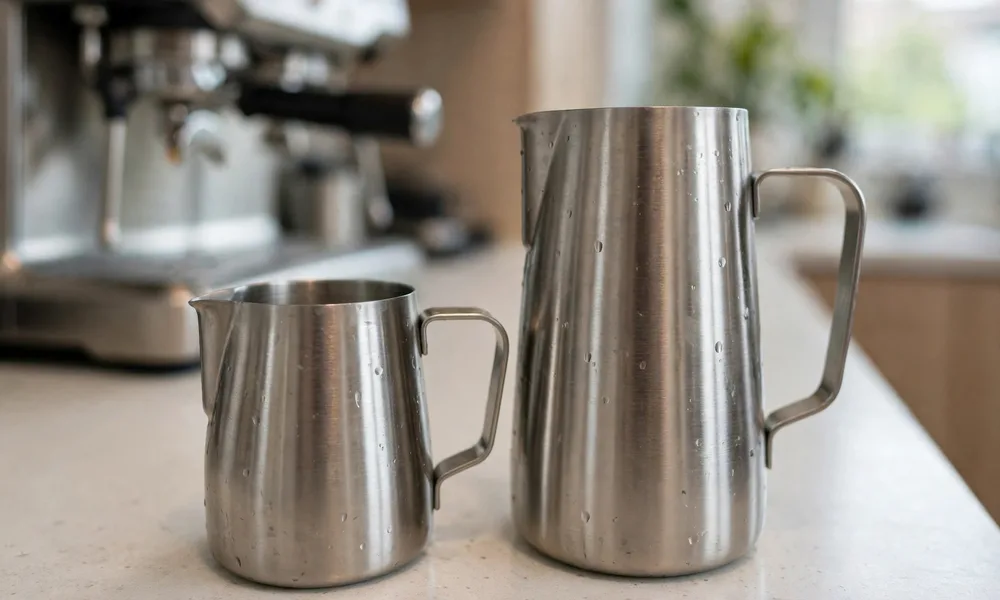
What a Milk Pitcher Actually Is
A milk pitcher, also called a milk frothing pitcher, is a small stainless steel jug with a spout and a handle, made to hold milk while it is steamed and pour it into coffee. It has no heater, whisk or motor: the steam wand does the heating and frothing, and the pitcher holds the milk and lets you feel its temperature.
The pitcher does four jobs. First, holding milk: too small and it spills as it expands; too large and a single drink swims too shallow for a whirlpool. Second, shaping foam: a tall, narrow pitcher keeps the milk in a deep column, so steam folds air through it. Third, pouring: a good spout releases milk in a thin thread you can aim. Fourth, temperature: steel lets you feel when the milk hits 60 to 65 degrees.
The Five Things That Decide a Good Milk Pitcher
1. Size
Milk roughly doubles as it steams, so fill to about a third and never past two-thirds. A 12oz pitcher, about 350 millilitres, holds enough for one flat white or latte; a 20oz, about 600 millilitres, covers two drinks or one large latte. A 32oz is a café tool, too big for one person at home.
2. Spout
The spout is where latte art is won or lost. A narrow, sharply pointed spout pours a thin thread you can steer into rosettas and tulips, because the flow starts and stops when you tilt. A wide, rounded spout pours faster and thicker, which suits cappuccinos, poured in a broad cap rather than drawn.
3. Steel
Stainless steel is the only material worth buying. Food-grade 304 steel resists rust, takes no flavour from the milk, and survives knocks against a sink. Steel around 0.8 to 1.0 millimetres holds heat evenly; very thin steel dents and overheats milk. Glass breaks; plastic stains and warps.
4. Handle
The handle should sit far enough from the body that your knuckles clear the hot steel, and it should be fixed with a solid weld or rivets rather than a spot weld that loosens. Some baristas prefer handle-free pitchers, but a proper handle is safer for most home users, especially with a full 20oz pitcher.
5. Markings and Cleaning
Etched markings inside take the guesswork out of filling: a line at a third and a line at half covers most drinks. For cleaning, a smooth interior with no seams is what matters, because dried milk finds every crease, and a pitcher that goes in the dishwasher gets used every day.
The Best Milk Pitchers of 2026
Five pitchers below cover every kitchen and budget, judged on spout control, steel quality, balance, cleaning, and how well each steams a single drink.
| Pitcher | Size | Best For | Price Range |
|---|---|---|---|
| Everyday Classic 12oz | 12oz / 350ml | One drink a day | Budget |
| Café Tall 20oz | 20oz / 600ml | Two drinks at once | Mid-range |
| Precision Pour 12oz | 12oz / 350ml | Latte art | Mid-range |
| Heavyweight Barista 20oz | 20oz / 600ml | Daily heavy use | Higher |
| Budget Starter 12oz | 12oz / 350ml | First pitcher | Low |
1. Everyday Classic 12oz
The Everyday Classic 12oz is the best all-round milk pitcher of 2026. The 350 millilitre body is tall enough for a proper whirlpool, the spout is a gentle point that pours a clean thread for hearts and tulips, and the 0.8 millimetre steel feels solid without being heavy. Etched markings take the guesswork out of filling, and the smooth interior rinses clean while still warm.
2. Café Tall 20oz
The Café Tall 20oz is the best milk pitcher for two drinks at once. Taller and slightly narrower than the Classic, it holds 600 millilitres and steams enough microfoam for two flat whites or one very large latte in one round. The longer handle keeps your knuckles clear of the hot wall, and the wider spout pours fast, which suits cappuccinos better than fine art.
3. Precision Pour 12oz
The Precision Pour 12oz is the best milk pitcher for latte art. Its spout is narrow and sharply pointed, so the milk leaves in a thread thin enough to draw a rosetta petal by petal, and the flow stops the instant you level the pitcher. The steel is a touch thicker than the Classic, which keeps the milk temperature steady while you pour.
4. Heavyweight Barista 20oz
The Heavyweight Barista 20oz is the best milk pitcher for daily heavy use. Built from 1.0 millimetre 304 stainless steel, it is the thickest pitcher here, and the weight is the point: it sits steady, holds heat evenly while you steam, and survives years of knocks against a sink and a steam wand. The spout is a medium point that handles both art and fast pouring, and the handle is riveted rather than spot-welded.
5. Budget Starter 12oz
The Budget Starter 12oz is the best cheap milk pitcher, and the right first buy if you are not sure how seriously you will take home coffee. It is a straightforward 350 millilitre stainless jug with a rounded spout, a simple loop handle and no markings, and it steams a perfectly good single drink. The steel is thinner, so it heats faster and dents more easily, but it costs less than a bag of good beans.

How to Steam Milk and Pour Latte Art
Start with cold milk in a cold pitcher, filled to about a third: about 120 millilitres in a 12oz pitcher, about 200 millilitres in a 20oz. Whole dairy milk steams most easily; barista-style oat milk is the best plant-based option. Purge the steam wand, then sink the tip just below the surface, off-centre, so the milk spins in a whirlpool. The hiss at the start is air going in; once the milk reaches body temperature, sink the tip deeper. Stop at 60 to 65 degrees, when the pitcher is too hot to hold for more than a second.
After steaming, tap the pitcher once on the counter to pop the big bubbles, then swirl it until the surface looks like wet paint: glossy, with no bubbles at all. That glossy milk is microfoam. To pour latte art, start with the pitcher close to the cup, pouring a thin stream into the centre of the espresso from a height. As the cup fills, lower the pitcher until the spout almost touches the surface, then pour faster and wiggle gently side to side: the milk rides on the surface, and the wiggle lays down the leaves of a rosetta. To finish, lift the pitcher and pull a thin line straight through the pattern. A narrow spout forgives a bad tilt, because it limits the flow. And if your machine has a weak steam wand, our guide to the best espresso machines of 2026 covers which models steam milk well and which ones only pretend to.

Cleaning and Care
Rinse the pitcher under hot water the moment you finish pouring, while the milk is still wet, and wipe the inside with a damp cloth. Dried milk welds itself to steel within minutes, and once it sets you need a soak and a scrub to shift it. Purge and wipe the steam wand every time too, because milk baked onto a wand burns the next drink. Most stainless pitchers are dishwasher safe, but hand-washing keeps the steel brighter. Never put a pitcher away wet and sealed: a damp, closed jug smells of old milk within a day. A dented spout pours unevenly and cannot be fixed, so store the pitcher upright.
Checklist: Before You Buy a Milk Pitcher
- Match the size to your drink: 12oz for one drink, 20oz for two, never a 32oz at home.
- Check the spout: narrow and pointed for latte art, wide and rounded for fast cappuccino pours.
- Feel the weight: 0.8 to 1.0 millimetre steel feels solid and holds heat evenly; very thin steel dents and overheats milk.
- Look for etched markings inside, at a third and a half, so you fill it right without a measuring jug.
- Test the handle: your knuckles should clear the hot wall, and it should be riveted or solidly welded.
- Check it fits under your steam wand with room to tilt, and goes in the dishwasher if you will not hand-wash it.
Frequently Asked Questions
What size milk pitcher should I buy?
Buy a 12oz pitcher, about 350 millilitres, for one drink at a time, and a 20oz, about 600 millilitres, for two drinks at once or one very large latte. Fill either to about a third before steaming, because milk roughly doubles as it froths.
Is a milk pitcher the same as a milk frother?
No. A frother is the machine or wand that makes the foam, while a pitcher is the jug you steam the milk in and pour it from. Electric jug frothers have a whisk and heater built in; a pitcher has neither. Our guide to lattes that actually taste like coffee explains what the finished drink should taste like.
What is the best material for a milk pitcher?
Stainless steel, specifically food-grade 304 or 18/8 steel, is the best material. It holds heat evenly, lets you feel the temperature through the wall, resists rust, and survives the dishwasher. Glass breaks, and plastic stains and warps.
How much milk should I put in the pitcher?
Pour cold milk to about a third of the pitcher, roughly 120 millilitres in a 12oz pitcher and 200 millilitres in a 20oz. It will roughly double as it steams, ending at about two-thirds full. Filling past halfway means the milk will spill over the rim.
Can I make latte art with any milk pitcher?
You can make simple latte art with any pitcher, but a narrow, pointed spout makes it far easier, because it pours a thin, controllable thread. A wide, rounded spout pours too fast for fine patterns. The milk must also be glossy microfoam, steamed to 60 to 65 degrees.
How do I clean a milk pitcher?
Rinse it under hot water immediately after pouring, while the milk is still wet, and wipe the inside with a damp cloth. Dried milk welds itself to steel. Most pitchers are dishwasher safe, but hand-washing keeps the steel brighter, and never store one away wet and sealed.
The Bottom Line
The best milk pitcher is the one matched to your drink, not the biggest or prettiest on the shelf. For one milky coffee a day, buy the 12oz Everyday Classic: it steams a single drink properly, pours cleanly, and rinses clean in seconds. If you make two drinks at once, add the 20oz Café Tall for weekends and guests. If latte art is the goal, the Precision Pour 12oz will improve your pour faster than any amount of practice with a rounded spout.


