
A warm evening outside should feel relaxing, not like a battle. Yet for many homes the moment the sun drops, the mosquitoes arrive, and the patio, the garden and even the bedroom become places to avoid. Sprays help for a while, candles help a little, and nets help only when you stay behind them. A good mosquito trap works differently: it sits quietly in the background, drawing insects away from people. The best mosquito traps of 2026 are not the loudest or the most expensive. They are the ones that match the space, run reliably, and keep catching mosquitoes week after week without constant attention.
What Makes a Mosquito Trap Good
The first thing to judge is how the trap attracts mosquitoes. Most good traps use a mix of light, warmth and scent, because mosquitoes follow carbon dioxide from breath, body heat and the smell of skin. Ultraviolet light alone will catch some insects, but a trap that adds a warm glow, a gentle fan and a scent lure will catch far more mosquitoes and far fewer harmless moths. The fan matters most: it pulls insects into a chamber they cannot escape from, and it keeps working even when the light is not the main draw.
The second thing is coverage. A trap rated for a small bedroom will not protect a large garden, and a powerful garden trap will be noisy and oversized indoors. Coverage is usually given in square metres, and it is worth taking seriously, because a trap only protects the area its lure can reach. For a bedroom or a small living room, a compact indoor trap is enough. For a patio or a garden, a larger outdoor trap with a stronger fan and a weatherproof body is the sensible choice. Buying too small is the most common mistake, and it leaves the buyer convinced that traps do not work at all.
The third thing is how easy the trap is to live with. It needs to be quiet enough to sleep near, simple to empty and clean, and cheap enough to run every night without worry. A trap that is loud, fiddly or expensive to run will end up switched off, and a switched-off trap catches nothing. Look for a removable collection tray, a washable chamber and a power cord long enough to reach a sensible spot. The best traps are boring to own: plug them in, empty them weekly, and forget about them.
The Main Types of Mosquito Trap
Ultraviolet light traps are the most familiar type. They use a soft blue or violet light to attract flying insects, a fan to pull them in, and a mesh or tray to hold them. They are quiet, cheap to run and safe indoors, which makes them the natural choice for bedrooms, kitchens and living rooms. Their weakness is that light alone is a modest lure compared with heat and scent, so they work best in a closed room where the trap is the brightest thing around.
Carbon dioxide traps are the heavyweights. They release a small stream of carbon dioxide, sometimes with heat and a scent lure, to mimic a breathing person. Mosquitoes follow the gas, get drawn in by the fan and are caught in a net or chamber. These traps cover large gardens and patios well, and they catch far more mosquitoes than a light-only trap. They cost more, need regular lure refills, and are best kept outdoors, away from where people sit.
Electric zappers use a glowing grid that kills insects on contact. They are dramatic and satisfying to watch, and they work well in a garden or on a farm where the crackle does not matter. Their weakness is that they kill everything that touches the grid, including harmless insects, and the light can attract more insects to the area than it kills. A zapper is a reasonable choice for a large outdoor space, but it is a poor choice for a bedroom, where the noise and the flash will disturb sleep.
How to Choose the Right Trap
Start with the place, not the product. A bedroom needs a quiet fan trap that can sit on a bedside table and run all night without disturbing sleep. A patio needs a weatherproof outdoor trap that can handle rain and wind. A garden needs a carbon dioxide trap placed at the edge of the space, drawing mosquitoes away from the seating area. A kitchen or a greenhouse needs a sticky trap or a small fan trap that is safe near food and plants. When the place is clear, the right type usually chooses itself.
Then think about who else uses the space. Homes with small children or pets should avoid open electric grids and chemical lures, and favour enclosed fan traps and sticky traps with covered sheets. Homes with someone who is sensitive to light should choose a trap with a dim glow or a cover that hides the light at night. A trap that is safe for the whole household will be used every night. Safety decides whether the trap is actually used.
The Best Mosquito Traps of 2026
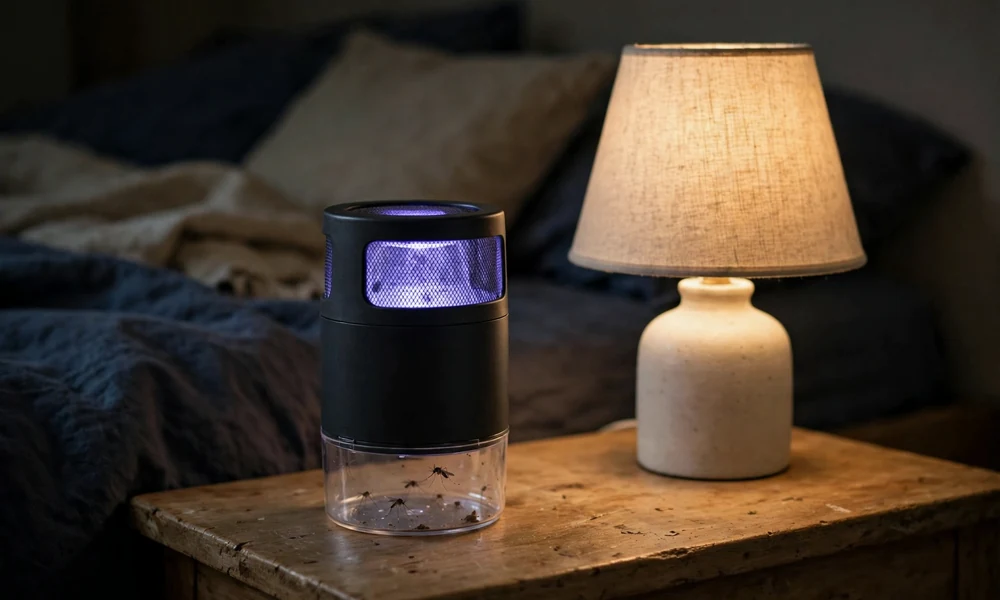
The best trap for most homes this year is a compact indoor fan trap with a warm ultraviolet light, a quiet motor and a removable collection tray. It sits on a bedside table or a shelf, draws mosquitoes in with light and the gentle pull of the fan, and holds them in a chamber that empties in seconds. It is quiet enough to sleep beside, cheap to run, and it needs no refills beyond an occasional clean. For a bedroom, a small flat or a quiet living room, this is the pick that makes the most sense for the most people.
The best outdoor trap of 2026 is a larger carbon dioxide trap built for gardens and patios. It releases a steady stream of carbon dioxide with a warm glow and a scent lure, and its strong fan pulls in mosquitoes from a wide area. It is weatherproof, it runs all evening without attention, and it keeps the seating area clearer than any light-only trap could. It costs more and needs lure refills, but for a garden that is unusable in summer, that cost is easy to justify. Place it at the edge of the garden, away from the chairs.
The best trap for a patio or a balcony is a mid-sized outdoor fan trap with a rainproof body and a long power cord. It is stronger than an indoor trap and quieter than a zapper, and it covers the area where people actually sit without drawing in every insect in the neighbourhood. It hangs from a hook or stands on a table, and its collection tray empties without tools. For a flat with a balcony or a small house with a patio, this is the most practical choice.
The best quiet trap for a bedroom is a small fan trap with a dim light and a soft motor, designed to sit beside the bed and run all night. It has no zap, no smell and no bright glare, and its collection tray is easy to empty in the morning. It will not protect a garden, and it was never meant to, but in a closed bedroom it catches the few mosquitoes that slip in through a window or a door. For light sleepers and for children’s rooms, quiet matters more than power.

Where to Put a Trap
Placement matters as much as the trap itself. Mosquitoes follow scent and warmth, so a trap placed right beside the chairs will draw insects toward the people first, and the trap second. The better spot is between the mosquitoes and the people: at the edge of a patio, near a hedge, by a damp corner of the garden, or beside the door the insects come through. Indoors, the trap should sit near the window or door where mosquitoes enter, and away from other lights, so it is the brightest thing in the room.
Keeping a Trap Working Well
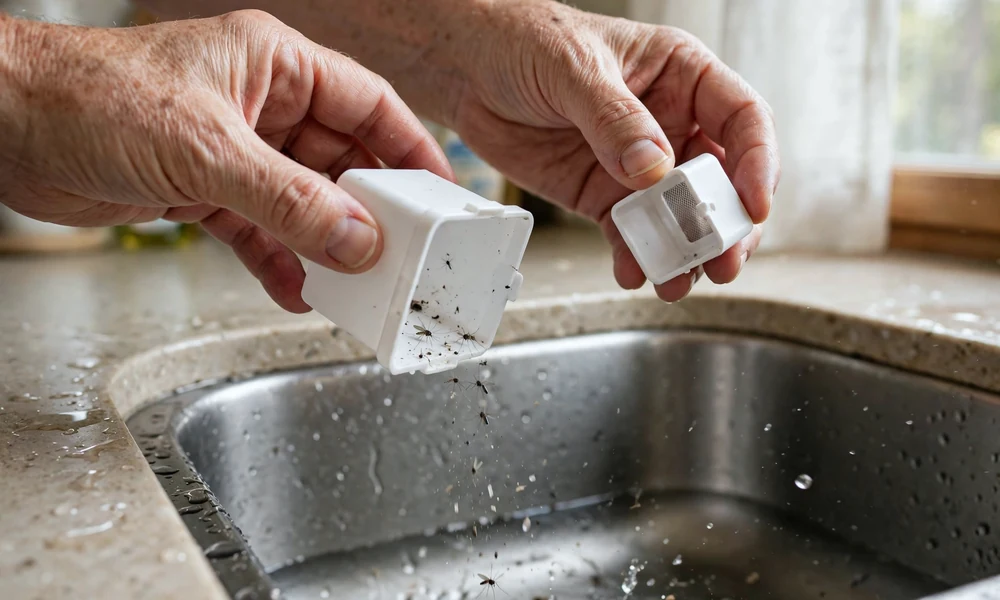
A trap is not a device to plug in and forget entirely. The collection tray needs emptying once or twice a week in mosquito season, and the chamber needs a rinse so old insects do not block the airflow. The light or bulb needs checking now and then, because a dim bulb attracts little, and the scent cartridge, if the trap has one, needs replacing on schedule. A clean trap with a fresh lure catches far more than a dirty trap with a spent cartridge. Ten minutes a week is all it takes.
Common Mistakes to Avoid
The biggest mistake is expecting one trap to do everything. A trap protects the area its lure can reach, and no single trap will clear a whole house and garden at once. The second mistake is placing the trap beside the chairs, which draws mosquitoes toward people instead of away from them. The third is buying on power alone, without checking noise, running cost or safety around children and pets. A powerful trap that is too loud to sleep near will end up in a cupboard, and a cupboard trap catches nothing.
Traps, Nets and Sprays Together
A trap works best as part of a small system, not on its own. A net over the bed keeps mosquitoes away while you sleep, and a trap in the room catches the ones that slip past the net, so the two together cover the night far better than either alone. Readers who sleep under a net will find the best mosquito nets guide useful for choosing one that fits the bed and stays up without fuss. The same logic applies outside: a trap at the garden’s edge and a net over a pram protect the people the trap cannot reach.
Sprays have their place too, especially for an evening walk or a trip away from home, where no trap can follow. A good spray protects the skin for a few hours, while a trap protects a place for a whole season, and the two complement each other rather than competing. The best bug sprays guide covers the sprays that last longest without feeling sticky or smelling harsh. Use the spray when you leave the house, and let the trap look after the house while you are in it.
The same thinking applies to other flying insects. A home that has trouble with mosquitoes often has trouble with flies too, and the two pests need different tools: a mosquito trap draws mosquitoes with warmth and scent, while a fly trap uses a different lure and a different placement. The best fly traps guide explains that difference, and why a trap that is good for one pest is often poor for the other. Together, a trap, a fly trap, a net and a spray cover the pests most homes meet.
The Verdict
The best mosquito trap of 2026 is the one that matches the place it has to protect. For most homes that means a quiet indoor fan trap for the bedroom, and a larger carbon dioxide trap at the edge of the garden for the summer evenings outside. For a patio or a balcony, a mid-sized outdoor fan trap is the practical pick, and for a kitchen or a greenhouse, a cheap sticky trap is the honest choice. Whatever the choice, put the trap in the right spot, run it from dusk, empty it twice a week and give it a week to prove itself.


