Best Outdoor Sofas for Patios, Gardens and Balconies in 2026
The best outdoor sofas turn a patio into a room you actually live in: morning coffee stretches into a second cup, friends settle after dinner instead of drifting back inside, and summer evenings last until the light goes. An outdoor sofa looks like its indoor cousin, but it is judged by different rules: rain, sun, pollen and frost. A living-room sofa will sag and smell within one wet season outdoors; a garden-built sofa stays comfortable for years. This guide explains how to choose the best outdoor sofas in 2026: which frame materials survive the weather, which fabrics dry fast and hold their colour, and how the main shapes suit different spaces. If you are choosing a sofa for inside the house, our guide to how to choose a sofa that survives real life covers living-room sofas; everything here is about sofas that live outside.
Key takeaways
- Buy the frame first: powder-coated aluminium never rusts, teak weathers for decades, and all-weather wicker over aluminium survives rain that destroys bare steel.
- Fabric decides comfort outdoors: solution-dyed acrylic holds its colour, and quick-drying foam with a mesh base dries within hours of a shower, not days.
- Match the sofa to the space: a three-seater suits a wide patio, a loveseat fits a balcony, and a sectional only earns its size on a large flat terrace.
- Seat depth matters more than looks: a seat 55 to 60 centimetres deep with cushions at least 10 centimetres thick stays comfortable for a long evening.
- Budget for a cover and winter storage: even the toughest outdoor sofa lasts years longer covered or stored through the cold months.
Outdoor sofa types compared
Most outdoor sofas fall into five shapes, and the right one depends on how many people you seat and how big the space is. The table below covers the shapes you will actually find in shops in 2026.
| Sofa type | Best for | Seats | Typical price | Watch out for |
|---|---|---|---|---|
| Three-seater sofa | Wide patios, family evenings | 3 | $700–$2,000 | Needs 2 metres of clear run |
| Loveseat | Balconies, small patios | 2 | $400–$1,200 | Too narrow for lying down |
| Sectional | Large patios, big groups | 5–8 | $1,200–$3,500 | Heavy, needs a flat base |
| Modular sofa | Changing groups, flexible layouts | 3–6 | $900–$2,800 | Sections drift without clips |
| Daybed | Sunbathing, naps, pool sides | 1–2 | $800–$2,500 | Poor back support for sitting |
Three-seater sofas
The three-seater is the standard outdoor sofa and the best choice for most patios. It seats three adults, or two people stretched out, and pairs naturally with two armchairs and a low coffee table. Look for a seat depth of 55 to 60 centimetres and a back high enough to support your shoulders. It needs about two metres of clear run, plus walking space in front, so measure before you buy. Check it fits through the garden gate before delivery day.
Loveseats
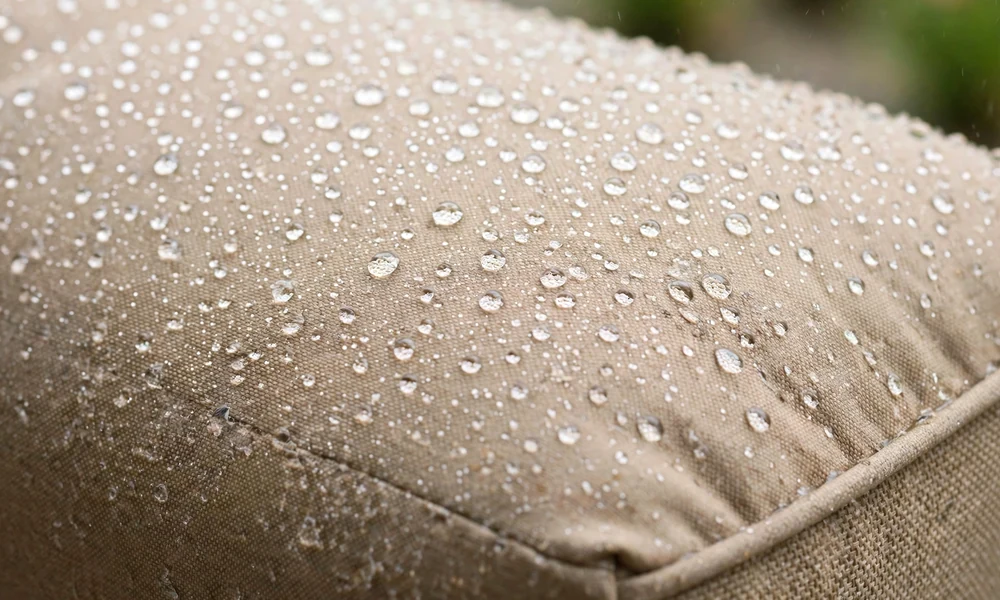
A loveseat is a two-seat outdoor sofa, usually 120 to 150 centimetres wide, and the right answer for balconies and small patios where a three-seater would swallow the space. It suits couples, morning coffee for two, and a quiet corner with a book. The trade-off is obvious: two people sit close, and nobody lies down properly. Buy one when the space forces the choice, not when you hope to squeeze three people onto it.
Sectionals
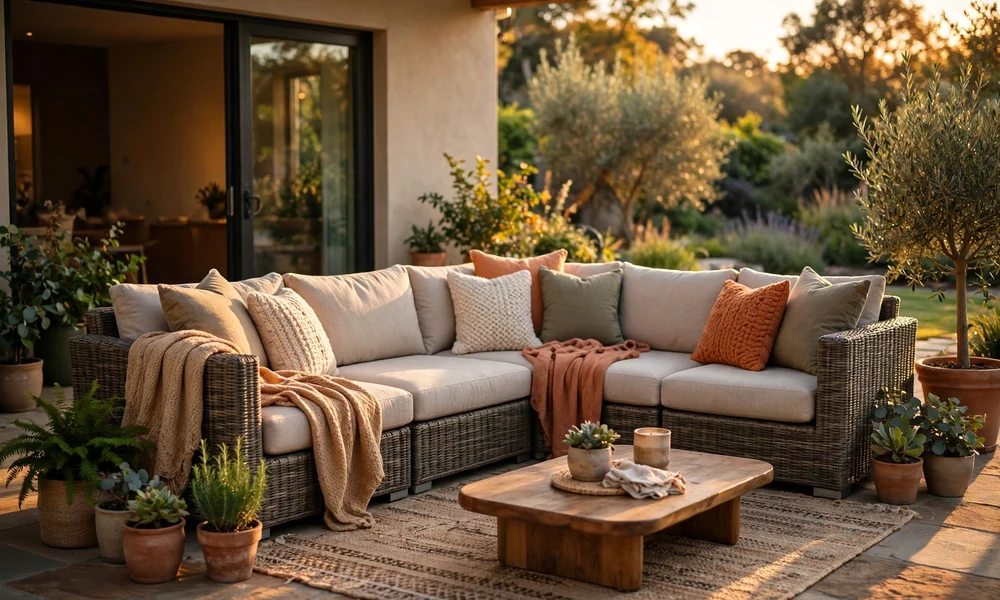
A sectional is an L-shaped outdoor sofa of joined sections, seating five to eight people, and the best choice for large patios where the group changes size through the evening. It only works on a large, flat terrace: it needs three metres or more along each arm of the L, and it is the heaviest and dearest of the common shapes. Check that the sections clip together firmly, because unclipped sections drift apart every time someone stands up. A sectional bought as part of a matched group is covered in our guide to the best patio furniture sets of 2026; here we judge the sofa on its own.
Modular sofas
A modular outdoor sofa is a set of separate seat, corner and chaise pieces you arrange as you like: a straight run for a quiet evening, an L-shape when friends come over, or two separate sofas for a party. Each piece travels alone through a narrow gate. The weakness is the same as its strength: pieces move, so buy only a set with solid clips between sections, and test the join by pushing one piece sideways.
Daybeds
A daybed is a wide, low outdoor sofa with no proper back, built for lying down rather than sitting up. It suits pool sides and afternoon naps. It is a poor choice as the only sofa on a patio, because sitting upright to eat or read is uncomfortable without back support. Buy one as a second piece, after the main seating is sorted, and check the mattress is at least 12 centimetres thick and quick-drying.
The frame: what survives outside
The frame decides whether an outdoor sofa lasts five summers or one. Powder-coated aluminium is the low-maintenance champion: it never rusts, it is light enough to move, and modern finishes hold their colour for years. Its weakness is wind, so look for a solid, well-braced design. Teak is the classic choice: its natural oils repel water and insects, and a well-made teak sofa can last twenty years with almost no care beyond an occasional wash. It silvers with age unless you oil it, but that grey patina is weathering, not damage. All-weather wicker, woven over an aluminium frame, gives the warm look of natural rattan without the fragility. Avoid bare steel, which rusts at every scratch, and untreated softwood, which warps and splits within a season or two. Check the joints: welded or bolted joints last, while staples or thin screws wobble by the second summer.
Cushions and fabric: the comfort test
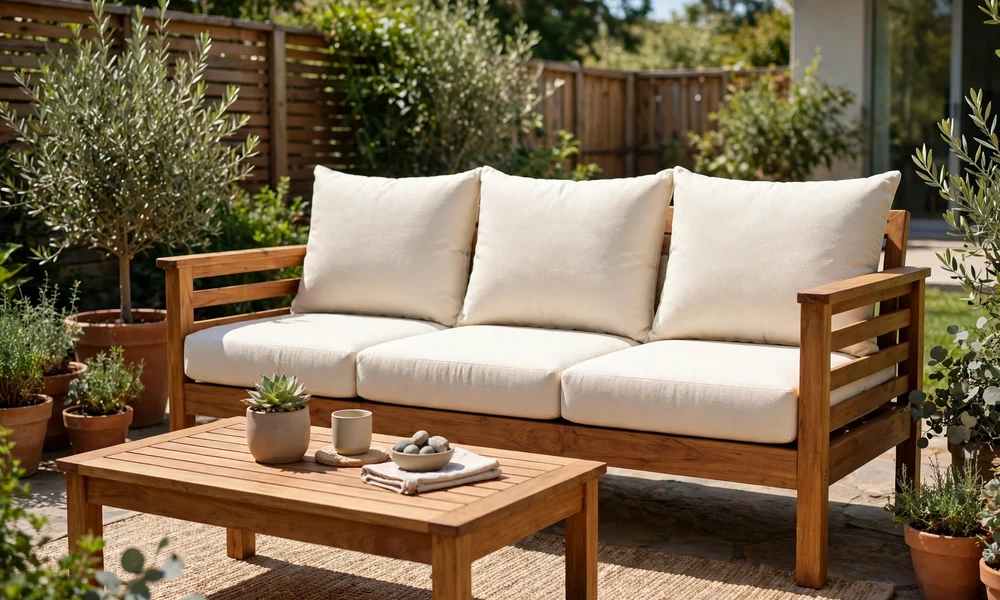
Cushions decide whether an outdoor sofa is comfortable or merely decorative, and fabric decides whether it stays that way. A good outdoor cushion is at least 10 centimetres thick, springs back when pressed, and dries within hours of a shower. Quick-drying foam with an open cell structure lets water drain straight through, while ordinary indoor foam acts like a sponge and stays damp for days. A mesh or slatted base lets water escape; a solid base traps it. Solution-dyed acrylic is the best outdoor fabric because the colour runs through the whole fibre, so it holds its shade through a whole summer of sun. Cheap printed cotton fades by August. Look for removable covers with zips, in mid-tone colours that hide pollen and dust. Our guide to outdoor cushions that stay comfortable all summer covers thickness, drying times and fabric in depth.
Size and layout: measure before you buy
Size is where most outdoor sofa purchases go wrong. Measure the patio first, then the sofa, then the route it has to travel to get there. Leave at least 60 centimetres of walking space in front of the sofa and 45 centimetres between it and the coffee table, or the patio will feel cramped no matter how good the sofa is. A three-seater needs roughly two metres of clear run; a sectional needs three metres along each arm. Then measure the delivery route: garden gates, side passages and steps. Ask whether the legs come off and the back detaches. Check the ground too: a sofa that rocks on uneven decking works its joints loose, and legs sink into soft grass after rain, so put it on pavers or a solid base.
Weather, covers and winter storage
Every outdoor sofa ages, but the good ones age gracefully and the bad ones fail suddenly. Sun fades fabric, dries out wood and makes cheap wicker brittle. Rain finds every unsealed joint and feeds mildew in foam that cannot drain. Frost is the hardest test: water trapped in a frame or cushion expands as it freezes and cracks whatever holds it. A cover is the cheapest insurance you can buy: choose a breathable cover that fits, with vents that let damp air out, and use it whenever the sofa will sit unused for days. In winter, bring the cushions inside and cover the frame, or move the whole sofa into a shed or garage. Teak and aluminium frames can stay out under a cover; wicker and softwood are safer indoors. Before the first frost, wash the frame, dry the cushions fully, and check the feet: worn feet let water into hollow legs, where it freezes and splits them.
What to avoid
A few warning signs separate a good outdoor sofa from a regret. Avoid cushions with no zips and no removable covers, because you cannot wash what you cannot remove. Avoid frames with hollow legs and no drainage holes, because they fill with water and split from the inside. Avoid very light sofas on an exposed patio, because the first strong wind will move them, and avoid very cheap wicker that feels thin and papery, because it cracks in the sun within a season. Finally, avoid buying a sofa for a photograph: sit on it the way you actually sit at home and stay for five minutes.
Shopping checklist
- Measure the patio, the delivery route and the walking space in front of the sofa first.
- Check the frame: powder-coated aluminium, teak or all-weather wicker over aluminium; no bare steel or untreated softwood.
- Press the cushions: at least 10 centimetres thick, quick-drying foam, a mesh base, and removable zipped covers.
- Check the fabric: solution-dyed acrylic that holds its colour, in a mid-tone that hides pollen and dust.
- Test the joints: welded or bolted, sections that clip firmly, and a frame that stays rigid when you lift one corner.
- Budget for a breathable cover and a winter plan for the cushions.
Frequently asked questions
Can an outdoor sofa stay outside all winter?
Teak and aluminium frames can, under a breathable cover, but bring the cushions inside; wicker and softwood are safer in a shed. Dry everything fully before the first frost.
What is the best material for an outdoor sofa frame?
Powder-coated aluminium for low maintenance, teak for longevity and looks, and all-weather wicker over an aluminium frame for warmth without fragility. Bare steel rusts and untreated softwood rots, so avoid both.
How thick should outdoor sofa cushions be?
At least 10 centimetres for seat cushions, and 12 centimetres or more for a daybed mattress. Quick-drying foam with a mesh base matters as much as thickness, because a thick cushion that stays wet for days will smell.
What size outdoor sofa do I need?
A loveseat of 120 to 150 centimetres for a balcony, a three-seater of about two metres for a normal patio, and a sectional only for a large flat terrace. Leave 60 centimetres of walking space in front of the sofa.
How do I stop outdoor sofa cushions going mouldy?
Use quick-drying foam, a mesh base that lets water drain, and removable covers you can wash. Stand cushions on edge after rain, and never cover a damp sofa with a plastic sheet.
Is a sectional or a three-seater better outdoors?
A three-seater suits most patios: it seats three, pairs with armchairs, and is easier to move and cover. A sectional suits large patios and big groups, but it needs a large flat terrace and its sections must clip together firmly or they drift apart.
The bottom line
The best outdoor sofas earn their place by surviving the weather without losing their comfort. Start with the frame: powder-coated aluminium, teak or all-weather wicker over aluminium, with welded or bolted joints. Then judge the cushions: thick, quick-drying, with a mesh base and removable covers in solution-dyed fabric. Match the shape to the space you have, measure the patio and the delivery route before you buy, and budget for a breathable cover and a winter plan for the cushions. Buy the sofa you will sit on for long evenings, not the one that photographs best.