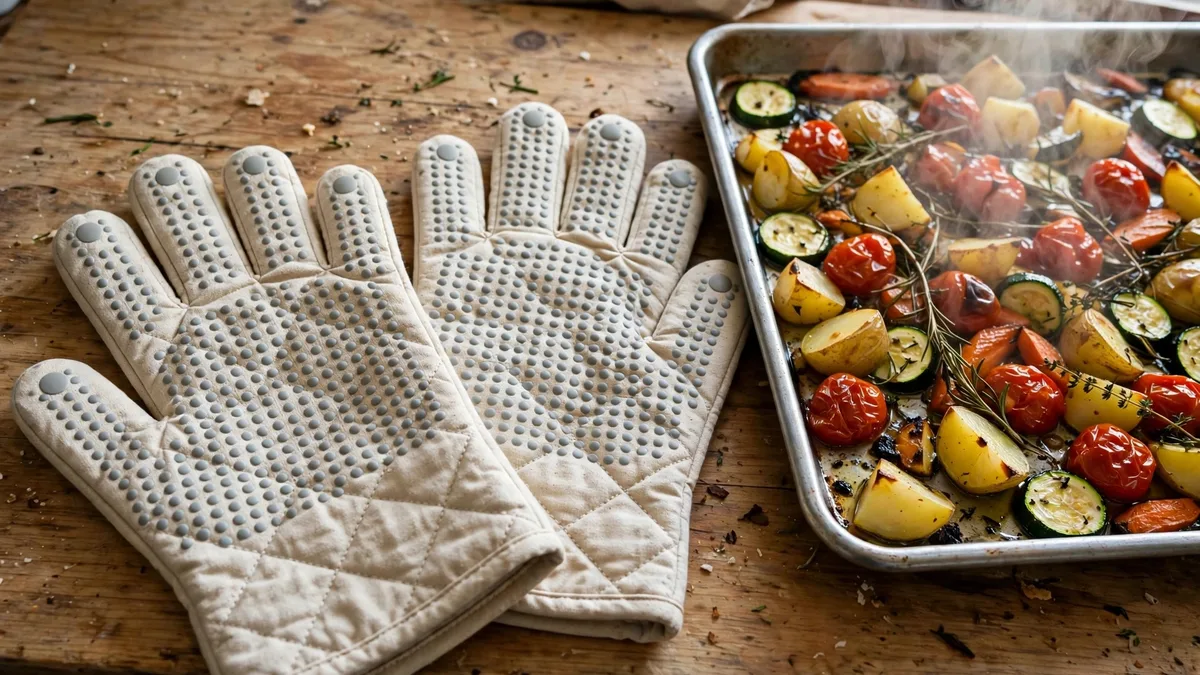
The best oven gloves of 2026 are the five-finger kind, and that detail matters more than most shoppers realise. An oven glove with separate fingers lets you grip a roasting tin by its handles, turn a tray halfway through cooking, and lift a heavy casserole out of the oven without the clumsy fumbling that a single-pocket mitt forces on you. The best oven gloves protect your hands from heat, give you a steady grip on smooth metal and glass, and cover your wrists against the oven rack,
Key Takeaways
- Five-finger oven gloves beat mitts for grip and dexterity, because separate fingers let you hold handles, turn trays, and lift heavy dishes with control.
- Heat protection comes from insulation thickness, not a headline temperature rating: a glove must hold a hot tray for at least ten seconds without heat reaching your skin.
- Silicone grip dots or a silicone palm stop trays sliding, but silicone alone is not enough without thick padding underneath it.
- A cuff that covers the wrist protects against oven racks and steam, which cause more kitchen burns than direct contact with hot dishes.
- Buy a pair, not a single glove, and check the fit first: a glove that is too loose slips, and one that is too tight leaves no insulating air inside.
What Makes an Oven Glove Different From an Oven Mitt
An oven glove and an oven mitt look like close cousins, and in many kitchens the two words are used as if they meant the same thing. They do not, and the difference shows up the moment you lift something awkward. An oven mitt is a single padded pocket: your fingers sit together inside one chamber, and you grip by pressing the whole pocket around a handle or a tray edge. That works well enough for a flat baking sheet, but it gives you almost no control over a round casserole with two small handles, a roasting tin full of hot fat, or a loaf tin you need to tip upside down. An oven glove has five separate fingers, so each finger can wrap around a handle, pinch a tray edge, or steady a dish while the other hand does something else. Our guide to the best vs worst oven mitts in 2026 covers the pocket-style option in full, and it is worth reading alongside this one if you are deciding between the two shapes. The other close cousin is the pot holder, a flat pad that folds around a handle or slides under a dish. Pot holders are handy for setting a hot dish on the table, and our guide to the best pot holders of 2026 picks the thickest and most practical ones. But a pot holder leaves your fingers and wrist exposed, and it cannot grip a tray the way a glove can.
How We Judged the Best Oven Gloves
We judged oven gloves the way they are actually used in a home kitchen: grabbed in a hurry with one hand, wrapped around a heavy tray, and held for longer than planned while you look for somewhere to put it down. Heat protection came first. A good glove keeps your hands comfortable for at least ten seconds on a tray straight out of a 220-degree oven, and the padding must hold its thickness under pressure rather than flattening the moment you squeeze a handle. After heat came grip and coverage. Does the tray stay steady, or does it slide on smooth metal? Does the cuff cover your wrist, or does the oven rack catch bare skin as you reach in? We also looked at fit, because a glove that is too big slips off at the worst moment, and one that is too small squeezes out the air that insulates your hands.
Oven Gloves 2026 at a Glance
| Best for | Glove type | Standout strength |
|---|---|---|
| Best overall | Quilted cotton with silicone grip | Thick, washable, and steady on smooth trays |
| Best grip | Full silicone palm glove | Will not slip on metal, glass, or greasy cast iron |
| Best for heavy dishes | Double-layer aramid and cotton | Extra insulation for roasts and Dutch ovens |
| Best for small hands | Compact quilted glove | Snug fit with full finger control |
| Best value | Thick cotton pair with long cuffs | Everyday protection at a fair price |
The Best Oven Gloves of 2026
Best Overall: Quilted Cotton Gloves With Silicone Grip
The best all-round oven gloves pair thick quilted cotton with a silicone grip pattern across the palm and fingers, and that combination is hard to beat for everyday cooking. The cotton is soft and comfortable, it breathes well enough that your hands do not sweat through a long roast, and it washes easily when it gets stained with fat or tomato sauce. The silicone dots do the job plain cotton cannot: they stop a smooth baking tray or a glass dish from sliding, even when your hands are damp or the tray is greasy. Look for a pair with at least two layers of padding and a cuff that reaches a few centimetres past the wrist,
Best Grip: Full Silicone Palm Gloves
If your main frustration is slipping, a glove with a full silicone palm is the answer. Silicone grips metal, glass, and ceramic far better than fabric, and it stays grippy when wet, which matters when you lift a dish out of a steamer or handle a tray with condensation on it. The catch is that silicone on its own is a poor insulator: a thin silicone glove lets heat through in seconds, so the best designs put a thick cotton or aramid lining behind the silicone shell. Check the lining before you buy, and press the palm between your fingers: if you can feel your fingertips through it easily, the glove will not protect you on a heavy roast.
Best for Heavy Dishes: Double-Layer Aramid and Cotton Gloves
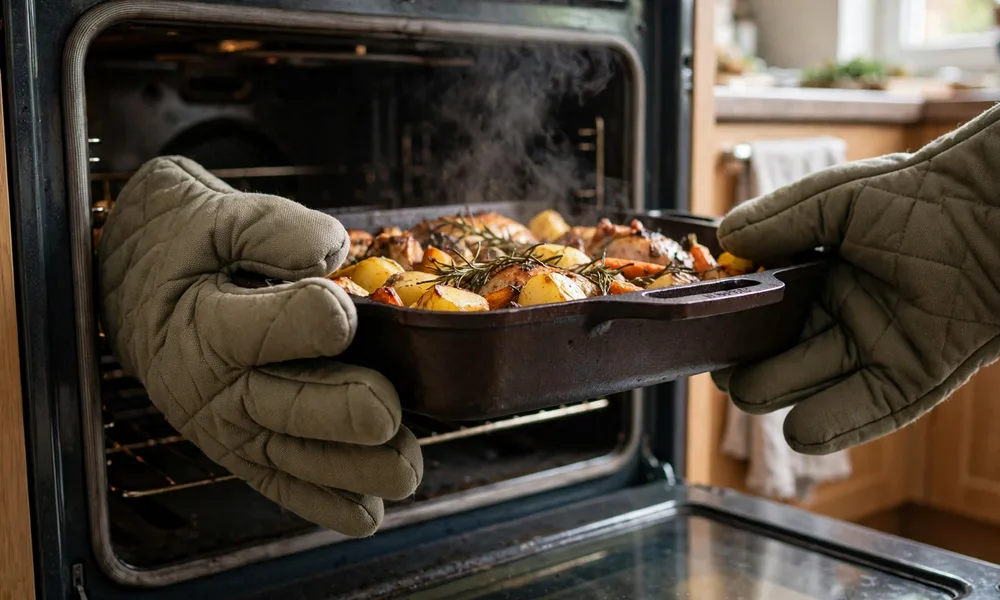
Heavy cooking needs heavy protection, and the best gloves for roasts, Dutch ovens, and cast iron skillets use aramid fibre, the heat-resistant material also used in firefighters’ gloves, layered with thick cotton. Aramid does not melt or scorch the way ordinary fabric can, and it keeps its insulating power even when you hold a very hot dish for longer than planned. These gloves are usually longer, with cuffs that reach well up the forearm, which matters when you reach into a deep oven.
Best for Small Hands: Compact Quilted Gloves
Most oven gloves are made in one generous size, which is a problem if your hands are small: excess fabric bunches at the fingertips, grip suffers, and the glove can slip off when you lift something heavy. Compact quilted gloves solve this with a shorter finger length and a narrower palm, while keeping the same thick padding and silicone grip as the full-size versions. The fit matters more than any material claim, because a snug glove lets your fingers close properly around a handle, and that control is what keeps a hot dish steady. When you try a pair on, make a fist and then spread your fingers wide: the glove should move with your hand, not drag behind it.
Best Value: Thick Cotton Pair With Long Cuffs
You do not need to spend a fortune to protect your hands. A thick cotton pair with long cuffs, decent padding, and a simple silicone grip pattern does the job for most home cooking at a modest price, provided the padding is genuinely thick and the seams are well stitched. Judge value by pressing the glove flat and seeing how quickly the padding springs back: good padding recovers its thickness, while cheap padding stays flat and lets heat through. Buy a pair rather than a single glove, because most hot dishes need two hands, and a spare is always useful when one glove is in the wash.
Materials: What Actually Protects Your Hands
Cotton is the most common oven glove material, and for good reason: it is comfortable, washable, and cheap, and when quilted in thick layers it insulates well. Its weakness is steam and damp, because wet cotton carries heat quickly, so never use a soaking wet cotton glove on a hot dish. Silicone is the best grip material and resists water, but it insulates poorly on its own and needs a thick lining behind it. Aramid fibre is the strongest heat protection available in a home kitchen glove, but it is stiffer, bulkier, and more expensive. The honest answer is that no single material does everything, which is why the best gloves combine them: cotton for comfort and insulation, silicone for grip, and aramid for the hottest jobs.
Heat Ratings: Read Them With Care
Many oven gloves carry a headline temperature rating, sometimes as high as 300 or even 500 degrees, and those numbers are easy to misread. A rating usually describes the temperature at which the outer material starts to break down, not the temperature your hand can comfortably hold for ten seconds. A glove rated to 300 degrees may still let heat through in five seconds on a tray at 220 degrees if its padding is thin, while a thick quilted glove with a lower rating may keep you comfortable for far longer. What matters is contact time: how long you can hold a hot dish before the heat reaches your skin. Keep your oven clean while you are at it, since a clean oven means fewer flare-ups; our guide to the best oven cleaners of 2026 covers the products that cut through baked-on grease without harsh fumes.

Your Oven Glove Checklist
- Choose five-finger gloves, not a single-pocket mitt, when you need to grip handles and turn trays with control.
- Press the padding before you buy: it should spring back quickly and feel thick across the palm and fingers.
- Check the cuff covers your wrist, and prefer a longer cuff if you reach into a deep oven.
- Make sure the grip works when wet, not just when dry, since steam and condensation are part of real cooking.
- Try both gloves on and make a fist: they should move with your hands, not slip or bunch at the fingertips.
- Replace any glove with split seams, flat padding, or a torn lining, and never cook with a soaking wet glove.
Frequently Asked Questions
Are oven gloves better than oven mitts?
For most cooking, yes, because separate fingers give you a better grip on handles, tray edges, and heavy dishes. Mitts are simpler and can feel warmer on a flat tray, but they give you less control over awkward shapes.
What temperature should oven gloves withstand?
Look past the headline rating and think about contact time instead. A good glove should let you hold a tray from a 220-degree oven comfortably for at least ten seconds.
Can I use oven gloves for the barbecue?
Only in a pinch, and only for short jobs away from open flame. Barbecue cooking involves flare-ups, glowing charcoal, and radiant heat that kitchen gloves are not built for.
How do I wash oven gloves?
Most cotton gloves go in the washing machine on a gentle cycle, then air-dry flat. Check the label first, and never use a glove while it is still soaking wet.
How long do oven gloves last?
A well-made pair lasts a year or two of regular home use.
Do I need one glove or a pair?
Buy a pair. Most hot dishes need two hands, and a spare glove is invaluable when one is in the wash or still damp from cleaning.
The Bottom Line
The best oven gloves of 2026 are five-finger gloves with thick padding, a silicone grip, and a cuff that covers the wrist, because that combination protects your hands and gives you the control that heavy cooking demands. Buy a pair that fits properly, test it on a hot tray before you trust it, and replace it the moment the padding thins or the seams split.