
Best Pot Holders 2026
A pot holder is the smallest piece of safety equipment in the kitchen, and the one most people buy without thinking. It hangs by the stove for months, gets grabbed in a hurry, and is expected to stop a 220-degree dish from burning your hands. When it works, you never notice it. When it fails, you notice it instantly, usually with a yelp and a dropped tray.
The best pot holders of 2026 are thick enough to hold a hot dish for ten seconds without heat reaching your skin, flexible enough to fold around a handle, and tough enough to survive regular washing. They come in quilted cotton, silicone, leather, and crochet, and the right one depends on how you cook, not on which colour matches the tea towels.
Key Takeaways
- Thickness beats material names: a pot holder needs enough padding to hold a hot dish for at least ten seconds before heat reaches your fingers.
- Flat pads suit most kitchens, because they fold around handles, slide under dishes, and double as a heat shield on the table.
- Silicone grips best on smooth metal and glass, while quilted cotton is softer, quieter, and easier to wash.
- Steam and damp are the real enemies: a wet pot holder carries heat straight to your skin, so never use one soaking wet.
- Buy a set of four, not a single pad, because a hot casserole needs two hands and a spare is always in the wash.
Pot Holders 2026 at a Glance
| Best for | Holder type | Size | Standout strength |
|---|---|---|---|
| Best overall | Thick quilted cotton | 20 cm square | Soft, washable, and thick enough for daily use |
| Best grip | Full silicone pad | 18 cm square | Will not slip on metal, glass, or ceramic |
| Best for heavy dishes | Double-layer quilted | 23 cm square | Extra padding for roasts and cast iron |
| Best for small hands | Compact silicone | 15 cm square | Light, flexible, and easy to fold |
| Best for the table | Thick cotton with loop | 20 cm square | Doubles as a mat under a hot dish |
| Best classic | Crochet cotton | 20 cm round | Charming, heat-resistant, and fully washable |
What a Pot Holder Is Really For
A pot holder does three jobs at once. First, it protects your hands when you lift a hot dish out of the oven or off the hob. Second, it protects the worktop and the table when that dish needs to be set down somewhere. Third, it gives you grip, so a smooth ceramic dish or a greasy cast iron pan does not slide out of your hands at the worst moment.
It helps to know the difference between a pot holder and its close cousins. An oven mitt is a glove that covers your whole hand and wrist, and our guide to the best oven mitts of 2026 covers that style in detail. A pot holder is the flat pad: simpler, quicker to grab, and easier to fold around a handle or slip under a dish. The two work best as a pair, not as rivals.
The Main Types of Pot Holder
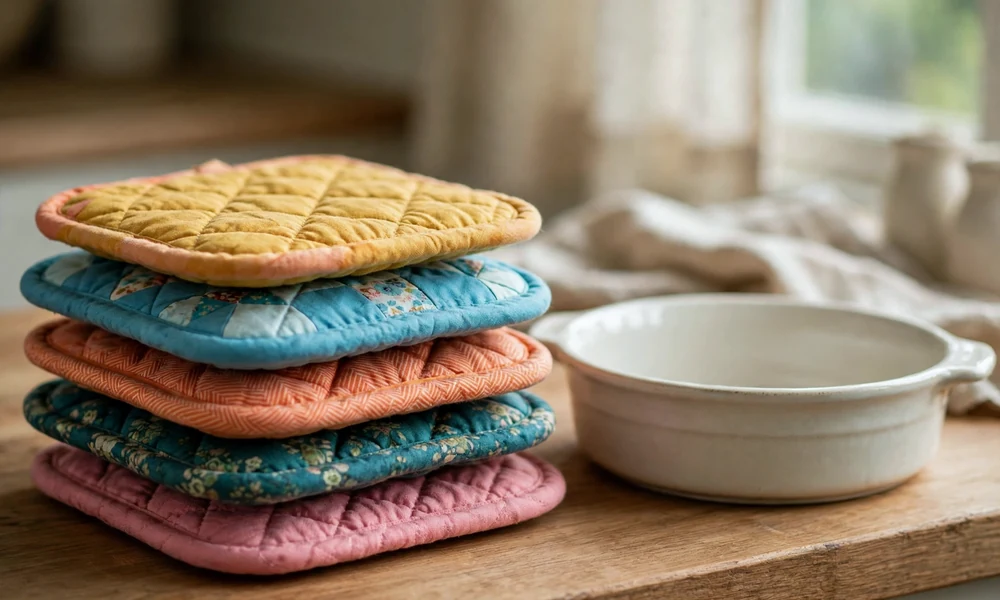
Quilted cotton is the classic pot holder, and it is still the best choice for most kitchens. Layers of cotton batting stitched between two fabric faces give it real thickness, and the quilting keeps the padding from bunching up in the wash. A good one feels substantial in the hand, not floppy, and it washes easily. Its weakness is steam and damp: cotton soaks up moisture, and a damp pad lets heat through far faster than a dry one.
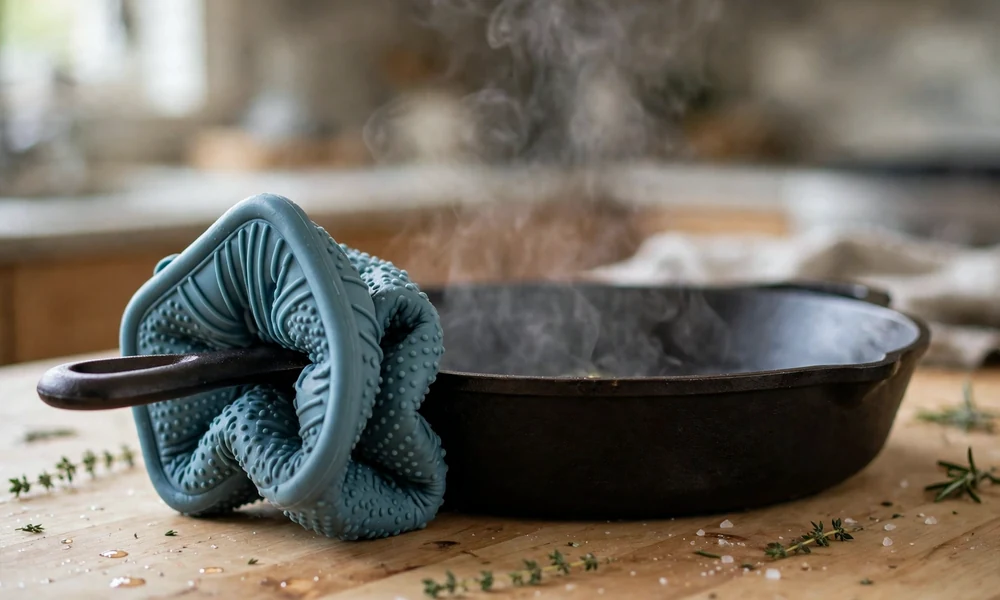
Silicone pot holders are the modern answer to the grip problem. They are heat-resistant to high temperatures, they do not absorb water, and their textured surface holds on to smooth metal, glass, and glazed ceramic that cotton would slide across. They are slightly stiffer than fabric, and a thin silicone pad can feel less forgiving on a heavy dish, but for grip alone nothing else comes close.
Double-layer quilted pot holders are the heavy lifters. Two layers of batting, sometimes with a heat-reflective lining in the middle, give them the padding to hold a cast iron casserole or a roasting tin for a proper ten-second carry. They are bulkier than a standard pad and take longer to dry, but if you cook large roasts or bake in heavy stoneware, the extra thickness is worth it.
Crochet cotton pot holders are the handmade classic, and the good ones are genuinely good. Dense crochet in thick cotton yarn traps air between the stitches, which is exactly what insulation is, and they wash and dry well. The trap is thin, lacy crochet with gaps you can see through: those are decorative, not protective, and they belong on a wall, not under a hot dish.
Heat Protection: What Actually Matters
Heat protection is about thickness and insulation, not just the material name on the label. A pot holder works by slowing heat down: layers of air trapped in batting, yarn, or silicone texture give the heat somewhere to go before it reaches your skin. That is why a thick pad outperforms a thin one made from a fancier material, and why a pad that has gone flat in the wash protects far less than it did when new.
The ten-second rule is the simplest test. Pick up a dish straight from a hot oven with the pad folded double, and you should be able to hold it comfortably for ten seconds. If heat reaches your fingers in three, the pad is too thin, too flat, or too damp. Steam is the hidden danger here: a pad that is wet from the sink or steamy from the dishwasher will carry heat almost instantly, so keep a dry spare within reach.
Sizing, Shape, and Fit
Size is where most pot holder purchases go wrong. A pad that is too small leaves your fingertips exposed over the edge of a hot dish, and a pad that is too large is clumsy to fold around a narrow handle. For most hands, a square of about 20 centimetres is the sweet spot: big enough to cover the palm and fingers with a margin, small enough to fold in half around a handle.
Shape matters more than people expect. Square pads are the most versatile, because they fold cleanly along a diagonal and cover a dish evenly. Round pads suit round casserole dishes and suit hands that grip from the sides. Pads with a pocket or a fold are handy for gripping a handle one-handed, but they are harder to wash and slower to dry. Whatever the shape, look for a hanging loop: a pot holder that lives on a hook by the stove is one you will actually reach for.
Materials That Last
Cotton is the workhorse material, and it lasts when it is thick. Look for pads with a dense cotton face and a proper batting layer, not a single layer of printed fabric with a thin wadding. Good cotton survives dozens of washes, and it softens without going flat. Cheap cotton thins out after a few months, and once the padding has compressed, the pad is finished, however nice the pattern still looks.
Silicone lasts differently. It does not wear out in the wash, it does not stain easily, and it keeps its grip for years. The weakness is heat at the edges: a silicone pad that is too thin can flex and let a hot rim touch your fingers, so choose one with a proper thickness and a raised texture. Food-grade silicone is the standard to look for, and it should feel firm, not floppy, in the hand.
Grip, Flexibility, and Handling
Grip is what stops accidents. A pot holder that slips on a smooth dish is worse than useless, because it gives you false confidence and then fails at the worst moment. Silicone texture, rubberised dots on cotton, and the natural friction of a quilted surface all help. Test a new pad on a smooth ceramic dish before you trust it with a full casserole: if it slides, it goes back in the drawer.
Washing and Care
Washing is where most pot holders die. Cotton and crochet pads go in the machine on a normal cycle, but they should be dried flat or on a low heat, because a hot dryer compresses the batting and thins the insulation. Silicone pads can be washed by hand or in the dishwasher, and they dry in minutes. Leather pads should never go in the machine: wipe them clean and let them air dry.
Replace a pot holder when it goes flat, scorches through, or starts to smell of burning. A scorched pad has already failed once, and the next failure will be on your hands. Keep the set fresh by rotating the pads, so no single one takes all the wear, and keep a spare dry pad by the stove for the days when the others are in the wash. A kitchen towel is not a substitute: our comparison of the best vs worst kitchen towels of 2026 shows how quickly thin fabric lets heat through.
Storage and Everyday Use
At the table, a thick pot holder doubles as a mat under a hot dish, protecting wood and stone from scorch marks. For a full casserole, though, a dedicated mat spreads the heat better, and our guide to the best trivets of 2026 covers the options that sit flat and stay put. Use the pot holder for carrying, the trivet for serving, and both will last longer.
Mistakes to Avoid
- Using a wet pot holder on a hot dish, because damp fabric carries heat straight to your skin.
- Buying a single thin pad and expecting it to handle a cast iron casserole on its own.
- Choosing a decorative pad with gaps, lace, or thin spots that let heat straight through.
- Using a tea towel as a pot holder, since thin woven cotton has almost no insulation.
- Keeping a scorched pad in use, because a pad that has burned once will burn again.
How to Choose Yours
Start with how you actually cook. If you bake most weekends, you need a thick quilted set that handles heavy trays and long holds. If you mostly reheat and roast, a silicone pad with strong grip will cover you. If you cook with cast iron, buy the double-layer pads and use two at a time, one for each side of the dish.

Check the thickness before you fall for a pattern. Press the pad between thumb and finger: it should spring back, not stay flat. Hold it up to the light: you should not see through the middle. Fold it in half and grip a handle with it: your fingertips should be covered with room to spare. If any of those tests fail, the pad is decoration, not protection.
Buy a set of four in a colour you like, and you are done. Four pads mean a pair for the casserole, a pair for the tray, and a spare when two are in the wash. Keep them by the stove, keep them dry, replace them when they go flat, and the smallest piece of safety equipment in your kitchen will do its job quietly for years.


