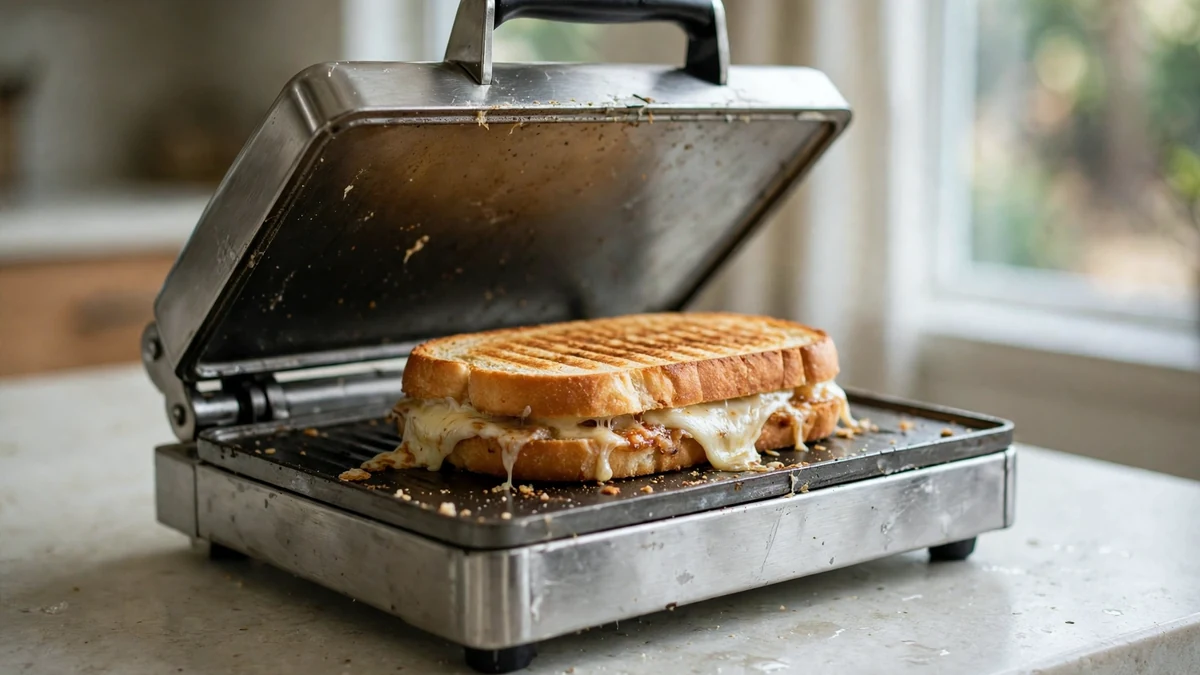
A panini press sounds like a luxury until you use one for a week. Then it becomes the lunchtime habit: bread, cheese, whatever is in the fridge, three minutes, and you are eating something warm and crisp that tastes like it came from a café. The trouble is that presses look almost identical in the shop, and the differences that matter only show up after a month of use — plates that stick, a hinge that will not close over a thick sandwich, a handle that gets too hot to hold.
We tested the way you would actually use one: lunch for one, then for a family of four, then again the next day. We pressed ciabatta, sourdough, soft white bread, wraps, and the thick sandwiches most presses claim to handle and then quietly fail at. We looked at browning, melting, cleaning after a cheesy leak, and how much counter space each press really takes.
Key Takeaways
- A good panini press has heavy plates that heat evenly, a floating hinge that closes over thick sandwiches, and a non-stick surface that survives daily use.
- Removable plates are worth paying for, because a press you can wash properly stays non-stick far longer than one you can only wipe.
- Flat plates press a better panini than sealed-edge plates, which are built for toasties and tend to crush a ciabatta flat.
- The worst presses have thin plates, hot spots, and coatings that peel within a few months, leaving bread stuck and burnt.
How We Judged the Panini Presses
We judged every press on five things that matter at the lunch table rather than on the box. First, browning: whether the bread turns an even golden brown, or burns in patches. Second, melting: whether the cheese melts right through before the bread overcooks. Third, the hinge: whether the lid floats and settles evenly over a thick sandwich. Fourth, cleaning: whether the plates wipe clean, come out for washing, or trap cheese in corners you cannot reach. Fifth, size: whether the press fits your usual bread and your usual cupboard.
Best Overall: The Heavy Stainless Steel Press
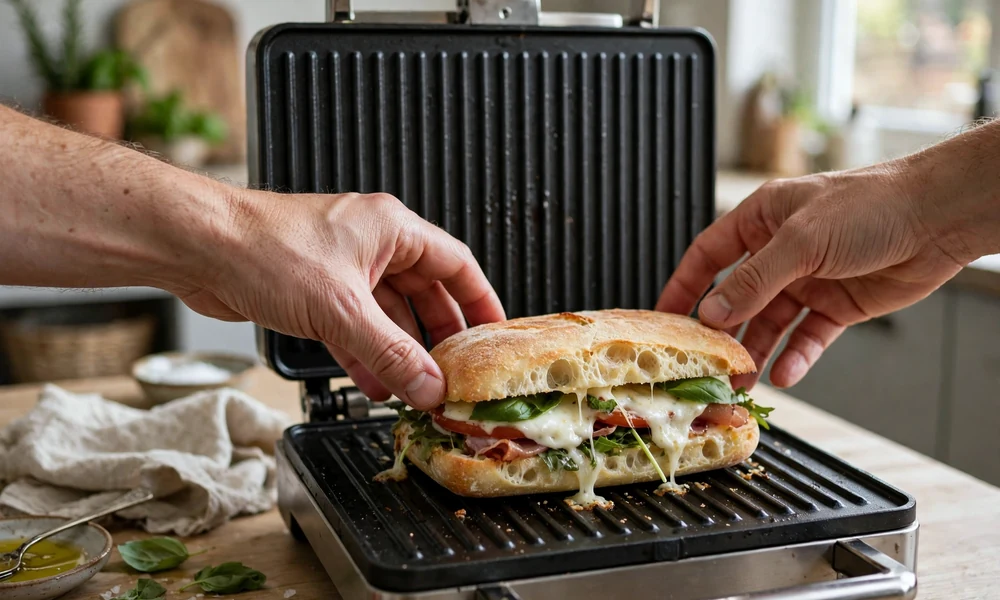
If you buy one panini press and never think about it again, buy this kind: a heavy stainless steel press with thick cast plates. The weight is the point. Thick plates hold their heat when cold bread and cheese land on them, so the first panini browns just as well as the third. Thin plates drop temperature the moment food touches them, and the bread steams instead of crisping.
In testing, this style gave the most even browning we saw: golden stripes across the whole slice, not just the middle. The floating hinge closed over a stuffed ciabatta without squeezing the filling out, and the handle stayed cool through a full round of sandwiches. The plates are flat and ribbed rather than sealed-edge, which is exactly what a panini wants. It costs more than the others, but it is the press most likely to still be working in five years.
Best for Families: The Large Double Press
One panini at a time is fine when you live alone. Feeding four people that way is slow, and by the time the fourth sandwich is done the first is cold. A large double press solves it: two full-size sandwiches at once, with plates wide enough for two slices of sourdough side by side.
What matters here is not just size but heat. A bigger plate needs more power behind it or the edges run cold, and the good family presses hold temperature across the whole surface. Look for a temperature dial rather than a single on-off setting, because a family press also becomes the weekday grill for chicken, halloumi, and vegetables. The compromise is storage: it needs a permanent home on the counter.
Best Compact Press for Small Kitchens
Most panini presses are bought for small kitchens, and most are too big for the cupboards they are bought for. A compact press is the honest answer: a single-sandwich footprint, a lid that locks shut, and a shape that stands upright in a cupboard. It presses one panini at a time, and does it well, because small plates heat fast and evenly.
The best compact presses do not feel like a compromise. The plates are still thick enough to hold heat, the hinge still floats, and the coating matches the bigger models. What you lose is room: a wide ciabatta hangs over the edges, and lunch for two means two rounds. What you gain is a press you will actually use, instead of a big one that lives at the back of a cupboard.
Best Budget Press: The Simple Flat Grill
A budget panini press is not a contradiction, but it is a narrower choice than the shop shelf suggests. The good cheap ones are simple: two flat ribbed plates, one heat setting, a lid that closes firmly, and nothing else. That simplicity is a strength, because every extra feature on a cheap press is a place where the maker saved money.
What we found is that a simple flat grill at the low end presses a perfectly good panini, as long as you accept its limits. It browns well on thin and medium sandwiches, heats up in about three minutes, and wipes clean while the plates are still warm. It struggles with very thick sandwiches, because the hinge does not float far, and the second sandwich browns more slowly than the first. But for one person making one lunch a day, it is the best value on this list.
Best Premium Press: The Press With Removable Plates
The single feature that separates a premium press from everything else is removable plates. Cheese leaks — it always does, sooner or later — and on a fixed-plate press it leaks into the hinge and corners where no cloth can reach. A press whose plates unclip and go into the sink stays clean, and a clean press stays non-stick.
Premium presses usually add a temperature dial and a timer, and both are genuinely useful. A lower setting grills a delicate wrap without scorching it; a higher one sears a thick sourdough panini in under three minutes. The plates on the best models are also reversible, flat on one side and ribbed on the other, so the same press works as a griddle. You pay roughly twice the price of a mid-range press — for the one still pleasant to use after a year of daily lunches.
Best Multi-Use Press: The Grill That Opens Flat
Some presses open out to a full 180 degrees, so the lid becomes a second flat grill instead of a lid. On paper that is a party trick. In practice it turns one appliance into a tabletop grill for two: burgers, vegetables, halloumi, and chicken, all cooked at once.
As a panini press it is just as good as the others here, with a floating hinge and even heat. Opened flat, it needs a little more counter space, and the drip tray has to be emptied more often. But if you are choosing between a panini press and a small electric grill, this shape means you do not have to choose. It is also the shape most likely to be used for dinner as well as lunch, which is the real test of whether an appliance earns its space.
What to Look for Before You Buy
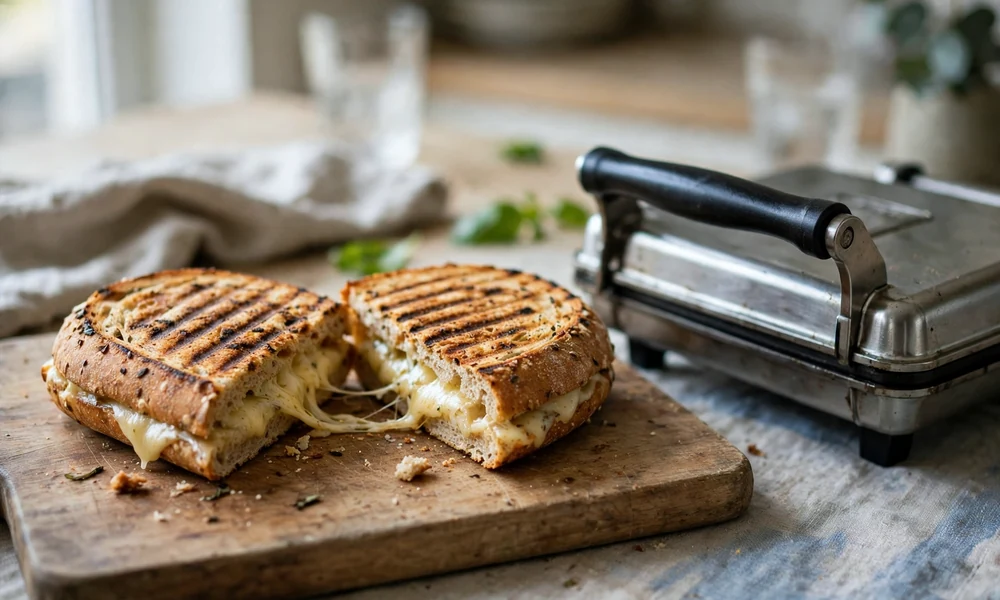
Start with the plates. Thick plates are the single best sign of a good press, and you can feel them: open the lid and press the plate with a fingertip. If it flexes or feels thin, it will lose heat the moment cold food touches it. Ribbed plates give the classic grill marks and let fat drain away; flat plates crisp more evenly and are easier to wipe. What does not work is a sealed-edge plate, which pinches the bread shut like a toastie maker.
Next, the hinge. A floating hinge is the joint that lets the lid sit level on a thick sandwich instead of pressing one edge flat. Open and close the lid in the shop and watch whether the top plate stays parallel to the bottom. If it swings down at an angle, thick sandwiches will come out uneven. The handle should stay cool, and lock the lid shut for storage.
Then think about heat. A single on-off setting is fine if you only make panini, but a temperature dial is worth having if you will grill anything else. High heat crisps sourdough quickly; lower heat is kinder to wraps, soft bread, and anything with sugar in it, which burns fast. Last, size: measure your usual bread against the plates, and your cupboard against the press.
It is worth remembering that a panini press is one of several ways to make a hot sandwich. Our comparison of the best and worst sandwich makers of 2026 shows where a sealed-edge maker beats a press, and where it does not. Our guide to the best toaster ovens that actually earn counter space in 2026 covers the other way to get a crisp, hot sandwich. And our comparison of the best and worst electric griddles of 2026 is the closest cousin to a press that opens flat.

Mistakes That Ruin a Good Panini
The most common mistake is overfilling. A panini is not a sandwich bar: too much filling squeezes out, burns on the plates, and leaves the middle soggy. Two or three fillings, layered thin, beat five piled high. Butter the bread, not the plates — a thin layer on the bread crisps evenly, while oil on the plates just smokes.
The second mistake is pressing too hard. The lid should rest on the sandwich, not squash it. The third is impatience: lifting the lid every thirty seconds lets the heat out and leaves the bread pale. Give it two to three minutes, then look once. Finally, never cut a panini the moment it comes off the press — thirty seconds of rest lets the cheese set enough to stay inside the bread.
Cleaning and Care
Clean the plates while they are still warm, and never with anything abrasive. A damp cloth takes off most cheese if you get to it before it hardens; once it has cooled, it needs soaking, and that is where removable plates pay for themselves. Unclip them, soak them in warm soapy water, and the cheese lifts off.
Never put a press away with crumbs in the hinge, because crumbs there turn to a sticky paste that stops the lid closing level. Wipe the outside with a dry cloth — stainless steel shows fingerprints but wipes clean in seconds. Keep the cord wrapped loosely rather than wound tight, because a tight cord pulls at the joint where it enters the press.
The Verdict
The best panini press for most people is the heavy stainless steel press: thick plates, a floating hinge, even browning, and nothing to go wrong. If you feed a family, go large and double. If your kitchen is small, go compact. If your budget is tight, the simple flat grill presses a perfectly good panini. If you hate cleaning, pay for removable plates.
A panini press earns its place the quiet way: not by doing something dramatic, but by making an ordinary lunch better in three minutes, with almost no washing up. Choose the shape that fits your kitchen and your bread, look after the plates, and it will be the most-used appliance on your counter within a month.


