Patio Umbrellas That Shade the Whole Table in 2026
A good patio umbrella is the difference between a table everyone gathers around and a table everyone avoids after eleven in the morning. The best patio umbrellas of 2026 shade the whole table, stand firm when a breeze picks up, and open and close without a struggle. The worst ones wobble, leave half the chairs in full sun, and fade grey by the end of their first summer.
Buying one looks simple until you start comparing them. Canopy sizes are measured in different ways, and the base — the part that keeps the whole thing upright — is often sold separately. Get the size wrong and your guests eat in the sun; get the base wrong and a gust of wind does the choosing for you.
Key Takeaways
- Buy a canopy at least two feet wider than your table, so every chair sits in shade.
- A heavy base matters more than a heavy frame: at least 50 pounds for a nine-foot umbrella, and more for a cantilever.
- Solution-dyed acrylic holds its colour and blocks UV far better than cheap polyester.
- A crank lift and a tilt mechanism are the features you will use every day, so test them first.
- Close the umbrella whenever you leave it unattended — none is built to survive a storm open.
What Makes a Patio Umbrella Good
A good patio umbrella starts with its frame. The best frames of 2026 are aluminium or fibreglass, because both resist rust and flex slightly in wind instead of snapping. Wooden poles look beautiful but are heavier and can crack if left out through a wet winter. Avoid thin steel poles: they rust at the joints within a season.
The canopy is where most of the money goes. A good one is made from solution-dyed acrylic, in which the colour runs through the fibre instead of sitting on the surface. It resists fading for years, sheds light rain, and typically carries a UPF 50 rating, blocking almost all UV. Polyester is cheaper and lighter but fades faster and lets more UV through. Look for a vented canopy — a second layer at the top that lets hot air escape and stops the umbrella acting like a sail.
The third test is the mechanism. A crank lift winds the canopy open smoothly, while a pulley system relies on a rope and a pin, which is cheaper but harder work and wears out sooner. A tilt mechanism angles the canopy to follow the sun, keeping the shade on the table instead of sliding off it. For daily use, the crank and tilt are worth more than any other upgrade.
The Main Types of Patio Umbrella
Most patios suit one of four designs, and the right choice depends more on your table and space than on the umbrella itself. A market umbrella is the classic centre-pole design that stands through a hole in the middle of the table — the simplest, cheapest and most stable option for a dining set. Its weakness is the pole, which eats the middle of the table and makes serving large platters awkward.
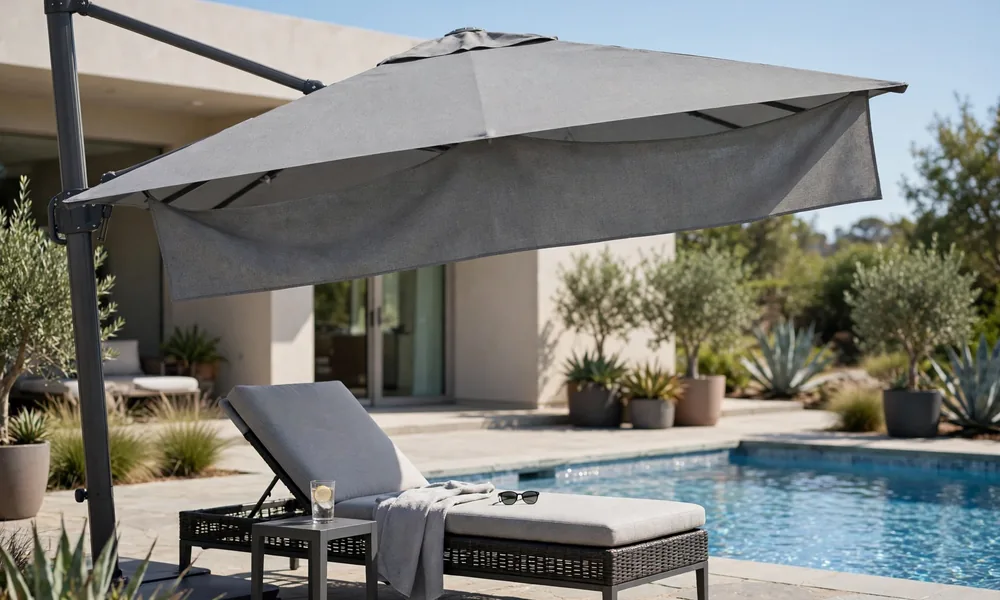
A cantilever umbrella hangs its canopy from an arm on a side pole, so nothing stands in the middle of your table or seating area. That makes it the best choice for lounge furniture and poolside loungers, and the canopy can be rotated and tilted to follow the sun. The trade-off is the base: a cantilever needs a very heavy one, often 100 pounds or more, and it catches more wind than a centre-pole design, so it must be closed in gusty weather.
A tilt umbrella is a market umbrella with an angled pole or tilting canopy, built for patios where the sun comes in low. It solves the most common complaint about centre-pole umbrellas: shade sliding off the table by late afternoon. A half umbrella, sometimes called a wall umbrella, is a semicircular canopy that sits flat against a wall or balcony railing — the only sensible option for a narrow balcony, where a full canopy would overhang the edge and catch every gust.
Choosing between them comes down to how you use the space: a dining table wants a market umbrella, a lounge set wants a cantilever, and a narrow balcony wants a half umbrella. Our guide to patio furniture that turns your garden into a second living room is a good starting point, since the table and chairs decide the umbrella size before anything else does.
Size: Measure the Table, Then Add Two Feet
Size is the mistake most buyers make, and it is entirely avoidable with a tape measure. The rule is simple: the canopy should be at least two feet wider than the table it shades. A four-foot round table needs a six-foot canopy at minimum, and a six-foot rectangular table needs an eight- or nine-foot one. That extra width keeps the chairs in shade most of the day. Measure across the widest point, leaves included, and add two feet. If you are between sizes, go up, not down.
The canopy should sit at least seven feet above the patio so people can walk under it without ducking. Shape follows the table — round tables suit round canopies, while rectangular tables suit rectangular canopies.
The Base: The Part Nobody Wants to Buy
The base is the least glamorous part of a patio umbrella and the most important. A nine-foot market umbrella needs at least 50 pounds of base weight, and a ten- or eleven-foot canopy needs 75 pounds or more. Cantilevers need far more — 100 to 200 pounds, usually a cross base with weighted plates. Too light a base, and the first proper gust topples the umbrella onto the table and chairs.
Concrete and cast stone are the heaviest and most stable bases, staying put in weather that would shift a lighter one. Steel bases filled with sand or water are cheaper and easier to move, but a water-filled base must be emptied before winter or it will crack when the water freezes. Resin bases are light to carry and can be filled on site. Whatever the material, check that the base fits the pole diameter — poles are usually an inch and a half or two inches across, and a loose base lets the umbrella sway.

A through-table base, which sits under the table and grips the pole below the tabletop, is steadier than a freestanding one, because the table itself adds stability. And whatever base you buy, the umbrella should still be closed when you leave it: no base, however heavy, makes an open umbrella safe in a storm.
Fabric, Colour and Care
Fabric decides how the umbrella looks in its second and third summers, when cheap umbrellas start to show their age. Solution-dyed acrylic is the best fabric on the market in 2026: the colour is locked into the fibre, so it resists fading, and it naturally blocks UV and resists mildew. It costs more, but it is why some umbrellas still look new after five years. Polyester is the budget option — light, quick to dry and fine for a season or two, but it fades fastest and offers the least UV protection.
Colour is a practical decision as much as a style one. Light colours — cream, sand, pale grey — reflect heat and keep the shade underneath noticeably cooler. Dark colours absorb heat and can make the space under the canopy feel warmer, though they hide marks and look smarter for longer. In afternoon sun, a light canopy is the more comfortable choice.
Care is simple and mostly about drying. Brush off leaves and dust, wipe the canopy with mild soap and water, and let it dry fully open before closing it for storage — a damp canopy folded away will grow mildew within days. Oil the crank and tilt joints once a season, and store the umbrella upright in a dry place over winter, ideally with a cover.
Comparing the Types
| Type | Best for | Typical size | Base needed | Watch out for |
|---|---|---|---|---|
| Market (centre pole) | Dining tables | 7–11 ft | 50–75 lb | Pole blocks the middle of the table |
| Cantilever (offset) | Lounges, poolside | 9–13 ft | 100–200 lb | Catches wind; must be closed in gusts |
| Tilt | West-facing patios | 7–10 ft | 50–75 lb | Extra moving part to maintain |
| Half / wall | Balconies, narrow patios | 4–9 ft | 30–50 lb | Shades one side only |
No type wins on every measure. The right choice is the one whose weakness you will notice least on your patio.
Styling the Shaded Patio
An umbrella does more than block the sun — it defines the outdoor room. A canopy in a colour that picks up the cushions or the rug underneath pulls the whole patio together. Our guide to the best outdoor rugs for patios covers the materials that survive rain and sun.
Lighting extends the umbrella’s working day. Lights strung under the canopy turn a shaded lunch spot into an evening dining room, and the umbrella keeps the dew off at nine. That is also when a heater earns its place: our guide to the best patio heaters for longer evenings outside explains which types suit a dining table and which suit a lounge, so the space stays usable into autumn.

Checklist: Before You Buy
- Measure the table across its widest point and add two feet — that is your minimum canopy size.
- Check the pole diameter against the base, and budget at least 50 pounds for a nine-foot canopy.
- Choose solution-dyed acrylic for full sun, and check for a UPF 50 rating.
- Test the crank and tilt; they should move smoothly with one hand.
- Confirm the canopy has a vent at the top.
- Buy a cover, and plan winter storage.
Frequently Asked Questions
What size patio umbrella do I need for a six-seater table?
A six-seater table is usually about six feet long, so you need a nine-foot canopy as a minimum — roughly eighteen inches of shade beyond each end.
How heavy should a patio umbrella base be?
For a nine-foot market umbrella, at least 50 pounds; for a ten- or eleven-foot canopy, 75 pounds or more. Cantilevers need 100 to 200 pounds because the canopy hangs to one side and levers against the base. When in doubt, go heavier.
Can I leave my patio umbrella open overnight?
Better not to. A calm evening can turn windy without warning, and an open umbrella catches wind like a sail. Close it whenever you go inside, and always before a storm.
Is acrylic fabric worth the extra money?
Yes, in full sun. Solution-dyed acrylic holds its colour for years, blocks almost all UV, and resists mildew. A polyester canopy costs less up front but fades within a couple of seasons, so acrylic usually works out cheaper over its life.
What is the difference between a market umbrella and a cantilever umbrella?
A market umbrella has a centre pole through the table — stable and affordable, but with a pole in the middle of your dining space. A cantilever hangs from a side pole, but needs a much heavier base and must be closed in windy weather.
How do I stop my patio umbrella fading?
Choose solution-dyed acrylic in the first place, keep the canopy clean with mild soap and water, and use a cover when the umbrella is closed for any length of time. Let it dry fully open before closing it, to prevent mildew.
The Bottom Line
The best patio umbrella of 2026 shades the whole table, stands firm on a base you never have to think about, and opens smoothly in its third summer. Measure the table, add two feet, buy the heaviest base you can live with, and pay for acrylic fabric if the sun hits your patio all day. Do those four things and the umbrella becomes part of the patio itself.