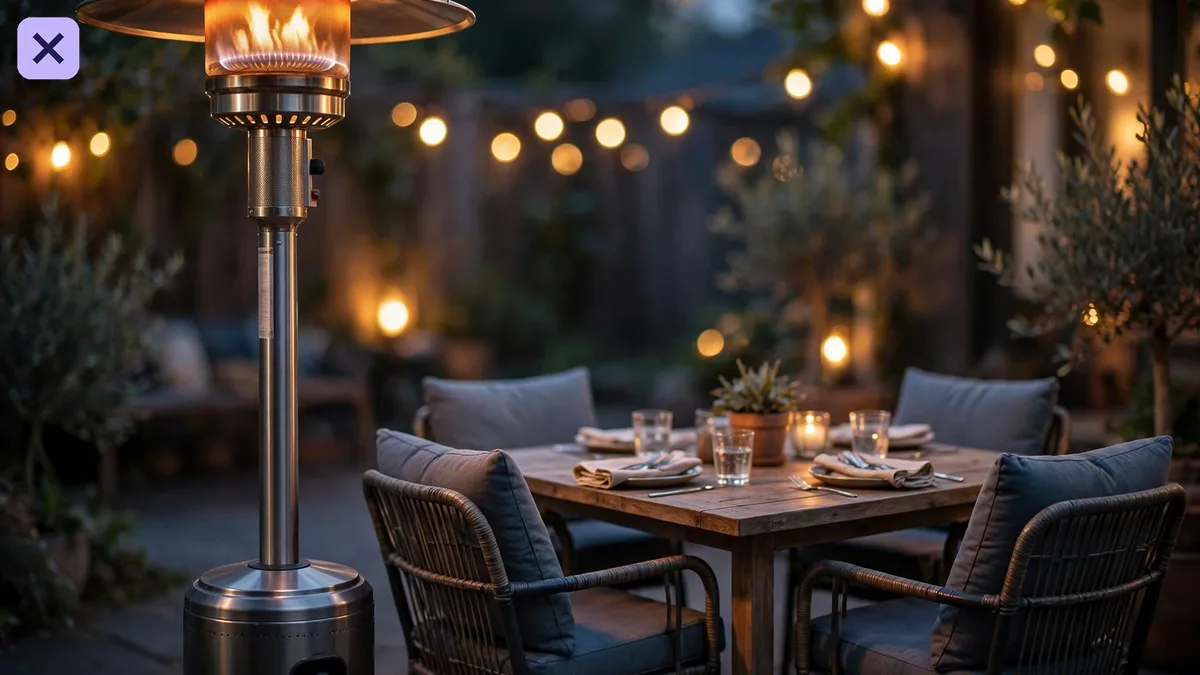
The best patio heaters for longer evenings outside in 2026 do one simple thing well: they take the chill off the air just as the sun goes down, so dinner, drinks and conversation can carry on for another hour or two. A good patio heater does not try to turn your garden into a sauna. It warms the people sitting around it, quietly and steadily, without smoke, fuss or a shocking running cost.
Choosing well is mostly about matching the heater to the space. A freestanding gas heater suits a big open patio and a crowd; a slim electric infrared heater suits a sheltered dining area; a tabletop model suits a balcony where a full-size heater would never fit.
Key Takeaways
- Freestanding gas patio heaters warm the widest area, while electric infrared patio heaters are cheaper to run and warm people faster in sheltered spots.
- Match the heat to the space: around 1,500 to 2,000 watts of electric heat suits a small seating area, while a large open patio needs a gas heater rated at 40,000 BTU or more.
- Infrared heat fades fast with distance, so two smaller heaters close to the seating usually beat one big heater in the middle of the patio.
- Check the running cost before you buy: a gas patio heater can cost three to four times as much per evening as an electric one.
- Keep any gas patio heater at least one metre from walls, furniture and plants, and never use a gas heater in an enclosed space.
Why a Patio Heater Earns Its Place
Most patios sit empty for half the year, not because people stop enjoying them but because the temperature drops just enough to make sitting outside uncomfortable. A fall of five or six degrees is all it takes. A patio heater closes exactly that gap. It only needs to make a cool evening comfortable, which is why even a modest heater can transform how often a garden gets used.
The best patio heaters also change the rhythm of an evening. Without one, everyone drifts inside when the light fades. With one, the table stays full and the patio becomes the warmest room in the house. That is the real test of a patio heater: not how hot it gets on paper, but how many extra evenings it buys you across the year.
The Main Types of Patio Heater Compared
There are four main types of patio heater, and they work very differently. Freestanding gas patio heaters burn propane and throw heat in a wide circle, suiting open patios and large groups. Electric infrared patio heaters radiate heat directly onto people, which is efficient in sheltered spots but weaker in wind. Tabletop patio heaters are small gas or electric models for a single table, suiting balconies and small patios.
If you want open flames and the crackle of a real fire as well as warmth, our guide to the best fire pits covers the other way to gather outside after dark.
| Patio heater type | Heats | Warm-up time | Typical running cost | Best for |
|---|---|---|---|---|
| Freestanding gas | 15 to 25 square metres | 5 to 10 minutes | £1.50 to £2.50 per hour | Large open patios, big groups |
| Electric infrared | 6 to 12 square metres | Instant to 2 minutes | £0.50 to £0.70 per hour | Sheltered patios, dining areas |
| Wall-mounted infrared | 6 to 10 square metres | Instant to 2 minutes | £0.50 to £0.70 per hour | Covered terraces, dining tables |
| Tabletop | 2 to 4 square metres | 2 to 5 minutes | £0.40 to £1 per hour | Balconies, small tables |
Our Picks: The Best Patio Heaters for Every Patio
We judged every type of patio heater on the same five tests: usable warmth, warm-up speed, running cost, safety and stability, and how easy it is to live with across a whole season. These are the picks that came out on top.
Best Overall: Freestanding Gas Patio Heater
The classic tall freestanding gas patio heater remains the best all-round choice for a typical garden patio. It stands about two metres tall, throws heat in a wide circle, and warms a whole seating area rather than one chair. Look for a model with a tilt safety switch that cuts the gas if it is knocked over, a piezo ignition that lights first time, and wheels so you can move it into storage.
Best for Dining: Wall-Mounted Infrared Patio Heater
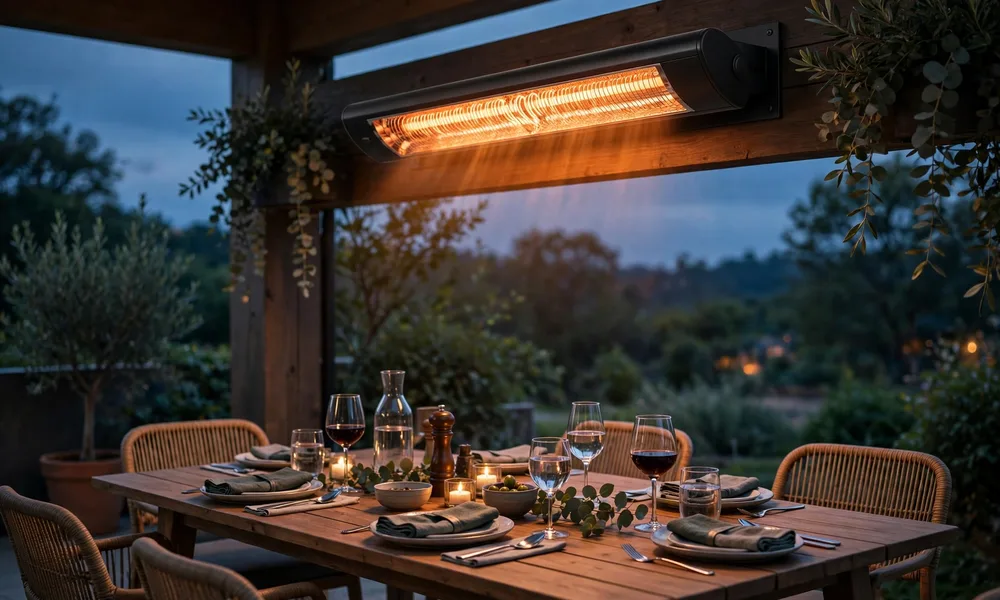
For a covered terrace or a dining table against a wall, a wall-mounted infrared patio heater is hard to beat. It warms the people at the table within seconds, costs little to run, and takes up no floor space at all. Choose a model with at least two heat settings so you can turn it down once everyone is warm. It needs a proper outdoor socket, not an extension lead threaded through a window.
Best for Balconies: Tabletop Patio Heater
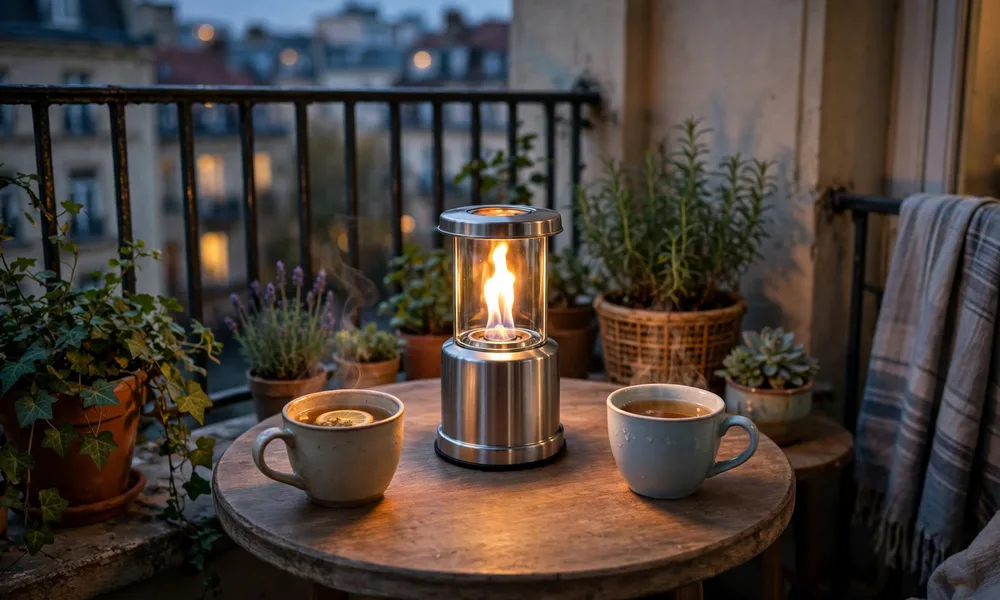
A balcony has no room for a freestanding heater, and often no gas storage either, which is where a tabletop patio heater earns its keep. A small electric tabletop model warms two people sitting close together and packs away in a cupboard; a small gas tabletop model gives a real flame and a little more heat. Either way, check the weight and the base before you buy: a top-heavy model on a small round table is an accident waiting to happen.
Best for Large Gardens: Two Freestanding Heaters
A single heater, however powerful, struggles in a large garden, because infrared heat falls off quickly with distance and wind steals the rest. Two freestanding gas patio heaters, one at each end of a long seating area, warm far more evenly than one big one, and you can run just one of them on quieter evenings. Pair them with comfortable seating from our guide to the best patio furniture.
How Much Heat Do You Actually Need?
Heat output is the number most buyers get wrong, because manufacturers quote it in different units and under ideal conditions. In a real garden, the effective heat is far less than the headline number. As a rough guide, you need about 1,000 watts of electric heat, or 3,400 BTU of gas heat, for every three to four square metres of seating on a cool evening.
A nine-square-metre patio needs roughly 3,000 watts or 10,000 BTU; a 20-square-metre patio needs 6,000 to 7,000 watts or 20,000 to 25,000 BTU. Distance matters more than most people realise. Infrared heat falls off quickly: at one metre you feel the full effect, at two metres roughly half, and at three metres very little. That is why a single powerful heater in the middle of a large patio often disappoints, while two smaller heaters close to the seating work far better and cost less to run.
Wind is the other big factor. A light breeze can cut the effective heat of a gas patio heater by a third. Electric infrared heaters cope better, because they heat people directly rather than the air, but even they lose effectiveness in a strong breeze. If your garden is exposed, a windbreak or a pergola with side screens will do more for your comfort than buying a bigger heater. For a fuller comparison of heater types and fuels, our guide to choosing an outdoor heater covers gas, electric and wood options side by side.
Running Costs in 2026: What an Evening of Warmth Really Costs
Running costs are where the types of patio heater diverge most, and they are worth working out before you buy. A 2,000-watt electric heater running for three hours uses six kilowatt-hours, about £1.62 per evening at a typical 2026 rate of 27 pence per kilowatt-hour. A 13-kilowatt gas heater uses roughly one kilogram of propane per hour, so three hours costs around £6.
Those numbers do not tell the whole story. The gas heater warms a much larger area, so with eight people outside the cost per person is similar. The honest question is how often you will use it. If the answer is twice a week through spring and autumn, a gas heater is worth its running cost. If it is once a fortnight, an electric heater is the cheaper way to keep the evenings going.
Safety and Placement
Keep any gas patio heater at least one metre from walls, furniture, plants and parasols, and never use it under a low roof, in a gazebo with closed sides, or in any enclosed space. Gas heaters produce carbon monoxide, which is why they belong outdoors in open air, full stop.
Place freestanding heaters on flat, level ground, away from the path people take to the door, and always use the tilt switch and the weighted base as intended. For electric heaters, keep the cable out of walkways and puddles and use a proper outdoor socket with a residual current device. Cover any heater when it is not in use, and at the end of the season, disconnect the gas bottle, store it upright outdoors in a ventilated spot, and clean the burner and reflector before you put the heater away.

Buying Checklist
- Measure the seating area first, then buy the heat output that matches it, not the biggest heater in the shop.
- Choose gas for large open patios and electric infrared for sheltered dining areas and covered terraces.
- Check for a tilt safety switch on gas models and a proper outdoor rating on electric models.
- Work out the running cost per evening at your local energy prices before you commit.
- Make sure you have somewhere safe and ventilated to store a gas bottle, or choose electric.
- Check the warranty and the availability of spare parts, especially burners, igniters and heating elements.
Frequently Asked Questions
Are patio heaters worth it?
Yes, if you will use one at least twice a week in the cooler months. A patio heater that gets used fifty evenings a year is one of the best-value garden purchases you can make; one that gets used twice is an expensive ornament.
What is the best type of patio heater?
For most gardens, a freestanding gas patio heater is the best all-round choice because it warms the widest area. For sheltered patios and dining tables, an electric infrared patio heater is cheaper to run and warms people faster.
How much does it cost to run a patio heater?
An electric patio heater costs roughly 50 to 70 pence per hour, while a gas patio heater costs roughly £1.50 to £2.50 per hour. A three-hour evening costs about £1.60 on electric and about £6 on gas, though the gas heater warms a much larger area.
Can you use a patio heater on a balcony?
Yes, but choose a small tabletop electric model. Full-size gas patio heaters are too big, too hot and too heavy for most balconies, and many apartment blocks ban gas bottles on balconies.
Are electric patio heaters better than gas?
Electric patio heaters are cheaper to run, faster to warm up and easier to store, but they heat a smaller area and need an outdoor socket. Gas patio heaters are more powerful and work anywhere, but they cost more to run and need a gas bottle.
How long does a gas bottle last on a patio heater?
A 13-kilogram propane bottle typically lasts 10 to 12 hours on full power for a 13-kilowatt patio heater. Turning the heater down once everyone is warm, and switching it off during long gaps, can stretch a bottle across many more evenings.
The Bottom Line
The best patio heater is the one that fits your space, your habits and your budget. For a big open patio, buy a freestanding gas patio heater and enjoy the widest circle of warmth. For a sheltered dining area, buy a wall-mounted or freestanding electric infrared heater and enjoy cheap, instant heat. For a balcony, buy a small tabletop model and keep the evenings going two people at a time. Whichever type you choose, measure the space, work out the running cost, and place it well.


