
How to Choose Pool Ladders That Stay Steady on Any Deck in 2026
Pool ladders are the vertical rail-and-rung entry that most swimmers climb every time they get into the water, and a good one makes that climb feel boring in the best possible way: two hands on the rails, feet planted on wide non-slip treads, no wobble, no flex, no second thought. A poor ladder does the opposite. It sways when you step on it, its rungs turn slick with algae, its bolts loosen a little more every summer, and sooner or later someone — often a child, an older swimmer, or a guest carrying a drink — loses their footing. Choosing well is therefore not about looks. It is about rail height, tread depth, weight rating, material, and how the ladder anchors to your deck or pool wall, and this guide walks through every one of those decisions so the ladder you buy is the one you stop thinking about.
A pool ladder is not the same thing as pool steps, and the distinction matters before you spend anything. A ladder is a narrow, near-vertical frame: two upright rails joined by three to five rungs, bolted or hooked to the deck or the pool wall, taking up almost no water space. Pool steps are the wide, walk-in stairs moulded into the pool shell or set in as a broad unit, with treads you can stand on with both feet side by side. Steps suit swimmers who want a gradual, almost walking entry; a ladder suits pools where space is tight, where the wall is straight and deep, and where swimmers are happy to climb rung by rung. If your household includes very young children, anyone with limited mobility, or dogs that swim, wide walk-in steps are usually the kinder entry than a ladder. For everyone else, a well-chosen ladder is cheaper, simpler to fit, and easier to remove for winter, and keeping the water around the entry clean is easier with a good pool vacuum.
Key takeaways
- A pool ladder is a vertical rail-and-rung entry, not wide walk-in stairs — pick it when space is tight and swimmers can climb rungs comfortably.
- Look for rails that rise at least 30 inches above the deck, treads at least 5 inches deep, and a weight rating of 300 pounds or more.
- Stainless steel suits in-ground pools and salt water; resin and coated aluminium suit above-ground pools and tight budgets.
- Anchor the ladder properly — loose deck flanges are the single most common cause of a wobbly ladder.
- Check tread grip every month in summer, and clean algae off rungs before they turn slick.
What a pool ladder actually is
A pool ladder is a fixed or removable climbing frame that bridges the gap between the deck and the water. Two parallel rails run from above the deck down into the pool, joined by horizontal rungs that serve as steps. The top of each rail curves over or bends back so a swimmer has something to hold while stepping from the deck onto the first rung, and the bottom of the rails either bolts to the pool wall, rests on the pool floor, or hangs from deck-mounted flanges. Most in-ground ladders have three or four rungs; above-ground A-frame ladders have rungs on both sides, one set for the outside climb up to the deck and one set for the inside climb down into the water.
The main types of pool ladder
In-ground deck-mount ladders
The classic in-ground ladder bolts to the deck through two flanges and drops its rails into the water against the pool wall. Stainless steel is the standard material here, usually 304 grade for chlorine pools and 316 grade for salt-water pools, because it resists corrosion and stays rigid for years. These ladders are the most stable type you can buy, since the deck anchors carry the load, and they suit any in-ground pool with a straight wall and a solid deck. Their weakness is permanence: removing one for winter means unbolting the flanges, and the anchor sockets stay in the deck. Measure your deck thickness and the distance from the wall to the flange before ordering, because a ladder made for a 12-inch coping will not sit right on an 18-inch one.
Above-ground A-frame ladders
An A-frame ladder is the standard entry for an above-ground pool: a self-supporting frame that straddles the pool wall, with steps up the outside and steps down the inside. Most are made from resin or coated steel, weigh far less than a stainless ladder, and need no drilling at all. The best ones have a lockable or removable outside section, so children cannot climb in unsupervised, and a wide platform at the top where you can turn around before descending. The weakness is stability on soft ground — the outside feet must sit on a level, solid pad, not bare grass — and the weight rating, which is often lower than a deck-mount ladder. Check the rating against the heaviest person who will use it, not the average.
Drop-in and hook-over ladders
Stainless steel versus resin versus aluminium

How to choose the right pool ladder
Start with the pool, not the catalogue. Measure the depth at the point where the ladder will sit, the height from the waterline to the deck, the thickness of the coping, and the width of the deck where the flanges will bolt. A ladder that is too short leaves the bottom rung dangling above the floor and swimmers stepping into nothing; a ladder that is too long rests its rails on the floor at the wrong angle and rocks. Most makers publish a fitting range for each model, and the honest ones print the rail spacing, rung depth, and weight rating on the box. If a listing hides the weight rating, treat that as an answer: the maker does not want you to know it.
Next, match the ladder to the people who will use it. Children need closely spaced rungs they can climb without stretching, and a rail they can grip with a small hand — a rail diameter of about 1.5 inches is comfortable for most hands, while a fat 2-inch rail is hard for a child to close a fist around. Older swimmers need the opposite emphasis: a high rail above the deck, deep treads that take a whole foot, and a rung spacing that never forces a big step. Heavy swimmers need the weight rating first and everything else second; a 250-pound rating is the minimum for an adult household, and 300 pounds or more is the sensible choice. Dogs need wide, flat treads and a ladder that will not tip when a wet dog scrambles up it — an A-frame with a platform, or a deck-mount ladder with a wall brace, rather than a hook-over model.
Pool ladders compared
| Ladder type | Best for | Weight rating | Install effort | Price range |
|---|---|---|---|---|
| Deck-mount stainless | In-ground pools, daily use | 300–400 lb | Drill and bolt | High |
| A-frame resin | Above-ground pools, families | 250–300 lb | Assemble only | Low to medium |
| Drop-in hook-over | Rentals, soft-sided pools | 200–250 lb | None | Low |
| Deck-mount aluminium | Budget in-ground pools | 250–300 lb | Drill and bolt | Medium |
| Heavy-duty stainless | Large households, salt water | 400 lb and up | Drill and bolt | High |

Fitting a pool ladder properly
Fitting is where most ladders fail, and it is almost always the anchors, not the ladder. Deck-mount flanges need solid deck, not hollow pavers or a thin coping stone: drill into concrete or a proper anchor socket, use stainless fixings, and tighten them evenly so the flange sits flat. A flange that rocks on a high spot will work loose within weeks, and a loose flange turns a good ladder into a wobbly one. If your deck is pavers over sand, set a concrete pad under each flange first; it is a morning’s work and it is the difference between a ladder that lasts and one that does not.
Keeping a pool ladder safe all season
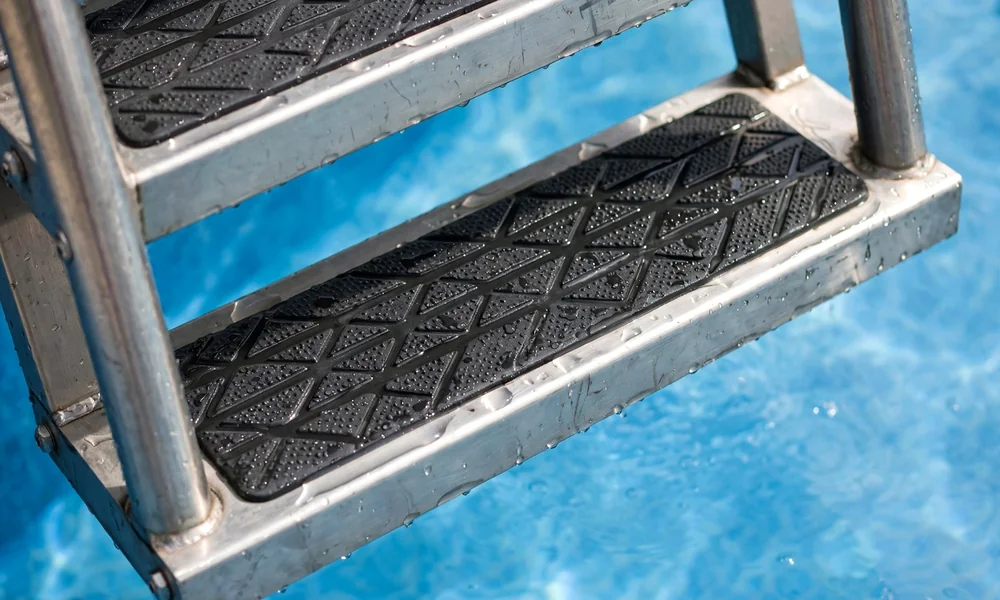
A pool ladder needs very little maintenance, but it needs it regularly. Brush the rungs weekly when you brush the pool, because algae starts on treads first — they are the one surface every swimmer touches with bare feet, and a thin green film is enough to make a rung treacherous. Pool brushes with a narrow head reach the rungs and the rail joints far better than a wide wall brush, and a quick scrub each week keeps the grip surface working as designed. Rinse the rails after heavy use, check the flange bolts monthly, and tighten anything that has worked loose before it becomes a wobble.
The pool ladder checklist
- Measure water depth, deck height, and coping thickness before you order anything.
- Choose rails at least 30 inches above the deck and treads at least 5 inches deep.
- Pick a weight rating of 300 pounds or more for an adult household.
- Match the material to the water: 316 stainless or resin for salt pools, padded contacts for vinyl liners.
- Anchor deck flanges into solid deck or a concrete pad, and test the ladder wet before first use.
- Brush rungs weekly, check flange bolts monthly, and remove or lock the ladder when the pool is unsupervised.
Frequently asked questions
How high should pool ladder rails rise above the deck?
At least 30 inches. That height lets most swimmers step up upright while holding both rails, instead of bending over and hauling themselves out of the water. Shorter rails are the most common comfort complaint on otherwise good ladders.
Are stainless steel pool ladders safe in salt-water pools?
Yes, if they are 316 grade. Standard 304 stainless steel can corrode in salt water over time, so check the grade in writing before you buy. Resin ladders are also safe in salt water and never corrode at all.
Can I fit a pool ladder to a vinyl liner pool?
Yes, provided the ladder has smooth, padded contact points where it touches the liner and the wall. Bare metal feet and sharp flange edges will wear a hole in a liner over a season, so inspect the contact points every spring.
What weight rating should a pool ladder have?
At least 250 pounds for a household of average adults, and 300 pounds or more is the sensible choice for a family pool. The rating should cover the heaviest person who will use the ladder, plus the extra load of climbing wet.
How do I stop my pool ladder from wobbling?
Wobble almost always means loose anchors, not a weak ladder. Tighten the flange bolts evenly, check that the flange sits flat on solid deck, and set a concrete pad under the flanges if the deck is pavers over sand. If the ladder still moves, take it off and redo the anchors.
Should I remove my pool ladder in winter?
Yes, if it is removable. A ladder left in a frozen pool can crack resin treads and stress welds, and one left standing all winter collects debris in every joint. Hose it down, dry it, and store it under cover until spring.
Bottom line
The best pool ladder is the one you never have to think about: rails high enough to hold standing up, treads deep and grippy enough for wet feet, a weight rating with room to spare, and anchors set into solid deck. Measure first, match the material to your water, and test the ladder wet before the season starts. Do that, and the ladder disappears into the background of every swim — which is exactly what a good ladder should do. Keep the water moving and the entry safe by pairing it with a reliable pool pump and a cleaning routine that starts at the surface, and the climb in and out of the pool will stay the easiest part of the day.


