
The Pool Brushes That Keep Walls and Floors Algae-Free in 2026
Pool brushes stop algae before it takes hold. Algae starts as a faint green film on the wall, steps or waterline, and a brush is the only tool that scrubs it off while it is still loose. No chemical kills algae that is gripping the plaster, and no vacuum sucks up what is still stuck to the surface. A brush breaks that grip, so chlorine can finish the job and the vacuum can carry the dead algae away. This guide explains the kinds of brush, which bristle suits which surface, and how to brush properly in 2026.
Key Takeaways
- A brush scrubs, a skimmer scoops, a vacuum sucks. Brushing, skimming and vacuuming are three different jobs.
- Nylon suits vinyl liners and fibreglass; stainless steel is for concrete and plaster with stubborn algae only.
- An 18-inch head covers open water fast, but a smaller or curved head reaches steps, corners and the waterline.
- Brush from the shallow end toward the deep end, walls first and floor last, so loosened dirt drifts where the vacuum can reach it.
- Brush weekly in summer and after every shock; sunlight makes a stored brush brittle within a season.
What a Pool Brush Actually Does
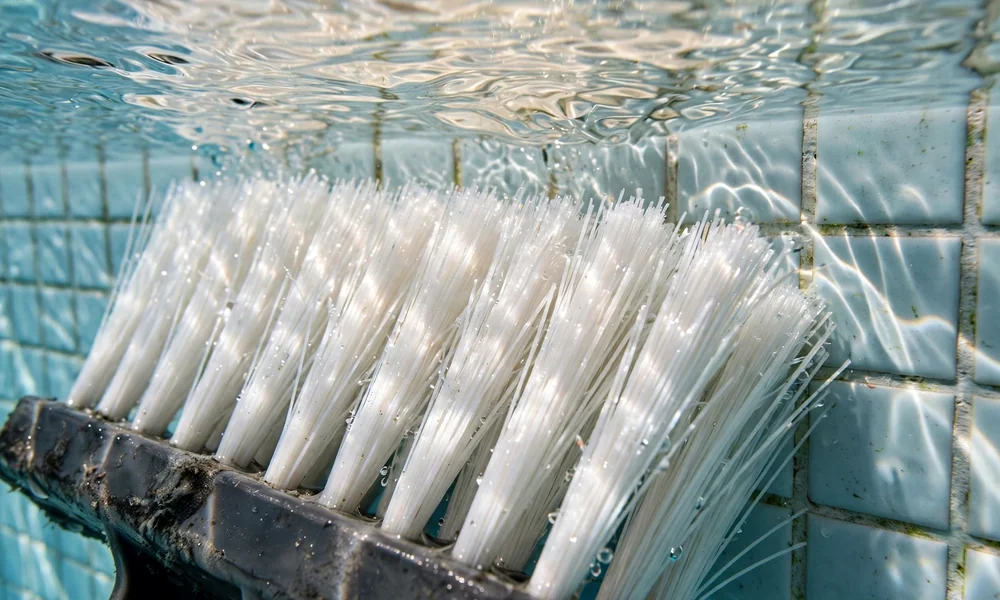
A pool brush does one thing: it scrubs. Its bristles drag across the wall, floor, steps and waterline, breaking the grip of algae, biofilm, scale and the grime that collects where water meets air. Algae clings with a hold chlorine alone cannot break, because the chemical cannot reach through the slimy layer the algae builds around itself. Brushing tears that layer open and lets the chlorine kill it. Without brushing, the algae keeps growing under its own shield and the water turns green.
Brushing also protects the surface. Scale starts as a rough patch and grows into a crust that stains and pits the finish if left alone. A weekly brush keeps those deposits from taking hold, and keeps the waterline free of the oily ring sunscreen and body oils leave behind.
Pool Brush vs Pool Skimmer: Scrubbing vs Scooping
The difference between a pool brush and a pool skimmer is the dirt each one removes. A skimmer scoops floating debris off the surface: leaves, insects, pollen, dust. A brush scrubs stuck-on dirt off solid surfaces under the water: algae on the wall, grime on the steps, scale on the floor. A skimmer never touches the wall, and a brush never lifts a floating leaf.
A pool net deserves a note, because it is easy to confuse with a brush: a net on a pole is not a separate tool from a skimmer. A pool net IS a manual skimmer, the hand-held version of the scooping job the built-in basket does automatically. A brush is the opposite kind of tool: where the net lifts dirt out of the water, the brush pushes dirt off the wall and into the water, where the filter and vacuum deal with it. Our guide to pool skimmers that keep the surface clear covers the scooping half in full. This guide is only about scrubbing.
Pool Brush vs Pool Vacuum: Scrubbing vs Sucking
A vacuum sucks up loose dirt from the floor. A brush loosens stuck-on dirt from walls and floor so the vacuum has something to suck up: the brush prepares, the vacuum removes. Run a vacuum over a wall coated in algae and the head passes straight over it, because suction cannot grip what is glued to the plaster. Brush the same wall first and the algae comes off in a cloud, settles to the floor, and the vacuum picks it up on the next pass. Skipping the brush is why so many pools stay green after vacuuming.
The two tools are used in a fixed order. Brush first, always, working from the walls down to the floor, and vacuum second, once the loosened dirt has settled. Vacuuming first and brushing second just stirs the dirt back into the water. Our guide to pool vacuums that clear the floor covers the sucking half: manual, suction-side, pressure-side and handheld vacuums. This guide is only about scrubbing, and about choosing a brush that will not damage the surface it protects.
The Main Types of Pool Brush
Pool brushes differ in bristle material, head shape and width. The bristle decides what the brush can clean and what it might damage; the shape decides where it can reach; the width decides how fast the job goes.
Nylon-bristle brushes
Nylon is the default choice for most pools. Its bristles are firm enough to scrub algae off plaster and fibreglass, but soft enough not to scratch vinyl. It is the brush to buy first, and for many pools the only one ever needed. Its weakness is stubborn algae on rough concrete: nylon can take several passes to shift what a steel brush removes in one.
Stainless steel algae brushes
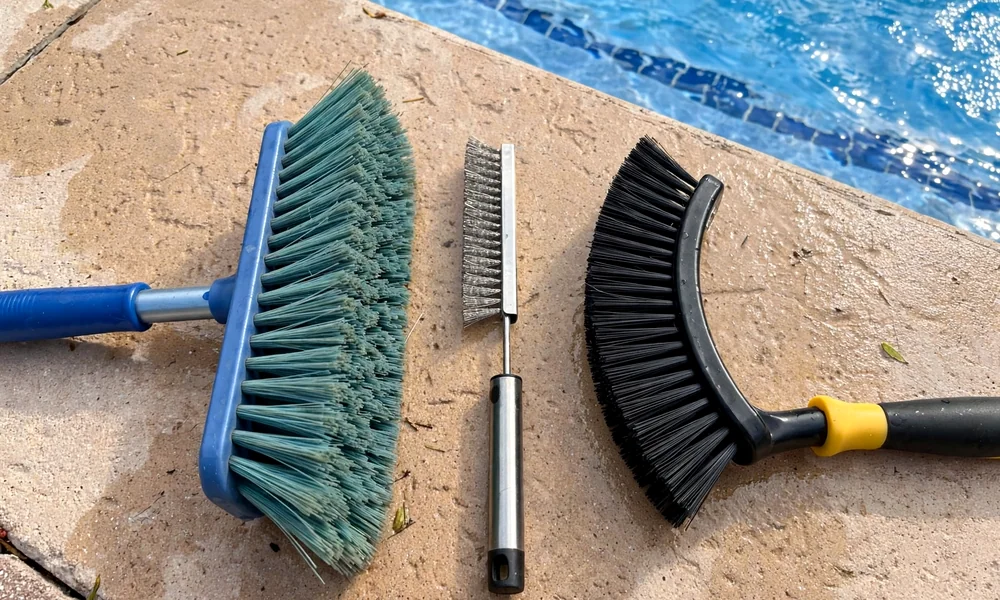
A steel brush has thin wire bristles made for concrete and plaster pools with algae that will not shift. It cuts through black algae and heavy scale faster than nylon. It must never be used on a vinyl liner or fibreglass shell, which it will scratch and tear, and it should be used sparingly even on plaster, because the wires wear the surface a little with every pass.
Curved and corner brushes
A curved brush follows the wall where it meets the floor, and a corner brush is a small, stiff head for steps, ledges and tight corners. These reach the places a wide flat head cannot: the waterline, the cove where wall meets floor, and the corners where algae starts first. Most algae problems begin in a corner the big brush never touched.

Pool Brushes Compared
| Brush type | Best for | Safe surfaces | Algae power | Reach |
|---|---|---|---|---|
| Nylon bristle | Weekly brushing, all pools | Vinyl, fibreglass, plaster | Good | Open walls and floor |
| Stainless steel | Stubborn black algae | Concrete and plaster only | Excellent | Open walls and floor |
| Curved brush | Wall-to-floor cove, waterline | Vinyl, fibreglass, plaster | Good | Curves and waterline |
| Corner brush | Steps, ledges, tight corners | Vinyl, fibreglass, plaster | Good | Corners and steps |
Bristles, Heads and Poles: How to Choose
Your pool surface decides the bristle. Vinyl liners and fibreglass shells need nylon: anything harder scratches the finish, and a scratched liner tears. Concrete and plaster can take nylon for weekly brushing, with a steel brush kept in reserve for the rare black-algae outbreak. If you are not sure what your surface is, buy nylon: a brush that takes two passes is always better than one that damages the pool in one.
Then pick the head width: an 18-inch head covers open water fast and suits a large rectangular pool with long straight walls. A 12-inch head is easier to control around steps and curves, and suits a small or freeform pool. Most owners end up with two: a wide one for the open floor and a small curved one for the waterline and corners. The wide head does the bulk of the work; the small one does the work that stops algae.
Then check the pole, because a brush is only as good as the pole behind it. A telescopic aluminium pole that reaches across the pool without bending is the difference between a ten-minute job and a thirty-minute one. It should lock firmly at length, with no wobble at the joint, and the head should clip on with a standard fitting so you can swap heads without tools. A pole that flexes wastes your effort and leaves the deep end unbrushed.
Brushing Technique That Actually Removes Algae
Brush in a fixed order, every time. Start at the waterline and work down the walls, then the steps, then the floor, moving from the shallow end toward the deep end, so the dirt you loosen drifts down and away from areas already cleaned. Use short, firm strokes with the bristles flat against the surface, overlapping each pass by half, and let the pole’s weight do the work rather than pressing down hard. Hard pressure bends bristles sideways and scrubs less, not more.
Brush weekly in summer, when warm water makes algae grow fastest, and always after shocking, when dead algae needs loosening before the vacuum can remove it. A robotic cleaner does some of this work for you: its rotating brushes scrub the floor and walls as it moves, which is why our guide to the best robotic pool cleaners of 2026 is worth reading if you want a machine that brushes while it vacuums. Even with a robot, the waterline and steps still need a hand brush: robots rarely reach either properly.
Mistakes That Ruin a Pool Surface
The most expensive mistake is the wrong bristle on the wrong surface: a steel brush on a vinyl liner scratches it in a single pass, and a torn liner costs far more than any brush. The second is brushing too rarely: algae that has had a month to grip needs acid, not a brush. The third is storing the brush in the sun: ultraviolet light makes nylon brittle, and a brittle brush sheds bristles into the pool, where they clog the filter. Store it head down, in the shade, and rinse it after use. The fourth is brushing with a worn head: when bristles splay outward and no longer stand straight, they stop scrubbing and start sliding.
Before You Buy: The Checklist
- Check your pool surface first: vinyl and fibreglass need nylon, never steel.
- Size the head to your pool: wide for open rectangles, narrow for curves and steps.
- Add a curved or corner brush for the waterline and cove, where algae starts first.
- Check the pole reaches the far wall without bending and locks firmly at length.
- Use a standard fitting, so you can swap heads without tools.
- Plan to replace the brush when the bristles splay: a worn brush scrubs nothing.
Frequently Asked Questions
How often should I brush my pool?
Once a week in summer, every two weeks in cooler months, and always after shocking. A pool under trees or in full sun needs it more often, because warm, nutrient-rich water grows algae fastest.
Can I use a stainless steel brush on my pool?
Only on concrete or plaster, and only for stubborn algae nylon will not shift. Never use steel on a vinyl liner or fibreglass shell: it scratches and tears the finish in a single pass.
Does brushing replace vacuuming?
No. Brushing loosens dirt; vacuuming removes it. Brush first, then vacuum to pick it up from the floor. A pool brushed but never vacuumed just moves the dirt around.
Why does algae keep coming back in the same spot?
Because that spot is not getting brushed. Algae returns first in corners, behind ladders, along the waterline and in the cove where wall meets floor. Use a corner or curved brush on those spots weekly.
How long does a pool brush last?
A nylon brush kept out of the sun lasts one to two seasons. One left baking on the deck goes brittle and sheds bristles within a single summer. Store it head down in the shade and rinse it after use.
Do I still need a hand brush if I own a robot?
Yes. Robots scrub the open floor and walls well, but rarely reach the waterline, steps or tight corners properly. A hand brush for those spots, used weekly, keeps the pool truly algae-free.
Bottom Line
A pool brush is the cheapest tool in pool care and the one that matters most against algae. Buy nylon first, whatever your surface, and add steel only if you have a concrete or plaster pool with stubborn black algae. Pair a wide head for open water with a curved or corner head for waterline and steps, put both on a pole that reaches without bending, and brush weekly from the waterline down. Do that, vacuum after, and the pool will stay clear with less chlorine and less trouble than any chemical alone.


