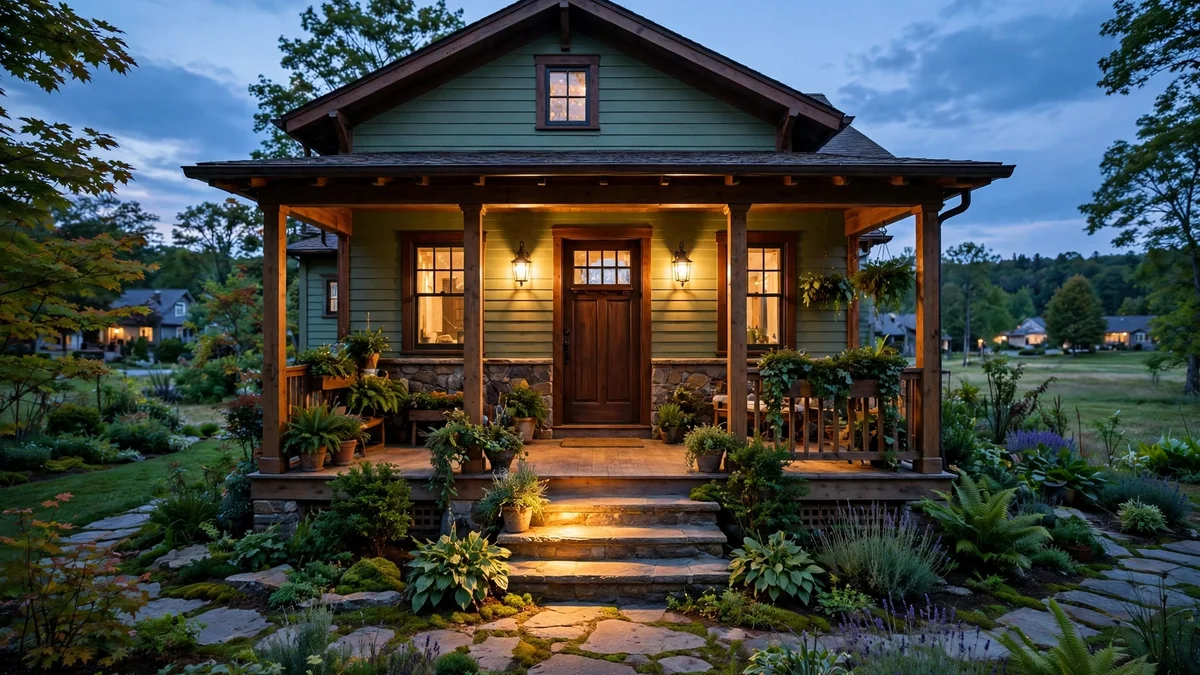
A Guide to Porch Lights for a Welcoming Entry in 2026
Porch lights are the first thing visitors notice about a home after dark, and the best porch lights in 2026 do far more than switch on. They make the front door easy to find, the step safe to use, and the whole entry feel warm and welcoming, without dazzling the person on the mat. A good porch light flatters the house, shows faces clearly, and lets you find the lock on the first try. This guide covers only fixed lights for the entry itself: fittings mounted beside or above the front door, on the porch wall, or hanging from the porch ceiling.
Key Takeaways
- Choose warm white light, around 2700K: it flatters faces, brick, and wood, while cool white looks harsh at a front door.
- Mount porch lights at face height, roughly 165 to 175 centimetres from the floor, so light falls on faces and the step, not into eyes.
- Two matching lights, one on each side of the door, give the most even entry; one light works best above the door or on a narrow porch.
- Look for IP44 as the minimum for a sheltered porch, and IP65 for any fitting fully exposed to rain and wind.
- Hide the bulb behind frosted glass or a shade: if you can see the bare bulb from the step, the fitting is aimed wrong.
Porch Lights 2026 at a Glance
| Best for | Type | Typical brightness | Standout strength |
|---|---|---|---|
| Best overall | Paired wall lanterns | 400 to 800 lumens each | Even light on faces from both sides |
| Best for narrow porches | Single wall lantern | 400 to 800 lumens | One fitting, no clutter beside the door |
| Best for covered porches | Hanging pendant | 400 to 600 lumens | Warm pool of light over the step |
| Best for modern homes | Flush wall light | 300 to 600 lumens | Slim profile, clean lines, no glare |
| Best for security | Motion-sensor wall light | 800 to 1,500 lumens | Bright welcome when someone approaches |
| Best on a budget | Bulkhead light | 300 to 500 lumens | Tough, weatherproof, and easy to fit |

What a Porch Light Is Really For
A porch light has three jobs, and only one is decoration. First, it must light the step, the lock, and the face of the person at the door, so nobody fumbles for keys in the dark. Second, it must make the house easy to find from the street, marking the front door clearly among windows and walls. Third, it should make the entry feel welcoming, so arriving home at night feels like coming in, not like approaching a security checkpoint. A path light points down at the ground, and a patio lantern sits on a table, but a porch light is a fixed fitting, wired into the house, that lights a small, busy space where people stand close to the wall and wait to be let in. Our guide to the best outdoor lights for porches, paths and patios covers the whole garden from a wider angle, but this guide stays at the door itself.
The Main Types of Porch Light
Paired wall lanterns
Two matching lanterns, one on each side of the door, are the classic arrangement. Light comes from both sides, so faces have no hard shadow, the step is lit evenly, and the door reads clearly from the street. Buy a pair that matches exactly, mount them at the same height, and use the same bulb in each, or the entry will look lopsided after dark.
Single wall lantern
One lantern beside the door, or centred above it, suits a narrow porch where two fittings would crowd the wall. Above the door works well when the porch is shallow, because light falls straight down onto the step. Beside the door works better when there is a bell or a house number to light. Choose a lantern with glass panels and a solid top, so light goes down and out, not up into the eyes of the person waiting.
Hanging pendant lights
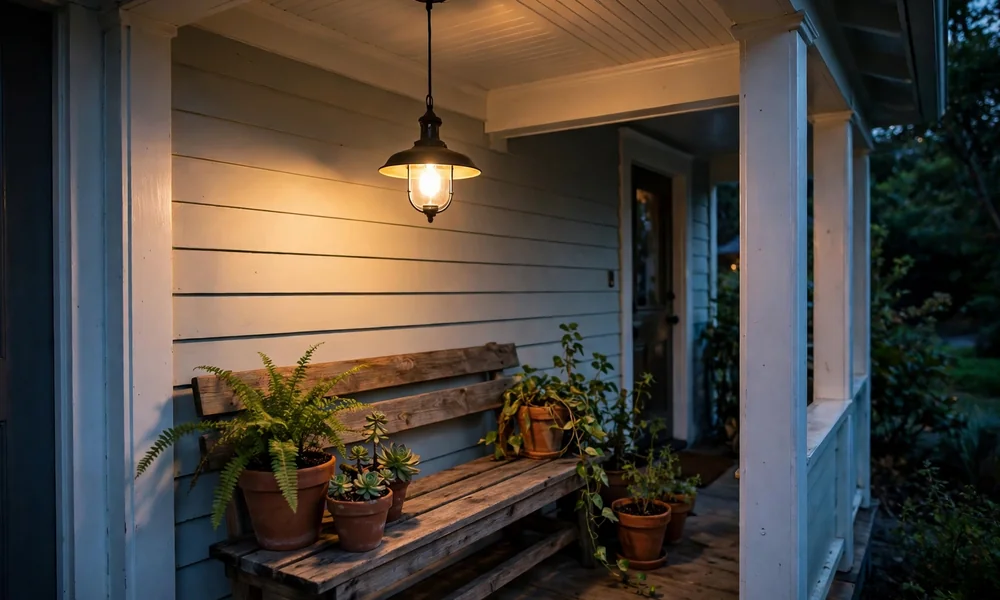
A pendant hangs from the porch ceiling and lights the space from above, which suits a covered porch with room to stand underneath. It gives a warm pool of light over the step and the welcome mat, and it looks at home on cottages and period houses. Hang it high enough that nobody walks into it, and low enough that light still reaches the step: roughly 210 centimetres from the floor to the bottom of the fitting is a good starting point.
Flush and bulkhead lights
Motion-sensor porch lights
Brightness and Colour: The Numbers That Matter
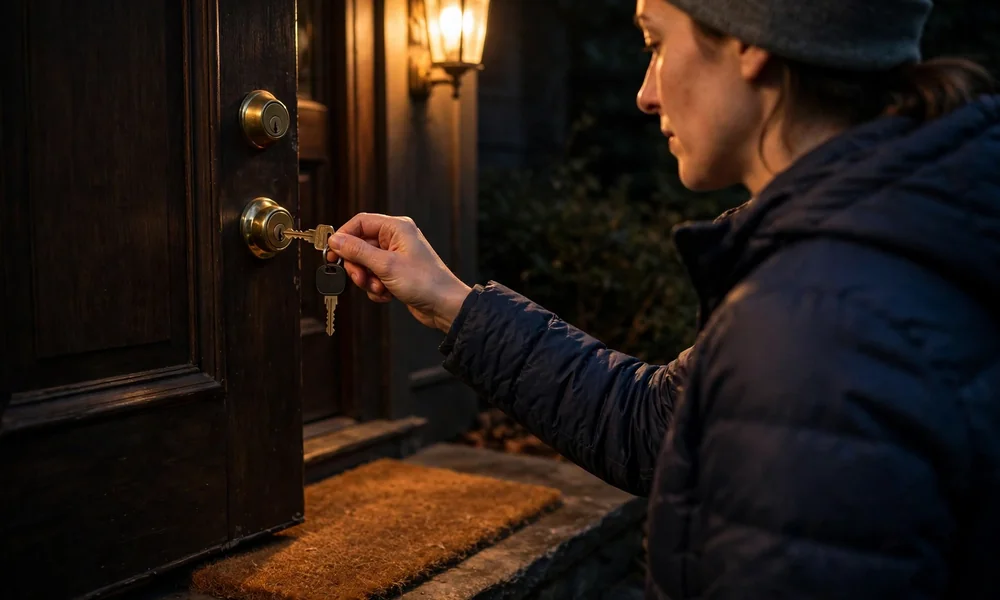
Brightness is measured in lumens, and a porch needs far less than most people expect. A single lantern of 400 to 800 lumens lights a normal step and doorway comfortably. Two lanterns of 400 lumens each give a better result than one of 1,200, because light comes from two directions and leaves no hard shadow. Above 1,500 lumens, a porch light starts to feel like a security floodlight, which is the wrong mood for a front door.
Colour temperature matters just as much, and it is measured in kelvin. Warm white light, between 2700K and 3000K, makes brick look warm, wood look rich, and skin look healthy. Cool white light, at 4000K and above, makes the same porch look like a shop entrance: colours flatten, faces look pale, and moths gather around the bulb. Check the box before you buy, and if a fitting comes with a cool bulb, swap it for a warm one: it is the cheapest porch upgrade there is.
Where to Mount a Porch Light
Height is the detail that makes or breaks a porch light. Mount wall lanterns so the centre of the fitting sits roughly 165 to 175 centimetres from the floor of the porch, which puts light at face height for most adults. Too low, and light glares up into faces and throws long shadows. Too high, and it lights the top of the door while the step stays dark. On a porch with steps, measure from the step where visitors stand, not from the ground below.
Distance from the door matters too. A lantern mounted 15 to 30 centimetres from the door frame lights the lock and the bell without crowding the frame. Further out, and light spreads too wide and loses its focus on the door. Keep fittings clear of sidelights or a fanlight, or light will bounce off the glass and back into the porch. A lantern beside a pale wall looks brighter than the same lantern beside dark brick, because the wall bounces light back into the porch.
Power, Controls, and Sensors
Most porch lights are mains-wired, which is the most reliable option: steady brightness, no batteries to change, and no panel to keep in the sun. A wired fitting needs an electrician if there is no existing wiring at the door, but once it is in, it will last for years with only a bulb change. Solar porch lights suit a sunny, south-facing porch far better than a shaded north-facing one, and they rarely match a wired light for brightness on a winter evening.
Controls decide whether the porch is lit when it matters. A dusk-to-dawn sensor switches the light on at sunset and off at sunrise, so the porch is always lit when someone arrives after dark. A timer does the same job on a fixed schedule, and a motion sensor adds a brighter welcome when someone approaches. The simplest reliable setup is a dusk-to-dawn sensor with a manual override, so you can switch the light on during the day if you need to.
Weather, Materials, and How Long They Last
A porch light lives outdoors, so its weatherproof rating is not a detail to skip. The IP rating tells you how well it keeps out water and dust. IP44 means protection against splashing water, which is enough for a fitting under a porch roof. IP65 means it can handle jets of water, which is what you want for a fitting fully exposed to rain, or for a house on a windy hill. If the rating is not printed on the box, treat the fitting as indoor-only, however sturdy it looks.
Materials age very differently outside. Powder-coated metal resists rust if the coating stays intact, but a chip or a scratch will rust in the first wet winter, so check the coating every spring. Brass and copper weather gracefully, darkening over time, and suit period houses. Plastic fittings are light, cheap, and never rust, but thin plastic yellows in the sun and cracks in frost, so choose a thick, UV-rated plastic if you go that way. Whatever the material, a fitting with a sealed glass panel and a rubber gasket will outlast an open one.
Choosing a Porch Light for Your House
Start with the house, not the catalogue. A cottage suits a lantern with clear glass and a black metal frame. A modern house suits a slim flush light in matching metal. A period house suits brass, copper, or a candle-style lantern. The fitting should look as if it belongs to the house in daylight, when it is switched off, as well as at night, when it is lit.
Then match the fitting to the porch. A wide, covered porch takes a pair of lanterns or a pendant with room to hang. A narrow porch takes a single slim fitting that does not stick out into the walkway. A porch with no roof takes a fully weatherproof fitting, mounted on the wall rather than hanging, since a pendant would swing in the wind and fill with rain. A porch with steps needs light on the lowest step as well as the door.
Porch Light Checklist
- Warm white bulb, 2700K to 3000K, with a colour rendering index of 90 or above.
- Centre of the fitting 165 to 175 centimetres above the step where visitors stand.
- IP44 minimum under a porch roof, IP65 if fully exposed to rain and wind.
- Bulb hidden behind frosted glass or a shade, with no bare bulb visible from the step.
- Dusk-to-dawn sensor or timer, plus a manual override you can reach from indoors.
- Spare warm bulb kept indoors, and the fitting cleaned and checked every autumn.
Frequently Asked Questions
How bright should a porch light be?
For most porches, 400 to 800 lumens per fitting is enough. Two 400-lumen lanterns beat one very bright one, because light comes from both sides.
What colour temperature is best for a porch light?
Warm white, between 2700K and 3000K, suits almost every porch. Cool white above 4000K looks harsh and clinical at a front door.
Should I put one porch light or two?
Two matching lights, one on each side of the door, give the most even entry. One light works well on a narrow porch or above the door.
How high should I mount a porch light?
Mount the centre roughly 165 to 175 centimetres above the step where visitors stand, so it lights faces and the lock without shining into eyes.
Do porch lights need to be weatherproof?
Yes. Look for IP44 minimum for a sheltered porch, and IP65 for a fitting fully exposed to rain. No IP rating means indoor-only.
Are motion-sensor porch lights a good idea?
Yes, if the sensor covers only the step and the path to the gate. A low warm glow all evening, rising when someone approaches, saves energy too.
The Bottom Line
The best porch lights in 2026 are warm, well shaded, and mounted at face height, with a pair beside the door whenever the porch has room. Choose a fitting that suits your house in daylight, lights the step and the lock after dark, and keeps the rain out for years. Get the warmth, the height, and the shade right, and the porch will welcome everyone who arrives, including you, on the darkest night of the year.


