A two-story home is the hardest test a robot vacuum can face. Most models clean the ground floor beautifully, then refuse to learn the upstairs, drift toward the staircase, or lose their map the moment you carry them upstairs. The best robot vacuums for two-story homes 2026 solve all three problems at once: they store a separate map for each floor, treat every staircase as a hard boundary, and remember where they left off when the battery runs low.
Living on two levels changes what matters in a robot vacuum. Suction power still counts, but mapping memory, cliff detection, and battery range matter far more.
This guide compares the strongest options side by side and walks through the setup that makes a robot vacuum genuinely useful across two floors.
Key takeaways
- Multi-floor mapping is non-negotiable: the vacuum must store a separate map for each level.
- Reliable cliff sensors matter more than suction: one fall down a staircase can destroy the vacuum.
- Look for at least 120 minutes of runtime and recharge-and-resume, so a single charge can cover one full floor.
- LiDAR navigation beats camera-only and random-bounce systems, especially on landings and in dim hallways.
- A self-emptying dock on the main floor saves the most time, and a second dock upstairs is the easiest upgrade.
Why Two-Story Homes Need a Different Robot Vacuum
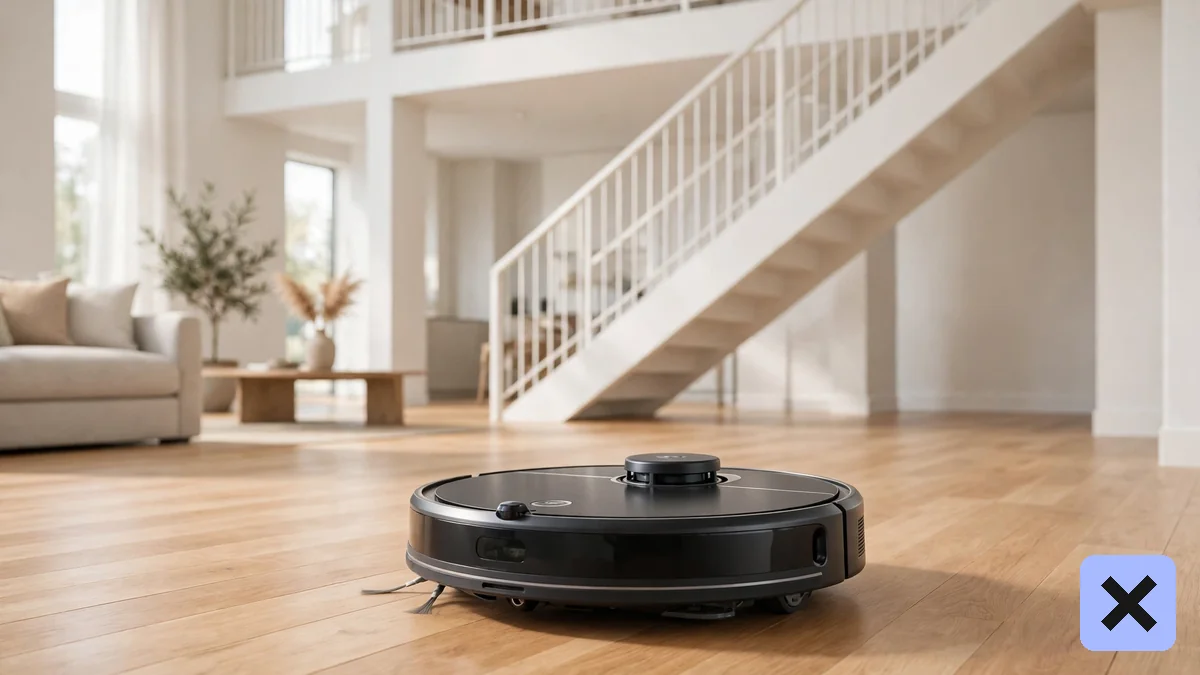
A single-level apartment asks very little of a robot vacuum: the floor is flat, the rooms are few, and the machine only needs one map. A two-story home breaks every one of those assumptions, with two cleaning zones, a staircase that is both an obstacle and a hazard, and hard floors downstairs and carpet upstairs.
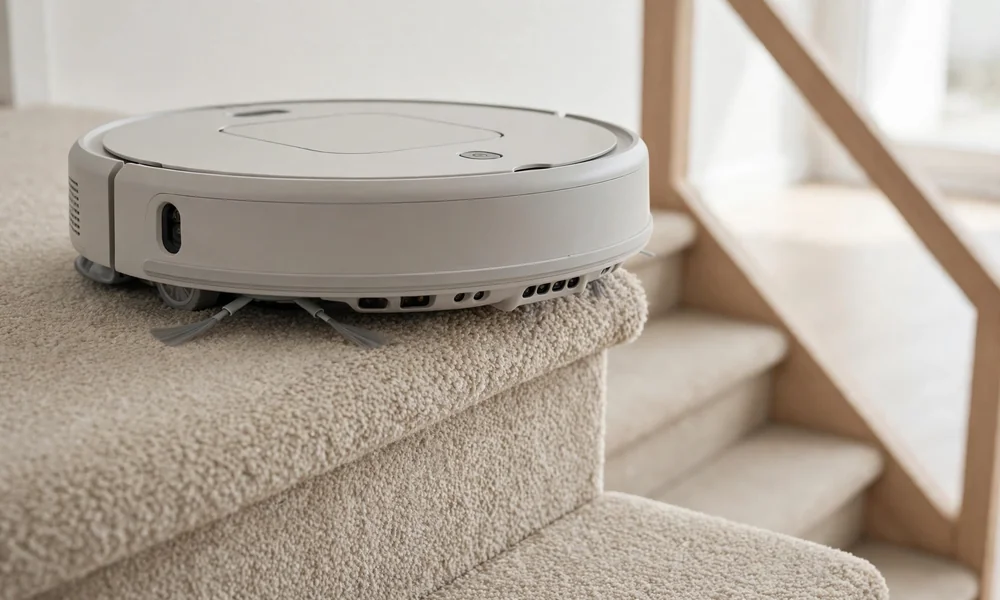
The staircase is the central problem. Robot vacuums cannot climb stairs, so the machine must be carried between floors. The vacuum needs to know which floor it is on without being told, remember the layout of both levels, and stay away from every stair edge, including the landing. A vacuum with weak cliff sensors is not just ineffective upstairs; it is a breakage waiting to happen.
What to Look For in a Robot Vacuum for Two Floors
Get the mapping and safety features right first. A vacuum with enormous suction and a single saved map will always lose to a slightly weaker machine that knows both floors by heart.
Multi-Floor Mapping
Multi-floor mapping lets a vacuum store two, three, or even four separate floor plans and recognise which one it is standing on. When you carry the machine upstairs and press start, it loads the right one. This is the single most important feature for a two-story home, so check how many maps the model stores: two is enough for most homes, but four gives you room for a basement or a finished attic later. Models that only remember one map will still clean, but every upstairs session starts with a slow mapping run and the vacuum will not remember no-go zones or room names. If your home has pets, the pet-focused models in our guide to robot vacuums made for pet owners are worth comparing.
Cliff Sensors That Actually Work
Cliff sensors sit on the underside of the vacuum, detect a drop, and tell the machine to stop and reverse. They are not all equal: cheap sensors can be fooled by dark carpet, which absorbs infrared light and looks like empty space. Favour models with four or more cliff sensors, and use virtual barriers as a second layer: once the upstairs map is saved, draw a no-go line across the top of the staircase.
Battery Life and Recharge and Resume
More floor area means the battery matters. Look for at least 120 minutes of runtime on standard power, and more if the upstairs is heavily carpeted. Just as important is recharge and resume: when the battery runs low, the vacuum returns to its dock, charges, and goes back to the exact spot where it stopped. The upstairs clean starts away from the dock, so if the vacuum runs out of charge upstairs, it cannot drive itself home; it will stop where it is and wait. For homes over 2,500 square feet, the models in our roundup of robot vacuums built for large homes are a useful starting point.
The Best Robot Vacuums for Two-Story Homes 2026
Each model below stores multiple floor maps, carries reliable cliff detection, and has the battery to finish a full floor in one run.
| Model | Multi-floor maps | Suction | Runtime | Self-empty dock | Best for |
|---|---|---|---|---|---|
| Roborock S8 MaxV Ultra | 4 maps | 10,000 Pa | 180 min | Yes | Best overall |
| iRobot Roomba j9+ | 3 maps | Strong | 150 min | Yes | Pet hair and obstacles |
| Dreame X40 Ultra | 4 maps | 12,000 Pa | 180 min | Yes | Deep carpet cleaning |
| Ecovacs Deebot X2 Omni | 3 maps | 8,000 Pa | 160 min | Yes | Mopping both floors |
| Shark Matrix Plus 2-in-1 | 2 maps | Strong | 120 min | Yes | Best value |
Best Overall: Roborock S8 MaxV Ultra
The Roborock S8 MaxV Ultra is the most complete answer to the two-story problem. It stores four floor maps, navigates with LiDAR and a camera, and recognises the floor it is on within seconds. Its 10,000 pascals of suction and carpet boost handle carpeted bedrooms upstairs and hard floors downstairs, and its self-emptying and self-washing dock empties the dustbin, washes the mop, and refills the water tank. Its main weakness is price.
Best for Pet Hair: iRobot Roomba j9+
If the upstairs bedrooms are full of pet hair, the Roomba j9+ is the pick. Its dual rubber brushes resist tangles better than anything else here, and its obstacle avoidance is trained to recognise and avoid pet waste. It stores three floor maps and switches between them reliably, and its clean-base dock empties the dustbin into a sealed bag that holds weeks of hair and dust. It is not the strongest on raw suction, but for a home where the main problem is hair on carpet, that trade-off is easy to accept.
Best for Deep Carpet: Dreame X40 Ultra
The Dreame X40 Ultra brings the highest suction in this group at 12,000 pascals. It stores four maps and lifts its mop pads when it detects carpet, so a mopping run downstairs never drags a damp pad across the upstairs rug. Its dock empties the dustbin, washes the mops with hot water, and dries them. The trade-off is size: the dock is large and needs clear space on the ground floor.
Best for Mopping: Ecovacs Deebot X2 Omni
The Deebot X2 Omni is the choice if both floors have large areas of hard flooring to mop. Its square front reaches into corners better than round models, and its rotating mop pads scrub rather than just dragging a damp cloth. It stores three maps, navigates with LiDAR, and its dock handles emptying, washing, and hot-air drying. Its suction is lower than the Dreame, so very thick carpet upstairs is not its strongest area.
Best Value: Shark Matrix Plus 2-in-1
The Shark Matrix Plus 2-in-1 is the sensible budget pick. It stores two maps, exactly enough for a two-story home, and its matrix cleaning pattern makes two passes over each area. It comes with a self-emptying dock, a sonic mopping pad, and strong suction for its price. It lacks the camera-based obstacle avoidance of the premium models, so you will need to tidy cables before a run, but the cleaning itself is genuinely good.
How to Set Up a Robot Vacuum in a Two-Story Home
Spend an hour on the first day and the machine will largely take care of itself. Rush the setup and you will spend the next month rescuing it from the stairs.
Map the Ground Floor First
Put the dock on the ground floor, with clear space on both sides and a power outlet nearby. Let the vacuum run a full mapping pass before you ask it to clean anything. Once the map is saved, name the rooms and draw no-go zones around the staircase. Run two or three cleaning cycles on this floor first to catch mapping errors while the dock is nearby.
Add the Upstairs Map Second
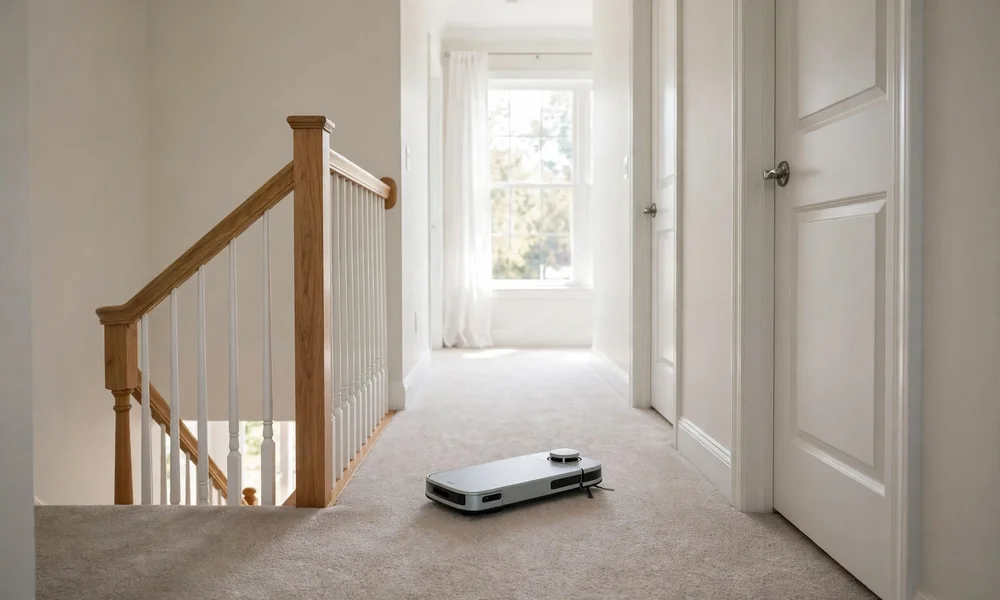
When the ground floor is working well, carry the vacuum upstairs and start a new map from the app. Place it on the landing, away from the stair edge, and let it map the whole floor. Save the map, name the rooms, and draw a no-go line across the top of the stairs: even if a cliff sensor is fooled by dark carpet, the vacuum will not cross it. Even if one of the models in our guide to robot vacuums designed for small apartments would cover a single floor, both maps still need to be saved separately.
Decide on a Second Dock
A second charging dock upstairs is the single best upgrade for a two-story home. It lets the vacuum recharge and resume upstairs without being carried down, and run a scheduled upstairs clean while you are out. Not every model supports a second dock, so check before you buy one. If yours does not, schedule the upstairs clean for a time when you are home to carry the vacuum up and down.
Checklist: Buying a Robot Vacuum for a Two-Story Home
- Confirm multi-floor mapping; two stored maps is the minimum for a two-story home.
- Check the cliff sensor count and how the vacuum behaves on dark carpet near stair edges.
- Look for at least 120 minutes of runtime and recharge-and-resume.
- Choose LiDAR navigation over random or camera-only systems.
- Pick a self-emptying dock for the main floor and check whether a second dock upstairs is supported.
- Measure the dock space downstairs and confirm the vacuum fits under beds upstairs.
Frequently Asked Questions
Can a robot vacuum clean two floors by itself?
Yes, but it cannot climb stairs, so you still carry it between floors. On its own it recognises which floor it is on, loads the correct map, and cleans that floor fully.
Do I need two robot vacuums for a two-story home?
Usually not. One good vacuum with multi-floor mapping covers both levels, and carrying it upstairs takes less than a minute. Two vacuums only make sense in a very large home, or if nobody can carry the machine up the stairs.
Will a robot vacuum fall down the stairs?
A modern vacuum with working cliff sensors will not fall down the stairs: it stops and reverses the moment it detects a drop. Keep the sensors clean and draw a no-go line across the top of the stairs in the app.
How many floor maps should a robot vacuum store?
Two maps is the minimum, and three or four is better if you also have a basement or a finished attic. Reliability matters more than the number.
Is LiDAR better than camera navigation for two floors?
Yes, for most two-story homes. LiDAR builds an accurate map in the dark and in dim hallways, which matters upstairs where landings are often poorly lit.
Should the dock go upstairs or downstairs?
Downstairs, because the ground floor is cleaned more often and the kitchen and entrance produce the most dirt.
The Bottom Line
The best robot vacuum for a two-story home is not the one with the biggest suction number. It is the one that stores a map for each floor, respects every staircase, and finishes a full level on one charge. The Roborock S8 MaxV Ultra does all of that better than anything else right now, the Dreame X40 Ultra cleans carpet deeper, and the Shark Matrix Plus 2-in-1 covers the essentials for far less money. Map both levels on the first day, draw the no-go line at the top of the stairs, and the vacuum will quietly handle both floors.