
Why Rock Candy Still Beats Modern Sweets in 2026
Rock candy is the oldest sweet in the shop, and it still earns its place in 2026. A stick of sugar crystals, grown slowly in a jar of syrup until it sparkles like a gemstone, is a very different sweet from the soft, chewy sweets that fill most of the aisle today. It is hard, slow, and honest: sugar, water, and time, with colour and flavour added only when the maker wants them. You suck it, you stir it into tea, and it lasts far longer than any sweet of the same weight.
This guide looks at why rock candy still beats modern sweets in 2026, which sticks are worth buying, how to tell a well-grown crystal from a cheap imitation, and how to grow your own at home. The same rules apply whether you are buying a single stick for a cup of tea or a jar of them for a party: clear crystals, a sturdy stick, honest flavour, and a maker who does not rush the growing.
5 Key Takeaways
- The best rock candy is made from real sugar crystals grown slowly over days, not moulded sugar shaped to look crystalline.
- Clear, even crystals with a firm grip on the stick beat cloudy, crumbly, or patchy sticks.
- Colour should be used lightly, and flavour should taste of the fruit or spice it claims to be.
- A good stick dissolves slowly, sweetens tea or coffee gently, and lasts long enough to be worth its price.
- Store rock candy dry and airtight, away from damp, and it keeps for months.
What Rock Candy Actually Is
Rock candy is sugar in its most visible form. It is made by dissolving a large amount of sugar in hot water to make a syrup, then letting the syrup cool slowly around a stick or a string. As the water cools, it can no longer hold all the sugar, so the sugar comes out of the syrup as crystals, growing on the stick one layer at a time over several days until it is covered in hard, sparkling lumps.
That slowness is the whole point. A sweet that takes a week to grow cannot be made cheaply in bulk, and the crystals themselves are the proof of the work. Hold a good stick up to the light and you can see square edges, flat faces, and clear centres that catch the light. A poor stick looks dull and grainy instead, because it was rushed, or because the maker used a mould and pressed sugar into a crystal shape rather than growing it.
How the Crystals Grow
The growing starts with a seed. The stick is dipped in syrup and rolled in dry sugar, which gives the new crystals somewhere to start, then lowered into a jar of hot syrup and left alone in a warm, still place. For the first day, almost nothing seems to happen. By the second day, small crystals appear. By the fifth or seventh day, the stick is thick with them. The syrup must not be shaken or stirred, because movement knocks the young crystals off the stick.

Why Rock Candy Still Wins
Most modern sweets are built for speed. They are soft so you can chew them quickly, sweet so the flavour hits at once, and gone in under a minute. Rock candy works the other way round. It is hard, so you suck it slowly, and its sweetness comes out gradually as the crystals dissolve, which means one stick can last twenty minutes or more. That slow pace is why it still wins: you get more pleasure from less sugar.
It is also a cleaner sweet to eat. There is no sticky chew to pull at fillings, no gummy coating to leave on the teeth, and no crumbs to drop. A stick is easy to hold, easy to share, and easy to stop eating: when you have had enough, you put it down. Parents like it for parties because a jar of sticks lasts the whole afternoon, while a bowl of soft sweets is empty in ten minutes.
Clear Sticks vs Coloured Sticks
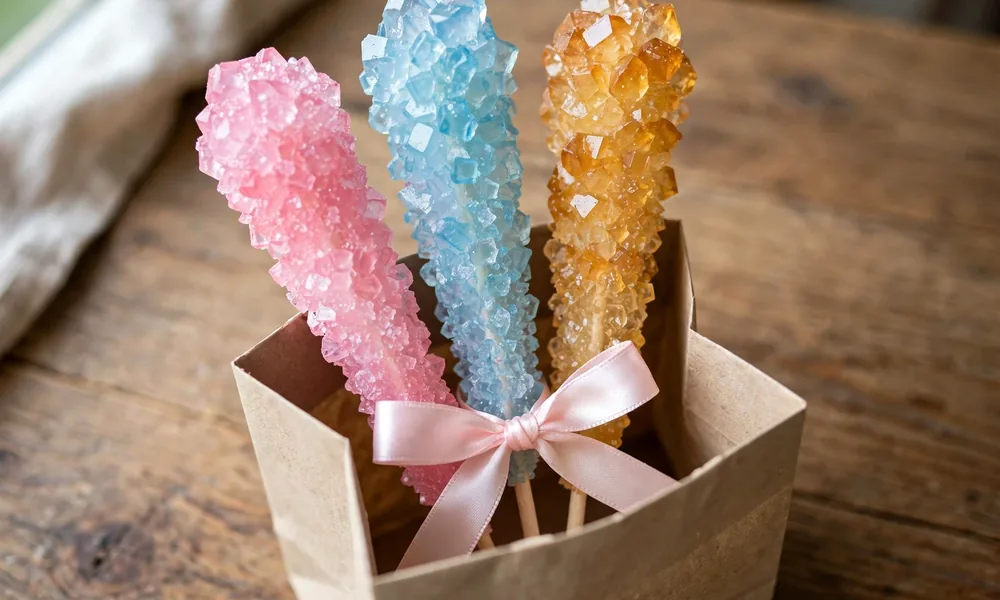
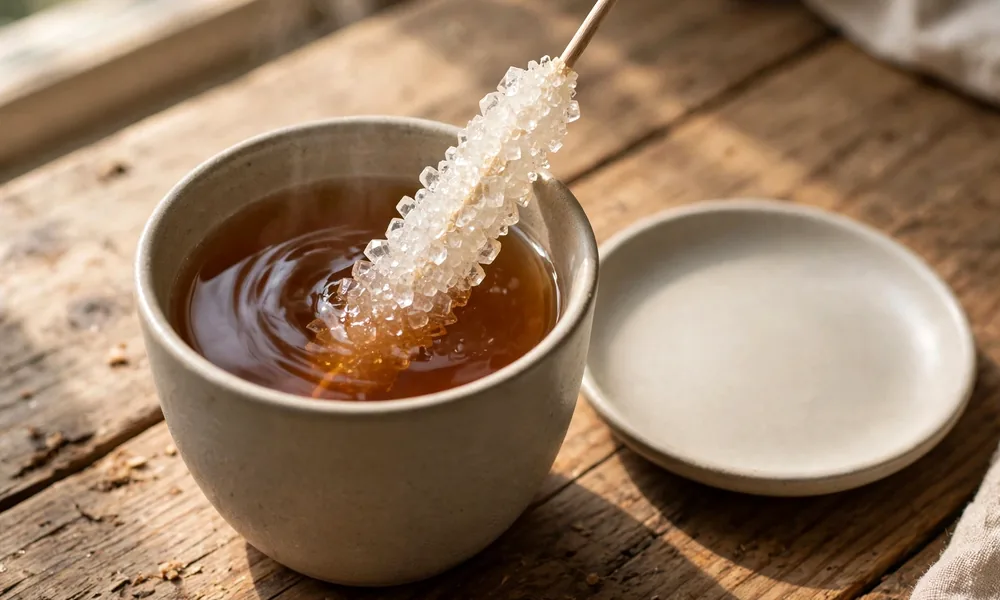
Clear rock candy is the original, and it is still the best test of a maker. With nothing to hide behind, a clear stick shows the quality of the crystals at once: the size, the evenness, the sparkle. It tastes of clean sugar, which makes it the best choice for stirring into tea or coffee. Coloured sticks are the same candy with food colouring and flavouring added to the syrup, and they can be just as good when done lightly. The best coloured sticks look like stained glass, with the colour running through the crystal. The worst look painted, with a flat, opaque colour that hides cloudy crystals underneath.
The Main Rock Candy Types in 2026
Rock candy comes in only a few forms, and each one suits a different use. The table below covers the types you are most likely to meet in 2026.
| Type | Best for | What to look for |
|---|---|---|
| Classic clear sticks | Tea, coffee, and gifts | Large, clear crystals, straight stick |
| Fruit-coloured sticks | Parties and sweet jars | Colour through the crystal |
| String rock candy | Decorating cakes and drinks | Even crystals along the string |
| Swizzle sticks | Stirring cocktails and hot drinks | Long handle, stays dry |
| Mini sticks | Children and party bags | Small, even crystals |
How to Judge a Good Stick
Judging rock candy takes less than a minute, and it is mostly done with your eyes. Hold the stick up to the light. The best sticks have large, well-shaped crystals that cover the stick evenly from top to bottom, with no bare patches and no loose grains falling off. If the stick looks dusty, grainy, or dull, the crystals never grew properly.
Crystal Size and Coverage
Bigger crystals are usually better, because they take longer to grow and dissolve more slowly, which is what makes a stick last. On a full-size stick, small crystals mean the maker pulled the stick out early. A good stick is coated all the way round, with crystals on every side, so it dissolves evenly.
The Stick Itself
The stick is easy to overlook, and it matters more than most buyers think. A good stick is straight, smooth, and long enough to hold comfortably, with a dry handle at the top that stays out of the drink. Wooden sticks are the classic choice. Paper sticks are lighter and cheaper, but they can go soft in a hot drink. Give the stick a gentle shake: if crystals fall off, the batch was not grown properly.
Growing Rock Candy at Home
Growing rock candy at home is one of the simplest kitchen projects there is, and also one of the slowest. You need sugar, water, a jar, a stick, and a week of patience. Dissolve three parts sugar in one part water over a gentle heat, stirring until the syrup is clear, then let it cool slightly and pour it into a clean jar. Dip your stick in the syrup, roll it in dry sugar, let it dry, then lower it into the jar so it hangs without touching the sides or the bottom. Cover the top with a cloth, put the jar somewhere warm and still, and leave it alone. The stick is ready in five to seven days.
The one tool that makes the difference is a thermometer. The syrup must be hot enough to dissolve all the sugar, but not so hot that it starts to colour or caramelise, and the only reliable way to know is to measure it. Our guide to the best candy thermometers in 2026 explains which types read accurately in a small pan of syrup. If your first batch grows thin, the syrup was probably not strong enough, or the jar was moved.
Rock Candy vs Other Sweets
Rock candy sits in a class of its own, but it is worth comparing it with its neighbours before you buy. Against toffee and caramel, it is the lighter, cleaner sweet: no butter, no chew, no stickiness, and a flavour that stays simple. Our guide to the best caramel in 2026 covers the rich, buttery end of the sweet aisle, and it is the right choice when you want something soft and indulgent rather than slow and sparkling. Against gummy sweets, rock candy is the opposite in every way: hard where gummies are soft, slow where gummies are quick, and plain where gummies are bright and fruity. Our comparison of the best and worst candies of 2026 puts the whole aisle side by side, and rock candy comes out of it as one of the most honest sweets on the shelf.
Your Rock Candy Checklist
- Hold the stick to the light: look for large, clear crystals with square edges.
- Check the coverage: crystals should coat the stick evenly on every side, with no bare patches.
- Shake it gently: no crystals should fall off, and the stick should feel firm, not bendy.
- Read the label: sugar and water first, with colour and flavour used lightly.
- Match the stick to the use: clear for tea, coloured for parties, mini sticks for children.
- Store it dry and airtight: keep sticks sealed away from damp, and they keep for months.
Frequently Asked Questions
Is rock candy just sugar on a stick?
Yes, and that is the point. Rock candy is crystallised sugar grown from a syrup of sugar and water, usually with colour and flavour added. There is no fat, no gelatine, and no chew. What you are paying for is the time it takes to grow the crystals.
How long does rock candy last?
A stick lasts far longer than most sweets. Sucked slowly, a full-size stick can last twenty minutes or more, and stirred into a hot drink it dissolves in a minute or two. Kept dry and sealed, unopened sticks keep for months.
Can you make rock candy without a thermometer?
You can, but the results are less reliable. The syrup must be hot enough to dissolve all the sugar without boiling into caramel, and guessing that temperature is hard. A thermometer takes the guesswork out.
Why is some rock candy cloudy?
Cloudy crystals usually mean the syrup was stirred while the crystals were growing, or the stick was pulled out too early, or the sugar was not fully dissolved. Cloudy sticks still taste sweet, but they dissolve faster and look dull.
Is rock candy safe for children?
Rock candy is safe for older children who can suck a hard sweet without biting it, but it is not suitable for very young children, because the stick and the hard crystals are a choking risk. Mini sticks are a better choice for party bags.
What is the difference between rock candy and sugar sticks?
The two names are often used for the same thing, but a true rock candy stick is grown from crystals over days, while some sugar sticks are simply moulded sugar pressed into a shape. Grown crystals sparkle, have flat faces, and dissolve slowly. Moulded sugar looks grainy and dissolves fast.
The Bottom Line
Rock candy has survived for centuries because it does one simple thing better than any modern sweet: it turns plain sugar into something beautiful, slow, and satisfying. Buy sticks with large, clear crystals and flavour that tastes of what it claims to be.
Verdict: the best rock candy in 2026 is slow-grown, clear-crystalled, and honestly flavoured. Buy sticks that sparkle, dissolve slowly, and taste of something real.


