Top Rope Lights That Outline a Garden Without the Glare in 2026
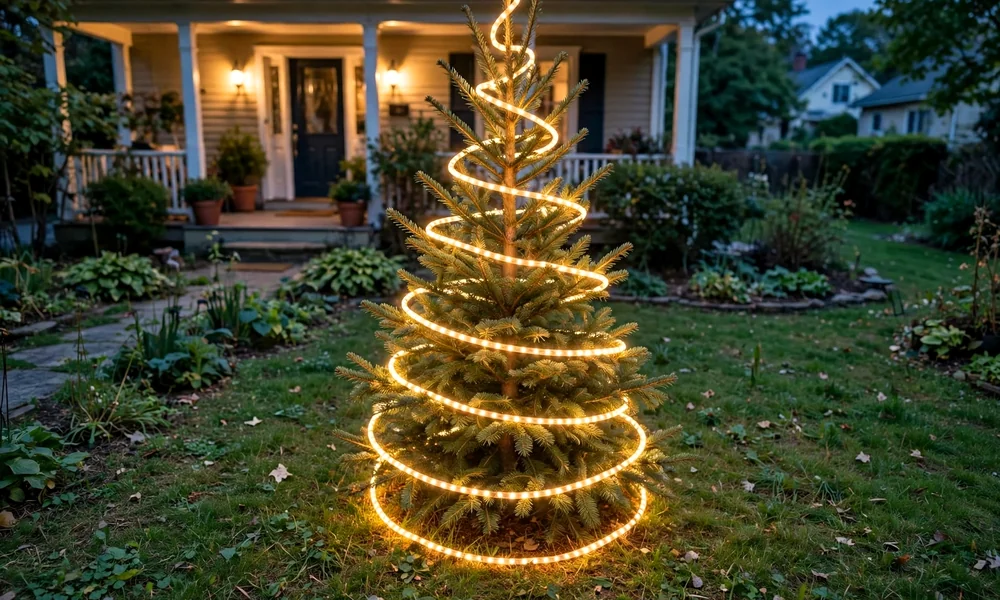
The best rope lights in 2026 are the ones you notice as a line of light, not as a string of bulbs: a sealed tube of LEDs that traces the edge of a deck, wraps a pergola post, or spirals around a tree, and gives a garden a finished outline after dark. A good rope light survives rain, frost and a season left outside, glows evenly from one end to the other.
A rope light earns its place the moment you want light that follows a shape. A deck edge, a flight of garden steps, the outline of a patio roof or the trunk of a tree all need a light that bends with them. Rope lights do that better than any other outdoor light, because the LEDs sit inside a flexible plastic tube that seals them away from rain and dust.
Key Takeaways
- A rope light is a sealed tube, not a string of bulbs: judge it on the tube, the LED spacing and the weatherproof rating.
- Buy outdoor-rated rope lights for anything left outside: look for IP65 or better, and check the tube is UV-resistant so it does not yellow in the sun.
- Warm white between 2700K and 3000K suits gardens and patios; save colour-changing modes for Christmas and parties, not everyday evenings.
- Measure the run first: a rope light that cannot be joined or cut to size will leave you short.
- Mount with clips, not nails or staples through the tube: a pierced tube lets water in and kills the section it feeds.
What a Rope Light Actually Is
A rope light is a long, flexible tube of clear or coloured PVC with a string of LEDs sealed inside it, spaced evenly along its length. The LEDs inside are wired in sections, so the rope can be cut at marked points and joined to another length. The tube protects the LEDs from weather and diffuses their light into one continuous line.
That continuous line is what sets a rope light apart from the decorative lights it is confused with. String lights are individual bulbs spaced along a cable, made to hang in a sag between two points and give pools of light; our guide to how to pick string lights that last all year covers those in full. Fairy lights are tiny bulbs on a fine wire, made for draping loosely indoors for a scattered, cosy glow, and our guide to the best fairy lights for a cosy evening glow covers that softer job. An LED strip is a flat adhesive tape for indoors; a rope light is a round, sealed tube built to survive outside.
The Types of Rope Light
Warm White Rope Lights
Warm white rope lights are the workhorses of the garden: a steady 2700K to 3000K glow that outlines decking, steps and paths without turning the garden into a fairground. Look for even LED spacing inside the tube, because a warm white rope with wide gaps shows as a dotted line, while one with tight spacing reads as a single unbroken thread.
Colour-Changing Rope Lights
Colour-changing rope lights use RGB LEDs and a controller to switch between colours or run chasing effects. They suit Christmas trees, parties and seasonal displays, where the colour is the point. Their weakness is everyday use: a rainbow mode left on all year looks cheap. Buy them for the occasions that call for colour.
Solar Rope Lights
Solar rope lights run from a small panel that charges a battery during the day, so they need no socket and no cable across the lawn. They suit paths, fences and trees far from the house. Their limit is winter: a panel in shade charges slowly, and many solar sets glow for only a few hours after dark in December.
Heavy-Duty and Commercial Rope Lights
Heavy-duty rope lights use a thicker tube, brighter LEDs and stronger connectors, and they are built for roofs, shopfronts, signs and long runs that stay up all year. They cost more per metre, but they survive wind, frost and repeated use. For a permanent roofline they are the right buy; for one season around a tree, a standard set does the same job for less.

Rope Lights vs the Other Garden Lights
The nearest neighbours are worth knowing, because each one lights a garden differently. String lights hang in a sag and give pools of light from separate bulbs; a rope light follows an edge in one continuous line and never sags. Landscape lights are fixed spotlights and path lights that pick out plants and features from a single point, and our guide to the top landscape lights for gardens that glow after dark covers that whole-garden design job, while a rope light traces the outline the landscape lights sit inside.
How We Judged the Best Rope Lights
We judged every rope light the way it gets used: clipped along a deck edge, wrapped around a pergola post, spiralled around a tree, and left outside through rain and frost. Evenness of the glow came first: a rope light that reads as one unbroken line beats one that shows as a row of dots. Next came weatherproofing and the tube itself.
The Best Rope Lights of 2026
Five rope lights stood out in 2026, covering every garden job from a deck edge to a Christmas tree.
| Rope Light | Type | Best for | Length |
|---|---|---|---|
| Everyday Warm White | Warm white | Decks and steps | 10 m |
| Garden Outline | Warm white | Patios and pergolas | 15 m |
| Festive Colour | Colour-changing | Christmas and parties | 10 m |
| Solar Path | Solar | Paths and fences | 8 m |
| Heavy-Duty Commercial | Heavy-duty | Roofs and signs | 20 m |
The Everyday Warm White
The everyday warm white is the rope light most gardens should buy first. Its LEDs sit close together inside a 13-millimetre tube, so the glow reads as one line, and its IP65 rating means it can stay out through rain and frost. It cuts at marked points every metre and joins to a second length with a sealed connector.
The Garden Outline
The garden outline rope is the longer, brighter version for patios and pergolas: fifteen metres in one length, a slightly thicker tube that holds its shape around a post, and a dimmer on the controller so the glow can be turned down for a quiet evening.
The Festive Colour
The festive colour rope is the choice for Christmas trees and parties: RGB LEDs, a remote with steady colours and chasing modes, and a warm white mode for the nights between. Its tube is thinner than the heavy-duty sets, so it wraps a tree easily. Keep its plug end under cover.
The Solar Path
The solar path rope is the choice where there is no socket: an eight-metre tube with a panel on a stake, a battery that charges by day, and a dusk sensor that switches it on at night. It suits a path or fence far from the house. It glows softer than a mains set, so buy it for marking a path, not for lighting one.
The Heavy-Duty Commercial
The heavy-duty commercial rope is built for rooflines, signs and long permanent runs: a thick UV-resistant tube, bright LEDs, and connectors rated for years outside. It can be joined to forty metres or more from one power feed. It costs the most per metre here, but for a roofline that stays up all year, it is the only sensible buy.

Length, Cut Points and Connections
Measure the run with a tape, add ten percent for corners and drops, and buy a rope that covers it in as few joins as possible, because every join is a place water can get in. Most rope lights cut only at marked points, usually every metre, so a run of seven and a half metres needs an eight-metre rope. Check the maximum connectable length too: many sets allow two or three lengths from one plug, and joining more than the maker allows overloads the feed and dims the far end. Seal cut ends with the cap supplied, and push each connector fully home.
Mounting Without Damaging the Tube
A rope light should be clipped, never nailed or stapled. Plastic mounting clips screw or stick to the surface and hold the tube in a loose loop, so it can expand in summer heat and contract in winter cold without pulling free. Space the clips every 30 to 40 centimetres, and keep the tube slightly slack, because a tube pulled taut will snap at a fixing in a frost. Never drive a nail or staple through the tube: the hole lets water in and kills the section beyond it. Around a tree, wrap loosely and leave room for the trunk to grow.
Weatherproofing and Looking After Rope Lights
The IP rating tells you what a rope light survives. IP44 means protection against splashing water, enough for a sheltered patio. IP65 means it handles jets of water, which is what you want for a rope left out in open rain all winter. Anything without a rating is an indoor light, however tough it looks, and it will fail at the first heavy rain. A UV-resistant tube stays clear for years, while a cheap tube yellows in one summer.
Before You Buy: The Checklist
- The tube is outdoor-rated at IP65 or better and UV-resistant, so it will not yellow in the sun.
- The length covers your measured run plus ten percent, with cut points that fit the job.
- The LEDs sit close enough together that the glow reads as one line, not a row of dots.
- The colour suits the place: warm white for everyday garden use, colour-changing only for parties and Christmas.
- The power source fits the spot: mains for long runs, solar only where there is no socket.
- Mounting clips are included, and the rope is fixed with clips, never nails through the tube.
Frequently Asked Questions
What is the difference between a rope light and a string light?
A rope light is a sealed tube of LEDs that gives one continuous line of light and follows an edge; a string light is individual bulbs spaced along a cable that hang in a sag and give pools of light.
Can rope lights be left outside all year?
Yes, if they are outdoor-rated at IP65 or better and the tube is UV-resistant. Indoor-rated sets will fail at the first heavy rain.
Can you cut a rope light to length?
Yes, but only at the marked cut points, usually every metre. Cut anywhere else and the section beyond will not work. Never cut a rope light while it is plugged in.
How many rope lights can you join together?
Only as many as the maker allows, usually two or three lengths from one plug. Joining more overloads the feed and the far end goes dim.
Are rope lights safe around children and pets?
A mains rope light is low-voltage at the tube but the plug end is mains, so keep the plug and controller out of reach and under cover. The tube itself is sealed and cool to touch.
Do rope lights use much electricity?
Very little. A ten-metre LED rope light typically uses between 5 and 15 watts, about the same as a single LED bulb, so leaving one on for an evening costs a few pence.
Bottom Line
The best rope light for most gardens is a warm white outdoor-rated set with an IP65 tube, tight LED spacing and a length that covers the run in one or two pieces, because it outlines a deck, a pergola or a path in one even line and survives the weather. If the job is Christmas, step up to a colour-changing set, and if there is no socket, a solar set marks a path well enough. Measure first, clip it never nail it.