
Rotary Cutters That Slice Fabric Clean in 2026
Rotary cutters that slice fabric clean in 2026 are the tools that turn a stack of quilting cotton, dressmaking fabric or fleece into straight, accurate strips in a single rolling pass. A rotary cutter is a handle fitted with a sharp circular blade that rolls as you push it, cutting through several layers at once without lifting, dragging or chewing the edge of the cloth.
A sharp blade glides along a ruler and leaves a smooth edge that feeds neatly under a sewing machine foot. A dull blade skips, snags threads and leaves a ragged edge that frays before you have pinned the seam. This guide covers blade sizes, handles, safety locks and blade changing, and how a rotary cutter differs from the other cutting tools on your table.
Key Takeaways
- A rotary cutter rolls a circular blade through fabric, so it cuts several layers at once with one smooth pass and no lifting.
- The 45 mm blade is the all-rounder for quilting and dressmaking; 28 mm suits curves and small pieces, and 60 mm suits thick or folded fabric.
- Always cut on a self-healing mat with a ruler, because a rotary blade is ruined quickly on a hard surface and will mark a bare table.
- A working safety lock and a blade guard matter more than a fancy handle, because a rotary blade is extremely sharp even when it looks still.
- Change the blade as soon as it starts skipping or dragging, because a blunt blade is the main cause of ragged edges and sore wrists.
What a Rotary Cutter Actually Is
A rotary cutter looks simple: a handle, a round blade held on a bolt, and a guard that slides over the blade. Unlike scissors, which lift the fabric with every snip, a rotary blade stays in contact with the cloth and rolls forward, so the cut follows the ruler in one unbroken line and the layers underneath stay put.
That rolling action is why quilters adopted the tool first. Cutting a long strip with scissors means dozens of small cuts, each one a chance for the fabric to shift; a rotary cutter does it in one pass. It is a fabric tool first, not a general-purpose knife, and not meant for card, plastic or anything harder than cloth.
Rotary Cutters vs Utility Knives: A Rolling Blade Is Not a Straight Blade
The nearest neighbour is the utility knife. It has a short, straight, replaceable blade drawn through material in a slicing stroke, and is built for boxes, rope, carpet and packaging. Our guide to the top utility knives for everyday cutting in 2026 covers that world.
A rotary cutter is built for the opposite job. Its circular blade rolls rather than slices, so it passes through soft fabric without dragging it. A utility knife dragged through cotton pulls the weave and leaves a wavy line; a rotary cutter rolls through the same cotton and leaves it flat. Use the utility knife for the box the fabric arrived in, and the rotary cutter for the fabric itself.
The other difference is the surface underneath. A utility knife works on almost any firm surface, while a rotary cutter needs a cutting mat: the blade sinks a fraction into the mat, the mat closes behind it, and the blade stays sharp far longer than on wood or glass. Without a mat, a rotary cutter ruins both blade and table.

Blade Sizes: 28, 45 and 60 mm
Blade size is measured across the round blade. The three sizes cover different jobs, and most sewers start with the middle size.
28 mm Rotary Cutters
The 28 mm blade is the small, nimble one. Its tight turning circle follows curves, small pattern pieces and narrow bias strips without overshooting the line. It cuts fewer layers than the larger blades and is slower on long strips, but for fiddly work it is the most accurate size.
45 mm Rotary Cutters
The 45 mm blade is the standard and the one most people should buy first. It cuts four to six layers of quilting cotton in one pass, rolls smoothly along a ruler for long strips, and still steers around gentle curves. If you quilt, make clothes or cut fleece, a 45 mm cutter does nearly everything, and its blades are the easiest to find.
60 mm Rotary Cutters
The 60 mm blade is the heavyweight. It powers through thick folds, fleece, wadding, denim and upholstery that would stop a smaller blade. The trade-off is turning: a big blade follows a wide arc, so it is poor on tight curves. Buy it for thick fabric, not as a first cutter.
Handles, Locks and Safety
Handles matter because a rotary cutter is pushed, not pulled, and your hand drives it for long stretches. A straight handle keeps the wrist neutral on long cuts; an ergonomic or loop handle lets the hand sit higher and push with the palm, which suits anyone with wrist pain. Try the grip before you buy: a handle that digs into your palm on the first strip will hurt by the tenth.
The safety lock matters more than the handle. Every cutter should have a lock or guard that covers the blade when not in use, ideally one you can work with a thumb slide without looking. Never leave a cutter blade-up on a table, carry it loose in a bag without the guard on, or hand it to someone blade-first. The blade looks harmless when still, but it cuts skin with a light touch.
Rotary Cutters Compared
The table below gives the working range of each blade size. Treat the layer counts as a guide for ordinary quilting cotton; thick fabric and wadding cut the count roughly in half.
| Blade size | Best for | Layers of cotton | Curves | First buy? |
|---|---|---|---|---|
| 28 mm | Curves, appliqué, small pieces | Two to three | Excellent | Second cutter |
| 45 mm | Quilting, dressmaking, fleece | Four to six | Good | Yes |
| 60 mm | Thick folds, denim, wadding | Six to eight | Poor | For heavy work |
Blade Types and Changing a Blade
Most rotary blades are straight-edged and suit nearly all cutting. Pinking blades cut a zigzag edge that resists fraying on unhemmed fabric, and wavy blades cut a decorative edge for craft work. Neither replaces a straight blade for accurate seams, and both dull faster, so buy them as extras, not as your only blade.
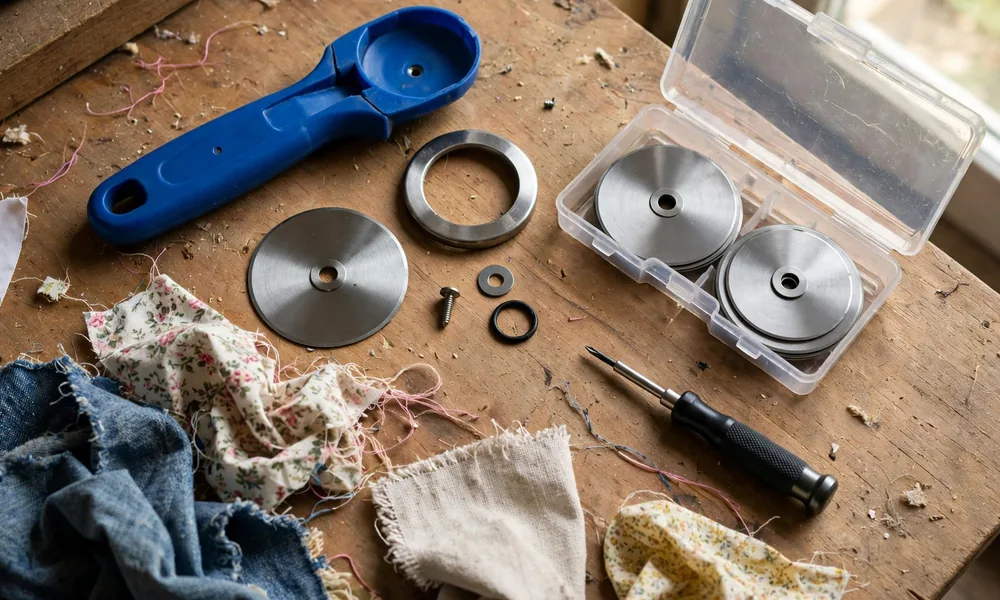
Changing a blade takes two minutes but needs care. Close the guard, lay the cutter flat, undo the bolt with the supplied tool or a coin, and lift the old blade off by its centre, never by the edge. Fit the new blade the same way up, replace the washer and nut, and tighten until it spins freely without wobbling. Test on scrap fabric first: a blade fitted upside down will drag and skip. Keep used blades in a sharps container, not loose in the bin.
How to Cut a Clean Straight Strip
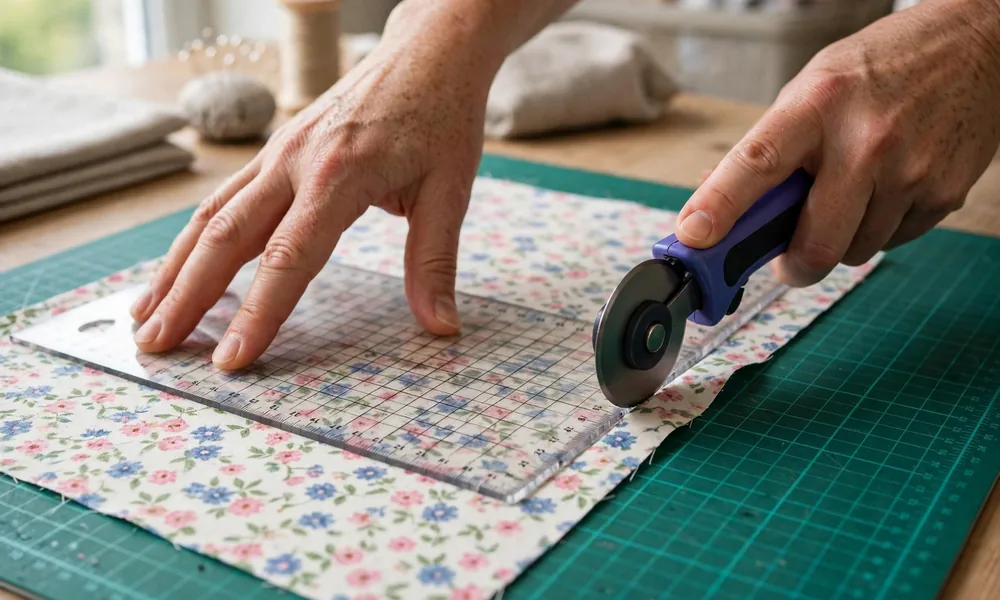
Press the fabric first, because a crease under the ruler becomes a wavy edge. Fold it with the selvedges together, line the fold up with a grid line on the mat, then trim the raw edge square before measuring anything. That squared edge is the reference for every strip that follows.
Hold the ruler firmly with your fingers well back from the edge the blade will run along. Push the cutter away from your body in one steady pass, keeping the blade tight against the ruler and the pressure even. Do not saw back and forth or stop halfway: a second pass leaves a step in the edge. Cut standing up if the mat is large, so your shoulder, not your wrist, drives the cutter.
When the strip is cut, lift the ruler straight up rather than sliding it, or the fabric underneath will shift. Re-square the edge every few strips, because small errors add up across a quilt. Clean cutting is not about speed: it is squaring the edge, holding the ruler still, and letting a sharp blade do the work.
Mistakes That Spoil Fabric
The most common mistake is cutting with a dull blade. It skips over the top layer, drags threads out of the weave and leaves an edge that frays in the wash. If you have to press hard, the blade is finished.
The second mistake is cutting on the wrong surface. A blade on wood dulls in minutes and scores the table; on glass it skates and chips. A worn mat is nearly as bad: it leaves grooves that pull the blade off line. Replace a mat when cuts stay open or the grid fades.
The third mistake is lifting the ruler mid-cut or cutting towards your hand. Slow down, keep the guard on between cuts, and remember that a good sewing machine for beginners in 2026 will forgive a lot, but it cannot fix a strip cut a centimetre out of square.
Checklist: Before You Buy a Rotary Cutter
- Start with a 45 mm blade unless you mainly cut curves or very thick fabric.
- Check the safety lock closes easily with one hand and covers the blade fully.
- Hold the handle and push it along a table: it should feel comfortable, not dig into your palm.
- Buy a self-healing cutting mat at the same time, large enough for the strips you cut.
- Check spare blades are easy to buy for that size and brand before you commit.
- Keep a blade case and a sharps container with the cutter, and change blades at the first skip.
Frequently Asked Questions
What size rotary cutter should a beginner buy?
A 45 mm cutter is the best first buy. It cuts four to six layers of cotton in one pass, rolls smoothly for long strips, and handles gentle curves well. Add a 28 mm cutter later for curves, and a 60 mm one only for thick fabric.
Do I really need a cutting mat with a rotary cutter?
Yes. The blade is designed to sink slightly into a self-healing mat, which keeps it sharp and protects the table. Cutting on wood dulls the blade and scores the surface; on glass it skates and chips. A mat is part of the tool, not an optional extra.
How often should I change a rotary blade?
Change it as soon as it starts skipping or leaving threads uncut. Heavy use can wear a blade out in a few weeks; occasional use can last months. If you are pressing hard, the blade is finished.
Can a rotary cutter cut through several layers at once?
Yes, that is its main advantage. A 45 mm blade cuts four to six layers of cotton in one pass, provided the layers are flat and the blade is sharp. Thick fabric and wadding cut the count roughly in half.
Is a rotary cutter safe to use at home?
Yes, if you respect the blade. Always use the guard when the cutter is not cutting, keep your fingers behind the ruler edge, cut away from your body, and store it with the blade covered and out of reach of children.
What is the difference between a rotary cutter and fabric scissors?
Scissors open and close and lift the fabric with every snip, which suits curves and single layers. A rotary cutter rolls in one continuous pass, which suits long straight cuts and several layers at once. Most sewers keep both. For loose threads and pills on finished fabric, see our guide to the best fabric shavers for pilling sweaters in 2026.
The Bottom Line
Rotary cutters make straight, accurate cutting fast and repeatable. Buy a 45 mm cutter with a comfortable handle and a reliable safety lock, pair it with a self-healing mat and a clear ruler, and change the blade at the first sign of skipping. Keep it for fabric only, cut away from your body, and let the sharp blade do the work.


