
A good science kit does something no worksheet ever can: it lets a child see an idea happen. A colour changes, a small motor whirs into life, a crystal grows overnight, and suddenly chemistry is not a chapter in a book but something that happened on the kitchen table. The best science kits of 2026 are built around that moment. They give children real tools, real materials and real experiments, with instructions clear enough that a child can follow them and results reliable enough that the experiment actually works the first time.
What Makes a Science Kit Worth Buying
A science kit is not a box of random bits. The best ones are designed as a complete experience: every material is included, every step is explained, and every experiment has a reason. A child should be able to open the box and start within minutes, without a trip to the shops for a missing ingredient or a piece of equipment the instructions assumed you already owned. If a kit needs a long list of extras, it is not a complete kit.
Clear instructions are another mark of a good kit. The best kits explain what to do in short steps, with pictures at every stage, and then explain why it worked in plain language a child can understand. A kit that only says what to do, without ever saying why, teaches a child to follow a recipe. A kit that explains the idea behind each experiment teaches a child to think like a scientist, and that is the difference worth paying for.
How to Choose: Three Things That Matter Most
Start with age. Every good kit states an age range on the box, and it is worth trusting. A kit made for a five-year-old uses big pieces, bright colours and instant results, because a young child needs to see something happen quickly. A kit made for a twelve-year-old uses finer parts, longer experiments and real measurements, because an older child can wait for a result and wants to understand it. A kit bought for the wrong age will either bore an older child or frustrate a younger one, and neither is a bargain.
Next, look at safety and supervision. Science kits are designed for children, but they still need an adult nearby, especially for chemistry kits that use powders and liquids. Check what the kit contains before you buy it, and read the safety notes together before the first experiment. Goggles should be included where liquids are involved, and the instructions should say clearly which steps need an adult. A kit that hides its safety guidance in tiny print is not a kit to trust.
Real learning comes third. A good kit teaches a real idea: why vinegar and baking soda fizz, how a circuit carries power, what makes a crystal grow, or how a lens bends light. A weak kit produces a flashy effect and moves on without explaining anything. Before buying, read the description of a few experiments and ask whether your child would learn something they could explain to a grandparent afterwards. If the answer is no, the kit is entertainment, not science.
The Best Science Kits by Age
For children aged three to five, keep it simple and sensory. The best kits for this age use water, colour, bubbles and magnets, with big pieces and results that appear in seconds. A young child does not need to understand the chemistry; they need to see a colour change, feel a magnet pull and watch a bubble grow. Adult supervision is essential at this age, and the best kits are designed for a parent and child to do together, with the adult handling every pour and the child doing the mixing and watching.
For children aged six to eight, the experiments can get longer and more hands-on. This is the age for crystal growing, simple circuits, volcano eruptions and nature observation. Children at this age can follow a sequence of steps, record what they see in a notebook and compare one result with another. A kit with a simple logbook or observation sheet is a bonus, because it teaches the habit of recording results, which is the foundation of real scientific work.
For children aged nine to twelve, a science kit can be genuinely challenging. This is the age for chemistry sets with real reactions, robotics kits that need building and programming, and microscope kits that reveal a hidden world. The child can work more independently now, but an adult should still be nearby for chemistry and for any experiment involving heat or sharp tools. A kit that lets a child design their own experiment, changing one thing at a time and seeing what happens, is the best choice at this age.
Chemistry Kits: Colour, Fizz and Real Reactions
Chemistry kits are the classic science kit, and the best ones are still the most exciting. A good chemistry kit lets a child mix safe chemicals and watch real reactions: colours changing, gases fizzing, crystals forming and liquids separating. The experiments should be varied, with some that happen in seconds and some that take a day or two, so the child learns that science sometimes needs patience.
Adult supervision matters more here than in any other kind of kit. Always read the instructions together first, wear the goggles provided, and keep food and drink away from the experiment table. Work in a well-ventilated room, wash hands after every session, and store the chemicals out of reach of younger children. These are simple habits, and a good kit will teach them as part of the experiment, not as an afterthought.
Physics and Robotics: Building Things That Move
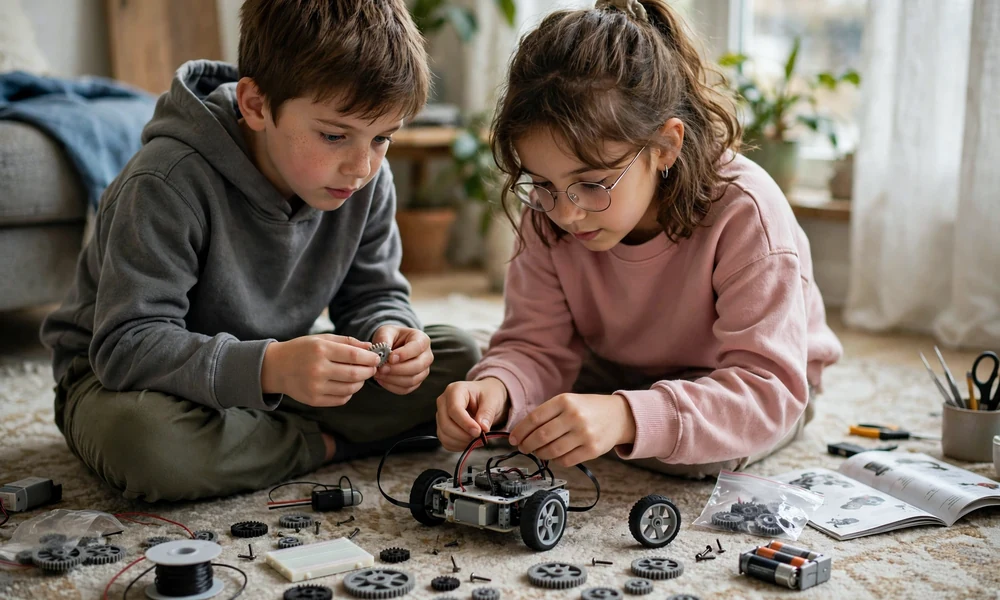
Physics kits and robotics kits are for children who like to build. A good one includes motors, gears, wheels and circuits, and it ends with something that moves: a small car, a waving arm, a walking robot. The building itself is the lesson. A child who assembles a gearbox learns how gears trade speed for strength, and a child who wires a circuit learns why a loose connection stops everything.
Building toys that teach engineering go well with a science kit, and our guide to the best Lego sets of 2026 covers construction sets that build the same spatial and problem-solving skills. A child who enjoys following a robotics manual will often enjoy a complex building set too, and the two together make a strong combination for a birthday or holiday gift.

Astronomy Kits: The Night Sky From Your Backyard
Astronomy kits open up a different kind of science: observation. A beginner telescope, a star chart and a simple guide to the moon and planets are enough to keep a child looking up for months. The best kits include a sturdy tripod, an eyepiece a child can actually use, and a guide that shows what to look for each month of the year.
Binoculars can be a useful companion to a first telescope, and our guide to the best binoculars of 2026 explains what to look for in a pair a child can hold steady. Binoculars are lighter than a telescope, easier to carry on a walk, and a good way to find the moon and bright stars before pointing a telescope at them.
Biology and Nature: The Hidden World Up Close
Biology kits bring the living world into focus. A microscope kit lets a child look at a leaf, a drop of pond water or a strand of hair and see a world that is invisible to the naked eye. A nature kit with specimen jars, a magnifying glass and a field guide turns a walk in the park into a research trip. The best kits encourage children to collect, observe and ask questions about what they find.

Safety and Adult Supervision: The Rules That Matter
Every science kit needs an adult nearby, and the amount of supervision depends on the kit. For young children, the adult does every pour and handles every chemical. For older children, the adult checks the plan, stays in the room and is there for any step involving heat, sharp tools or chemicals. No child should use a chemistry kit alone, and no experiment should be attempted without reading the instructions first.
What to Avoid When Buying a Science Kit
Avoid kits that promise dozens of experiments but use the same three materials for all of them. A box that claims a hundred experiments and delivers ten variations of the same fizz is not good value, and a child will notice the repetition faster than any adult will. Read reviews that describe the actual experiments, and be wary of kits whose descriptions are vague about what is inside.
Avoid kits with poor instructions. If the manual is a single folded sheet with tiny diagrams and no explanation of the science, the kit will cause frustration rather than curiosity. A good manual is a small book, with clear steps, pictures and a short explanation after each experiment. If you cannot read a sample of the instructions before buying, choose a kit from a maker known for clear guides.
Recording Results and Keeping the Interest Alive
A science kit becomes a hobby when a child starts recording what they find. A simple notebook, with the date, the experiment, what happened and what the child thought would happen, turns a fun afternoon into real scientific practice. Encourage your child to draw what they saw under the microscope, to photograph a crystal as it grows, and to compare results from one experiment with another.
A tablet can be a useful companion for this, and our guide to the best kids tablets of 2026 covers devices that are tough enough for a child to use at the experiment table. A child can photograph results, look up a question that came up during an experiment, or watch a short video that explains the science behind what they just saw. The tablet supports the science; it does not replace the hands-on experiment.
Frequently Asked Questions
What age should a child be for their first science kit? Most children are ready for a simple kit around the age of five, with close adult supervision. Start with a kit made for young children, with big pieces and instant results, and move to more complex kits as the child grows. There is no rush, and a kit that is too advanced will put a child off rather than inspire them.
Are science kits safe? Yes, when they are used as instructed and with an adult nearby. Kits sold for children use safe materials in small quantities, and the instructions explain how to handle them. The key is supervision: read the safety notes together, wear goggles where advised, wash hands after every session and store the kit out of reach of younger children.
The best science kit is the one that matches your child: their age, their interests and the way they like to learn. Choose a kit with real experiments, clear instructions and materials that can be used more than once, and supervise every session with care. Do that, and the kit will do far more than fill an afternoon. It will give your child a way of looking at the world that lasts long after the box is empty.


