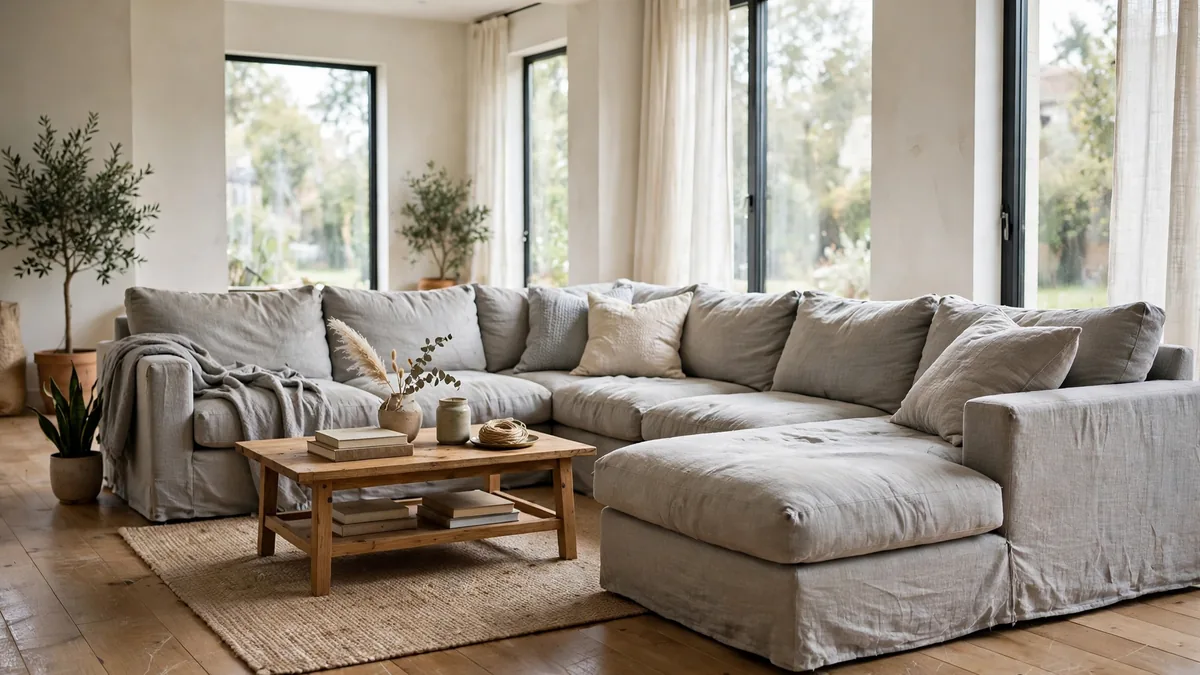
The best sectional sofas for big living rooms in 2026 are not just bigger versions of an ordinary sofa. They are a different kind of furniture: a configurable seating system that wraps around a corner, stretches along a wall, and gives five, six or seven people a proper seat without anyone perching on an arm. In a large room, a standard three-seat sofa leaves the space feeling empty, while a well-chosen sectional anchors the room.
Sectionals are also the easiest large purchase to get wrong. They are heavy, expensive and hard to return, and the difference between one that transforms your living room and one that blocks the walkway comes down to configuration: corner or chaise end, modular or fixed, and whether you measured the room properly. This guide walks through all of it.
Key Takeaways
- A sectional earns its floor space only in a big enough room: allow at least 90 centimetres of clear walkway around every side you need to pass.
- Corner sectionals seat the most people per square metre; chaise-end sectionals give one or two people a proper stretch-out spot.
- Modular sectionals cost more per seat but can be rearranged, moved through narrow doors, and repaired one piece at a time.
- Measure the room, the delivery route, and the tape-out on the floor before you order.
- Seat depth of 55 to 60 centimetres suits most adults for sitting upright; deeper seats suit lounging only.
What Makes a Sectional Different From a Sofa
A sectional is not one sofa but several seats joined into a single shape, usually an L. A standard sofa is a straight line against a wall; a sectional turns a corner and claims two walls, or stretches out with a long chaise. In a big living room, a straight sofa leaves a dead zone in the middle of the floor, while a sectional defines the seating area and faces the television.
The trade-off is commitment. A sofa can be pushed against a different wall on a whim; a sectional has a handedness, left or right, and a corner that dictates where it lives. That is why the first decision is not fabric or colour but configuration. Our guide to how to choose a sofa that survives real life in 2026 covers frames, springs and fabrics in depth; this guide helps you choose which kind of sectional.
Corner vs Chaise-End: Choosing Your Shape
A corner sectional has two arms of seating meeting at a right angle, usually a three-seat run on one side and a two-seat run on the other. It seats the most people and suits square rooms, open-plan spaces, and households that regularly host five or more. Everyone faces inward, which makes conversation easy.
A chaise-end sectional has a straight run of seating with one long, backless extension at one end: the chaise. It seats fewer people than a corner of the same length, but the chaise is the most comfortable seat in the room for stretching out, napping, or reading with your legs up. It suits rectangular rooms where a corner would block a doorway or a window.
Handedness matters with both shapes. Retailers are not consistent about which viewpoint a left or right chaise means, so never order from a product name alone. Look at the floor-plan diagram on the listing, check which side the chaise sits on when you face the front of the sofa, and confirm it against your room before you pay.
When a Corner Wins
Choose a corner sectional when your room is roughly square, when you regularly seat five or more people, or when the television sits in a corner. Corners also suit open-plan rooms, where the back of the sectional acts as a soft divider between the living and dining areas.
When a Chaise End Wins
Choose a chaise-end sectional when the room is long and narrow, when a doorway or radiator sits where a corner would go, or when stretching out matters more than seating a crowd. The low back of the chaise also leaves windows unblocked.
Modular Sectionals: Pieces You Can Rearrange
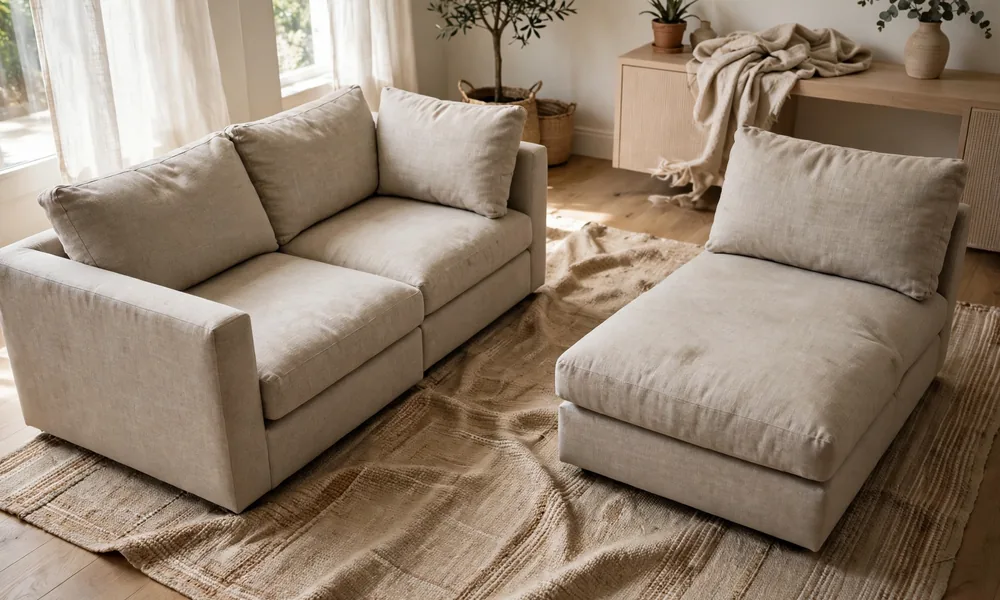
A modular sectional is made of separate pieces — armless chairs, corner units, chaises and ottomans — that clip together. You buy the pieces you need and arrange them into the shape your room wants, then rearrange them when you move house or redecorate. The same six pieces can be an L-shape this year and two separate sofas when you move to a smaller flat.
Modular pieces also solve the delivery problem. A fixed corner sectional arrives as two or three enormous pieces that may not fit through your front door or around a tight landing. Modular pieces are single seats, small enough to fit through a standard doorway. In a flat above the ground floor, modular is often the only sectional that can reach your living room.
The downsides are real. Modular sectionals cost more per seat, and the joins can shift with use, so buy from a maker whose connectors are metal rather than plastic, and sit on the join itself in the showroom: if you can feel the gap, you will feel it every evening. A fixed sectional costs less, feels more solid, and has no gaps — the right choice if your room is settled and your doorway is wide.
Measuring the Room Like a Sectional Demands
A sofa needs one wall measurement; a sectional needs the whole room, because it occupies two directions at once. Measure both walls the sectional will sit against, noting every door, window, radiator and socket. Then measure the depth of the room and the width of every doorway and stair turn on the delivery route.
Then do the step most buyers skip: tape it out. Use masking tape on the floor to mark the full footprint, including the chaise, and live with the outline for a day. Walk the routes you actually walk: from the sofa to the kitchen, from the front door to the stairs. If you have to sidestep the tape, the sectional is too big. Our guide to the best area rug size for your living room in 2026 covers the rug, which should extend at least 15 centimetres beyond the sectional’s front edge on every side.
Leave at least 75 centimetres of walkway on any side you need to pass, and 90 centimetres where two people pass each other. And remember the television: the ideal viewing distance is roughly two and a half times the diagonal of the screen, so a 65-inch television wants about 4 metres.
Seating Capacity: Counting Real Seats, Not Advertised Ones
Retailers count seats generously. A sectional advertised as seating seven often has five comfortable seats, a corner seat only a child enjoys, and a chaise used by one person lying down. Count real seats by cushion width: each adult needs 55 to 60 centimetres. Divide the total seat width by 58 centimetres and you have the honest capacity.
In most households, two or three seats do the heavy lifting every evening, and the rest are used when guests arrive. So the everyday seats — the middle of the long run and the chaise — deserve the best cushions and the most durable fabric. With children or pets, choose a chaise with a single long cushion rather than two small ones, because the seam between cushions is where the fabric wears first.

Frame, Cushions and Fabric for a Big Piece
Everything that makes a good sofa matters more in a sectional, because there is more of it to go wrong. The frame should be kiln-dried hardwood with corner blocks and screws, not staples. Lift one end of a floor model: a good sectional feels heavy and rigid, while a cheap one flexes and creaks. Seat cushions should be high-resilience foam with a density of at least 30 kilograms per cubic metre.
Seat depth decides whether a sectional feels like a lounge or a trap. A depth of 55 to 60 centimetres suits most adults for sitting upright. Deeper seats are wonderful for lounging but leave shorter people with nowhere to put their feet. The chaise should be at least 150 centimetres long; shorter chaises leave tall people with their feet hanging off the end.
Fabric is a practical choice before it is a colour choice. A tightly woven fabric with a rub count above 30,000 will outlast a loose weave by years, and a washable slipcover is worth its weight in gold with children or pets. Leather looks magnificent and wipes clean, but it costs far more and shows scratches. Performance fabrics, with stain resistance built into the fibre, are the sensible middle ground.

Sectional Configurations at a Glance
| Configuration | Best Room | Real Seats | Best For | Watch Out For |
|---|---|---|---|---|
| Corner, fixed | Square, large | 5 to 6 | Hosting a crowd | Heavy delivery, fixed shape |
| Corner, modular | Square or open-plan | 5 to 7 | Rearranging, moving house | Higher price, joins shift |
| Chaise-end, fixed | Long, rectangular | 4 to 5 | Stretching out daily | Chaise handedness |
| Chaise-end, modular | Long or awkward | 4 to 5 | Tight delivery routes | Chaise cushion wear |
| U-shaped | Very large, open | 6 to 8 | Big families, film nights | Dominates the room |
Buying Checklist
- Tape the full footprint on the floor with masking tape and live with it for a day before ordering.
- Measure every doorway, hallway and stair turn on the delivery route, not just the room.
- Confirm the chaise handedness against the floor-plan diagram, not the product name.
- Count real seats at 58 centimetres per adult, not the advertised number.
- Check the frame is kiln-dried hardwood, the cushions high-resilience foam, and the fabric rub count above 30,000.
- Ask about the returns policy and the cost of collecting a sectional that does not fit.
Frequently Asked Questions
How big should a living room be for a sectional?
The room should be at least 4 by 5 metres for a standard L-shaped sectional, with 75 to 90 centimetres of clear walkway on every side you need to pass. Smaller than that, a loveseat and an armchair usually work better. Our guide to loveseats that fit small living rooms in 2026 covers the alternative.
Is a corner or a chaise-end sectional better?
A corner seats more people and suits square rooms and hosting; a chaise end gives one or two people a stretch-out spot and suits long, narrow rooms. Choose by how you spend your evenings, not by which shape looks better in the showroom.
Are modular sectionals worth the extra money?
Yes if you move house, redecorate often, or have a tight delivery route, because the pieces fit through ordinary doors.
How do I know if a sectional will fit through my door?
Measure the narrowest point on the delivery route and compare it with the smallest dimension of the largest piece. Modular pieces are single seats and almost always fit; fixed corner pieces often do not.
What seat depth should I choose?
Most adults are happiest at 55 to 60 centimetres for sitting upright. Go deeper only if you mainly lounge with your legs up, and check shorter members of the household can still sit with their feet on the floor.
How long should a sectional last?
A well-built sectional should last ten to fifteen years of daily use. Cheap frames with stapled joints and low-density foam often sag within two or three years, so the frame and the foam matter far more than the fabric colour.
Bottom Line
The best sectional sofa for a big living room in 2026 is the one whose shape matches your room and your evenings: a corner sectional if you host a crowd in a square room, a chaise-end sectional if you stretch out every night in a long one, and a modular set if you move or face a tight doorway. Tape the footprint on the floor, count real seats, check the frame and the foam, and the sectional will anchor your living room for a decade.