Best Shoe Benches 2026
A shoe bench earns its place by the front door only if it does two jobs at once: it gives you somewhere to sit while you put your shoes on, and it gives those shoes a proper home underneath. A bench that is only a seat leaves the shoes in a pile on the floor. A rack that holds shoes but offers nowhere to sit leaves you hopping on one foot, holding the wall, every morning.
Key Takeaways
- Count the pairs first, because a bench that holds eight pairs will not serve a household of four that owns thirty.
- Cubby height matters more than bench length: trainers need about 15 centimetres, ankle boots about 25, and tall boots about 40 or a dedicated tall slot.
- Open slatted shelves dry damp shoes far faster than solid shelves or closed cupboards, which trap moisture and smell.
- A seat height of 45 to 48 centimetres suits most adults for sitting down to lace up and standing up again without effort.
- Choose a bench deep enough for your largest shoes, usually 30 to 35 centimetres, and check that boots do not stick out past the front edge.
Shoe Benches 2026 at a Glance
| Best for | Bench type | Shoe capacity | Standout strength |
|---|---|---|---|
| Best overall | Open cubby bench | 8 to 12 pairs | Every pair visible and grabbable |
| Best for families | Wide cubby bench | 12 to 16 pairs | One cubby per person, no arguments |
| Best for small halls | Slim two-shelf bench | 6 to 8 pairs | Narrow footprint, shoes still off the floor |
| Best for wet weather | Slatted-shelf bench | 8 to 10 pairs | Airflow dries damp shoes between wears |
| Best for comfort | Upholstered bench | 6 to 10 pairs | Padded seat for slow mornings and stiff knees |
| Best for mudrooms | Metal bench with boot tray | 8 to 12 pairs | Tough, washable, built for mud and rain |
What a Shoe Bench Is Really For
A shoe bench is a seat with shoe storage built in, and the two halves matter equally. The seat is there because putting shoes on standing up is awkward at any age and genuinely difficult for older people, for children, and for anyone with a bad knee or a baby on one hip. The storage is there because shoes left on the floor multiply: one pair becomes four, four become a drift across the hallway, and the hallway stops being a room you walk through and becomes an obstacle course.
It helps to know how a shoe bench differs from its close cousins. A general entryway bench is a seat with storage for everything by the door — coats, bags, hats, post and shoes together — and our guide to the best entryway benches of 2026 covers that broader family, including benches with hooks above and benches with no shoe storage at all. A shoe bench narrows the job: every compartment, shelf and cubby is sized and ventilated for footwear, and the seat is positioned so you can reach your feet comfortably. A shoe rack, by contrast, stores shoes but gives you nowhere to sit, and our guide to shoe racks that keep your entryway tidy in 2026 covers freestanding racks for households that already have a chair by the door.
Getting the Size Right
Size is where most shoe bench purchases go wrong, and the mistake is almost always the same: people measure the wall and forget to measure the shoes. A bench that fits the hallway perfectly but cannot hold a pair of size 11 boots is a handsome failure.

Height is the next number, and it matters twice over. The seat should sit 45 to 48 centimetres high, which suits most adults for sitting and standing without a struggle. Lower benches are hard to get up from, especially with stiff knees, and higher benches leave shorter legs dangling. The cubbies underneath need their own heights: trainers and flat shoes fit in about 15 centimetres, ankle boots need about 25, and tall boots need about 40 or a dedicated tall slot at one end. A bench with identical shallow cubbies will hold trainers beautifully and leave every boot on the floor beside it.
Depth is the number people forget. Most shoe benches are 30 to 35 centimetres deep, which is enough for the longest adult shoe, usually about 30 centimetres. Anything shallower leaves heels sticking out past the front edge, where they catch ankles and collect dust. Measure your largest pair, add two centimetres, and that is your minimum depth. Also check the weight the bench must carry: a solid wood bench should hold at least 150 kilos across the seat, because two adults sitting at once is not unusual.
The Main Types of Shoe Bench
The open cubby bench is the safest choice for most homes: a wooden unit with a row of square or rectangular cubbies under a flat or cushioned seat. Each person gets a cubby or two, shoes go in and out without opening anything, and you can see at a glance what is missing. Its weakness is display, since every pair is visible, and a cubby that overflows looks messy within days.
The slatted-shelf bench is the best choice for wet weather. Its shelves are made of spaced slats rather than solid boards, so air circulates around damp shoes and water drips through instead of pooling. It is the bench for households that walk the dog in the rain, cycle to work, or live somewhere with a proper winter. The trade-off is that small items fall through the gaps, so keep loose laces and insoles out of it.

The upholstered bench is the comfortable option. A padded seat, often with a removable washable cover, makes sitting down pleasant rather than merely possible, which matters if anyone in the house has stiff knees or a bad back. Underneath, upholstered benches usually have open shelves rather than deep cubbies, holding six to ten pairs. Check that the fabric is hard-wearing and that the cover comes off, because muddy shoes and pale upholstery are not friends.
Materials and Build Quality
Solid wood is the classic choice, and it earns its price. Oak, walnut and ash benches feel steady, age gracefully, and can be repaired if they are scratched by a boot heel. Wood veneer over engineered board is the sensible middle ground: it looks like solid wood and costs far less, but the edges chip more easily, so check the thickness of the top panel and the quality of the edge banding.
Shoe Storage That Actually Works
Ventilation is the difference between a shoe bench that smells fresh and one that smells like a changing room. Shoes arrive damp from rain, sweat and mud, and a closed compartment turns that damp into odour within a day. Open cubbies and slatted shelves let air move, which matters far more than any deodorising spray. If you choose a closed bench, look for vented backs, slatted doors or a gap at the top of each compartment, and leave the doors open overnight after a wet day.
Where to Put a Shoe Bench
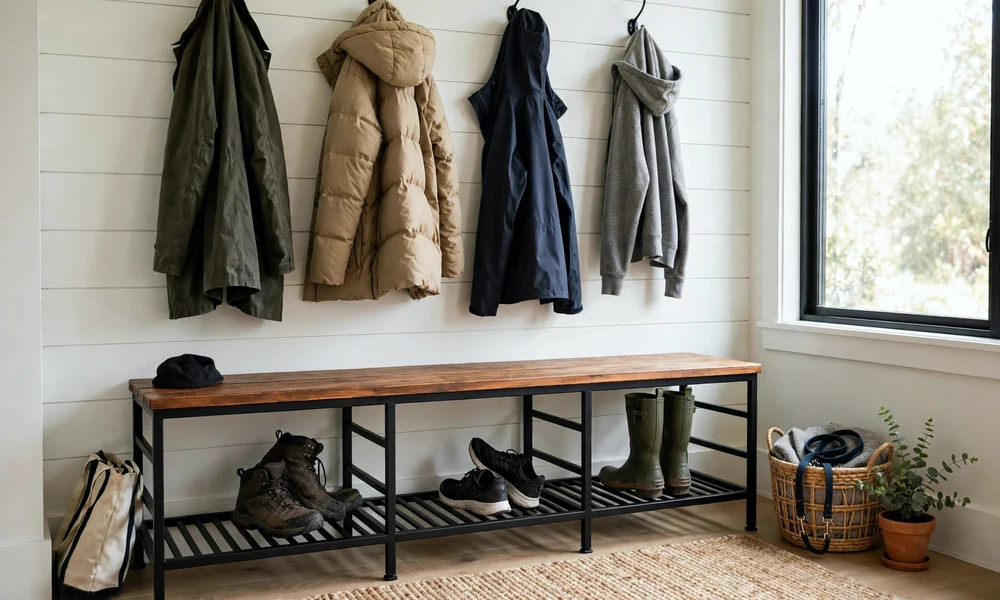
In a mudroom or boot room, choose the toughest bench you can find, with a boot tray and slatted shelves, and pair it with hooks above for coats. Our guide to the top coat racks for a tidy entryway in 2026 covers freestanding and wall-mounted racks if the wall above the bench is bare. In a bedroom, a slim upholstered bench at the foot of the bed or beside a wardrobe holds the pairs you wear most and doubles as a seat for getting dressed. In a narrow hallway, keep the bench slim, 30 to 35 centimetres deep, and leave at least 90 centimetres of clear walkway in front of it so nobody has to sidestep past the boots.
Stability and Safety
A shoe bench is sat on twice a day by people leaning forward to lace up, which puts real sideways force on it. A wide, low bench is inherently stable, which matters in homes with small children who climb furniture and large dogs who charge past it. A tall, narrow bench with a heavy adult on top is the opposite, and it should be fixed to the wall with the anti-tip strap in the box if one is supplied.
Common Mistakes to Avoid
The most common mistake is buying the bench before counting the shoes: people remember the household and forget the pairs, then discover half the shoes still live on the floor. The second is choosing cubbies too shallow for boots, so the tallest pairs never fit. The third is choosing a closed bench for wet shoes without checking ventilation, which turns the compartments into a smell trap. The fourth is ignoring the seat height, so sitting down to lace up feels like a squat. The fifth is buying a bench too deep for a narrow hallway, so the walkway disappears. Finally, do not buy a bench you cannot get into the house: measure the doorways and the lift first, and confirm whether it arrives assembled or flat-packed.
Before You Buy: A Short Checklist
- Count every pair in daily rotation, add two for guests, and buy a bench with at least that many compartments.
- Measure your tallest pair and your longest pair against the cubby height and the bench depth.
- Sit on the bench at 45 to 48 centimetres high and stand up again: it should feel easy, not like a squat.
- Choose open cubbies or slatted shelves for damp shoes, and closed doors only for mostly dry pairs.
- Check the seat weight limit and the shelf weight limit, especially for heavy boots.
- Look for a removable boot tray underneath and a washable seat cover if the bench will see mud.
- Measure the doorways and hallway, and confirm whether the bench arrives assembled or flat-packed.
Frequently Asked Questions
How many pairs of shoes should a shoe bench hold? Count the pairs your household wears in a normal week and add two for guests. A couple needs about eight to ten pairs, while a family of four usually needs twelve to sixteen.
What cubby height do boots need? Trainers and flat shoes fit in about 15 centimetres, ankle boots need about 25, and tall boots need about 40 or a dedicated tall slot at one end of the bench.
Are open cubbies or closed doors better for shoes? Open cubbies suit damp shoes because air circulates and they dry between wears. Closed doors look tidier but trap moisture, so they suit mostly dry pairs or benches with vented backs.
The Bottom Line
The best shoe bench of 2026 is the one that holds every pair your household actually wears, fits the boots as well as the trainers, lets damp shoes dry, and gives you a comfortable seat at exactly the right height. It is sized by the shoes, not by the wall, and it is ventilated, not sealed.
Start with the shoe count, not the catalogue. Count the pairs, measure the tallest and the longest, and then choose the type that fits: an open cubby bench for a family, a slim two-shelf bench for a narrow hall, a slatted bench for wet weather, an upholstered bench for comfort, or a metal bench with a boot tray for the mudroom.