
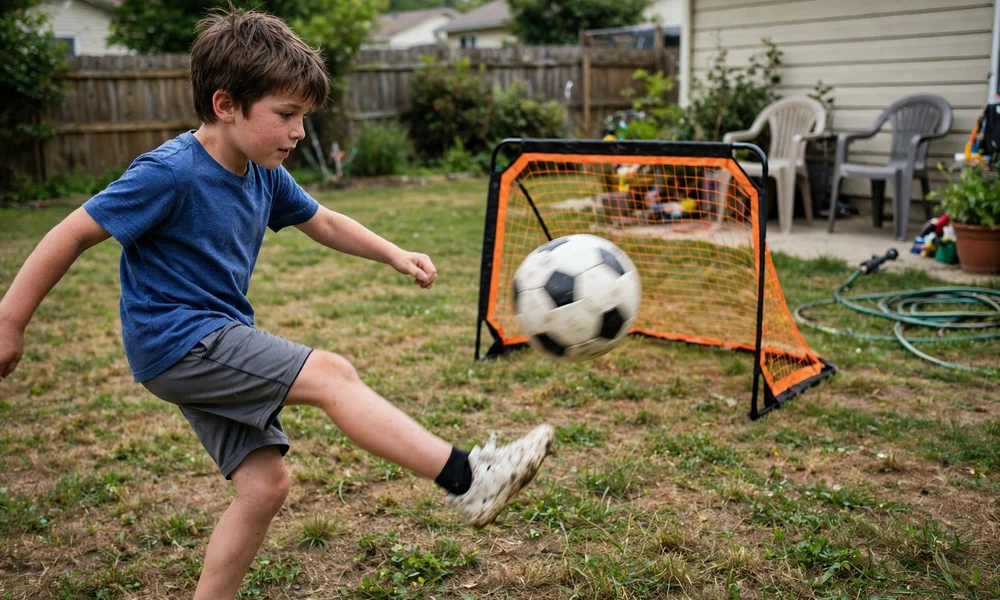
A backyard soccer goal turns an ordinary patch of grass into a place where a game can start in minutes. There is no need to drive to a park, book a pitch, or wait for a free slot. The ball comes out, the goal goes up, and someone is shooting within a few minutes. That is the whole appeal, and it is why a good backyard goal gets used far more often than a fancy one that lives in a shed. The best soccer goals for backyard play in 2026 are the ones that stay standing when a shot hits the corner, fold away without a fight, and survive a summer of sun and rain without falling apart.
What Makes a Backyard Soccer Goal Good
The first thing to judge is stability. A backyard goal takes harder knocks than it looks like it should, because shots arrive at full pace, players lean on the posts, and the wind catches the net like a sail. A goal that tips over every time the ball hits the post is not a goal at all, it is a hazard. The best goals have a wide base, ground stakes or sandbags, and a frame that does not flex when a shot lands. Before buying, check how the goal is anchored. Stakes work well on soft lawns, sandbags suit harder ground, and a goal with no anchoring at all is only safe on a calm day with gentle kicks.
The second thing is the net. A good net stops the ball cleanly, holds its shape, and does not tangle after every shot. Look for knotted netting rather than knotless mesh if the goal will see daily use, because knotted nets keep their squares and resist tearing at the corners. The net should attach firmly to the frame with clips, ties, or sleeves, and it should be easy to take off at the end of the season.
The third thing is the frame itself. Steel frames are the strongest and the most durable, but they are heavy and they need to be kept dry or they will rust at the joints. Fibreglass poles are light and springy, which makes them ideal for pop-up goals, but they can snap if they are bent too far. PVC frames are cheap and light, and they suit very young children, but they will not survive a powerful shot from a teenager.
The Main Types of Backyard Soccer Goal
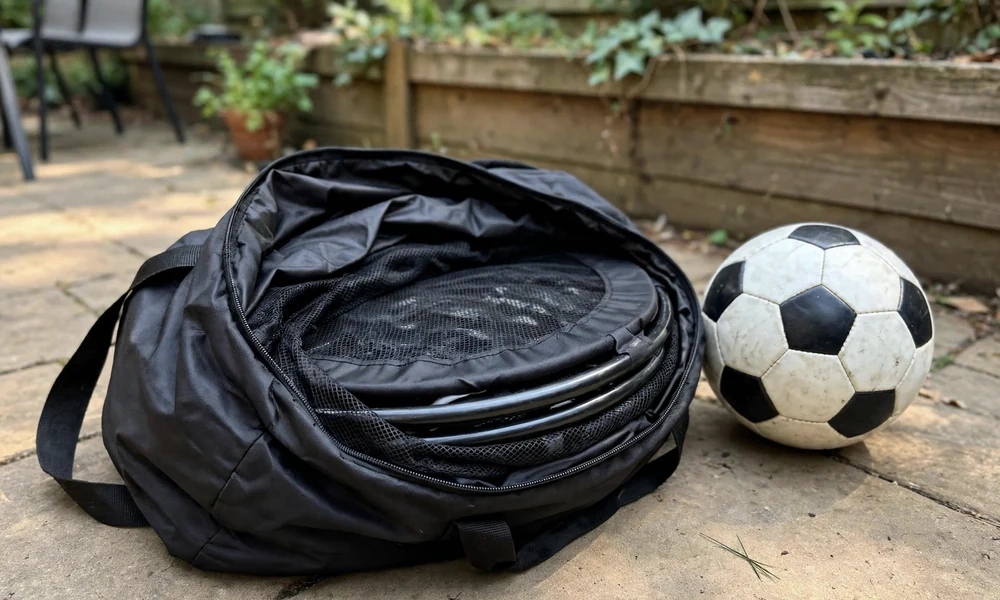
Pop-up goals are the simplest choice, and for most families they are the right one. They unfold in seconds, they weigh almost nothing, and they pack into a flat bag that fits in a car boot or a garden shed. They suit casual games, younger children, and anyone who wants a goal that appears for an hour and disappears again. The trade-off is strength. A pop-up goal is not built for full-power shots, and a strong strike can fold it or send it sliding across the grass.
Steel-frame goals are the serious option. They have rigid metal posts, a proper crossbar, and a deep net that catches the ball the way a real goal does. They suit older children, teenagers, and adults who want to practise shooting properly, and they are the best choice for a family that plays most days. The downside is the weight and the setup time. A steel goal takes longer to build, it needs anchoring, and it is not something to put up and take down every evening.
PVC and plastic goals sit between the two. They are light enough for a child to move, they do not rust, and they are cheap enough that a broken part is not a disaster. They suit younger players and small gardens, where a steel goal would be too big and too heavy. The weakness is the joints, which are usually the first part to fail. If the joints feel loose in the shop, they will feel worse after a month of use. A plastic goal with solid, well-fitting joints is a fine buy, but a wobbly one is money wasted.
Rebounder and training goals are a different idea altogether. A rebounder is a small angled net that sends the ball back to the player, which makes it ideal for solo practice, passing drills, and first-touch training. It is not a goal for a match, but it is the best extra for a child who wants to improve. Some families buy one rebounder alongside a normal goal, and the pair covers both games and practice. If the aim is to get better rather than just to play, a rebounder earns its place in the garden.

Choosing the Right Size
Size is where most buyers go wrong, because a goal that is too big dominates a small garden and a goal that is too small frustrates a good player. For children under eight, a goal around four feet wide is plenty, and it keeps the game fast and fun. For children between eight and twelve, a six-foot goal is a good middle ground, big enough to aim at and small enough to fit most gardens. Teenagers and adults should look at eight feet or wider, and a full-size twelve-foot goal only makes sense in a very large garden or on a proper pitch. Measure the lawn before ordering, and leave at least a few feet of clear grass behind the goal for the net and for anyone chasing a loose ball.
Think about who else uses the garden, too. A goal that stays up all summer needs to share the space with washing lines, patio furniture, and flower beds, and a goal that blocks the path to the shed will be resented within a week. A portable goal that folds away solves this problem neatly, which is one reason pop-up goals are so popular. If the garden also hosts other games, it helps to plan the space as a whole, and a guide to the best basketball hoops shows how a second piece of kit can share a yard without taking it over.
The Best Goals for Different Players
For younger children, the best goal is a small pop-up pair. Two small goals turn any lawn into a proper little pitch, and children can set them up themselves, which means the game starts without an adult having to assemble anything. Look for bright netting that is easy to see, soft poles that will not hurt if a child runs into them, and a carry bag so the goals can come on holiday. Small pop-up goals are also the cheapest way to start, and if the children lose interest, very little has been spent. For more ideas on keeping younger players busy outdoors, the guide to the best outdoor toys for kids covers the kit that pairs well with a first soccer goal.
For older children and teenagers, the best goal is a steel-frame goal of at least six feet. At this age the shots are harder, the games are faster, and a light goal will not survive a season. A steel goal with a knotted net, ground stakes, and a crossbar that does not sag is the standard to aim for. It costs more, but it lasts longer, and it gives a teenager a proper target to practise against. If two teenagers share the garden, consider a pair of matching steel goals so that a real game can be played without one side defending a smaller target.
For small gardens, the best goal is a compact pop-up that folds flat. A goal that is four feet wide and packs into a bag the size of a laptop sleeve can live in a cupboard and appear whenever the sun comes out. It will not suit a powerful shot, but in a small garden nobody should be taking powerful shots anyway. The neighbours, the windows, and the flower beds will all be grateful. A small goal used often is worth far more than a large goal that never comes out of the shed.
Setting Up and Anchoring the Goal
Setting up a pop-up goal takes less than a minute, but it is still worth doing properly. Unfold it fully, check that the poles have locked into their curve, and peg it down before the first kick. A pop-up goal that is not pegged will slide across dry grass, and a sliding goal is both annoying and unsafe. Steel goals take longer, usually twenty to forty minutes for the first build, and the instructions are worth reading rather than guessing. Tighten every bolt, check that the crossbar is level, and attach the net evenly so that it does not pull the frame to one side.
Anchoring is the step that most people skip, and it is the step that matters most. Ground stakes should go in at an angle, away from the goal, so that they resist being pulled out. Sandbags work well on hard or dry ground where stakes will not hold, and they have the advantage of being easy to move. On a windy day, even a heavy steel goal can shift, so check the anchors before every game rather than assuming they are still firm.
Looking After the Goal
A backyard goal lives outside, so it needs a little care to last. The net should be taken down and dried after heavy rain, because a wet net left on the frame will sag and can grow mould. The frame should be wiped down at the end of the season, and any rust on a steel frame should be treated before it spreads. Joints and clips are the parts that wear first, so keep a few spares if the maker sells them. A goal that is looked after will last several summers, while a goal that is left out all winter will often need replacing after one.
What to Avoid
Avoid a goal with no anchoring at all, because it will tip, and a tipping goal can hurt a child. Avoid a goal whose net is attached with thin elastic that perishes in the sun, because the net will be on the ground by midsummer. Avoid buying the biggest goal that will fit the garden, because a goal that leaves no room to run is a goal that spoils the game.
It is also worth thinking about the rest of the garden. A yard that hosts several games needs each piece of kit to earn its space, and a goal that is used every day earns it easily. If the family also plays catch or practises batting in the same space, the guide to the best baseball bats is a useful companion, because it covers the same question of size, weight, and who the kit is really for. The principle is the same in every garden game: buy for the player, not for the picture.
The Bottom Line
The best backyard soccer goal is the one that matches the garden, the players, and how often the game actually happens. A small pop-up pair suits young children and small gardens. A steel-frame goal suits teenagers and daily play. A rebounder suits anyone who wants to practise rather than just play. Measure the lawn, check the anchoring, look at the net, and buy the goal that will be used, not the goal that looks impressive in a photograph. Get that choice right, and the garden becomes the place where the game happens, every day, all summer long.


