
A disc golf basket is the target that turns an open field into a course. It is a pole with hanging chains above a round catch tray, and a good putt hits the chains, loses speed, and drops in. The best disc golf baskets of 2026 are the ones that make putting practice honest: when a putt misses, you know it was your throw, not the basket.
What Makes a Disc Golf Basket Good
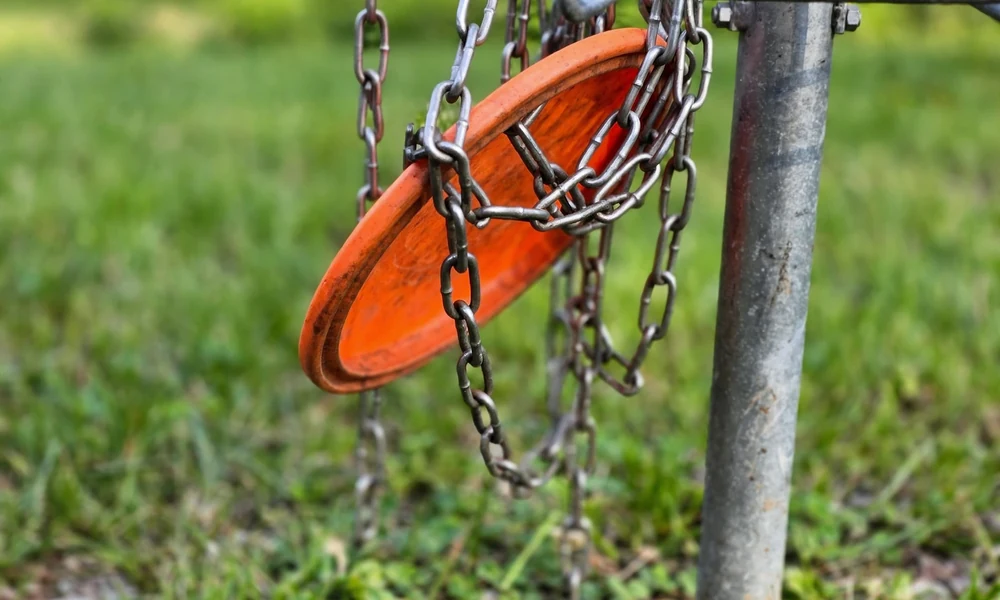
The first thing to judge is how it catches. A basket catches with its chains, and the number, weight, and arrangement of those chains decide whether a putt stays in or bounces out. Light chains on a cheap basket let a firm putt push straight through and spit back toward the thrower, which is frustrating and teaches nothing. Heavier chains in two rings, an inner set and an outer set, slow the disc down in stages, so even a putt that arrives fast has somewhere to lose its energy. When you test a basket, throw ten putts at it from twenty feet and count how many stay in; a good basket keeps eight or nine, and a great one keeps all ten.
The second thing is the tray. The catch tray, sometimes called the cage, is the wide ring of metal bars below the chains, and it has to be deep enough and wide enough to hold the discs that drop into it. A shallow tray lets discs bounce out on a hard landing, and a narrow tray misses discs that fall at an angle. Look for a tray that is at least twenty-four inches across, with bars close enough together that a disc cannot slip through the gaps.
The third thing is the stand. A basket is only useful if it stays upright where you put it, and the base decides that. A portable basket stands on folding legs that spread wide, and the best ones have feet that grip grass and a low centre of gravity, so a gust of wind or a disc hitting the pole does not tip it over. A permanent basket is bolted to a concrete pad or buried in the ground, and it should not wobble at all when you shake the pole.
The Main Types of Disc Golf Basket
Portable baskets are the most popular choice, and for most players they are the right one. They fold up, fit in a car boot, and set up in a minute or two, so you can practise in the garden, take one to the park, or set up a temporary hole for a party. The best portable baskets have twenty-four or more chains, a solid tray, and legs that lock open, and they weigh enough to stay put without being too heavy to carry. For a first basket, a good portable model is the one to buy.
Permanent baskets are the course standard. They are built from thick galvanised steel, anchored in concrete, and made to stay outside in all weather for years. They have the heaviest chains, the deepest trays, and the most consistent catch of any basket type, which is why every real disc golf course uses them. If you are building a course, even a short one, permanent baskets are the only honest choice.
Practice baskets are the light, simple option, and they have a clear job: short putts in a small space. They are often smaller and lighter than a full portable basket, with fewer chains and a smaller tray, and they are the cheapest way to start putting at home. They suit a flat, a small garden, or a child learning the game, and they fold away into a cupboard when the session ends. A practice basket is a good first step, but most players outgrow one within a year and move up to a full portable basket.

How to Choose the Right Basket
Start with where it will live. If it will stay in one spot in the garden, a heavier portable basket or a permanent one makes sense, because weight is an advantage when the basket never moves. If it will travel to the park, to friends, or to a course for a casual round, weight is a cost, and a folding basket you can carry with one hand matters more than a few extra chains.
Next, count the chains and check how they hang. Twenty-four chains in two rings is the standard for a good basket, and more is better up to a point, because extra chains fill the gaps a disc can slip through. Look at how the chains attach at the top: they should hang from a solid ring, not from thin wire that bends, and they should hang straight down, not tangled or bunched to one side.
Then check the build. Pick the basket up and feel the weight of the pole and the tray, and look at the joints: welded joints last longer than bolted ones, and a powder-coated or galvanised finish keeps rust away. Push the pole and watch the base: a basket that flexes or creaks under a firm push will only get worse with use.
Also check the height and the assembly. A regulation basket stands about fifty-four inches tall, with the tray at roughly thirty-three inches, and a basket that is much shorter or taller than this will teach you the wrong muscle memory for the course. Some portable baskets let you adjust the pole height, which is useful for children or for practice in a low-ceilinged space, but a basket that adjusts should lock firmly at each height and never slide down mid-round. Assembly matters too: a basket that needs tools, loose bolts, and half an hour to set up will stay in the garage, while one that folds open and locks in a minute will get used every day.
The Best Disc Golf Baskets of 2026
The best portable basket of 2026 is a full-size folding model with twenty-four chains in two rings, a wide tray, and locking legs. It sets up in under two minutes, it catches well enough for serious practice, and it is heavy enough to stay put in a breeze while still light enough to carry to the park. This is the basket most players should buy first, and it is the one that gets used the most.
The best permanent basket of 2026 is a heavy galvanised model with a deep tray and a pole that bolts to a concrete sleeve in the ground. It is the closest thing to a real course basket you can put in a garden, and its catch is noticeably better than any portable model: firm putts that would spit out of a light basket stay in. Buy this one if you have a fixed spot and you play every week.
The best practice basket of 2026 is a light, simple model with twelve to eighteen chains and a smaller tray, built to fold flat and store in a cupboard. It is not the best catcher, and it will spit out the occasional hard putt, but it is the cheapest honest way to build a putting routine at home, and it is the right size for a small garden or a child. For a player on a tight budget, this is the sensible place to start.
The best basket for a family is a sturdy portable model with a wide, stable base and no sharp edges on the tray. A mid-weight portable basket with a low centre of gravity does this best, and it is also the easiest for a child to help set up. Avoid the very lightest practice baskets for family use, because they tip too easily when a child bumps into them.
The best basket for a small garden is a compact portable model that folds flat enough to lean against a wall or slide behind a shed. It will not catch as well as a full-size basket, because the tray is smaller and the chains are fewer, but it fits a space where a full basket would crowd out everything else, and it still builds a putting routine. Pair it with a few soft putters that will not damage a fence or a window, and practise from ten feet and in, where the smaller tray is still an honest target. For a flat or a shared garden, this is the basket that actually gets used.

What Else You Need
A basket is only half the game, and the other half is the discs. A putting practice set with a putter, a mid-range disc, and a driver covers everything a beginner needs, and choosing the right discs matters as much as choosing the right basket. If you are starting from scratch, read our guide to the best frisbees of 2026 first, because it covers the disc types that work for disc golf as well as for a casual throw, and a putter that feels right in your hand will make practice far more enjoyable.
A basket also turns a garden into a place for outdoor games, and it pairs well with other lawn games for a family afternoon. A set of boards and bags is the classic companion, and our guide to the best cornhole boards of 2026 will help you pick a set that is as sturdy as your basket. For a quieter game that suits a smaller garden, our guide to the best croquet sets of 2026 covers mallets and hoops that work on the same lawn. A basket, a board, and a croquet set together make a garden that gets used all summer.
Common Mistakes to Avoid
The most common mistake is buying the cheapest basket and expecting it to catch like a course basket. A very cheap basket has thin chains, a shallow tray, and a wobbly base, and it will spit out putts so often that practice becomes frustrating instead of useful. Spend a little more for a basket with two rings of chains and a wide tray, and you will practise more, because the basket rewards good putts instead of punishing them.
The second mistake is leaving a portable basket outside all winter. Rain and snow rust the chains and the joints, and a basket that was steady in summer becomes loose and noisy by spring. If the basket lives outside, choose a galvanised model and store it under cover when it is not in use, or at least tip it on its side so water drains out of the tray. A permanent basket is built for this, but a portable one is not, and a winter in the rain can halve its life.
The third mistake is practising only from one distance. A basket is most useful when you putt from five feet, ten feet, twenty feet, and thirty feet, because each distance teaches something different, and a basket that only ever sees ten-foot putts teaches only one skill.
The Verdict
For most players, a full-size portable basket with twenty-four chains, a wide tray, and locking legs is the best disc golf basket of 2026, because it catches well, travels easily, and gets used the most. Players with a fixed spot who practise every week should step up to a permanent galvanised basket, and players on a tight budget should start with a light practice basket and upgrade later. Whichever you choose, buy the sturdiest basket you can afford, put it somewhere you will walk past every day, and throw ten putts at it before breakfast.


